European markets are among the most important components of the global financial system. They include major stock exchanges, bond markets, currency markets, banking systems, commodities markets, and financial centers across the European Union, the euro area, the United Kingdom, Switzerland, and other European economies.
Europe is home to some of the world's largest companies, financial institutions, industrial businesses, luxury brands, pharmaceutical companies, automobile manufacturers, energy companies, and technology firms. Its markets are also closely connected to global trade, investment, currencies, energy, and geopolitical developments.
In 2026, European markets are operating in a complicated environment. The European economy has demonstrated resilience, but energy-price shocks, geopolitical tensions, trade uncertainty, inflation, competitiveness concerns, and changing monetary policy continue to influence financial markets.
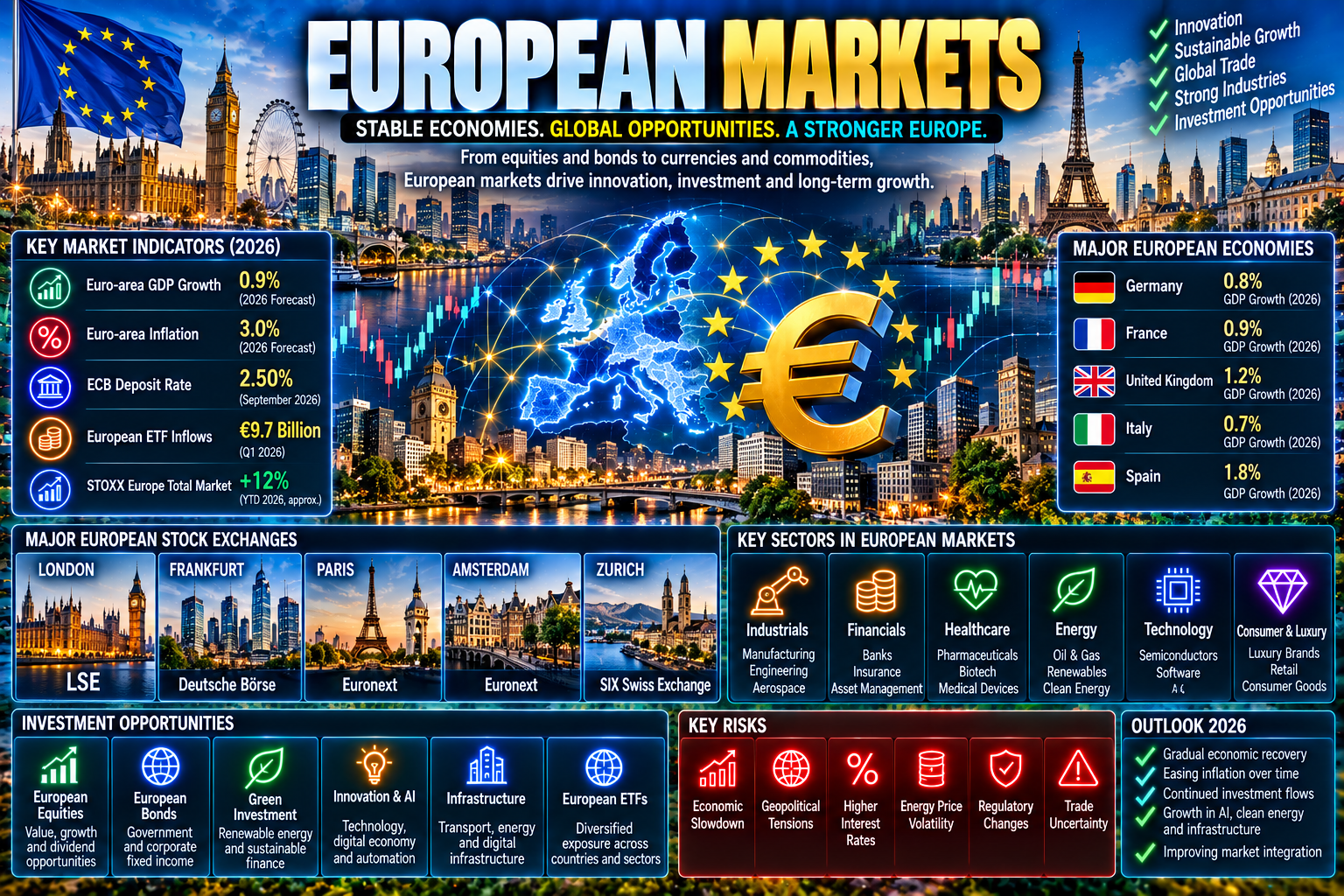
The European Central Bank's September 2026 projections put euro-area GDP growth at 0.9% for 2026, 1.4% for 2027, and 1.5% for 2028, while headline inflation is projected at 3.0% in 2026 before declining to 2.5% in 2027 and 2.1% in 2028.
What Are European Markets?
European markets are the collection of financial and economic markets operating across Europe.
They include:
Stock markets
Bond markets
Foreign-exchange markets
Commodity markets
Banking markets
Derivatives markets
Private-equity markets
Venture-capital markets
Real-estate markets
Exchange-traded funds
Money markets
European markets are not one single market. They consist of numerous national markets that increasingly interact through European economic and financial institutions.
The euro has also created a highly integrated financial market among the countries that use the common currency.
Major European Financial Markets
Several financial centers and exchanges play an important role in European markets.
London
London remains one of the world's major financial centers, with important markets for:
Equities
Foreign exchange
Bonds
Derivatives
Investment banking
Insurance
Asset management
The United Kingdom is outside the European Union but remains deeply connected to European and global financial markets.
Frankfurt
Frankfurt is one of the major financial centers in continental Europe and is closely associated with Germany's financial system and the European Central Bank.
Germany's large industrial economy gives its capital markets particular importance for automobiles, chemicals, industrial technology, machinery, and other manufacturing industries.
Paris
Paris is a major European financial center and the home market for numerous multinational companies.
Important sectors include:
Luxury goods
Aerospace
Financial services
Energy
Consumer products
Industrial companies
Healthcare
Zurich
Switzerland has an important financial system outside the European Union and outside the euro area.
Zurich is particularly significant for banking, wealth management, insurance, and financial services.
Amsterdam
Amsterdam is an important European market center and hosts Euronext's Dutch operations alongside a range of multinational companies and financial institutions.
European Stock Markets
European equity markets provide access to thousands of companies across different countries and industries.
Major European equity markets include:
United Kingdom
Germany
France
Switzerland
Netherlands
Italy
Spain
Sweden
Denmark
Norway
Finland
The STOXX Europe Total Market Index provides broad exposure across European equities. As of August 31, 2026, its country weighting included the UK at 22.5%, France at 14.5%, Switzerland at 13.6%, Germany at 13.1%, and the Netherlands at 7.5%.
This composition demonstrates that European equity exposure extends beyond the euro area and includes major non-euro economies.
European Stock Market Sectors
European markets have a different sector composition from some other major global markets.
Important sectors include:
Financial Services
Banks, insurers, asset managers, and financial institutions represent a significant part of European equity markets.
Industrials
Europe has major industrial companies involved in:
Engineering
Machinery
Transportation
Automation
Aerospace
Defense
Manufacturing
Healthcare
Europe has globally important pharmaceutical, biotechnology, medical-device, and healthcare companies.
Consumer Goods
European markets contain major companies involved in:
Luxury goods
Food and beverages
Automotive products
Retail
Household goods
Energy
Energy companies remain important, although Europe's transition toward lower-carbon energy is changing the composition of the sector.
Technology
Europe has a smaller concentration of mega-cap technology companies than the United States, but it has important businesses in semiconductors, software, industrial technology, telecommunications, and digital services.
European Markets and the Euro
The euro is one of the world's most important currencies.
The euro provides a common currency for participating countries, eliminating exchange-rate risk between those countries for transactions conducted in euros.
The common currency also supports:
Cross-border trade
Investment
Banking
Bond issuance
Payments
Capital-market integration
However, euro-area countries still have different economic structures, fiscal positions, banking systems, and levels of competitiveness.
European Bond Markets
European bond markets are an important source of financing for governments and corporations.
They include:
Government bonds
Corporate bonds
Investment-grade bonds
High-yield bonds
Green bonds
Sustainability-linked bonds
Short-term debt
Covered bonds
Government bond markets are particularly important because investors monitor differences in yields between countries.
German government bonds, often called Bunds, are widely used as a reference point in European fixed-income markets.
Other major sovereign bond markets include those of:
France
Italy
Spain
Netherlands
Belgium
Portugal
Ireland
Greece
European Central Bank and Monetary Policy
The European Central Bank plays a central role in euro-area financial markets.
Its monetary-policy decisions influence:
Interest rates
Bond yields
Bank lending
Credit conditions
The euro
Equity valuations
Household borrowing
Corporate financing
In September 2026, the ECB raised its three key interest rates by 25 basis points. The deposit facility rate was raised to 2.50%, the main refinancing rate to 2.65%, and the marginal lending facility to 2.90%.
The ECB said the decision reflected renewed inflation pressures associated with the Middle East conflict and higher energy prices.
European Markets and Inflation
Inflation remains an important market variable.
The ECB's September 2026 baseline projects euro-area headline inflation at:
3.0% in 2026
2.5% in 2027
2.1% in 2028
The ECB expects inflation to peak toward the end of 2026 before easing.
Higher inflation can influence markets through:
Interest rates
Consumer spending
Corporate margins
Bond yields
Currency movements
Equity valuations
Energy prices are particularly important for Europe because energy costs influence households and industrial companies.
European Economy in 2026
The euro-area economy entered 2026 with underlying resilience, but the economic environment became more challenging because of energy shocks and geopolitical developments.
The ECB's latest projections estimate:
Indicator | 2026 | 2027 | 2028 |
|---|---|---|---|
Euro-area GDP growth | 0.9% | 1.4% | 1.5% |
Headline inflation | 3.0% | 2.5% | 2.1% |
The European Commission's spring 2026 forecast similarly projected EU GDP growth of 1.1% in 2026, with inflation at 3.1%. It identified the energy shock, competitiveness, trade conditions, and investment as important influences on the outlook.
Germany and European Markets
Germany is Europe's largest economy and a major force in European financial markets.
Its economic importance comes from:
Automotive manufacturing
Machinery
Chemicals
Industrial equipment
Engineering
Exports
Business investment
German economic performance therefore has implications for European manufacturers and suppliers.
The country's transition toward electric vehicles, renewable energy, digitalization, and advanced manufacturing is also influencing investment priorities.
France and European Markets
France has one of Europe's largest economies and capital markets.
Major sectors include:
Luxury goods
Aerospace
Energy
Banking
Insurance
Transportation
Consumer products
French companies have a significant international presence, making the country's stock market an important component of European and global portfolios.
United Kingdom and European Markets
The UK remains a major financial market despite being outside the European Union.
London's financial ecosystem includes:
Foreign exchange
Investment banking
Asset management
Insurance
Derivatives
Equities
Corporate finance
The UK also maintains strong financial connections with North America, Europe, Asia, and the Middle East.
Switzerland and European Markets
Switzerland has a distinctive financial system.
Its markets are influenced by:
Global wealth management
Pharmaceuticals
Financial services
Industrial technology
Consumer brands
The Swiss franc
Swiss equities are often represented separately from euro-area markets because Switzerland uses the Swiss franc rather than the euro.
European Emerging Markets
Europe also contains emerging and developing economies.
These include markets in parts of:
Central Europe
Eastern Europe
Southeastern Europe
Countries in these regions can offer exposure to manufacturing, technology, infrastructure, financial services, and consumer growth.
However, emerging European markets can have higher exposure to currency, geopolitical, political, and liquidity risks.
European ETFs
Exchange-traded funds provide investors with a way to gain diversified exposure to European markets.
European ETFs can focus on:
Europe-wide equities
Euro-area stocks
Individual countries
European sectors
European government bonds
Corporate bonds
Dividend stocks
Small-cap companies
ESG strategies
Broad European ETFs can provide exposure to multiple countries through a single security.
European Investment Flows
Investor interest in European equities has been significant in 2026.
STOXX reported that ETFs tracking STOXX or DAX European equity indexes received €9.7 billion of net inflows during the first quarter of 2026, representing 36% of inflows within the relevant European equity ETF segment.
The development reflects continued investor interest in European equity exposure despite substantial market volatility.
European Markets and AI
Artificial intelligence is becoming increasingly important to European markets.
AI can affect Europe through:
Technology companies
Industrial automation
Manufacturing
Financial services
Healthcare
Cloud computing
Data centers
Semiconductor supply chains
Business software
The ECB has highlighted increasing AI-related activity in digital services, business investment, and exports.
AI-related investment may also create demand for electricity, data centers, semiconductor equipment, telecommunications infrastructure, and advanced industrial systems.
European Defense and Infrastructure
Defense and infrastructure spending have become increasingly important themes in European markets.
Higher public investment can affect:
Aerospace companies
Defense manufacturers
Engineering firms
Construction
Energy infrastructure
Transportation
Technology providers
The European Commission's 2026–27 economic recommendations emphasize investment in defense, competitiveness, research and innovation, clean energy, and digital transition.
European Energy Markets
Energy remains one of the most important factors affecting European markets.
Europe has undergone major changes in its energy system, including:
Renewable-energy expansion
LNG imports
Energy-efficiency improvements
Grid investment
Battery storage
Nuclear power in some countries
Reduced dependence on Russian fossil fuels
Energy-price shocks can affect inflation, household purchasing power, manufacturing costs, and corporate profits.
The European Commission noted that Europe is now less dependent on fossil fuels than during the 2021–22 energy crisis and has expanded renewable energy, which can reduce the pass-through from gas prices into electricity prices.
European Green Investment
Europe remains an important market for climate and sustainability investment.
Investment themes include:
Renewable energy
Electric vehicles
Battery technology
Green hydrogen
Energy efficiency
Carbon markets
Sustainable infrastructure
Grid modernization
Clean industrial technology
The transition creates opportunities for companies involved in energy, materials, industrial technology, transportation, and infrastructure.
European Financial Integration
European financial integration has improved in several areas.
The ECB reported in 2026 that euro-area financial integration had strengthened since late 2022, supported by greater cross-border activity in debt markets and interbank lending. However, it also reported that equity-market integration was declining, which can weigh on investment and competitiveness.
Greater financial integration can help capital move more efficiently across borders and improve risk sharing.
Key Risks for European Markets
European markets face several significant risks.
1. Energy Risk
Higher oil and gas prices can increase inflation and reduce household purchasing power.
2. Geopolitical Risk
Wars, sanctions, trade restrictions, and geopolitical tensions can affect supply chains and investment.
3. Trade Risk
Europe's export-oriented industries are sensitive to changes in global trade policy.
4. Currency Risk
Movements in the euro, pound, Swiss franc, and other currencies can affect companies and international investors.
5. Interest-Rate Risk
Higher rates can increase borrowing costs and reduce valuations for some assets.
6. Fiscal Risk
High government debt can restrict the ability of some governments to respond to economic shocks.
7. Competitiveness
European institutions have identified competitiveness and productivity as important structural challenges.
The European Commission's 2026 forecast specifically highlighted weaker competitiveness and Europe's limited presence in some rapidly growing AI-related sectors as concerns for medium-term performance.
European Markets: Major Opportunities
Despite these challenges, several areas could influence Europe's future market development.
Artificial Intelligence
AI-related investment can support productivity, digital services, technology infrastructure, and industrial automation.
Defense
Increased defense spending can create demand for aerospace, electronics, cybersecurity, and advanced manufacturing.
Clean Energy
Renewable energy, electricity grids, storage, and energy efficiency remain major investment areas.
Infrastructure
Europe requires investment in transport, energy, digital networks, and urban infrastructure.
Healthcare
Europe's pharmaceutical and medical-technology industries remain globally significant.
Industrial Modernization
Automation, robotics, advanced manufacturing, and digital technologies can improve industrial productivity.
Capital-Market Integration
Further integration of European capital markets could improve access to financing and investment.
European Markets vs. U.S. Markets
European and U.S. markets have different structures.
Feature | European Markets | U.S. Markets |
|---|---|---|
Market structure | Multiple national markets | Highly integrated national market |
Currency | Euro plus multiple national currencies | U.S. dollar |
Sector composition | Strong industrials, financials, healthcare, luxury | Large technology weighting |
Financial centers | London, Frankfurt, Paris, Zurich, Amsterdam | New York and other centers |
Regulation | EU and national frameworks | Federal and state frameworks |
Energy exposure | Significant | Large domestic energy production |
AI exposure | Growing | Very large technology ecosystem |
Integration | Improving but fragmented | Highly integrated |
These differences can affect sector performance, valuation, currencies, and investment flows.
Future of European Markets
The future of European markets will depend on a combination of economic growth, productivity, technology, energy security, fiscal policy, financial integration, and geopolitical developments.
Several themes are likely to remain important.
AI and Productivity
AI could help European companies improve productivity and compete more effectively in global markets.
Capital Markets Union
Greater integration could make it easier for businesses to access investment capital across European borders.
Energy Security
Renewable energy, grid investment, storage, LNG infrastructure, and energy efficiency can reduce vulnerability to energy shocks.
Defense Investment
Higher defense and security spending could support industrial investment.
Digital Transformation
Digital infrastructure and advanced technologies will continue influencing European companies and financial markets.
Sustainable Finance
Green bonds, carbon markets, renewable-energy investment, and climate-focused funds are likely to remain significant.
Conclusion
European markets represent a diverse and interconnected financial ecosystem covering equities, bonds, currencies, commodities, banking, investment funds, and private capital.
The region contains some of the world's largest economies and companies, with major financial centers including London, Frankfurt, Paris, Zurich, and Amsterdam.
In 2026, European markets are being shaped by a combination of resilience and uncertainty. The euro-area economy is projected to grow 0.9% in 2026, while inflation is projected at 3.0%. Energy prices, geopolitical developments, trade conditions, monetary policy, and competitiveness remain important factors.
At the same time, AI investment, defense, infrastructure, clean energy, healthcare, industrial modernization, and deeper financial integration provide important areas of economic activity.
Understanding European markets therefore requires looking beyond individual stock indexes. Investors, businesses, and policymakers need to consider economic growth, interest rates, currencies, energy, regulation, trade, technology, and country-specific conditions.
As Europe's economy continues to adapt to technological change, geopolitical developments, and the energy transition, European markets will remain an important part of the global financial landscape.
Frequently Asked Questions About European Markets
What are European markets?
European markets include the stock, bond, currency, commodity, banking, and investment markets operating across Europe.
What are the biggest European stock markets?
Major European stock markets include the UK, Germany, France, Switzerland, the Netherlands, Italy, Spain, Sweden, and Denmark.
What is the largest European financial center?
London is one of Europe's and the world's major financial centers, particularly for foreign exchange, investment banking, asset management, insurance, and derivatives.
What is the euro's role in European markets?
The euro is the common currency used by euro-area countries and plays a major role in European trade, banking, investment, bonds, and international finance.
How are European markets performing in 2026?
European markets are operating amid mixed conditions. The euro-area economy remains resilient, but energy prices, inflation, geopolitical uncertainty, trade conditions, and monetary policy continue to influence markets. The ECB projects euro-area GDP growth of 0.9% for 2026.
What industries are important in European markets?
Major industries include financial services, industrials, healthcare, pharmaceuticals, automobiles, energy, luxury goods, consumer products, technology, telecommunications, and aerospace.
What affects European stock markets?
European equities can be influenced by interest rates, inflation, corporate earnings, economic growth, currencies, energy prices, trade policy, geopolitical developments, and global investor flows.
Are European markets different from U.S. markets?
Yes. European markets have greater geographic and regulatory fragmentation, different sector exposure, multiple currencies, and a stronger representation of industrial, financial, healthcare, and luxury companies compared with the U.S. market.
What are European ETFs?
European ETFs are exchange-traded funds that provide exposure to European stocks, bonds, sectors, countries, or other European financial assets.
What is the future of European markets?
Important future themes include artificial intelligence, clean energy, defense, infrastructure, digital transformation, healthcare, industrial modernization, capital-market integration, and sustainable finance.