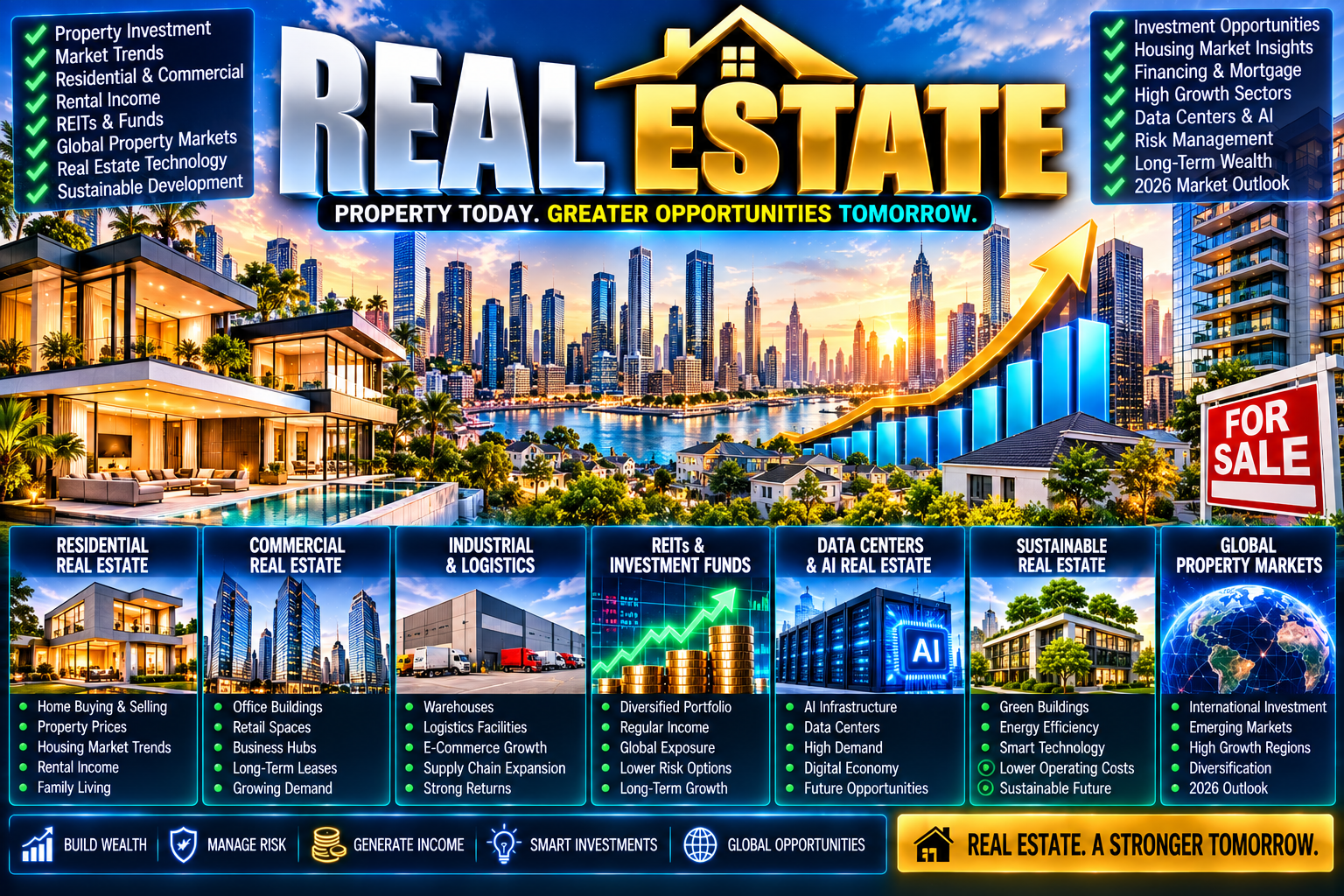
Real estate is one of the world's largest asset classes, covering residential properties, commercial buildings, industrial facilities, land, hotels, retail spaces, offices, and specialized properties such as data centers and student housing.
In 2026, the real estate industry is being shaped by interest rates, construction costs, housing supply, technology, artificial intelligence, energy demand, changing workplace patterns, and investor preferences. JLL's 2026 global outlook highlights supply shortages, rising construction costs, AI, energy security, and the changing investment landscape as major forces affecting real estate.
What Is Real Estate?
Real estate refers to land and the permanent structures attached to it.
The main categories include:
Residential real estate
Commercial real estate
Industrial real estate
Retail properties
Office buildings
Hospitality properties
Multifamily housing
Warehouses and logistics facilities
Data centers
Healthcare properties
Agricultural land
Development land
Real estate can be used for personal housing, business operations, rental income, development, or long-term investment.
Why Real Estate Matters
Real estate plays an important role in household wealth, business activity, employment, construction, banking, and economic development.
The industry supports a broad ecosystem involving:
Property developers
Homebuyers
Landlords
Tenants
Banks
Mortgage lenders
Construction companies
Architects
Property managers
Real estate agents
Institutional investors
Governments
Changes in property values can therefore affect both individual finances and broader economic activity.
Residential Real Estate
Residential real estate includes homes and properties designed primarily for living.
Common types include:
Single-family homes
Apartments
Condominiums
Townhouses
Multifamily buildings
Build-to-rent communities
Residential markets are influenced by mortgage rates, household income, employment, population growth, housing supply, construction costs, and consumer confidence.
In the U.S., Realtor.com’s 2026 midyear forecast projected existing-home prices to rise 1.2% during 2026, while existing-home sales were forecast at 4.10 million, representing approximately 1% growth from 2025.
These forecasts illustrate how affordability and borrowing costs continue to influence housing activity.
Commercial Real Estate
Commercial real estate, or CRE, includes properties used primarily for business and economic activity.
Major segments include:
Office
Office buildings remain an important part of urban property markets. Demand is increasingly focused on location, building quality, amenities, flexibility, and proximity to major employment centers.
JLL reported that global office leasing reached a new post-pandemic high during the first half of 2026, with the United States leading activity.
Retail
Retail properties include shopping centers, malls, high-street stores, and other consumer-focused locations.
Prime retail locations can remain attractive when supported by strong consumer demand and limited new supply.
Industrial and Logistics
Warehouses, distribution centers, fulfillment facilities, and logistics properties have become increasingly important because of e-commerce, manufacturing, supply-chain restructuring, and global trade.
JLL reported increased industrial take-up across many major markets during 2026.
Hospitality
Hotels, resorts, and other hospitality properties are influenced by tourism, business travel, consumer spending, and international travel patterns.
Real Estate Investment
Real estate investment can generate returns through:
Rental income
Property appreciation
Development profits
Operating income
Property improvements
Portfolio diversification
Investors can obtain real estate exposure through direct ownership or financial vehicles.
Direct investment involves purchasing a property, while indirect investment can include real estate investment trusts, funds, partnerships, and other securities.
Real Estate Investment Trusts
Real Estate Investment Trusts, commonly known as REITs, allow investors to gain exposure to portfolios of income-producing properties without directly purchasing and managing individual buildings.
REITs can provide exposure to sectors such as:
Residential properties
Offices
Retail
Industrial
Data centers
Healthcare
Hotels
Infrastructure
Publicly traded REITs can also provide liquidity that direct property ownership generally does not.
Interest Rates and Real Estate
Interest rates are one of the most important variables affecting property markets.
When borrowing costs increase:
Mortgage payments can rise.
Buyers may qualify for smaller loans.
Property affordability can decline.
Developers may face higher financing costs.
Investors may demand higher returns.
When borrowing costs decline, financing conditions can become more supportive.
However, the relationship is not automatic. Employment, supply, rents, inflation, credit availability, and investor expectations also influence real estate.
Housing Affordability
Housing affordability depends on more than the price of a property.
Important factors include:
Mortgage rates
Household income
Down-payment requirements
Property taxes
Insurance
Maintenance costs
Local housing supply
Rental costs
Even when property prices stabilize, high financing costs can keep monthly housing payments elevated.
Real Estate Supply
Supply is a major factor in property markets.
When construction remains below household or business demand, available properties can become scarce and prices or rents can face upward pressure.
JLL's 2026 global outlook identifies supply shortages and rising construction costs as major forces affecting real estate markets.
Construction costs can increase because of:
Labor costs
Materials
Energy
Transportation
Financing
Land prices
Regulatory requirements
Limited supply can also increase the value of existing high-quality properties.
Real Estate and AI
Artificial intelligence is becoming an increasingly important influence on real estate.
AI can affect the sector through:
Property valuation
Market analysis
Predictive analytics
Building management
Energy optimization
Tenant services
Property search
Construction planning
Portfolio management
AI is also creating direct demand for physical infrastructure.
Data centers require large amounts of land, electricity, cooling infrastructure, and connectivity. JLL identifies AI as a major factor in future real estate demand and reports that data-center demand reached record levels in 2026.
Data Centers and Digital Infrastructure
The expansion of cloud computing and AI has increased interest in data-center real estate.
Data-center investment depends on:
Electricity availability
Grid capacity
Fiber connectivity
Land
Cooling systems
Construction capacity
Local regulations
This makes digital infrastructure increasingly connected to both technology investment and real estate markets.
Real Estate and Energy
Energy has become an increasingly important consideration for property owners and developers.
Buildings consume significant amounts of energy, while data centers can require particularly large electricity supplies.
JLL's 2026 outlook highlights energy security as a major real estate consideration, alongside building efficiency and operating costs.
Properties with efficient energy systems can potentially benefit from lower operating costs and greater resilience.
Real Estate Financing
Real estate is frequently financed through debt.
Common financing methods include:
Mortgages
Commercial property loans
Construction financing
Bridge loans
Real estate investment funds
Private credit
Bonds
Equity financing
Financing conditions influence development activity, property transactions, and investment returns.
Higher financing costs can reduce the amount investors are willing or able to pay for properties.
Real Estate Valuation
Property valuation can involve several approaches.
Comparable Sales
A property is compared with recently sold properties that have similar characteristics.
Income Approach
The property's potential income is used to estimate value.
Cost Approach
The estimated cost of replacing the property is considered alongside land value and depreciation.
Professional valuation often combines multiple methods.
Real Estate and Rental Income
Rental properties can generate recurring income.
A basic rental calculation is:
Gross Rental Yield = Annual Rental Income ÷ Property Value × 100
However, gross rental yield does not represent the investor's final return.
Expenses can include:
Maintenance
Property management
Taxes
Insurance
Vacancy
Repairs
Financing costs
Utilities
Investors therefore need to distinguish gross income from net operating income.
Real Estate Development
Development involves transforming land or existing structures into properties with commercial or residential uses.
A typical development process can involve:
Land acquisition
Market research
Feasibility analysis
Planning and approvals
Financing
Design
Construction
Marketing
Sales or leasing
Property management
Development can produce significant returns but carries construction, financing, regulatory, market, and execution risks.
Global Real Estate Investment
International investors increasingly allocate capital across different property markets and sectors.
CBRE's 2026 Global Investor Intentions Survey found that investors across regions expected to buy and sell more real estate assets than in the previous year. Residential assets were particularly sought after in North America and Europe, while investor preferences differed across regions.
Cross-border real estate investment can provide diversification but also introduces currency, taxation, regulatory, political, and market-specific risks.
Real Estate Transparency
Transparency is becoming increasingly important for investors, lenders, developers, and regulators.
JLL's 2026 Global Real Estate Transparency Index found that transaction volumes in the world's most transparent real estate markets rose 64% over the previous two years. The research also highlights the growing importance of transparency around credit markets, AI, energy resilience, and investment access.
Better transparency can support:
More efficient transactions
Better market analysis
Improved investor confidence
Stronger governance
More reliable property information
Real Estate Technology
PropTech is transforming how properties are bought, sold, developed, financed, and managed.
Examples include:
Digital property platforms
Virtual tours
Automated valuation models
Smart buildings
Digital contracts
AI-powered property searches
Building-management systems
Real-time market analytics
Technology can reduce administrative work while giving property owners and investors access to more data.
Sustainability and Green Real Estate
Environmental considerations are becoming increasingly important in property markets.
Green buildings can incorporate:
Energy-efficient systems
Solar power
Smart lighting
Efficient heating and cooling
Water conservation
Sustainable materials
Green roofs
Low-carbon construction
Sustainability can affect operating costs, regulatory compliance, tenant demand, and long-term property value.
Major Real Estate Trends for 2026
1. AI-Driven Demand
AI is influencing both property operations and demand for data centers and digital infrastructure.
2. Supply Constraints
Limited construction and rising development costs are affecting property availability across several markets.
3. Growth in Logistics
Industrial and logistics properties remain important because of supply-chain requirements and changing distribution networks.
4. Living Sector Investment
JLL reported that global living investment increased approximately 9% during the first half of 2026 compared with the same period in 2025.
5. Higher Focus on Quality
Investors and tenants are increasingly focused on properties with strong locations, efficient operations, modern amenities, and resilient infrastructure.
6. Technology-Enabled Property Management
AI, automation, sensors, and data analytics are becoming more common in real estate operations.
Risks in Real Estate
Real estate is not risk-free.
Important risks include:
Interest-rate risk
Property-price declines
Vacancy
Tenant defaults
Construction delays
Rising construction costs
Regulatory changes
Economic downturns
Natural disasters
Climate-related risks
Liquidity constraints
Excessive leverage
Local market concentration
Because properties are relatively illiquid compared with publicly traded securities, investors may not always be able to sell quickly at their desired price.
The Future of Real Estate
The real estate industry is moving toward a more technology-driven, data-intensive, and specialized model.
AI, data centers, energy infrastructure, logistics, housing, healthcare, student accommodation, and other specialized property sectors are likely to remain important areas of industry development.
At the same time, traditional fundamentals—including location, supply, demand, financing, rental income, construction costs, and economic growth—will continue to influence property values.
JLL's 2026 outlook emphasizes that real estate organizations increasingly need to combine operational efficiency, technology, energy performance, experience, and capital strategy rather than treating these areas separately.
Frequently Asked Questions
What is real estate?
Real estate includes land and permanent structures such as homes, offices, warehouses, retail properties, hotels, and other buildings.
Is real estate an investment?
Real estate can be an investment when property is purchased or financed with the objective of generating income, appreciation, development profits, or diversification.
What affects property prices?
Interest rates, supply, demand, employment, income, construction costs, location, rents, financing conditions, and economic expectations can all influence property prices.
What is commercial real estate?
Commercial real estate includes properties primarily used for business purposes, including offices, retail centers, warehouses, hotels, and industrial facilities.
What is a REIT?
A Real Estate Investment Trust is an investment vehicle that owns or finances income-producing real estate and provides investors with exposure to property markets.
How is AI changing real estate?
AI is being used for market analysis, property valuation, building management, energy optimization, tenant services, construction planning, and portfolio management. It is also increasing demand for data-center infrastructure.
Conclusion
Real estate remains a major component of the global economy and investment landscape. Residential housing, commercial buildings, logistics facilities, data centers, hospitality, and specialized living assets all play important roles in property markets.
In 2026, the sector is being shaped by interest rates, affordability, supply shortages, construction costs, AI, energy demand, technology, and changing investor preferences. Global commercial real estate activity has shown resilience, while investors continue to evaluate opportunities across residential, industrial, logistics, office, retail, hospitality, and emerging technology-related property sectors.
Understanding these trends, alongside local market fundamentals, financing conditions, and investment risks, is essential for anyone participating in the modern real estate market.