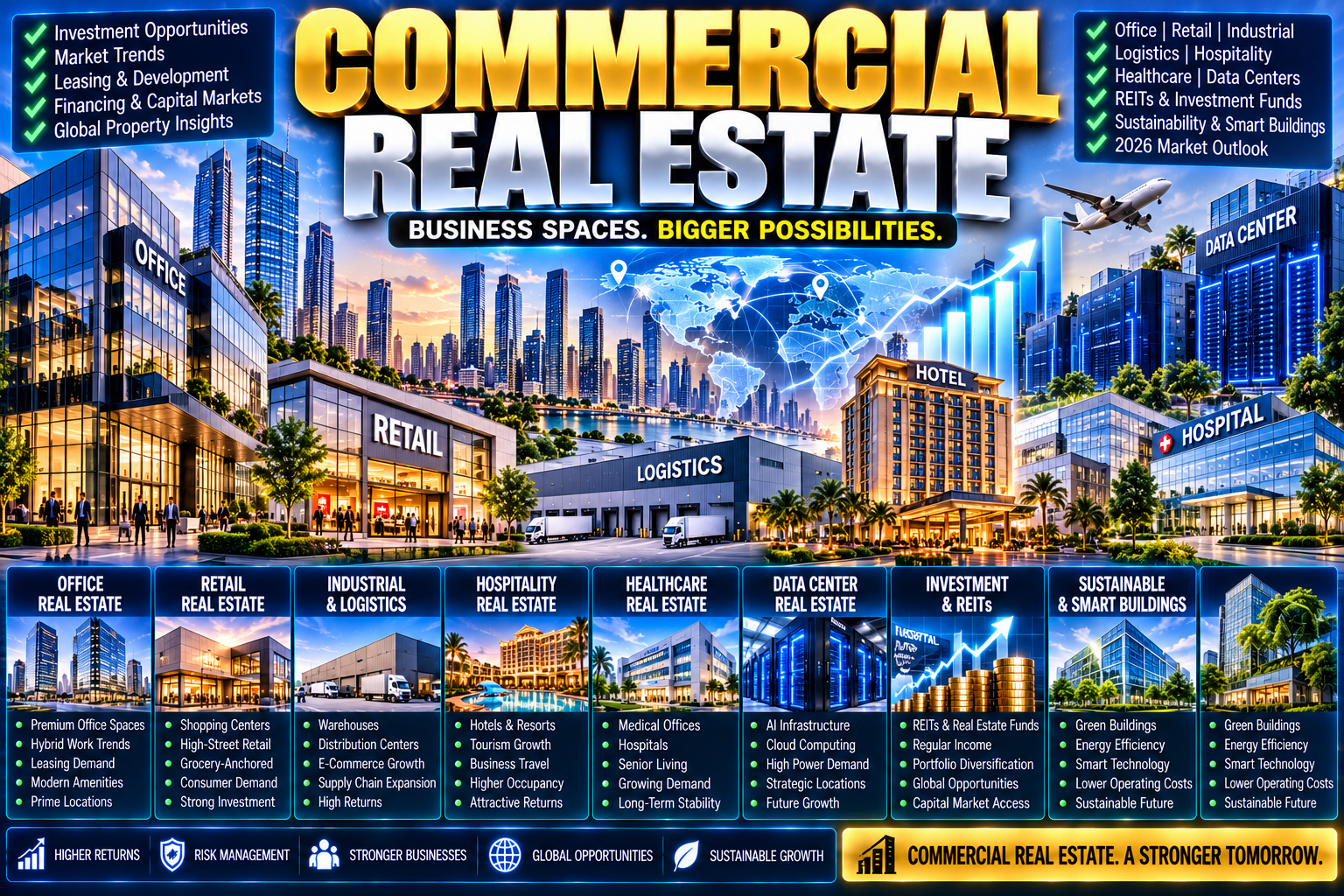
Commercial real estate (CRE) is a major part of the global property market, covering buildings and land used primarily for business, investment, production, logistics, retail, hospitality, healthcare, and other commercial activities.
In 2026, commercial real estate is being reshaped by interest rates, construction costs, limited supply of high-quality buildings, changing office demand, e-commerce, artificial intelligence, data centers, energy requirements, and evolving investment strategies. JLL's 2026 outlook identifies supply shortages, AI, energy security, efficiency, and technology as major forces influencing commercial real estate.
What Is Commercial Real Estate?
Commercial real estate refers to properties primarily used for business or income-producing purposes rather than personal residential use.
Major CRE categories include:
Office buildings
Retail properties
Industrial properties
Warehouses
Logistics centers
Hotels
Multifamily properties
Healthcare facilities
Data centers
Life-sciences properties
Self-storage facilities
Mixed-use developments
Commercial properties can generate income through rent, leases, operating businesses, property appreciation, and development.
Why Commercial Real Estate Matters
Commercial real estate supports economic activity by providing physical space for companies, retailers, manufacturers, logistics providers, hotels, healthcare organizations, and technology businesses.
The sector is closely connected to:
Employment
Consumer spending
Business investment
Construction
Banking
Infrastructure
Technology
Global trade
When businesses expand, they often require additional space. When economic activity slows, demand for certain types of commercial property can weaken.
Major Types of Commercial Real Estate
Office Real Estate
Office properties include traditional corporate buildings, coworking spaces, business centers, and specialized office facilities.
The office sector has undergone significant changes since the pandemic as companies have reassessed remote and hybrid work.
In 2026, demand is increasingly concentrated in high-quality buildings with strong locations, modern amenities, efficient layouts, and attractive workplace environments.
JLL reported that global office leasing reached a new post-pandemic high during 2026, with the United States leading activity.
The market is also becoming increasingly divided between high-quality properties and older buildings that may require renovation or conversion.
Retail Real Estate
Retail commercial real estate includes:
Shopping centers
Malls
Grocery-anchored centers
Power centers
High-street retail
Neighborhood centers
Outlet centers
Retail demand depends heavily on consumer spending, population growth, tenant performance, and location.
JLL reported strong investor interest in U.S. retail properties in 2026, with grocery-anchored and power centers attracting significant attention.
Industrial Real Estate
Industrial properties include warehouses, manufacturing facilities, distribution centers, and logistics buildings.
The sector has benefited from:
E-commerce
Supply-chain restructuring
Manufacturing investment
Inventory management
Third-party logistics
Automation
Global trade
CBRE reported that U.S. industrial leasing remained strong in early 2026, with manufacturing and third-party logistics contributing to demand.
Logistics Real Estate
Logistics properties are designed to move and store goods efficiently.
Important features can include:
Highway access
Rail connectivity
Airport proximity
Large loading areas
High ceilings
Automated systems
Large power capacity
As supply chains become more sophisticated, strategically located logistics properties can become increasingly important.
Hospitality Real Estate
Hospitality properties include hotels, resorts, serviced apartments, and other accommodation facilities.
Hotel performance is influenced by:
Tourism
Business travel
Consumer income
Events
International travel
Room rates
Occupancy
Healthcare Real Estate
Healthcare real estate includes:
Hospitals
Medical offices
Outpatient facilities
Senior-care facilities
Specialized healthcare centers
Population aging and demand for healthcare services can support long-term demand for specialized medical properties.
Commercial Real Estate Investment
Investors can gain exposure to CRE through direct property ownership or financial investment vehicles.
Direct investment involves acquiring a property and generating income through leasing or operations.
Indirect investment can include:
REITs
Private real estate funds
Real estate private equity
Joint ventures
Commercial mortgage investments
Real estate debt funds
Each structure has different characteristics related to liquidity, leverage, fees, control, risk, and potential returns.
How Commercial Real Estate Generates Returns
Commercial real estate investors generally look at two major sources of returns:
Rental or Operating Income
Properties can generate recurring income through leases or business operations.
Capital Appreciation
A property can potentially increase in value because of:
Higher rents
Improved occupancy
Better market conditions
Property improvements
Limited supply
Stronger demand
Favorable financing conditions
Total returns depend on the property's income, expenses, financing, valuation, and eventual sale price.
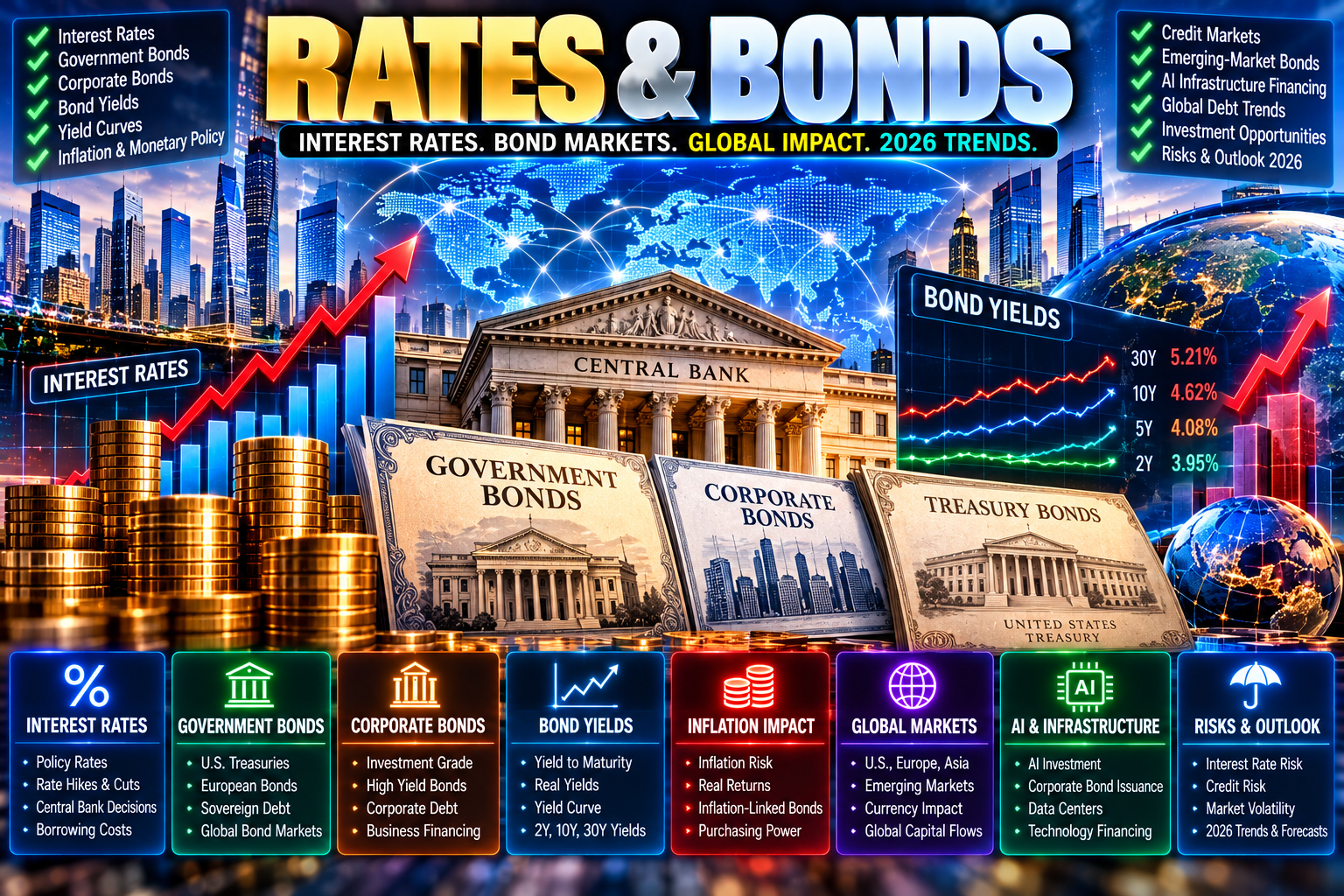
Commercial Real Estate and Interest Rates
Interest rates have a significant impact on commercial property markets.
Higher rates can increase:
Mortgage costs
Construction financing costs
Refinancing expenses
Required investment returns
Pressure on property valuations
Lower financing costs can support transaction activity and property investment.
However, interest rates are only one part of the equation. Rental growth, occupancy, supply, employment, economic growth, and property quality also influence commercial real estate performance.
CBRE's 2026 U.S. midyear outlook expects commercial real estate investment activity to increase, but notes that higher benchmark rates mean income growth and asset selection are increasingly important drivers of returns.
Cap Rates and Commercial Real Estate
Capitalization rates, commonly called cap rates, are an important CRE valuation metric.
A simplified calculation is:
Cap Rate = Net Operating Income ÷ Property Value × 100
For example, a property producing $1 million in annual net operating income and valued at $20 million would have a 5% cap rate.
Cap rates are influenced by:
Interest rates
Property risk
Location
Tenant quality
Lease duration
Growth expectations
Market liquidity
Investor demand
Changes in cap rates can have a substantial effect on commercial property valuations.
Commercial Real Estate Financing
CRE transactions often involve significant amounts of debt.
Common financing sources include:
Commercial mortgages
Bank loans
Insurance companies
Commercial mortgage-backed securities
Private credit
Real estate debt funds
Institutional capital
Equity partnerships
Borrowers typically need to consider loan-to-value ratios, interest rates, debt-service coverage, maturity dates, refinancing requirements, and lender conditions.
The Role of Institutional Investors
Institutional investors are major participants in commercial real estate.
They can include:
Pension funds
Insurance companies
Sovereign wealth funds
Private equity firms
Real estate investment managers
Family offices
Endowments
These investors often seek properties that can provide long-term income, diversification, and exposure to economic growth.
CBRE reported in January 2026 that 95% of surveyed North American investors planned to buy at least as much commercial real estate as in the previous year, while 55% planned to increase their capital allocation to real estate.
AI and Commercial Real Estate
Artificial intelligence is becoming one of the most important structural forces affecting commercial real estate.
AI can influence CRE through:
Property analytics
Automated valuation
Tenant demand forecasting
Building management
Energy optimization
Leasing analysis
Predictive maintenance
Portfolio management
AI is also creating direct demand for physical infrastructure.
Data centers require substantial amounts of land, electricity, cooling capacity, connectivity, and specialized construction.
JLL reported record North American data-center absorption of 25 gigawatts in the first half of 2026, driven by hyperscalers, AI companies, and neocloud providers.
Data Centers as Commercial Real Estate
Data centers have become one of the fastest-growing specialized CRE sectors.
Demand is being driven by:
Artificial intelligence
Cloud computing
Digital services
Machine learning
Streaming
Enterprise software
Data storage
JLL's 2026 Global Data Center Outlook reported global data-center occupancy of 97% at the end of 2025, while 77% of capacity under construction was already committed to tenants.
Power availability has become one of the industry's most important constraints.
Supply and Demand
Commercial property values are strongly influenced by supply and demand.
When demand increases while new construction remains limited, landlords can gain pricing power.
JLL's 2026 global outlook expects supply shortages of high-quality commercial space to intensify across several property sectors, partly because high construction and financing costs have reduced development activity.
This creates a growing distinction between:
High-quality, well-located properties
and
Older or less competitive properties.
Flight to Quality
The "flight to quality" describes increasing demand for properties with strong locations, modern facilities, attractive amenities, efficient operations, and high-quality tenants.
In office markets, companies may prioritize buildings that help with:
Employee recruitment
Collaboration
Workplace experience
Brand positioning
Transportation access
Sustainability
This can create a wider performance gap between premium and secondary properties.
Sustainability in Commercial Real Estate
Sustainability is becoming an increasingly important CRE consideration.
Commercial buildings can improve efficiency through:
Solar power
Efficient HVAC systems
Smart lighting
Energy monitoring
Water conservation
Better insulation
Sustainable construction materials
Building automation
Energy-efficient properties can potentially reduce operating expenses and improve long-term competitiveness.
Commercial Real Estate Technology
PropTech is changing how commercial properties are developed, leased, managed, and analyzed.
Technologies include:
AI analytics
Smart-building systems
Digital leasing platforms
Virtual property tours
Automated building controls
Internet of Things sensors
Digital twins
Property-management software
Technology can help owners understand occupancy, energy consumption, maintenance requirements, tenant behavior, and operational costs.
Global Commercial Real Estate Market
Commercial real estate markets differ significantly by country and city.
Important global CRE hubs include:
New York
London
Tokyo
Singapore
Dubai
Paris
Hong Kong
Sydney
Toronto
Los Angeles
San Francisco
Investment decisions are influenced by local economic growth, regulations, interest rates, supply, demographics, infrastructure, and business activity.
JLL reported that global commercial real estate transaction volumes increased 18% year over year in Q1 2026, while U.S. transaction volume reached $113 billion, up 25% from Q1 2025.
Commercial Real Estate in 2026
The 2026 market is characterized by improving investment activity alongside continued uncertainty.
CBRE's midyear U.S. outlook projected commercial real estate investment volume to rise 16% to approximately $605 billion. It also expected investment growth across major property types, including multifamily, retail, office, and industrial.
Globally, JLL reports resilient occupier demand, increasing capital deployment, strong office leasing, industrial demand, and limited supply in prime retail locations.
Major Commercial Real Estate Trends for 2026
1. AI Infrastructure
AI is driving demand for data centers, power infrastructure, warehouses, and technology-oriented properties.
2. Limited High-Quality Supply
Construction constraints are creating shortages of modern, well-located properties in several markets.
3. Office Recovery
Office demand is improving in major markets, particularly for high-quality buildings.
4. Industrial and Logistics Growth
Manufacturing, e-commerce, automation, and supply-chain restructuring continue to support industrial property demand.
5. Retail Resilience
Prime retail locations with strong tenants and limited new supply are attracting increased investor interest.
6. Energy Availability
Access to reliable and affordable electricity is becoming increasingly important for data centers and energy-intensive commercial properties.
7. Greater Selectivity
Investors are increasingly differentiating between property quality, location, tenants, lease structures, and long-term demand.
Risks in Commercial Real Estate
CRE investments can involve significant risks.
Major risks include:
Interest-rate volatility
Refinancing risk
Vacancy
Tenant defaults
Economic downturns
Construction delays
Rising costs
Property-price declines
Regulatory changes
Environmental risks
Liquidity constraints
Geographic concentration
Excessive leverage
Properties with weak tenants, short leases, poor locations, or high operating costs may face greater challenges during periods of economic stress.
Future of Commercial Real Estate
The future of commercial real estate is likely to be increasingly shaped by technology, AI, energy infrastructure, supply constraints, changing workplace patterns, and evolving consumer behavior.
Data centers and industrial properties are gaining strategic importance because of digitalization and supply-chain transformation. Offices are being repositioned around quality and workplace experience, while retail markets are increasingly differentiated by location and tenant strength.
JLL's 2026 outlook identifies six major forces reshaping CRE: efficiency, supply shortages, experience, AI, energy security, and broader access to real estate investing.
Frequently Asked Questions
What is commercial real estate?
Commercial real estate includes properties primarily used for business, investment, production, retail, logistics, hospitality, healthcare, and other commercial activities.
What are the main types of commercial real estate?
The major categories include office, retail, industrial, logistics, hospitality, healthcare, multifamily, data centers, and specialized properties.
How does commercial real estate make money?
Investors can generate returns through rental income, operating income, property appreciation, development, and property sales.
What is a cap rate?
A cap rate is a valuation measure calculated by dividing a property's net operating income by its value.
How do interest rates affect commercial real estate?
Interest rates influence borrowing costs, property valuations, investment returns, refinancing, and transaction activity.
Why are data centers important to commercial real estate?
AI, cloud computing, and digital services are increasing demand for data centers, making power availability, land, connectivity, and specialized infrastructure increasingly important.
Conclusion
Commercial real estate remains a critical component of the global economy and financial system. Office buildings, retail centers, warehouses, logistics facilities, hotels, healthcare properties, and data centers all serve different economic functions and respond differently to changes in demand.
In 2026, CRE markets are experiencing increased investment activity while navigating elevated interest rates, geopolitical uncertainty, construction costs, supply limitations, and rapidly changing technology. Current research from CBRE and JLL points to improving transaction activity, resilient occupier demand, strong interest in high-quality assets, and growing demand for AI-related infrastructure.
The commercial real estate market is therefore becoming increasingly selective. Location, property quality, tenant strength, income growth, financing, energy availability, and technological relevance are all important factors in evaluating commercial property.
As businesses and investors adapt to a more digital and energy-intensive economy, commercial real estate will remain closely connected to the future of global business, infrastructure, technology, and economic growth.