
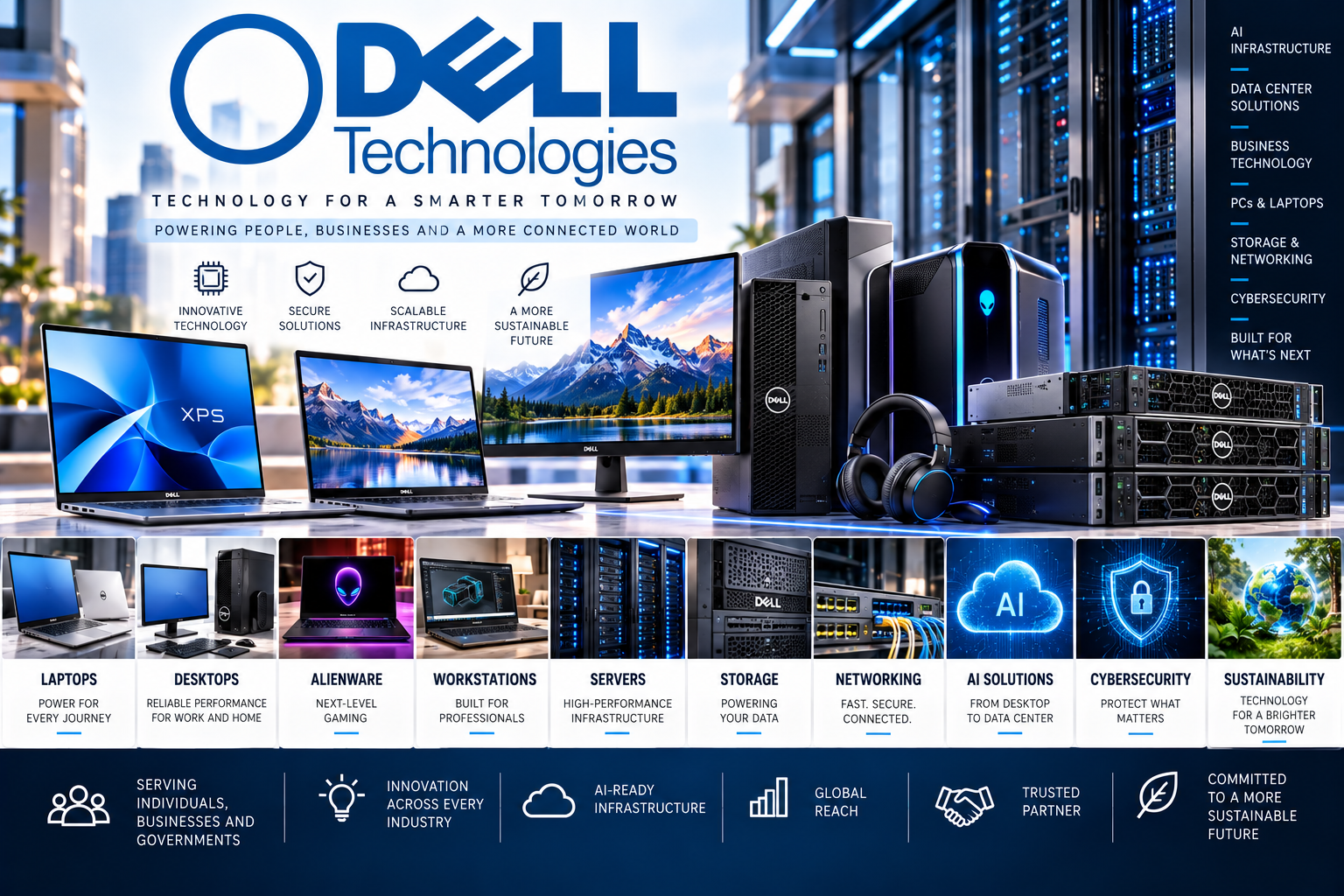
Dell Technologies is one of the world's best-known technology companies, with a business spanning personal computers, workstations, servers, storage, networking, cybersecurity, enterprise infrastructure, and artificial intelligence.
Originally known primarily for its direct-to-consumer PC business, Dell has transformed into a major provider of enterprise technology infrastructure. Its growing role in artificial intelligence is particularly significant in 2026, as businesses invest in servers, accelerators, storage, networking, and data-center systems designed for AI workloads.
Dell reported record fiscal 2026 revenue of $113.5 billion, up 19% year over year. The company also reported more than $64 billion in AI-optimized server orders during the fiscal year.
What Is Dell?
Dell Technologies is a global technology company headquartered in Round Rock, Texas.
The company provides technology products and services to consumers, small businesses, large enterprises, governments, and other organizations.
Its major areas include:
Personal computers
Laptops
Desktop computers
Workstations
Servers
Storage
Networking
AI infrastructure
Data-center technology
Cybersecurity
IT services
Cloud infrastructure
Enterprise software
Dell's business is generally divided into two major areas: Infrastructure Solutions Group (ISG) and Client Solutions Group (CSG).
The History of Dell
Dell was founded by Michael Dell in 1984.
The company originally focused on selling computers directly to customers, helping establish a business model based on direct sales and customization.
Instead of relying entirely on traditional retail distribution, Dell became known for allowing customers to configure computers according to their needs.
Over time, the company expanded from PCs into enterprise hardware and services.
A major transformation occurred with Dell's acquisition of EMC, completed in 2016. The combination significantly expanded Dell's presence in enterprise storage, infrastructure, and data-center technology.
Today, Dell is much more than a PC manufacturer.
Dell's Major Business Segments
Client Solutions Group
The Client Solutions Group focuses on devices used by individuals and organizations.
Products include:
Laptops
Desktop PCs
Workstations
Monitors
Accessories
Business computers
AI PCs
Dell's consumer and commercial PC brands include products marketed under the Dell and Alienware names.
Infrastructure Solutions Group
The Infrastructure Solutions Group provides technology for organizations operating data centers and large-scale computing environments.
Products include:
Servers
Storage
Networking
AI infrastructure
Data-center systems
Infrastructure management tools
This segment has become increasingly important as AI investment accelerates.
Dell Laptops
Dell laptops serve a broad range of customers.
Its portfolio includes computers for:
Students
Home users
Professionals
Businesses
Developers
Creators
Engineers
Gamers
Dell's laptop portfolio includes the XPS, Inspiron, Latitude, Precision, and Alienware families.
Different product lines target different requirements, from everyday computing to professional work and high-performance gaming.
Dell XPS
XPS is one of Dell's best-known premium PC families.
The series has traditionally focused on:
Premium design
High-resolution displays
Performance
Portability
Professional productivity
XPS products compete in the premium laptop segment against other major PC manufacturers.
Dell Latitude
Latitude is focused primarily on business computing.
Business laptops typically emphasize:
Security
Reliability
Manageability
Battery life
Enterprise support
Productivity
Latitude systems are designed for organizations that need to manage large numbers of computers across a workforce.
Dell Precision Workstations
Precision workstations are designed for demanding professional workloads.
Potential users include:
Engineers
Architects
Designers
Scientists
Video professionals
Developers
AI professionals
Workstations can provide significantly more processing and graphics capability than conventional business PCs.
Alienware
Alienware is Dell's gaming-focused brand.
Alienware products include:
Gaming laptops
Gaming desktops
Gaming monitors
Gaming accessories
Gaming hardware requires high-performance processors, graphics cards, memory, cooling, and displays.
The gaming market also contributes to broader demand for advanced computing hardware.
Dell Servers
Servers are a major part of Dell's enterprise business.
Dell PowerEdge servers are designed for workloads including:
Enterprise applications
Databases
Virtualization
Cloud infrastructure
High-performance computing
Artificial intelligence
Machine learning
As organizations deploy more AI applications, demand for high-performance servers has become increasingly important.
Dell and Artificial Intelligence
AI has become one of Dell's most important growth areas.
The company has developed the Dell AI Factory with NVIDIA, combining Dell infrastructure with NVIDIA accelerated computing and related technologies.
Dell announced in May 2026 that more than 5,000 customers were deploying the Dell AI Factory with NVIDIA.
The company's AI infrastructure strategy includes:
GPUs
AI servers
Storage
Networking
Cooling
AI software
Data management
AI services
Workstations
This allows Dell to address AI workloads from individual workstations to large data centers.
Dell AI Servers
AI servers are becoming a major part of Dell's infrastructure business.
During fiscal 2026, Dell reported approximately $24.7 billion in AI-optimized server revenue, compared with approximately $9.3 billion in the prior fiscal year.
The company also reported more than $64 billion in AI-optimized server orders for fiscal 2026.
These figures demonstrate how quickly AI infrastructure has become an important part of Dell's business.
Dell's 2026 AI Growth
Dell's AI momentum continued into fiscal 2027.
For the first quarter of fiscal 2027, Dell reported:
Revenue of $43.8 billion
AI orders of $24.4 billion
AI server revenue of $16.1 billion
Record operating cash flow of $4.1 billion
Dell also increased its fiscal 2027 AI server revenue expectation to approximately $60 billion.
Dell PowerEdge
PowerEdge is Dell's server platform.
The portfolio supports different workloads ranging from traditional enterprise applications to AI and high-performance computing.
In 2026, Dell introduced new generations of PowerEdge systems with advanced air- and liquid-cooling configurations.
Dell said its 18th-generation PowerEdge portfolio could provide significant performance and consolidation improvements compared with earlier generations.
Dell PowerRack
As AI workloads become larger, individual servers are increasingly being combined into complete rack-scale systems.
Dell's PowerRack platform integrates:
Compute
Networking
Storage
Power management
Cooling
Infrastructure management
The objective is to simplify deployment of large-scale AI and high-performance computing environments.
Dell introduced PowerRack as part of its broader AI infrastructure strategy in 2026.
Dell Data-Center Technology
Modern data centers require far more than servers.
They also require:
Storage
Networking
Cooling
Power systems
Cybersecurity
Backup
Monitoring
Automation
Infrastructure management
Dell announced a new generation of storage, compute, cyber-resilience, and automation technologies in May 2026 as part of its strategy for AI-ready data centers.
Dell Storage
Dell provides storage systems designed for businesses handling large amounts of information.
Storage technologies are important for:
Databases
Enterprise applications
Backup
AI datasets
Analytics
Cloud infrastructure
High-performance computing
AI increases the importance of storage because organizations need to move and analyze enormous volumes of data.
Dell's 2026 PowerStore Elite announcement emphasized higher performance, density, and non-disruptive upgrades for modern enterprise environments.
Dell Networking
AI infrastructure also requires high-speed networking.
Large AI systems need to move enormous amounts of information between:
GPUs → Servers → Storage → Networks → Applications
Dell provides networking technologies designed to support these environments.
High-speed networking is particularly important as AI clusters become larger and more distributed.
Dell and AI PCs
AI is not limited to data centers.
Dell is also incorporating AI capabilities into PCs and workstations.
AI PCs can support:
Local AI processing
Productivity assistants
Image generation
Voice processing
Translation
Security
Data analysis
Dell described AI PCs and workstations as part of a more distributed enterprise AI model in 2026, with intelligence moving closer to employees and users.
Dell and Agentic AI
The next stage of AI is increasingly focused on agentic AI.
Instead of simply generating text or images, AI agents can potentially:
Reason through tasks
Use software tools
Retrieve information
Automate workflows
Execute multi-step processes
Dell announced Deskside Agentic AI solutions in 2026 that allow organizations to deploy certain AI-agent workloads locally on Dell workstations and infrastructure.
This approach can be relevant for organizations concerned about:
Data sovereignty
Security
Latency
Cloud costs
Control over sensitive information
Dell and Cybersecurity
Cybersecurity is increasingly important as companies become more dependent on connected infrastructure.
Dell's enterprise portfolio includes technologies designed to support:
Data protection
Backup
Cyber resilience
Infrastructure security
Device security
Identity and access management
In 2026, Dell introduced additional cyber-resilience capabilities alongside its modern data-center infrastructure portfolio.
Dell and Cloud Computing
Although cloud computing has changed enterprise IT, many businesses continue to operate hybrid environments.
A hybrid infrastructure may combine:
On-Premises Data Centers + Private Cloud + Public Cloud + Edge Computing
Dell provides hardware and infrastructure technologies designed to operate within these environments.
This is particularly relevant for organizations that want greater control over sensitive data or specific workloads.
Dell and Enterprise AI
One of Dell's major strategic opportunities is helping organizations move AI projects from experimentation into production.
AI deployment requires more than a powerful GPU.
Companies also need:
High-performance servers
Storage
Networking
Data pipelines
Security
Governance
Software
Cooling
Power
Technical expertise
Dell's AI Factory strategy attempts to bring these components together into a more integrated infrastructure platform. The company said its AI Factory with NVIDIA had more than 5,000 customers by May 2026.
Dell's Business Model
Dell's business model combines hardware, infrastructure, software, services, and direct customer relationships.
Major revenue areas include:
PCs and Workstations
Dell sells consumer, commercial, and professional computing devices.
Enterprise Infrastructure
Servers, storage, and networking form a major part of Dell's enterprise business.
AI Infrastructure
AI servers and related infrastructure have become an increasingly significant growth area.
Services
Dell provides professional and infrastructure-related services to help organizations deploy and manage technology.
Direct Sales and Partners
Dell uses direct sales, e-commerce, channel partners, distributors, and enterprise relationships.
Dell's Financial Growth
Dell's fiscal 2026 results demonstrated strong overall business momentum.
The company reported:
$113.5 billion full-year revenue
19% year-over-year revenue growth
$11.2 billion operating cash flow
More than $64 billion in AI-optimized server orders
Approximately $43 billion in AI backlog entering fiscal 2027
The company therefore entered fiscal 2027 with substantial exposure to AI infrastructure demand.
Dell and Sustainability
Technology infrastructure consumes significant amounts of electricity and requires extensive manufacturing resources.
Dell has sustainability initiatives covering areas such as:
Energy efficiency
Product design
Recycling
Packaging
Supply-chain responsibility
Data-center efficiency
For AI infrastructure specifically, energy and cooling efficiency are becoming increasingly important because high-density computing systems can consume substantial amounts of power.
Dell's newer infrastructure products include both air- and liquid-cooling approaches designed for increasingly demanding workloads.
Dell's Global Market
Dell serves customers across multiple regions and industries.
Its customers include organizations in:
Finance
Healthcare
Education
Manufacturing
Government
Retail
Telecommunications
Technology
Energy
Its global infrastructure presence allows the company to participate in both consumer technology and enterprise computing markets.
Dell's Competitive Landscape
Dell operates in several highly competitive markets.
Its competitors vary by product category and can include:
Lenovo
HP
Apple
Cisco
HPE
Supermicro
IBM
NVIDIA
Other infrastructure and cloud-technology companies
Competition occurs across:
Performance
Price
Innovation
AI capabilities
Enterprise support
Energy efficiency
Security
Distribution
Customer service
Major Dell Trends for 2026
1. AI Infrastructure
AI servers, networking, storage, and data-center systems are major areas of Dell's expansion.
2. AI PCs
AI capabilities are moving closer to employees through PCs and workstations.
3. Agentic AI
Organizations are beginning to explore AI systems capable of executing more complex workflows.
4. Rack-Scale Computing
Large AI deployments increasingly require integrated rack-level infrastructure.
5. Liquid Cooling
Higher computing density is increasing demand for advanced cooling technologies.
6. Enterprise Storage
AI requires large-scale data storage and fast data access.
7. Hybrid Infrastructure
Organizations continue to combine on-premises and cloud environments.
8. Cyber Resilience
Growing AI and data-center adoption increases the importance of infrastructure security and recovery.
9. Edge AI
More AI processing is moving closer to users, devices, and business operations.
10. Sustainable Computing
Energy efficiency and data-center power consumption are becoming increasingly important.
Challenges Facing Dell
Dell operates in an industry with rapid technological change.
Major challenges include:
Semiconductor supply constraints
Component costs
AI infrastructure competition
Data-center power requirements
Cooling requirements
Global supply-chain disruptions
Currency fluctuations
Enterprise IT spending cycles
Cybersecurity threats
Rapid product obsolescence
Intense PC competition
AI infrastructure can create significant growth opportunities, but it also requires substantial engineering, manufacturing, supply-chain, and capital resources.
The Future of Dell
Dell's future is increasingly connected to the convergence of traditional IT infrastructure and artificial intelligence.
The company is moving beyond the traditional PC business toward a broader technology infrastructure model.
The emerging Dell ecosystem can be viewed as:
AI PCs → Workstations → Servers → GPUs → Networking → Storage → Data Centers → AI Applications
This gives Dell exposure to multiple layers of the computing ecosystem.
The company's 2026 product announcements also show a focus on helping organizations deploy AI locally, from individual workstations to large-scale data centers.
Frequently Asked Questions
What is Dell known for?
Dell is known for PCs, laptops, workstations, servers, storage, networking, enterprise infrastructure, and increasingly AI hardware.
Who owns Dell Technologies?
Dell Technologies is a publicly traded company listed on the New York Stock Exchange under the ticker DELL.
What is Dell AI Factory?
Dell AI Factory is Dell's portfolio and infrastructure approach for helping organizations deploy and scale artificial intelligence, including solutions developed with NVIDIA and other technology partners.
Is Dell still a PC company?
Yes. PCs remain an important part of Dell's business, but the company has expanded substantially into enterprise infrastructure, servers, storage, networking, services, and AI.
Is Dell growing in AI?
Dell reported strong AI-related growth in fiscal 2026, including more than $64 billion in AI-optimized server orders and approximately $24.7 billion in AI-optimized server revenue.
What are Dell's main products?
Dell's major products include laptops, desktops, workstations, monitors, servers, storage systems, networking equipment, AI infrastructure, and enterprise technology services.
Conclusion
Dell Technologies has evolved from a direct-to-consumer PC company into a broad technology infrastructure provider.
Its traditional PC and workstation businesses remain important, while enterprise servers, storage, networking, cybersecurity, and artificial intelligence are increasingly central to its strategy.
The company's fiscal 2026 results highlight the scale of this transformation: Dell generated a record $113.5 billion in revenue and more than $64 billion in AI-optimized server orders.
In 2026, Dell is positioning itself across the entire AI computing ecosystem—from AI PCs and workstations to servers, storage, networking, cooling, and large-scale data centers.
As businesses continue investing in artificial intelligence, cloud infrastructure, cybersecurity, and high-performance computing, Dell's role in enterprise technology is increasingly tied to the infrastructure required to make these systems work.