Digital assets are becoming increasingly integrated into traditional investment markets. what was once primarily accessed through crypto exchanges and specialized investment funds can now be accessed through regulated exchange-traded products, giving institutional investors a more familiar route into the asset class.
This shift is particularly important in 2026.
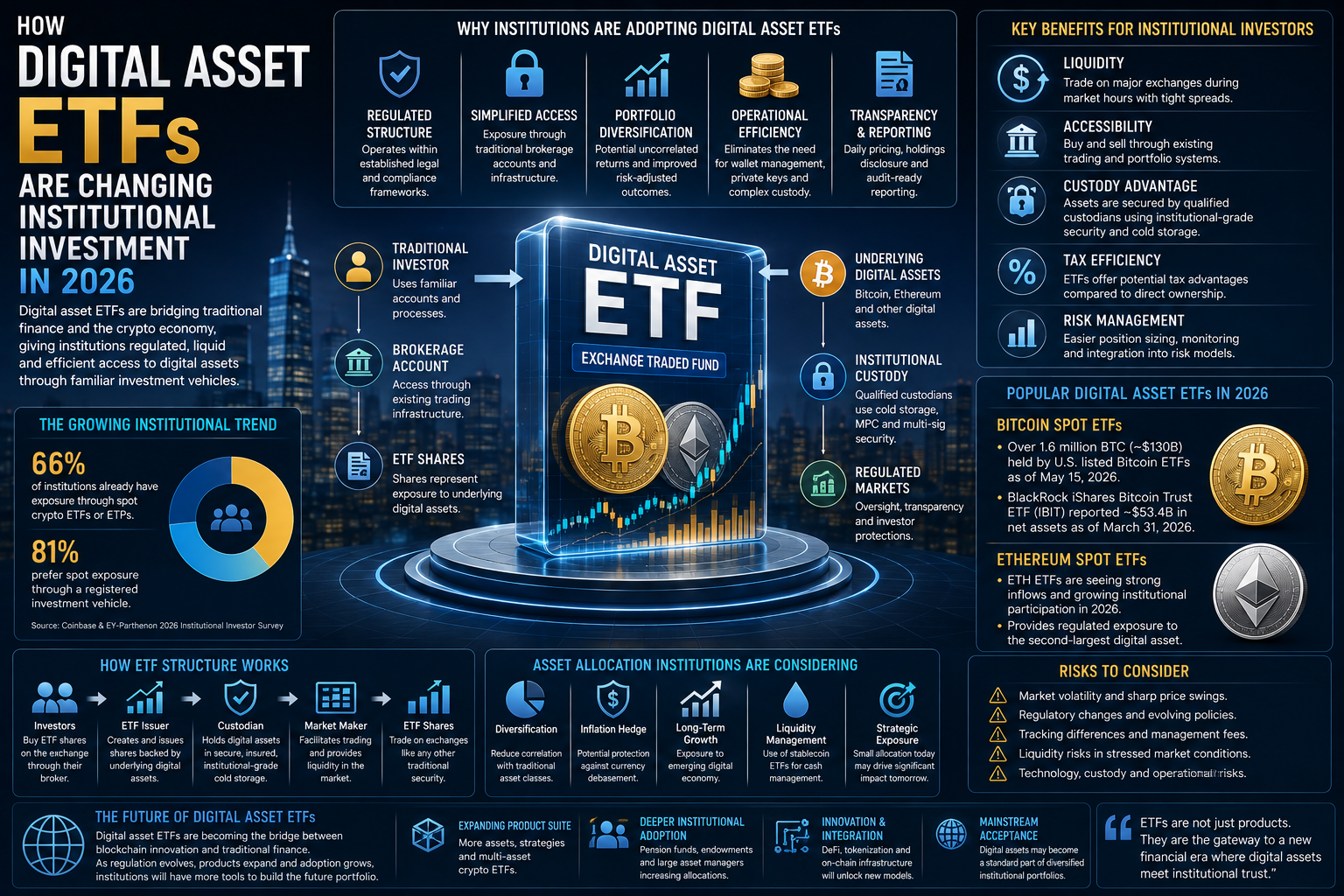
A January 2026 survey of 351 institutional decision-makers by Coinbase and EY-Parthenon found that 66% reported exposure through spot crypto ETFs or ETPs, while 81% preferred spot exposure through a registered vehicle. Nearly three-quarters also said they planned to increase their digital-asset allocations.
Digital-asset ETFs are therefore becoming more than another investment product. They are increasingly functioning as a bridge between traditional capital markets and blockchain-based assets.
What Are Digital Asset ETFs?
An exchange-traded fund or exchange-traded product provides investors with exposure to an underlying asset or strategy through a security that trades on an exchange.
For digital assets, these products can provide exposure to cryptocurrencies such as Bitcoin and Ether without requiring every investor to personally manage blockchain wallets and private keys.
Depending on the product structure, an investor can gain exposure through a traditional brokerage account.
This creates a familiar investment experience:
Brokerage account → ETF/ETP → digital asset exposure
rather than:
Crypto exchange → wallet → private keys → blockchain transaction.
That difference is particularly important for institutional investors operating within established investment, custody, compliance, and reporting frameworks.
Why Institutions Are Turning to ETFs
Institutional investors have specific operational requirements.
They need:
Regulated investment structures
Reliable custody
Institutional reporting
Compliance procedures
Auditable transactions
Portfolio accounting
Risk controls
Familiar trading infrastructure
Digital-asset ETFs can address some of these requirements through established financial-market structures.
Coinbase's 2026 institutional survey found that regulated products had become a default access point for many investors, with 81% preferring spot exposure through a registered vehicle.
This suggests that institutional adoption is increasingly occurring through financial wrappers that investors already understand.
Spot ETFs and Direct Ownership
One of the most important distinctions is between holding a digital asset directly and gaining exposure through an ETF.
Direct ownership requires investors to manage or delegate custody of the actual digital asset.
An ETF provides exposure through shares of an investment vehicle.
For institutions, the ETF model can simplify several operational processes.
However, it also means investors do not necessarily have the same rights or functionality as someone directly holding the underlying cryptocurrency.
For example, ETF investors generally cannot directly use the fund's Bitcoin or Ether for blockchain transactions.
The product is designed primarily as an investment vehicle.
Bitcoin ETFs as an Institutional Gateway
Bitcoin has become the most prominent example of institutional digital-asset exposure.
U.S.-listed spot Bitcoin ETFs have accumulated substantial assets. SEC-filed materials in 2026 showed that U.S.-listed spot Bitcoin ETFs collectively held roughly 1.6 million BTC, valued at about $130 billion, based on data through May 15, 2026.
BlackRock's iShares Bitcoin Trust ETF alone reported approximately $53.4 billion in net assets as of March 31, 2026.
These figures illustrate how digital assets are becoming integrated into mainstream investment structures.
Ethereum and Beyond Bitcoin
Institutional access is no longer limited to Bitcoin.
Ether and other digital assets are also becoming available through exchange-traded products.
Coinbase's 2026 institutional market guide notes that institutional investors can access BTC and ETH through spot markets, futures, options, ETFs/ETPs, and equity proxies.
SEC filings also show the expansion of digital-asset ETPs beyond Bitcoin and Ether, including products providing exposure to assets such as Solana, XRP, Dogecoin, Polkadot, and Sui.
This expansion could eventually create a broader digital-asset investment universe.
ETFs and Portfolio Diversification
Institutional investors rarely evaluate an asset in isolation.
They consider how it affects the entire portfolio.
Digital assets can potentially provide diversification characteristics that differ from traditional equities and bonds.
However, diversification should not be confused with low risk.
Cryptocurrency prices can experience significant volatility.
A digital-asset allocation can therefore materially affect portfolio risk depending on its size.
Institutional investors increasingly appear to be approaching digital assets with more disciplined allocation strategies rather than treating them as standalone speculative positions.
The 2026 Coinbase/EY-Parthenon survey found that 49% of respondents had strengthened their emphasis on risk management, liquidity, and position sizing.
Liquidity Advantages
Exchange-traded products can offer another important benefit: liquidity.
Shares trade during market hours on established exchanges, allowing investors to buy or sell positions through familiar market infrastructure.
This can be easier for some institutions than managing direct cryptocurrency positions across multiple exchanges and wallets.
However, ETF liquidity and underlying asset liquidity are not identical.
Investors should consider trading volume, spreads, market conditions, and the liquidity of the underlying digital asset.
Custody Becomes Simpler—but Still Matters
One of the major advantages of ETFs is that investors do not personally have to manage private keys.
The fund structure handles custody of the underlying digital assets.
This can remove some operational complexity for institutional investors.
But custody does not disappear.
It simply moves into the fund's infrastructure.
The custodian still needs strong security, key management, asset segregation, compliance, and disaster-recovery systems.
Institutional investors therefore need to evaluate the entire ETF structure rather than assuming that a regulated wrapper eliminates digital-asset risks.
Regulatory Developments
Regulation is playing an increasingly important role in the evolution of digital-asset ETFs.
In March 2026, the U.S. Securities and Exchange Commission issued an interpretation clarifying how federal securities laws apply to certain crypto assets and transactions involving crypto assets.
The SEC also permitted in-kind creations and redemptions for certain crypto ETPs in July 2025, including Bitcoin and Ether products.
These developments matter because ETF infrastructure depends heavily on the regulatory framework governing creation, redemption, custody, trading, and market structure.
In-Kind Creation and Redemption
The mechanics of ETF creation and redemption can have significant implications for market efficiency.
In an in-kind structure, authorized participants can exchange underlying assets for ETF shares, or vice versa, subject to the applicable rules.
The SEC's 2025 approval of in-kind creations and redemptions for certain crypto ETPs represented an important development in the evolution of these products.
More efficient creation and redemption mechanisms can potentially improve market functioning and reduce friction.
Institutional Risk Management
Digital-asset ETFs do not eliminate investment risk.
Institutions still need to evaluate:
Market volatility
Liquidity
Tracking differences
Fees
Counterparty exposure
Custody arrangements
Regulatory changes
Tax considerations
Operational risks
The ETF structure can simplify access, but the underlying asset remains exposed to market fluctuations.
Professional portfolio management therefore remains essential.
The Role of Asset Managers
Large asset managers are becoming increasingly important in digital-asset markets.
Their involvement can provide institutional investors with products that integrate digital assets into existing portfolio-management frameworks.
This can also increase the credibility and accessibility of the asset class.
As more asset managers develop digital-asset products, competition may increase around:
Fees
Liquidity
Product design
Custody
Index methodology
Investor services
This could make digital-asset exposure increasingly similar to other established investment categories.
ETFs and Traditional Brokerage Accounts
One of the biggest changes is accessibility.
Investors may be able to gain digital-asset exposure through an existing brokerage account without opening a dedicated cryptocurrency account.
This can make digital assets easier to incorporate into traditional portfolios.
For investment committees and wealth managers, the operational difference can be substantial.
Instead of building an entirely separate digital-asset workflow, an institution can potentially evaluate an ETF alongside other exchange-traded investments.
The Growth of Multi-Asset Digital Products
The next stage could involve increasingly sophisticated products.
Instead of offering exposure to only one cryptocurrency, asset managers could develop products based on:
Multiple digital assets
Crypto indexes
Staking strategies
Income strategies
Options-based strategies
Digital-asset baskets
Thematic blockchain portfolios
The SEC's June 2026 request for public comment on novel ETFs specifically addressed innovative asset classes and investment strategies, reflecting the continuing evolution of the ETF market.
ETFs and Institutional Portfolio Construction
The introduction of regulated digital-asset ETFs changes how investment committees can think about portfolio allocation.
Instead of asking:
“Should we directly hold cryptocurrency?”
institutions can ask:
“What role could digital-asset exposure play within our overall portfolio?”
Possible roles could include:
Diversification
Alternative growth exposure
Inflation or monetary-risk hedging thesis
Tactical allocation
Long-term strategic exposure
The appropriate role depends entirely on the institution's mandate and risk tolerance.
The Importance of Fees
ETF fees matter.
Even when two products provide similar exposure, differences in expense ratios can affect long-term returns.
Institutions also need to consider trading spreads and other costs.
As competition grows, fee pressure may increase.
Investors should therefore compare the total cost of ownership rather than looking only at the headline management fee.
Tracking Difference
An ETF designed to track Bitcoin or another asset may not perfectly match the asset's performance.
Differences can arise from:
Fund expenses
Trading costs
Cash management
Index methodology
Creation and redemption mechanics
Operational factors
Institutional investors should therefore examine historical tracking performance rather than assuming that exposure will exactly match the underlying asset.
ETFs and Digital-Asset Adoption
The broader significance of digital-asset ETFs extends beyond individual products.
They can help integrate blockchain-based assets into traditional capital markets.
An institution can use existing portfolio-management systems, brokerage relationships, reporting processes, and investment policies.
This lowers some of the operational barriers that previously made digital assets difficult for large organizations to access.
Coinbase's 2026 research describes this development as part of the broader maturation of institutional crypto markets, with regulated products becoming a major access point.
The Remaining Challenges
Despite rapid growth, digital-asset ETFs still face challenges.
Volatility
Digital assets can experience significant price swings.
Regulation
Rules continue to evolve across jurisdictions.
Market Structure
Crypto markets operate across regulated and offshore venues, creating differences in liquidity and market infrastructure.
Custody
The underlying assets still require sophisticated security.
Investor Understanding
A familiar ETF wrapper does not make the underlying asset risk-free.
These challenges will remain important as institutional participation grows.
The Future of Institutional Crypto Investing
The long-term significance of digital-asset ETFs may be their ability to connect two financial systems.
Traditional finance provides:
Regulation + brokerage + custody + portfolio management + institutional governance
Digital assets provide:
Blockchain networks + programmable assets + 24/7 markets + new forms of digital ownership
ETFs can sit between these ecosystems.
They allow traditional investors to gain exposure to blockchain-based assets through familiar financial infrastructure.
Conclusion
Digital-asset ETFs are changing institutional investment by making cryptocurrencies more accessible through regulated and familiar financial-market structures.
The growth of spot Bitcoin and Ether products, increasing institutional allocations, and expanding product diversity demonstrate that digital assets are moving further into mainstream investment infrastructure.
For institutions, the biggest advantage may not simply be convenience.
ETFs can provide a framework for incorporating digital assets into existing investment processes, portfolio construction, custody arrangements, and governance systems.
But investors still need to understand the underlying risks.
Volatility, liquidity, fees, tracking differences, custody, regulation, and market structure all remain important considerations.
The next stage of digital-asset adoption is therefore unlikely to be driven only by cryptocurrency-native investors.
It may increasingly be driven by traditional institutions using familiar financial products to gain controlled exposure to a new asset class.
In 2026, digital-asset ETFs are helping create that bridge.
And as regulated products continue to evolve, they could become one of the most important mechanisms.