Pricing has always been one of the most important decisions businesses make. The right price can increase revenue, improve customer acquisition, strengthen market positioning, and protect profit margins. The wrong price can drive customers away, reduce profitability, or leave money on the table.
For decades, businesses have relied on historical sales data, competitor research, market surveys, and human judgment to determine pricing strategies. While these methods remain useful, the growing complexity of modern markets is creating demand for more dynamic approaches.
In 2026, artificial intelligence is changing how companies think about pricing.
AI-powered pricing systems can analyze customer behavior, market conditions, inventory levels, competitor activity, demand patterns, and historical transactions to help businesses determine more effective pricing strategies. Instead of treating pricing as a decision that is reviewed periodically, organizations can increasingly make pricing a continuous, data-driven process.
This transformation is particularly important as companies compete in markets where customer expectations and demand can change rapidly.
What Is AI-Powered Pricing?
AI-powered pricing uses artificial intelligence and advanced analytics to analyze large amounts of business and market information and generate pricing recommendations.
Traditional pricing systems may rely on fixed rules. For example, a company might increase prices by a specific percentage each year or offer a standard discount during a seasonal promotion.
AI-powered systems can evaluate many variables simultaneously.
They can consider demand, customer segments, purchase history, inventory, competitor pricing, seasonality, market conditions, and other relevant factors.
The objective is not simply to charge the highest possible price.
Instead, AI can help businesses find a balance between demand, revenue, customer value, and profitability.
Why Pricing Is Becoming More Dynamic
Markets can change quickly.
A product that is highly popular today may experience weaker demand next month. A competitor may introduce a cheaper alternative. Inventory levels may change unexpectedly, or a new trend may suddenly increase customer interest.
Traditional pricing strategies can struggle to respond to these changes quickly.
AI can continuously analyze new information and identify changes in market behavior.
This allows businesses to evaluate pricing more frequently and adjust strategies when appropriate.
For example, an online retailer could identify increasing demand for a particular product and determine whether pricing should change or inventory should be increased.
The important difference is that pricing becomes responsive rather than static.
Understanding Customer Willingness to Pay
One of the most valuable applications of AI in pricing is understanding customer willingness to pay.
Different customers may place different values on the same product or service.
A business customer purchasing a large volume may have different requirements from an individual consumer. A premium customer may value additional services that another customer does not need.
AI can analyze purchasing behavior and customer characteristics to identify patterns.
This can help businesses create better pricing structures, packages, and offers.
However, organizations must use customer information responsibly. Pricing strategies should remain transparent and comply with applicable laws and regulations.
The goal should be better value alignment rather than unfair discrimination.
AI and Personalized Offers
Pricing and personalization are increasingly becoming connected.
AI can analyze customer preferences and determine which products, packages, or promotions are most relevant to different customer segments.
For example, a software company might identify customers who are likely to benefit from a premium feature and present them with a personalized upgrade offer.
A retailer could recommend a product bundle rather than simply reducing the price of an individual item.
This approach can increase perceived value while reducing unnecessary discounting.
Instead of offering the same promotion to everyone, businesses can use AI to make offers more relevant.
Reducing Unnecessary Discounts
Discounting is one of the simplest ways to attract customers, but excessive discounting can damage profitability.
Businesses sometimes reduce prices because they are uncertain about demand.
AI can provide better insight into whether a discount is actually necessary.
If demand is already strong, a company may not need to offer a large promotion.
If demand is weak, AI can help evaluate whether a discount, product bundle, improved marketing campaign, or another strategy would be more appropriate.
This can help businesses move from blanket discounting toward more targeted revenue strategies.
Dynamic Pricing in E-Commerce
E-commerce is one of the clearest examples of dynamic pricing.
Online businesses can collect large amounts of information about product views, purchases, inventory, search behavior, and market activity.
AI can analyze these signals and help companies understand demand in near real time.
For example, if demand for a particular product suddenly increases while inventory becomes limited, an AI system can identify the situation and provide pricing recommendations.
Businesses still need appropriate rules and human oversight to ensure that pricing changes remain reasonable and compliant.
AI-Powered Pricing in Travel and Hospitality
Travel and hospitality businesses have long used dynamic pricing, but AI can make these systems more sophisticated.
Hotels, airlines, and travel platforms can analyze booking patterns, seasonal demand, local events, capacity, cancellation behavior, and other factors.
AI can then forecast demand and help optimize pricing.
For example, a hotel may identify increasing demand for rooms during a major local event and adjust its pricing strategy accordingly.
Similarly, travel companies can use AI to evaluate demand across different routes and periods.
The objective is to maximize revenue while maintaining competitive positioning.
Pricing for Subscription Businesses
Subscription businesses face a different pricing challenge.
Companies need to balance customer acquisition, retention, upgrades, and long-term revenue.
AI can analyze customer behavior to identify patterns associated with cancellations, upgrades, or changes in usage.
A software company might discover that certain customers are more likely to upgrade when they reach a particular level of usage.
Instead of sending generic promotions, the company can use AI insights to create more relevant offers.
AI can also help businesses evaluate whether pricing changes might increase revenue while creating unacceptable churn.
AI and Competitive Pricing
Competitor pricing is another important factor.
Businesses need to understand how their prices compare with alternatives available to customers.
AI can help monitor publicly available pricing information and identify significant changes.
For example, if a competitor lowers its price on a popular product, an AI system can alert the pricing team.
The company can then evaluate whether it should respond, maintain its existing price, or compete through additional value rather than price.
This creates a more strategic approach to competitive pricing.
Forecasting Demand Before Changing Prices
Pricing decisions should not be based only on current conditions.
Businesses also need to understand what demand could look like in the future.
AI can analyze historical trends and current signals to forecast potential demand.
A manufacturer might use these forecasts to determine pricing before a seasonal demand increase.
A retailer can estimate how upcoming promotions might affect sales.
A SaaS company can model how different subscription prices could influence conversions and retention.
Forecasting gives decision-makers a way to evaluate pricing strategies before implementing them.
Protecting Profit Margins
Revenue growth does not automatically mean greater profitability.
A company can increase sales while reducing margins if discounts and costs grow too quickly.
AI-powered pricing systems can consider both revenue and profitability.
They can evaluate product costs, discounts, customer acquisition expenses, inventory levels, and other factors.
This helps businesses understand whether a pricing decision actually creates economic value.
For companies with thousands of products or services, this level of analysis can be difficult to perform manually.
AI can make it possible to evaluate pricing at a much larger scale.
AI Pricing and Inventory Management
Pricing is also connected to inventory.
Businesses need to balance the cost of holding inventory against the risk of running out of products.
AI can connect pricing decisions with inventory information.
If inventory is becoming excessive, a business may consider targeted promotions.
If inventory is limited and demand is strong, the company may choose a different strategy.
This connection between pricing and inventory can help organizations make more coordinated decisions.
The Importance of Human Judgment
AI-powered pricing does not mean businesses should allow algorithms to control every price automatically.
Pricing decisions can affect customer trust, brand positioning, and long-term relationships.
An AI system may identify a short-term revenue opportunity that conflicts with a company's broader strategy.
Human leaders therefore need to establish boundaries.
They can define minimum margins, acceptable price ranges, discount limits, and approval requirements.
AI can provide recommendations while humans remain responsible for strategic decisions.
Avoiding Unfair Pricing Practices
Responsible implementation is especially important when AI uses customer data.
Businesses need to ensure that pricing systems do not create unfair or discriminatory outcomes.
Organizations should regularly evaluate pricing models for unexpected patterns and establish clear governance policies.
Transparency can also help maintain customer trust.
Companies should be able to explain the general principles behind their pricing strategies and avoid practices that could be perceived as manipulative.
Responsible AI pricing should focus on creating value for both businesses and customers.
Building an AI Pricing Strategy
Companies interested in AI-powered pricing can begin with a focused use case.
A retailer might start with a small product category.
A SaaS company could test AI-assisted pricing analysis for one subscription tier.
A hotel could use AI forecasting for a specific property.
The organization can then measure important outcomes such as revenue, conversion rates, margins, customer retention, and discount usage.
Successful applications can gradually expand.
This approach reduces risk and allows employees to understand how AI recommendations affect business performance.
The Future of AI-Powered Pricing
Pricing systems are likely to become increasingly intelligent and connected.
Future systems could combine customer behavior, inventory, competitor information, market conditions, demand forecasts, and business objectives in a single decision environment.
AI agents may eventually monitor pricing conditions continuously and recommend changes automatically within predefined limits.
Businesses could also use simulation to test different pricing strategies before applying them to customers.
This would allow companies to evaluate potential outcomes rather than relying entirely on intuition.
Conclusion
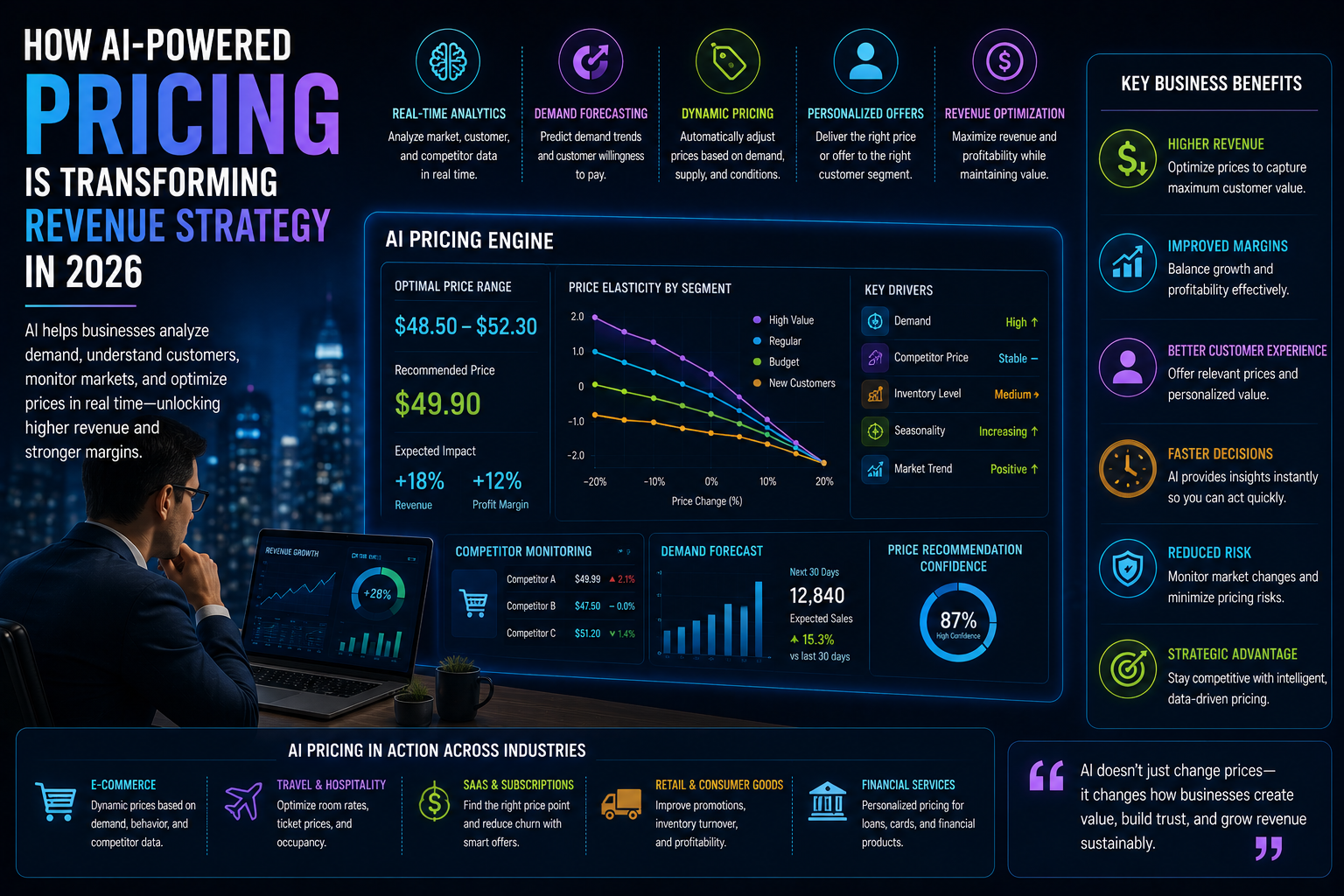
AI-powered pricing is transforming revenue strategy in 2026 by helping businesses analyze demand, understand customer behavior, monitor markets, optimize discounts, forecast future conditions, and protect profit margins.
The biggest opportunity is not simply changing prices more frequently. It is making pricing decisions more intelligent and closely connected to broader business objectives.
Organizations that combine AI analytics with strong data, responsible governance, and human judgment can create pricing strategies that are more responsive and efficient.
As markets become increasingly dynamic, businesses will need better tools to understand what customers value and how market conditions are changing.
AI can provide that intelligence.
The future of pricing will therefore not be about algorithms replacing business leaders. It will be about AI helping organizations make faster, more informed pricing decisions while keeping customer value, profitability, and trust at the center of the strategy.