
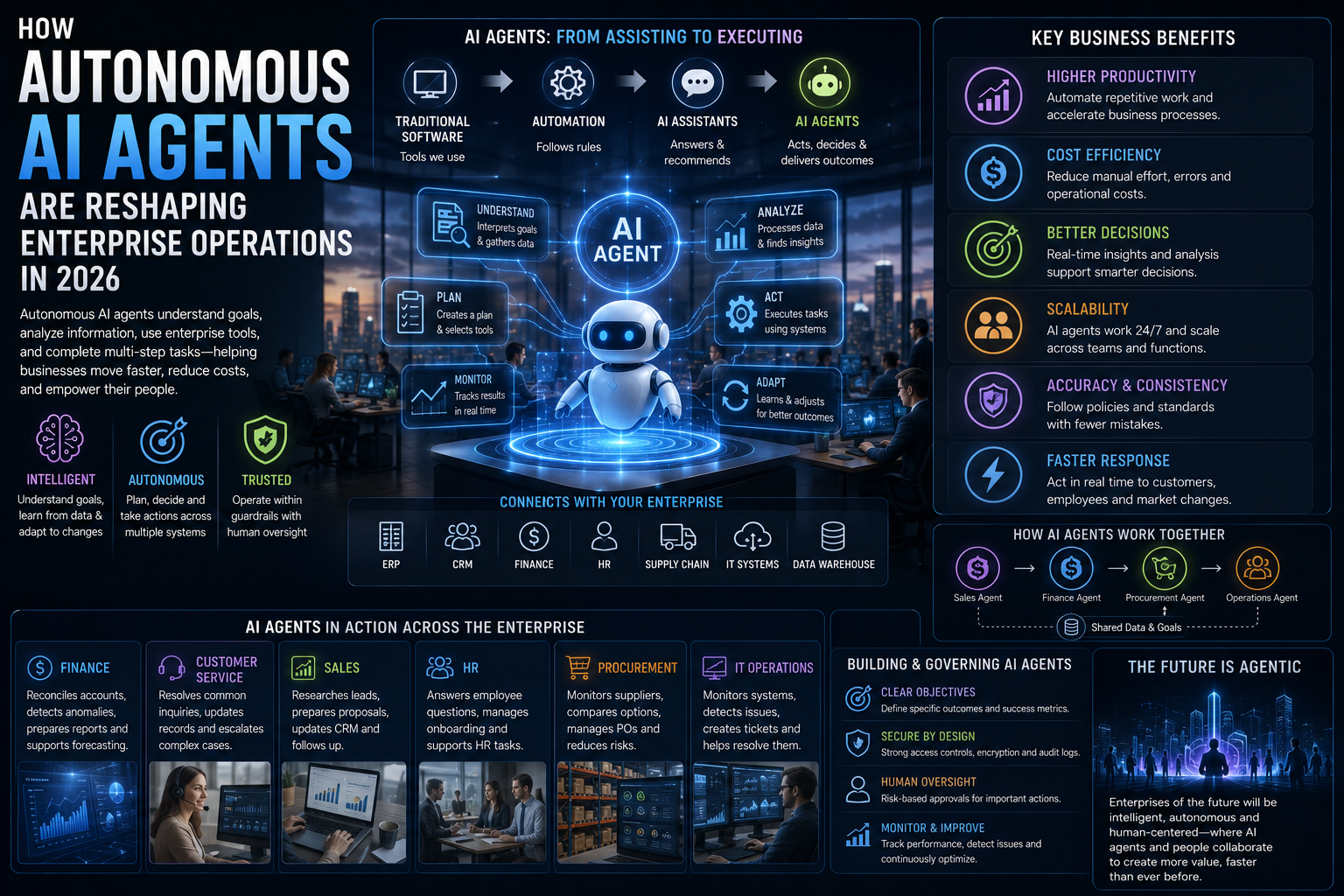
Artificial intelligence is moving beyond chatbots and simple digital assistants. In 2026, businesses are increasingly exploring autonomous AI agents that can understand objectives, analyze information, make recommendations, use software tools, and complete multi-step tasks with limited human intervention.
This represents an important shift in enterprise technology.
Traditional software waits for employees to provide instructions. Automation follows predefined rules. AI assistants respond to questions.
Autonomous AI agents can go further by taking a goal and determining a sequence of actions required to accomplish it.
For businesses, this could change how finance, sales, customer service, human resources, procurement, IT, and operations work.
The transition is not simply about replacing individual tasks. It is about creating organizations where intelligent software can continuously coordinate processes and support employees.
What Are Autonomous AI Agents?
An autonomous AI agent is a software system capable of pursuing a defined objective through multiple steps.
An agent may be able to:
Understand a business request
Gather relevant information
Analyze data
Use connected software
Make decisions within predefined limits
Complete tasks
Monitor results
Adjust its approach when conditions change
For example, a traditional automation system might send an invoice reminder every seven days.
An AI agent could examine customer history, payment status, previous communications, and account information before deciding what action should be taken.
It could prepare a personalized reminder, update the CRM, and escalate the account if necessary.
Human employees can remain involved when the decision has financial, legal, or strategic consequences.
From AI Assistants to AI Workers
The evolution of enterprise AI can be viewed as a progression.
First came software tools.
Then businesses adopted rule-based automation.
Generative AI introduced conversational assistants capable of producing content and answering questions.
Now autonomous agents are beginning to connect reasoning with action.
Instead of simply saying “Here is how you can complete this task,” an agent can potentially perform parts of the task itself.
This creates a new category of enterprise software: AI systems that operate as digital workers alongside human teams.
Why Businesses Are Interested
Organizations face growing pressure to improve productivity without increasing complexity.
Employees spend significant amounts of time on repetitive work, including data entry, reporting, scheduling, document processing, research, reconciliation, and internal communication.
Autonomous agents can potentially handle portions of these workflows.
The objective is not necessarily to eliminate employees.
Instead, businesses can shift human attention toward activities that require creativity, judgment, relationships, and strategic thinking.
AI Agents in Finance
Finance is one of the strongest potential applications.
An AI agent can monitor financial information, analyze transactions, prepare reports, identify anomalies, and support forecasting.
For example, a treasury agent could monitor cash positions and identify an upcoming liquidity requirement.
It could prepare a recommended transfer or financing option for human approval.
Similarly, an accounts-payable agent could review approved invoices, identify unusual payment requests, and prepare payments according to company policies.
This can reduce repetitive administrative work while maintaining appropriate controls.
AI Agents in Customer Service
Customer service involves many repetitive processes.
Customers ask common questions, request refunds, track orders, update account information, and seek technical assistance.
An AI agent can potentially handle straightforward requests by accessing approved company information and connected systems.
More complex cases can be transferred to human employees.
The agent can also summarize the customer's history before escalation, giving the employee the context needed to resolve the issue faster.
This creates a hybrid model in which AI handles routine interactions while humans focus on complex or sensitive cases.
AI Agents in Sales
Sales teams spend significant time researching prospects, preparing proposals, updating CRM systems, and following up with customers.
AI agents can automate parts of this workflow.
An agent could research an approved set of company information, summarize a prospect's business profile, identify relevant products, prepare a draft proposal, and update the CRM.
A salesperson can then review the information rather than starting from scratch.
This can reduce administrative work and give sales professionals more time for customer relationships.
AI Agents in Human Resources
Human resources departments manage large amounts of information.
Recruitment, employee onboarding, training, policies, benefits, and internal requests can all generate repetitive work.
An AI HR agent could answer employee questions using approved company policies.
It could help new employees find documents, understand procedures, or complete onboarding tasks.
Recruitment agents could potentially assist with scheduling and administrative coordination.
However, sensitive employment decisions should remain subject to appropriate human oversight.
Procurement and Supply Chains
Procurement involves suppliers, contracts, prices, purchase orders, inventory, and delivery schedules.
An AI agent can monitor these processes and identify changes that require attention.
For example, if a critical supplier's delivery performance begins to deteriorate, an agent could flag the issue and prepare alternative sourcing options.
A procurement agent could also compare approved suppliers based on predefined criteria.
This creates a more proactive procurement process.
Multi-Agent Enterprise Systems
The next stage may involve multiple AI agents working together.
Instead of one general-purpose agent handling every process, organizations can deploy specialized agents.
For example:
A finance agent manages financial workflows.
A sales agent manages customer opportunities.
A procurement agent monitors suppliers.
An HR agent handles employee services.
An operations agent monitors business processes.
These agents can potentially communicate through controlled enterprise systems.
A sales forecast could influence inventory planning.
Inventory requirements could influence procurement.
Procurement decisions could affect treasury requirements.
This creates the possibility of an interconnected multi-agent enterprise.
AI Agents and Business Intelligence
Agents can also change how executives interact with business information.
Traditional dashboards require managers to interpret charts and identify problems themselves.
An AI agent can continuously monitor approved business metrics.
If an important metric changes significantly, the agent can investigate the available information and prepare an explanation.
For example, instead of simply showing that sales declined, an agent could identify the regions where the decline occurred and summarize relevant customer or operational information.
The final decision remains with management, but the analytical process becomes faster.
Autonomous Software Development
AI agents are also beginning to influence software development.
Development agents can assist with code generation, testing, documentation, debugging, and project analysis.
An agent may be given a defined software task and use development tools to complete multiple steps.
Human developers can review the resulting work and approve changes.
This could accelerate development while allowing engineers to focus more on architecture, product decisions, security, and complex technical problems.
The Importance of Human Oversight
Autonomy does not mean unlimited independence.
Businesses need clear boundaries around what an AI agent can do.
A low-risk task such as organizing documents may be fully automated.
A financial transfer, contract modification, employee action, or security change may require human approval.
Organizations should establish authorization levels based on risk.
This creates a practical model:
AI acts within boundaries; humans control the boundaries.
AI Agent Security
Autonomous agents create new cybersecurity considerations.
An agent may have access to email, financial systems, customer records, databases, or enterprise applications.
If its credentials are compromised, an attacker could potentially use the agent's permissions.
Organizations therefore need strong identity and access controls.
Agent permissions should be limited to what is necessary.
Businesses should also monitor agent activity and maintain logs so actions can be investigated.
Preventing Agent Errors
AI systems can make incorrect decisions.
An autonomous agent may misunderstand a request, use outdated information, or select an inappropriate action.
Organizations should therefore introduce validation mechanisms.
Important actions can require confirmation.
Agents can also be restricted to approved data sources and tools.
Testing should occur in controlled environments before agents receive access to production systems.
The Role of Enterprise Data
Autonomous AI agents depend heavily on business data.
If an agent cannot access accurate information, its decisions may be unreliable.
Businesses need strong integration between AI systems and enterprise platforms such as:
CRM systems
ERP platforms
Accounting software
HR systems
Customer-service platforms
Supply-chain systems
Data warehouses
Data quality and permissions are therefore just as important as the AI model itself.
Measuring AI Agent Performance
Businesses should evaluate agents using measurable outcomes.
Important metrics can include:
Task completion rate
Error rate
Processing time
Cost per task
Human intervention rate
Customer satisfaction
Productivity improvements
Security incidents
Organizations should compare these metrics against the previous manual or automated process.
The purpose is to determine whether the agent creates genuine business value.
AI Agents and the Future Workforce
Autonomous AI agents will likely change job responsibilities.
Some repetitive tasks may increasingly be handled by software.
Employees may instead spend more time supervising AI systems, managing exceptions, developing strategies, and working directly with customers.
This does not mean every job will disappear.
Rather, many roles may evolve.
Employees will need to understand how to work with AI, verify its outputs, and manage increasingly automated workflows.
AI literacy could therefore become an important enterprise skill.
How Businesses Can Start
Companies should avoid trying to automate everything immediately.
A better approach is to identify one repetitive, measurable workflow.
For example:
Identify a high-volume process.
Define the desired business outcome.
Connect only the necessary data and tools.
Establish permissions and approval rules.
Test the agent in a controlled environment.
Measure performance.
Expand gradually.
This approach allows organizations to learn how agents behave before giving them broader responsibilities.
The Future of Enterprise Operations
The long-term potential of autonomous AI agents extends beyond individual departments.
Businesses could develop digital operating environments where agents continuously coordinate information and workflows.
An AI sales agent could identify a new opportunity.
A finance agent could evaluate commercial requirements.
A procurement agent could assess supplier availability.
An operations agent could determine capacity.
Humans could oversee the overall strategy and approve important decisions.
This creates an enterprise where intelligence is distributed throughout business processes.
Conclusion
Autonomous AI agents are becoming one of the most important developments in enterprise technology in 2026.
Unlike traditional automation, agents can potentially interpret objectives, reason through multiple steps, use business software, and adapt their actions based on changing information.
Their applications range from finance and customer service to sales, HR, procurement, software development, and operations.
However, successful adoption requires more than deploying an AI model.
Businesses need high-quality data, secure integrations, carefully defined permissions, human oversight, monitoring, and measurable performance objectives.
The strongest organizations will not simply give AI unlimited autonomy.
They will build controlled autonomy—allowing intelligent systems to handle appropriate tasks while ensuring humans remain responsible for important decisions.
As AI agents become more capable, enterprise software is likely to evolve from tools that employees operate into systems that actively participate in business processes.
The future enterprise may therefore look less like a collection of applications and more like an intelligent network of humans and digital agents working together.
In 2026, that transition is already beginning.