Industrial businesses are entering a new era of digital transformation. Manufacturing plants, energy facilities, logistics networks, construction projects, and complex infrastructure are becoming increasingly connected through sensors, cloud platforms, artificial intelligence, and automation.
One technology bringing these capabilities together is the digital twin.
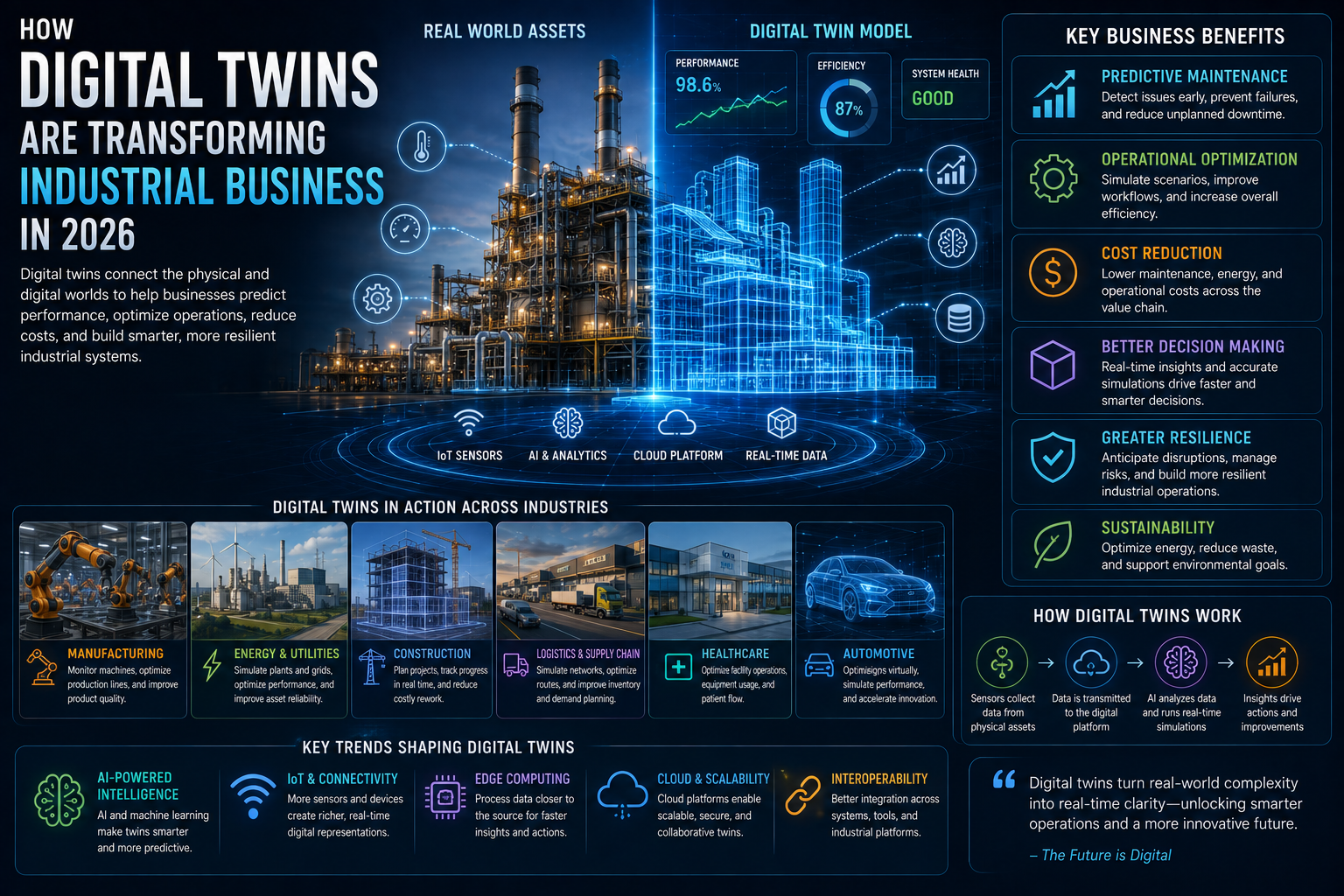
A digital twin is a virtual representation of a physical object, machine, process, or entire environment. It continuously uses real-world data to represent what is happening in the physical system and can help businesses analyze performance, identify problems, test scenarios, and make better decisions.
In 2026, digital twins are moving beyond basic visualization. When combined with AI, IoT, edge computing, and advanced analytics, they are becoming intelligent business tools capable of supporting predictive maintenance, operational optimization, product development, energy management, and strategic planning.
What Is a Digital Twin?
A digital twin is more than a traditional 3D model.
A 3D model primarily represents how something looks.
A digital twin can represent how something works.
For example, a manufacturer could create a digital twin of a production machine. Sensors attached to the physical machine can continuously provide information about temperature, vibration, energy consumption, operating speed, and other conditions.
The digital twin processes this information and provides a digital representation of the machine's current condition.
Businesses can then use this information to monitor performance and make decisions.
Why Digital Twins Matter in 2026
Industrial companies operate complex environments where even small problems can create significant costs.
A machine failure can stop production.
A poorly optimized factory can consume unnecessary energy.
A design error can create expensive rework.
A logistics bottleneck can delay deliveries.
Digital twins give organizations a way to understand these systems before problems become more serious.
Instead of relying only on historical reports, businesses can develop a more dynamic view of their operations.
Digital Twins and Artificial Intelligence
AI is making digital twins considerably more powerful.
A basic digital twin can show what is happening.
An AI-powered digital twin can potentially explain why it is happening and what might happen next.
Machine-learning models can analyze historical and real-time information to identify patterns.
For example, if a machine's vibration gradually changes, AI could identify the pattern as potentially associated with future equipment failure.
The digital twin can then simulate possible outcomes and help maintenance teams determine an appropriate response.
This combination of digital representation and predictive intelligence is becoming one of the most important developments in industrial technology.
Predictive Maintenance
Predictive maintenance is one of the strongest applications for digital twins.
Traditional maintenance often follows fixed schedules.
A machine may be serviced every few months regardless of its actual condition.
This can result in unnecessary maintenance or unexpected failures between scheduled inspections.
Digital twins can use sensor information to monitor equipment continuously.
AI can analyze the data and identify signs of deterioration.
Maintenance teams can then investigate equipment that shows meaningful warning signals.
The goal is not simply to predict failures.
It is to optimize maintenance timing while reducing downtime and unnecessary costs.
Reducing Unplanned Downtime
Unexpected equipment failure can be extremely expensive.
Production may stop.
Employees may be unable to work.
Orders can be delayed.
Emergency repairs may cost more than planned maintenance.
Digital twins can help companies identify potential problems earlier.
A virtual representation of the machine can continuously compare current performance with expected operating conditions.
When significant deviations appear, the system can alert relevant teams.
This can give businesses more time to investigate and respond.
Optimizing Manufacturing
Manufacturing environments contain many interconnected processes.
Changing one part of a production line can influence other operations.
Digital twins allow businesses to model these relationships.
A company can create a virtual representation of its production environment and experiment with different configurations.
For example, managers could evaluate whether changing the sequence of manufacturing operations would improve throughput.
They can test the scenario digitally before making changes to the physical factory.
This reduces the risk associated with experimentation.
Digital Twins and Smart Factories
Digital twins are an important component of smart manufacturing.
A smart factory combines connected machines, sensors, software, analytics, automation, and AI.
The digital twin provides a digital layer through which these systems can be understood.
Managers can monitor production in real time.
AI can identify anomalies.
Automation systems can respond to predefined conditions.
Engineers can simulate potential changes.
Together, these capabilities can create more responsive manufacturing environments.
Product Development
Digital twins can also change how products are designed.
Traditional product development often requires multiple physical prototypes.
These prototypes can be expensive and time-consuming.
A digital twin allows engineers to simulate how a product might behave under different conditions.
They can test design changes virtually.
For example, an automotive manufacturer could simulate how different components perform under various operating conditions.
A manufacturer of industrial equipment could test stress, temperature, or vibration scenarios digitally.
Physical prototypes may still be necessary, but digital simulation can reduce the number of iterations required.
Digital Twins in Construction
Construction companies can use digital twins to connect digital building models with physical environments.
A building can be represented digitally during design and construction.
As the project develops, information can be added to the digital representation.
This can help project teams track progress and identify potential problems.
After construction, the digital twin can continue to provide value by supporting building operations, maintenance, and energy management.
This creates a digital lifecycle extending beyond the construction phase.
Energy Management
Energy-intensive industries are under increasing pressure to improve efficiency.
Digital twins can help businesses understand where energy is being consumed.
Sensors can provide information about equipment and facility conditions.
AI can analyze the information and identify inefficient operating patterns.
Companies can then simulate alternative configurations.
For example, a factory could evaluate how changes in equipment schedules or temperature controls might affect energy consumption.
This can support both cost reduction and sustainability goals.
Digital Twins in Logistics
Supply chains are increasingly complex.
Companies need to coordinate warehouses, transportation, inventory, suppliers, and customer demand.
A digital twin can represent parts of this network.
Businesses can use simulations to explore different scenarios.
For example:
What happens if a warehouse reaches capacity?
What happens if transportation is delayed?
What happens if customer demand increases?
What happens if a supplier becomes unavailable?
AI can analyze the potential outcomes and help managers identify alternative strategies.
Improving Inventory Decisions
Inventory management requires a balance.
Too little inventory can create shortages.
Too much inventory increases storage costs and ties up capital.
Digital twins can help businesses simulate inventory scenarios.
When combined with AI forecasting, the system can evaluate demand patterns, supplier reliability, production capacity, and warehouse conditions.
This creates a more complete view of inventory requirements.
The result can be more informed decisions about stock levels and replenishment.
Digital Twins and Healthcare
Digital-twin technology is also being explored in healthcare.
Hospitals can create digital representations of facilities and operational systems.
These models can help analyze patient flows, equipment usage, staffing, and facility capacity.
At a more advanced level, digital modeling can also support research into personalized medical applications.
Healthcare use cases require especially strong privacy, security, safety, and regulatory controls.
However, the broader principle remains the same: creating a digital representation can help organizations understand complex real-world systems.
Real-Time Monitoring
One of the major advantages of digital twins is continuous monitoring.
Traditional business reports often provide periodic snapshots.
A digital twin can potentially provide a more current view of an asset or process.
This is particularly valuable in environments where conditions change quickly.
Factories, power facilities, logistics operations, and large buildings can use real-time information to monitor performance.
When connected to AI, these systems can also prioritize the most important changes.
Edge Computing and Digital Twins
Not all digital-twin information needs to travel to a centralized cloud platform.
Edge computing allows data processing closer to the physical equipment.
This can reduce latency and support faster responses.
For example, an industrial machine may need immediate analysis of sensor data.
An edge system can process the information locally and communicate important results to the wider digital-twin platform.
This combination of IoT + edge computing + AI + digital twins can support highly responsive industrial systems.
Digital Twins and Autonomous Operations
The future of digital twins could involve increasingly autonomous decision-making.
An AI system could monitor a digital twin, identify a problem, simulate several possible responses, and recommend the best option.
In tightly controlled situations, an automated system might even execute predefined actions.
For example, if a machine begins operating outside safe parameters, an automated system could reduce its operating speed or initiate a controlled shutdown.
High-impact decisions should still use appropriate human oversight and safety controls.
The Role of IoT Sensors
Internet of Things devices provide much of the information that makes digital twins useful.
Sensors can measure:
Temperature
Pressure
Vibration
Energy consumption
Location
Humidity
Machine performance
Equipment status
The quality of a digital twin depends heavily on the quality of the information it receives.
Poor sensor data can lead to inaccurate conclusions.
Businesses therefore need reliable devices, data-management processes, and appropriate monitoring.
Cybersecurity Challenges
Digital twins connect physical systems with digital infrastructure.
That creates cybersecurity risks.
If attackers gain unauthorized access to an industrial digital-twin environment, the consequences could potentially extend beyond data theft.
Connected systems may influence physical operations.
Businesses therefore need strong authentication, network segmentation, encryption, access controls, monitoring, and incident-response procedures.
Security must be built into digital-twin architecture from the beginning.
The Business Value of Digital Twins
Companies should evaluate digital twins based on measurable business outcomes.
Potential benefits include:
Lower equipment downtime
Improved productivity
Reduced maintenance costs
Better energy efficiency
Faster product development
Improved quality control
Better inventory management
More accurate forecasting
Safer operations
Faster decision-making
The technology itself is not the objective.
The objective is better business performance.
Challenges to Adoption
Despite their potential, digital twins can be complex to implement.
Businesses may need to invest in:
Sensors and IoT infrastructure
Data platforms
Cloud or edge computing
AI models
3D modeling
System integration
Cybersecurity
Employee training
Data fragmentation can also be a challenge.
A digital twin may need information from enterprise software, machines, sensors, maintenance systems, and external platforms.
Organizations should therefore begin with a clearly defined use case.
How Businesses Can Start
A practical digital-twin strategy can begin with one important asset or process.
For example, a manufacturer could start with its most critical production machine.
The company can:
Identify the asset and business problem.
Install or connect appropriate sensors.
Build the digital representation.
Connect operational data.
Add analytics and AI.
Measure performance improvements.
Expand the system after proving value.
This approach reduces implementation risk and makes the business case easier to evaluate.
The Future of Digital Twins
Digital twins are likely to become increasingly intelligent.
Future systems will not simply reproduce physical environments.
They will understand patterns, simulate potential outcomes, and support automated decisions.
AI agents could interact with digital twins continuously.
A factory's digital twin could identify production bottlenecks.
An AI system could test potential solutions.
A human manager could approve the preferred strategy.
The physical factory could then be adjusted accordingly.
This creates a continuous cycle between the physical and digital worlds.
Conclusion
Digital twins are becoming a powerful foundation for industrial transformation in 2026.
By creating dynamic digital representations of machines, facilities, products, and processes, businesses can gain greater visibility into how their operations perform.
When digital twins are combined with AI, IoT, edge computing, and automation, they can support predictive maintenance, manufacturing optimization, energy management, logistics planning, product development, and intelligent decision-making.
The technology does require investment and careful planning.
Businesses need reliable data, secure infrastructure, appropriate integrations, and employees who understand how to use the technology effectively.
But the potential value is significant.
The industrial organizations of the future will increasingly operate in two connected environments:
the physical world where products and machines operate, and the digital world where those operations can be analyzed, simulated, and optimized.
Digital twins provide the bridge between them.
In 2026, that bridge is becoming more intelligent, more connected, and more valuable—and companies that learn to use it effectively could gain a significant advantage in productivity, efficiency, resilience, and innovation.