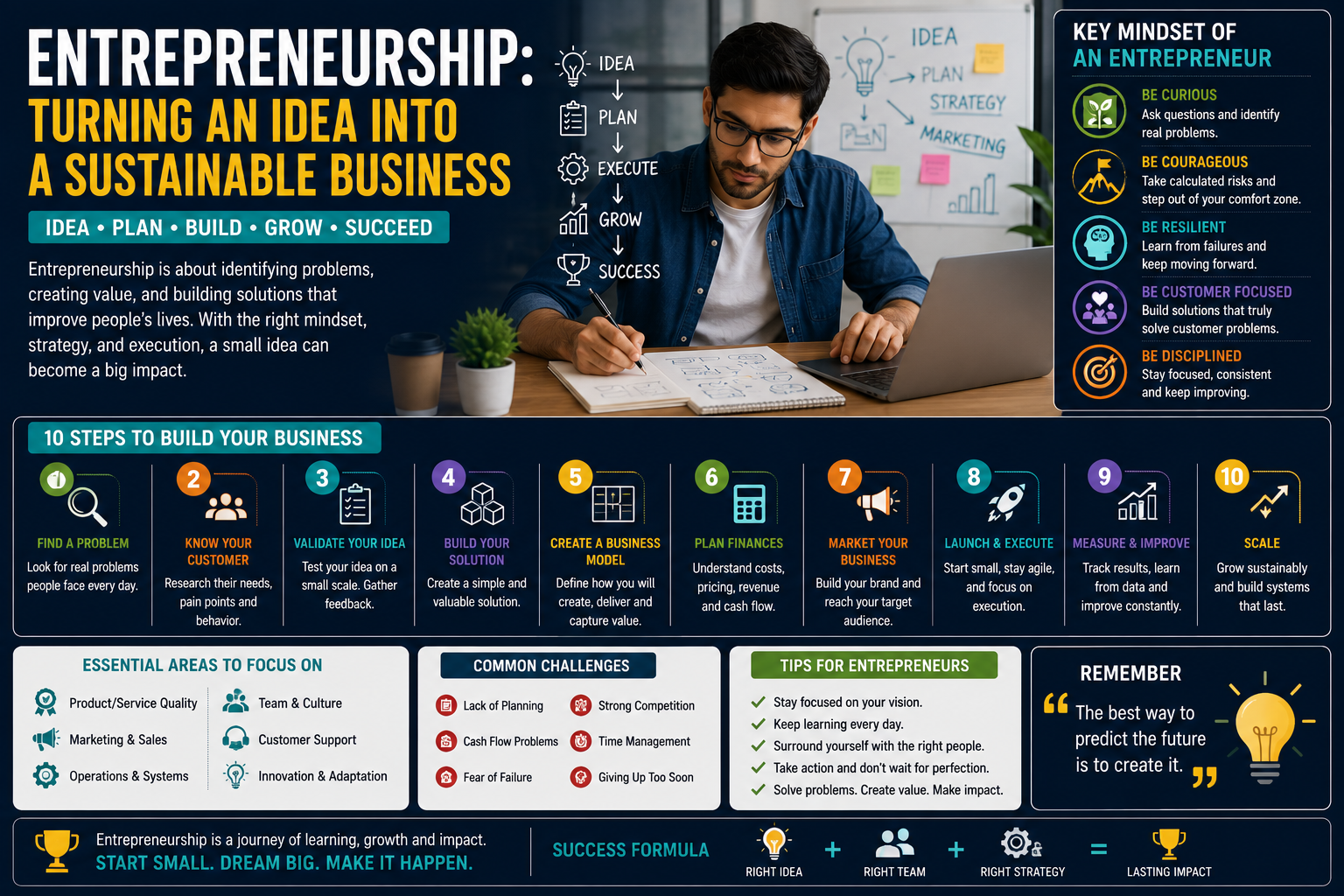
Entrepreneurship begins with an idea, but a successful business requires much more than a good idea.
Every day, people identify problems that could be solved through better products, services, technology, or business models. Some turn those ideas into successful companies, while others discover that an idea needs significant improvement before it can become a viable business.
The difference often comes down to execution.
Entrepreneurs need to understand customers, test assumptions, manage finances, build teams, use technology effectively, and adapt when circumstances change.
Building a sustainable business is a journey that combines creativity with planning, risk-taking with research, and ambition with discipline.
What Is Entrepreneurship?
Entrepreneurship is the process of identifying an opportunity and creating an organization, product, or service to address it.
Entrepreneurs can operate in many areas, including:
Technology
Retail
Finance
Education
Healthcare
Real estate
Media
Professional services
Manufacturing
E-commerce
Entrepreneurship isn't limited to launching a large company.
A freelancer, consultant, small-business owner, or independent creator can also be an entrepreneur.
Start With a Real Problem
One of the strongest foundations for a business is solving a genuine problem.
Instead of asking:
"What business should I start?"
consider asking:
"What problem can I solve?"
Customers are more likely to pay for solutions that make something easier, faster, safer, cheaper, or more convenient.
A strong business idea usually begins with understanding a real need.
Understand Your Customer
Knowing who the customer is can be more important than the original idea.
Entrepreneurs should understand:
Who needs the solution?
What problem are they experiencing?
How are they solving it today?
What alternatives are available?
What would make them change?
How much value does the solution provide?
Customer research can include interviews, surveys, online research, competitor analysis, and early product testing.
The objective is to replace assumptions with evidence.
Study the Competition
Almost every valuable market has competition.
Competition isn't necessarily a reason to abandon an idea.
Instead, it can provide useful information.
Study competitors to understand:
What they offer
Who they serve
How they price products
What customers like
What customers dislike
Where gaps may exist
The goal isn't always to eliminate competition.
It is to identify an opportunity to provide something better or different.
Define Your Value Proposition
A value proposition explains why customers should choose your product or service.
It should answer a simple question:
Why is this solution valuable?
The answer might involve:
Lower cost
Better quality
Greater convenience
Faster service
Specialized expertise
Better technology
Improved customer experience
A clear value proposition makes it easier to communicate the purpose of a business.
Start Small and Test
Entrepreneurs don't always need to build the complete version of a product immediately.
A small test can provide valuable information.
This might involve:
A prototype
A basic website
A pilot service
A limited product launch
A small customer group
The objective is to learn before making a large investment.
Early feedback can reveal problems that were difficult to see from the original idea.
The Importance of Customer Feedback
Customers provide some of the most useful information an entrepreneur can receive.
Feedback can reveal:
Missing features
Pricing concerns
Usability problems
Service issues
New opportunities
Entrepreneurs should listen carefully without automatically implementing every suggestion.
The goal is to identify patterns and understand the underlying problem.
Create a Business Model
A business model explains how a company creates and captures value.
Important questions include:
Who are the customers?
What are they buying?
How will they find the business?
How will the business make money?
What will it cost to deliver the product or service?
Different businesses may use different models, such as:
Direct sales
Subscriptions
Advertising
Licensing
Marketplaces
Service fees
E-commerce
Consulting
A great product still needs a sustainable business model.
Understand Revenue and Costs
Entrepreneurs need basic financial knowledge.
Revenue is the money generated from selling products or services.
Costs are the resources required to operate the business.
These can include:
Employees
Technology
Marketing
Rent
Inventory
Production
Software
Logistics
Professional services
Understanding these numbers helps entrepreneurs determine whether the business can become financially sustainable.
Manage Cash Flow
Profit and cash flow are not the same thing.
A business may have strong sales but still experience financial pressure if customers pay late while expenses must be paid immediately.
Entrepreneurs should monitor:
Money coming in
Money going out
Payment timing
Operating expenses
Cash reserves
Good cash-flow management can help a business survive periods of uncertainty.
Build a Strong Brand
A brand is more than a logo.
It represents how customers perceive a business.
A strong brand can communicate:
Quality
Reliability
Expertise
Personality
Values
Customer experience
Consistency matters.
The business name, website, communication, packaging, service, and customer interactions should create a coherent experience.
Use Digital Marketing
Digital platforms have made it easier for small businesses to reach customers.
Entrepreneurs can use:
Search engines
Social media
Email
Content marketing
Online communities
Digital advertising
Websites
The best marketing strategy depends on where the target customers spend their time.
Marketing should focus on communicating value rather than simply promoting a product repeatedly.
Technology Can Help Small Businesses
Modern technology allows entrepreneurs to accomplish tasks that previously required larger teams.
Cloud software can support collaboration.
Automation can reduce repetitive work.
Analytics can provide customer insights.
AI can assist with research, content creation, customer support, and administrative workflows.
Technology can therefore help entrepreneurs operate more efficiently.
However, technology should support the business strategy rather than become a distraction.
Artificial Intelligence and Entrepreneurship
AI is creating new opportunities for entrepreneurs.
Small teams can use AI tools to assist with:
Market research
Content creation
Customer support
Data analysis
Product development
Workflow automation
Brainstorming
This can reduce the time required for certain tasks.
But AI-generated work still needs human review.
Entrepreneurs remain responsible for accuracy, quality, privacy, and customer trust.
Build the Right Team
A business eventually depends on people.
Entrepreneurs should look for team members who bring complementary skills.
A company may need expertise in:
Product development
Marketing
Sales
Finance
Operations
Technology
Customer service
Hiring isn't simply about filling positions.
It is about building capabilities the business needs to grow.
Leadership Matters
Entrepreneurs become leaders as their organizations grow.
Leadership requires more than having an idea.
Entrepreneurs need to:
Communicate clearly
Make decisions
Set priorities
Delegate
Resolve conflicts
Develop employees
Accept responsibility
The founder's behavior can strongly influence company culture.
Learn to Delegate
Many entrepreneurs struggle with delegation.
When a company is small, the founder may handle almost everything.
As the business grows, this approach becomes difficult to sustain.
Delegation allows entrepreneurs to focus on high-value activities while giving employees opportunities to take ownership.
Effective delegation requires clear expectations and appropriate accountability.
Take Calculated Risks
Entrepreneurship involves risk.
But successful entrepreneurs don't necessarily take the biggest risks.
They learn how to manage risk.
Before making a major decision, consider:
Potential benefit
Potential loss
Probability of different outcomes
Available resources
Alternative options
Ability to recover from failure
A calculated risk is different from an impulsive gamble.
Learn From Failure
Not every business idea will succeed.
A product may fail to attract customers.
A marketing strategy may produce weak results.
A partnership may not work.
An entrepreneur may make a financial mistake.
These experiences can provide valuable lessons if the entrepreneur analyzes what happened.
The important question isn't only:
"Did we fail?"
It is:
"What did we learn?"
Adapt When Necessary
Successful businesses rarely remain exactly the same.
Customer needs change.
Competitors change.
Technology changes.
Economic conditions change.
Entrepreneurs need to recognize when their strategy should evolve.
Adaptability can involve changing pricing, improving a product, entering a new market, adjusting marketing, or changing internal processes.
Build Customer Trust
Trust is essential for long-term business success.
Customers want to know that a company will:
Deliver what it promises
Protect their information
Respond to problems
Communicate honestly
Provide reliable service
A single transaction may generate revenue.
Trust can generate repeat business and referrals.
Focus on Customer Retention
Finding new customers can require significant effort.
Keeping existing customers can therefore be extremely valuable.
Businesses can improve retention by providing:
Reliable products
Good customer service
Consistent communication
Personalized experiences
Responsive support
Customer retention should be part of the business strategy from the beginning.
Scale Carefully
Growth sounds attractive, but rapid expansion can create problems.
A company may grow faster than its:
Cash flow
Team
Technology
Operations
Customer support
Before scaling, entrepreneurs should make sure the underlying business model can handle greater demand.
Sustainable growth is often better than growth that creates operational instability.
Entrepreneurship and Resilience
Building a business can involve uncertainty.
Resilient entrepreneurs prepare for challenges rather than assuming everything will go according to plan.
Resilience can involve:
Maintaining financial discipline
Building strong relationships
Learning continuously
Keeping customers close
Developing multiple capabilities
Having contingency plans
Resilience helps businesses respond to unexpected problems.
Networking and Mentorship
Entrepreneurs don't have to build businesses alone.
Professional networks can provide:
Advice
Partnerships
Customers
Employees
Investors
Mentors
Industry knowledge
Mentors can provide perspective based on experience.
A strong network can become an important source of opportunities and support.
Continuous Learning
Entrepreneurship requires learning across multiple areas.
Founders may need to understand:
Finance
Marketing
Leadership
Technology
Sales
Operations
Customer behavior
No entrepreneur needs to know everything.
But successful founders recognize what they don't know and find people or resources that can fill those gaps.
Building a Sustainable Business
A sustainable business should be designed to create value over the long term.
That means balancing:
Customer needs
Employee capabilities
Financial health
Operational efficiency
Innovation
Responsible growth
Short-term revenue can be important, but long-term sustainability requires a strong foundation.
A Practical Entrepreneurship Framework
A simple process for developing a business idea is:
Identify → Research → Test → Learn → Improve → Launch → Measure → Adapt
Identify a meaningful problem.
Research customers and competitors.
Test the solution.
Learn from feedback.
Improve the offering.
Launch more broadly when appropriate.
Measure results.
Adapt based on evidence.
This cycle can continue throughout the life of the business.
The Future of Entrepreneurship
Technology is making entrepreneurship more accessible.
Individuals can reach global customers, create digital products, operate online businesses, and use automation to manage tasks that once required larger teams.
AI may further reduce barriers to experimentation and business creation.
But technology alone cannot guarantee success.
The fundamentals remain the same:
Solve a real problem.
Create genuine value.
Understand customers.
Manage money carefully.
Build trust.
Adapt continuously.
Final Thoughts
Entrepreneurship is not simply about having a great idea.
It is about turning an idea into something people genuinely value.
Successful entrepreneurs combine creativity with research, ambition with financial discipline, and innovation with execution.
They listen to customers, test assumptions, learn from mistakes, build capable teams, use technology strategically, and adapt when circumstances change.
The journey can be challenging, but it can also create opportunities for independence, innovation, employment, and long-term value.
A business doesn't become sustainable because everything goes according to plan.
It becomes sustainable because its founders are willing to learn, improve, adapt, and keep solving meaningful problems.
A great idea starts a business. Great execution builds it.