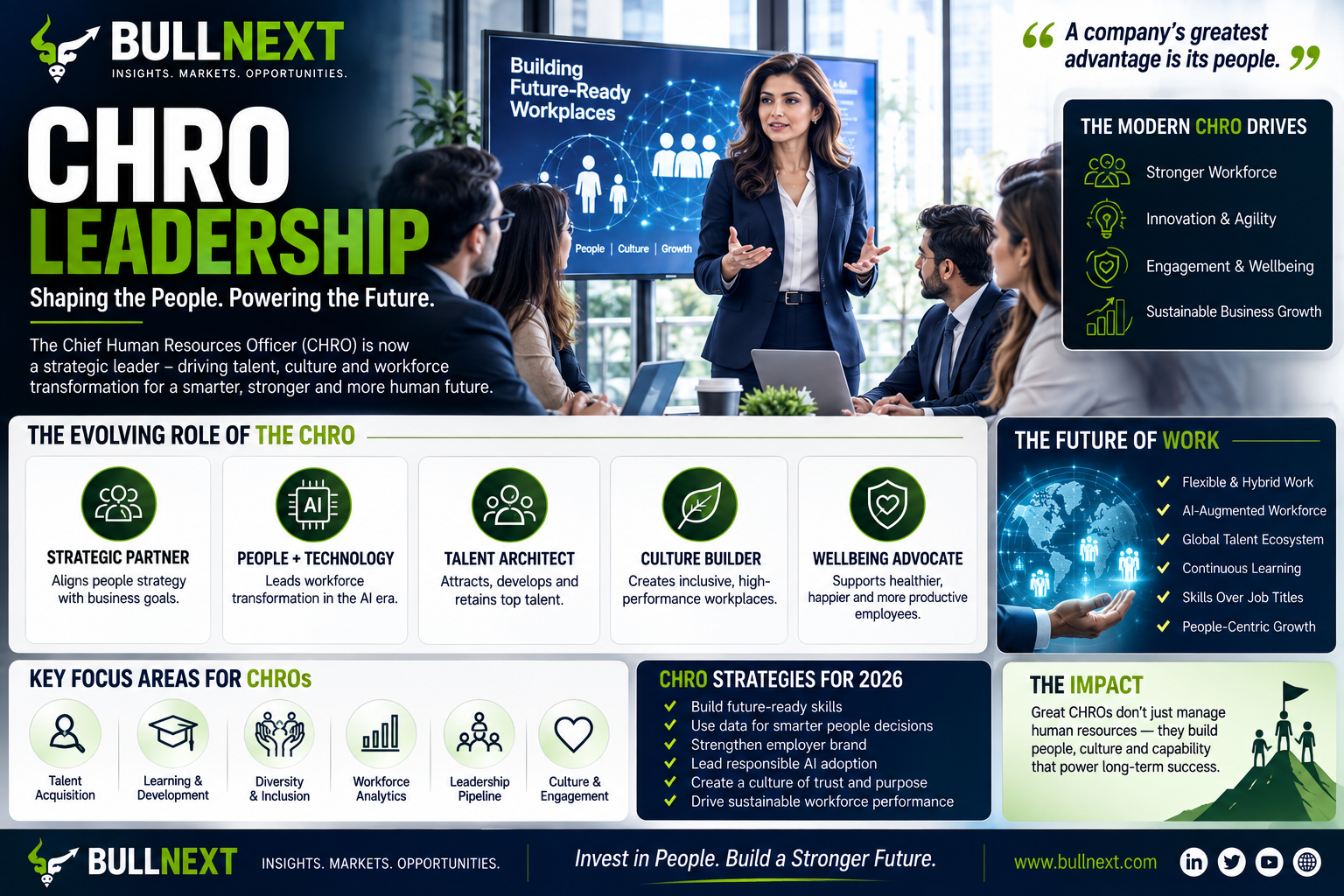
The role of the Chief Human Resources Officer (CHRO) has evolved far beyond traditional human resources. In today's business environment, CHROs are increasingly involved in executive strategy, workforce planning, artificial intelligence, company culture, employee experience, leadership development, and organizational transformation.
As businesses adapt to new technologies and changing employee expectations, the CHRO has become an important strategic partner to the CEO and the wider C-suite.
Modern organizations need more than talented employees. They need the right people, the right skills, the right culture, and a clear strategy for developing their workforce.
That makes the CHRO's role increasingly important in building organizations that can adapt and grow.
What Is a CHRO?
CHRO stands for Chief Human Resources Officer.
The CHRO is typically the senior executive responsible for an organization's people and workforce strategy.
Traditional HR responsibilities can include:
Recruitment
Employee relations
Compensation
Benefits
Training
Performance management
Workplace policies
Talent development
However, the modern CHRO often has broader responsibilities involving business strategy and organizational transformation.
Today's CHRO may help determine:
Which skills the organization needs
How technology will change jobs
How to attract top talent
How to retain employees
How to build leadership pipelines
How to create a strong company culture
How to prepare employees for AI
How to improve employee productivity
This makes the CHRO a strategic business leader rather than simply an HR administrator.
The CHRO as a Strategic Partner
One of the biggest changes in the CHRO role is the increasing connection between people strategy and business strategy.
A company cannot execute its growth plans without the right workforce.
For example, if a company wants to expand internationally, the CHRO may need to help develop a hiring strategy, identify leadership talent, understand local workforce markets, and build an organizational structure capable of supporting expansion.
If a company wants to introduce AI automation, the CHRO needs to understand how jobs and skills will change.
The people strategy must therefore support the company's overall strategy.
AI Is Transforming Human Resources
Artificial intelligence is becoming an important topic for CHROs.
Companies are exploring AI for:
Recruitment
Resume screening
Employee support
Training
Workforce analytics
Scheduling
Performance analysis
Internal communications
HR administration
Skills development
AI can reduce repetitive administrative work and help HR teams process information more efficiently.
However, AI also creates new responsibilities for CHROs.
Leaders need to consider fairness, privacy, transparency, employee trust, and appropriate human oversight when introducing AI into workplace decisions.
The goal shouldn't simply be to automate HR.
The goal should be to use technology to create a better employee and business experience.
The Future of Work
The workplace continues to evolve.
Many organizations now use combinations of:
Office work
Remote work
Hybrid work
Flexible schedules
Global teams
Freelancers
Contractors
This creates new challenges for CHROs.
How do you maintain company culture when employees work from different locations?
How do you develop junior employees remotely?
How do managers measure performance fairly?
How do organizations create collaboration between distributed teams?
These questions require more than HR policies.
They require thoughtful leadership and organizational design.
Talent Acquisition
Finding the right employees remains one of the CHRO's most important responsibilities.
Companies compete for talent across industries and geographical boundaries.
A strong talent strategy begins by identifying the skills that matter most.
Instead of hiring simply based on job titles, organizations can focus on capabilities.
For example:
Technology skills
Leadership skills
Communication
Problem-solving
Data analysis
Creativity
Industry expertise
This approach can help organizations build teams capable of adapting as business needs change.
Employee Retention
Hiring talented people is only half the challenge.
Organizations also need to keep them.
Employees may leave because of:
Limited career growth
Poor management
Lack of recognition
Inadequate compensation
Weak company culture
Burnout
Limited flexibility
Better opportunities elsewhere
CHROs need to understand why employees stay and why they leave.
Employee surveys, conversations, performance data, and exit interviews can provide useful information.
But data should be combined with human understanding.
An employee is more than a number in an HR dashboard.
Building Company Culture
Company culture influences how people work, communicate, collaborate, and make decisions.
A strong culture doesn't happen automatically.
It is shaped by leadership behavior, company values, management practices, hiring decisions, communication, and employee experiences.
The CHRO plays an important role in helping organizations build cultures that support their strategic objectives.
For example, a technology company may need a culture that encourages experimentation and innovation.
A financial organization may place greater emphasis on risk management, accuracy, and accountability.
Culture should therefore reflect what the organization needs to succeed.
Leadership Development
Organizations need leaders at every level.
A CHRO can help create leadership-development programs that prepare employees for greater responsibility.
This can include:
Mentoring
Coaching
Management training
Executive education
Leadership workshops
Cross-functional assignments
Succession planning
Developing internal leaders can also reduce dependence on external hiring for senior positions.
A strong leadership pipeline gives organizations greater resilience when executives change roles or leave the company.
Succession Planning
Succession planning is another important CHRO responsibility.
Companies need to prepare for leadership changes before they happen.
A succession strategy can identify employees who have the potential to move into important positions and provide them with the experience and development needed to succeed.
This applies not only to CEOs.
Organizations should consider succession planning for critical leadership and specialist roles throughout the business.
The CHRO and Employee Experience
Employee experience encompasses the entire journey of an employee within an organization.
It begins before hiring and continues through onboarding, development, promotion, and eventually departure.
Important stages include:
Recruitment → Onboarding → Development → Performance → Growth → Leadership → Transition
Each stage influences how employees perceive the organization.
Technology can improve many parts of this journey, but human interaction remains critical.
A sophisticated HR platform cannot compensate for poor management.
Workforce Analytics
Data is becoming increasingly important in HR.
Workforce analytics can help organizations understand:
Employee turnover
Hiring trends
Skills gaps
Workforce costs
Productivity
Training outcomes
Engagement
Internal mobility
The challenge is turning information into useful decisions.
A dashboard showing high employee turnover is only the beginning.
The CHRO needs to determine:
Why are employees leaving?
Which departments are affected?
Are managers contributing to the problem?
Are compensation levels competitive?
Are employees seeing opportunities for growth?
Good workforce analytics should lead to action.
CHRO and the CFO
The relationship between the CHRO and CFO is becoming increasingly important.
Employees represent one of the largest investments for many organizations.
The CFO focuses on financial performance and costs.
The CHRO focuses on people, skills, culture, and workforce strategy.
Together, they can evaluate:
Workforce budgets
Compensation
Benefits
Hiring plans
Training investments
Productivity
AI automation
Organizational restructuring
The goal should not simply be to reduce employee costs.
It should be to maximize the value created by the workforce while maintaining a healthy and sustainable organization.
CHRO and the CEO
The CHRO is increasingly becoming a close strategic partner to the CEO.
The CEO asks:
Where should the company go?
The CHRO helps answer:
Do we have the people and capabilities to get there?
If the company wants to enter a new market, introduce a new technology, acquire another company, or dramatically increase growth, workforce strategy becomes essential.
This makes the CHRO's role directly connected to long-term business performance.
Employee Skills in the AI Era
AI is changing the skills employees need.
Some repetitive tasks may become automated, while new responsibilities emerge.
Employees may increasingly need:
AI literacy
Data skills
Critical thinking
Creativity
Communication
Problem-solving
Adaptability
Collaboration
CHROs can help organizations identify these emerging skills and create programs to develop them.
The future workforce may not be about humans competing against AI.
It may be about people who know how to work effectively with AI outperforming those who don't.
Reskilling and Upskilling
Organizations can't always solve skills shortages through external hiring.
Sometimes the best solution is developing existing employees.
Upskilling helps employees become better at their current roles.
Reskilling prepares employees for different responsibilities.
For example, an employee whose administrative workload is reduced through automation could potentially be trained for analytical, customer-facing, or technology-supported responsibilities.
This can help businesses retain valuable institutional knowledge while preparing their workforce for change.
Diversity of Thought
Strong organizations benefit from different perspectives.
A workforce containing people with different professional experiences, educational backgrounds, skills, and perspectives can help organizations identify opportunities and challenge assumptions.
For CHROs, creating inclusive environments can therefore be part of broader organizational performance.
The objective is to create workplaces where employees can contribute effectively and where decisions benefit from diverse perspectives.
Mental Wellbeing and Sustainable Performance
Modern workforce strategy also requires attention to sustainable performance.
Organizations that continuously demand maximum output without considering workload and employee wellbeing may eventually face burnout, disengagement, and turnover.
CHROs can help organizations develop healthier approaches to:
Workload
Flexibility
Time management
Manager training
Employee support
Workplace communication
The objective isn't simply to make employees work harder.
It is to create an environment where people can perform effectively over the long term.
The Future CHRO
The CHRO of the future will likely be part strategist, part technology leader, part organizational psychologist, and part business advisor.
Successful CHROs will need to understand:
People
Technology
Business
Data
Culture
Leadership
Change
This broader skill set reflects the increasing importance of people strategy in business performance.
Final Thoughts
The modern CHRO is no longer simply the executive responsible for HR administration.
The role has become increasingly strategic, connecting people, technology, culture, leadership, and business growth.
As organizations adopt AI, restructure their workforces, compete for talent, and adapt to changing employee expectations, CHROs will play a critical role in determining how successfully companies navigate the future.
The strongest CHROs will understand that technology doesn't eliminate the importance of people.
It makes effective people leadership even more important.
AI can automate tasks.
Data can reveal patterns.
Software can improve processes.
But people create ideas, build relationships, lead teams, solve complex problems, and shape organizational culture.
The future of work will therefore not be defined by technology alone.
It will be defined by how effectively people and technology work together.