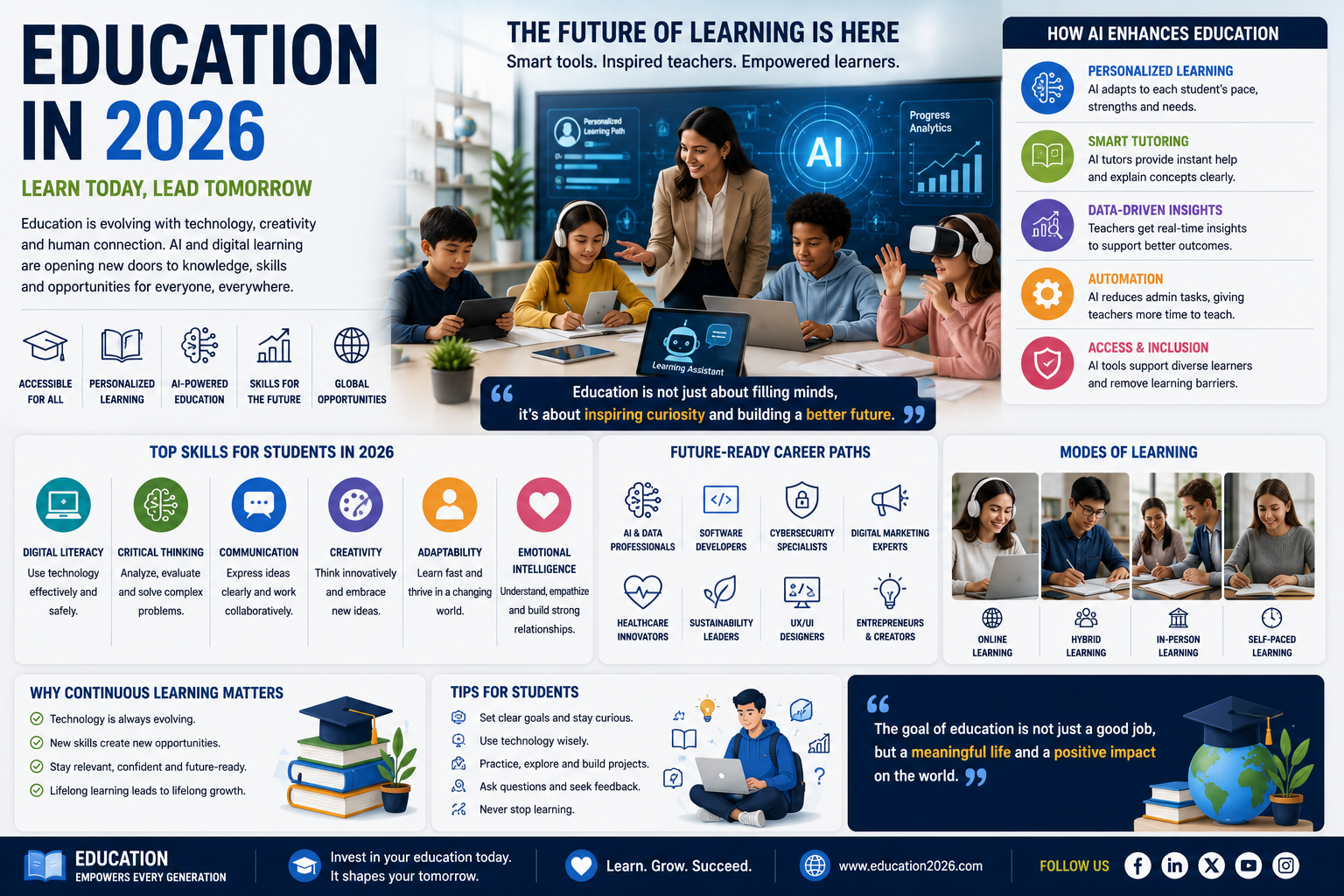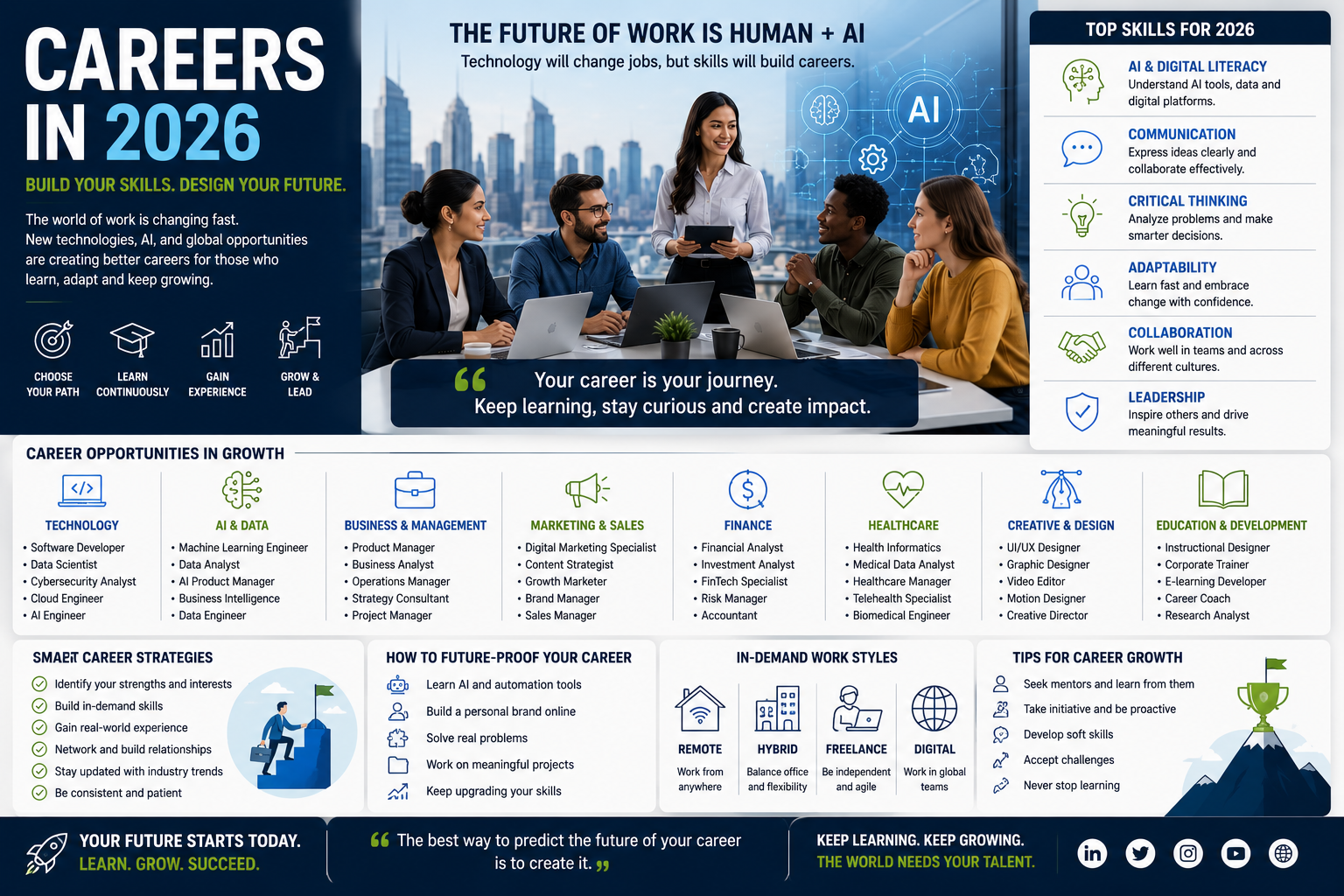
The world of work is changing quickly. Artificial intelligence, automation, remote collaboration, digital platforms, and changing business models are creating new opportunities while transforming traditional careers.
For professionals, students, and people considering a career change, the biggest question is no longer simply “What job should I get?”
A better question is:
“What skills will help me remain valuable as the world of work changes?”
In 2026, successful careers are increasingly built around a combination of technical knowledge, communication, adaptability, creativity, and continuous learning.
The Changing World of Careers
Technology has transformed how people search for jobs, communicate with employers, learn new skills, and perform their work.
Many organizations now use digital tools throughout the employee lifecycle.
Recruitment can involve online applications and AI-supported screening.
Employees may collaborate through cloud platforms.
Training can happen through online courses.
AI tools can support everyday tasks.
Remote and hybrid arrangements can allow people to work with companies outside their immediate geographic area.
These changes create opportunities for professionals who are willing to adapt.
Artificial Intelligence and Careers
AI is one of the most important forces affecting careers.
Some repetitive tasks are increasingly being automated, while new roles are emerging around AI development, implementation, governance, data, cybersecurity, and AI-assisted business operations.
AI is also becoming a tool that professionals in traditional roles can use.
Marketers can use AI for research and content development.
Finance professionals can use it for analysis.
Developers can use AI coding assistants.
Designers can use generative tools.
Researchers can use AI to organize information.
The key skill may therefore not simply be knowing how AI works.
It may be knowing how to use AI effectively within your profession.
The Rise of AI-Augmented Work
The future of work isn't necessarily humans versus machines.
A more realistic model is humans working alongside AI.
AI can be particularly useful for repetitive or information-heavy tasks.
People remain essential for:
Judgment
Creativity
Leadership
Empathy
Negotiation
Relationship building
Complex decision-making
Accountability
Professionals who learn how to combine these human strengths with AI capabilities can potentially become more productive and competitive.
Skills That Matter in 2026
A strong career strategy should include both technical and human skills.
Digital Literacy
Professionals should understand the digital tools used in their industry.
AI Literacy
You don't necessarily need to become an AI engineer, but understanding AI capabilities and limitations can be valuable.
Communication
Clear writing, speaking, presentation, and interpersonal communication remain essential.
Critical Thinking
Employees need to evaluate information rather than simply accept it.
Adaptability
Industries change. Skills that are valuable today may evolve tomorrow.
Creativity
Creative thinking can help professionals solve problems that automation cannot easily handle.
Collaboration
Modern work frequently involves cross-functional and geographically distributed teams.
Choosing a Career Path
Choosing a career can feel overwhelming because there are so many options.
A useful starting point is to consider three areas:
What are you good at?
What do you enjoy?
What does the market need?
The strongest career opportunities often exist where these three areas overlap.
For example, someone who enjoys technology, communicates well, and understands business could explore areas such as product management, technology consulting, AI implementation, or digital strategy.
Technology Careers
Technology remains one of the most dynamic career areas.
Potential paths include:
Software development
AI engineering
Data science
Cybersecurity
Cloud computing
UX design
Product management
IT management
Automation
Technology consulting
However, technology careers aren't limited to coding.
Organizations also need professionals who can connect technology with customers, operations, finance, marketing, and strategy.
AI Careers
The growth of AI is creating demand for specialized skills.
Potential career paths include:
AI engineering
Machine learning
Data analysis
AI product management
AI consulting
AI governance
AI safety
Prompt and workflow design
AI implementation
AI operations
Some of these roles require advanced technical education.
Others combine AI knowledge with existing professional expertise.
For example, someone with experience in marketing may specialize in AI-powered marketing systems without becoming a machine-learning engineer.
Business and Management Careers
Business careers continue to provide opportunities across industries.
Potential paths include:
Business development
Operations
Consulting
Project management
Strategy
Sales
Marketing
Finance
Human resources
The strongest business professionals increasingly understand technology and data.
A marketing manager who understands AI and analytics may have an advantage over someone who relies only on traditional marketing methods.
Healthcare Careers
Healthcare remains a major employment sector.
Technology is also changing healthcare through:
Digital health
Telemedicine
Medical data
AI-assisted diagnostics
Healthcare administration
Biotechnology
Healthcare careers require specialized training, but the industry also needs professionals in technology, management, communications, finance, and operations.
Finance Careers
Finance continues to evolve through automation and digital technology.
Career opportunities can include:
Financial analysis
Accounting
Investment management
Risk management
Fintech
Corporate finance
Wealth management
Financial technology
Compliance
AI may automate certain repetitive financial tasks, but professionals who can interpret financial information and provide strategic advice remain important.
Marketing Careers
Marketing has become increasingly data-driven.
Modern marketing professionals may work with:
Social media
Search marketing
Digital advertising
Content
Analytics
Influencer marketing
Ecommerce
Customer experience
Marketing automation
AI
Creativity remains essential, but marketers also need to understand data and technology.
Remote and Hybrid Careers
Remote work has expanded the geographic possibilities of many careers.
Professionals can potentially work with organizations outside their local area, depending on company policies, employment laws, time zones, and job requirements.
Remote work can provide flexibility, but it also requires strong self-management.
Important remote-work skills include:
Time management
Written communication
Digital collaboration
Independent problem-solving
Organization
Accountability
Building a Strong Resume
A resume should communicate value quickly.
Instead of simply listing responsibilities, focus on outcomes.
Compare:
“Managed social media accounts.”
with:
“Managed multi-platform campaigns and improved qualified website traffic.”
The second statement communicates impact.
Whenever possible, use measurable results.
Numbers can make achievements more concrete.
Building a Professional Online Presence
Your digital presence can influence career opportunities.
Professionals can showcase expertise through:
LinkedIn
Personal websites
Portfolios
GitHub
Industry communities
Professional articles
Speaking engagements
Online projects
The best approach is to demonstrate actual knowledge rather than simply claiming expertise.
Publishing useful insights, building projects, and sharing professional work can help establish credibility.
Networking for Career Growth
Career development isn't only about applications.
Relationships matter.
A professional network can provide:
Job opportunities
Mentorship
Industry information
Referrals
Collaboration
Career advice
Networking doesn't mean asking everyone for a job.
It means developing genuine professional relationships.
Connect with people in your field, learn from their experiences, and offer value when possible.
The Importance of Continuous Learning
One qualification may not be enough for an entire career.
Technology changes.
Industries change.
Job requirements change.
Continuous learning can therefore become a long-term career strategy.
Learning can happen through:
Online courses
Certifications
Books
Workshops
Professional communities
Mentorship
Projects
Industry publications
The most valuable learning often combines theory with practical application.
Building a Personal Skill Stack
Instead of trying to become an expert at everything, professionals can build a skill stack.
For example:
Marketing + Data + AI
could create opportunities in AI-powered marketing.
Finance + Technology + Analytics
could create opportunities in fintech or financial automation.
Design + UX + AI
could create opportunities in AI product design.
Healthcare + Data + Technology
could create opportunities in digital health.
Combining complementary skills can help professionals differentiate themselves.
Career Changes in Mid-Life
Changing careers isn't limited to young professionals.
People can transition into new industries by identifying transferable skills.
For example, a sales professional may transition into business development.
A teacher may move into corporate training.
A journalist may move into content strategy.
An accountant may move into financial technology.
The key is identifying what you already know and determining how those skills apply to a new environment.
Leadership and Career Development
Career growth eventually involves more than technical skills.
Professionals moving into management need to develop:
Communication
Delegation
Coaching
Conflict resolution
Decision-making
Strategic thinking
Becoming a great individual contributor and becoming a great leader are not exactly the same thing.
Leadership requires learning how to help other people succeed.
The Importance of Mentorship
A mentor can provide guidance based on experience.
Mentors can help professionals understand:
Career choices
Industry expectations
Leadership
Skill development
Professional challenges
A good mentor doesn't simply provide answers.
They help you ask better questions.
Career Resilience
No career is completely protected from change.
Companies restructure.
Industries evolve.
Technologies disrupt traditional roles.
Economic conditions fluctuate.
Career resilience comes from continuously developing transferable skills.
A professional with strong communication, analytical thinking, technology awareness, and adaptability can potentially move between roles more easily than someone whose skills are extremely narrow.
Careers and Entrepreneurship
Traditional employment isn't the only career path.
Some professionals choose entrepreneurship.
Others build:
Freelance businesses
Consulting practices
Digital products
Online services
Content businesses
Technology startups
Entrepreneurship provides independence but also introduces uncertainty.
Success requires more than a good idea.
Entrepreneurs need to understand customers, marketing, finance, operations, technology, and sales.
What Employers Are Looking For
Modern employers increasingly value candidates who can demonstrate:
Problem-solving
Adaptability
Communication
Digital skills
Teamwork
Initiative
Continuous learning
Results
Technical qualifications remain important, but employers also want people who can apply knowledge effectively.
The Future of Careers
The future job market will likely include both new roles and transformed versions of existing jobs.
AI may create new opportunities while changing how traditional professionals work.
Some tasks may disappear.
Others may become more valuable.
New career categories may emerge around technologies that don't yet exist at scale.
This makes adaptability one of the most important long-term career skills.
Final Thoughts
Building a successful career in 2026 isn't about predicting exactly which jobs will exist ten years from now.
It's about becoming capable of adapting as opportunities change.
Professionals who combine technical knowledge, AI literacy, communication, creativity, critical thinking, and continuous learning can position themselves for a changing employment environment.
The most valuable career strategy may be simple:
Learn continuously.
Build useful skills.
Create real experience.
Develop relationships.
Adapt to technology.
Keep improving.
A career is not a single decision.
It is a process of learning, experimenting, changing direction, and building new capabilities over time.
The future belongs to people who are prepared to keep learning.