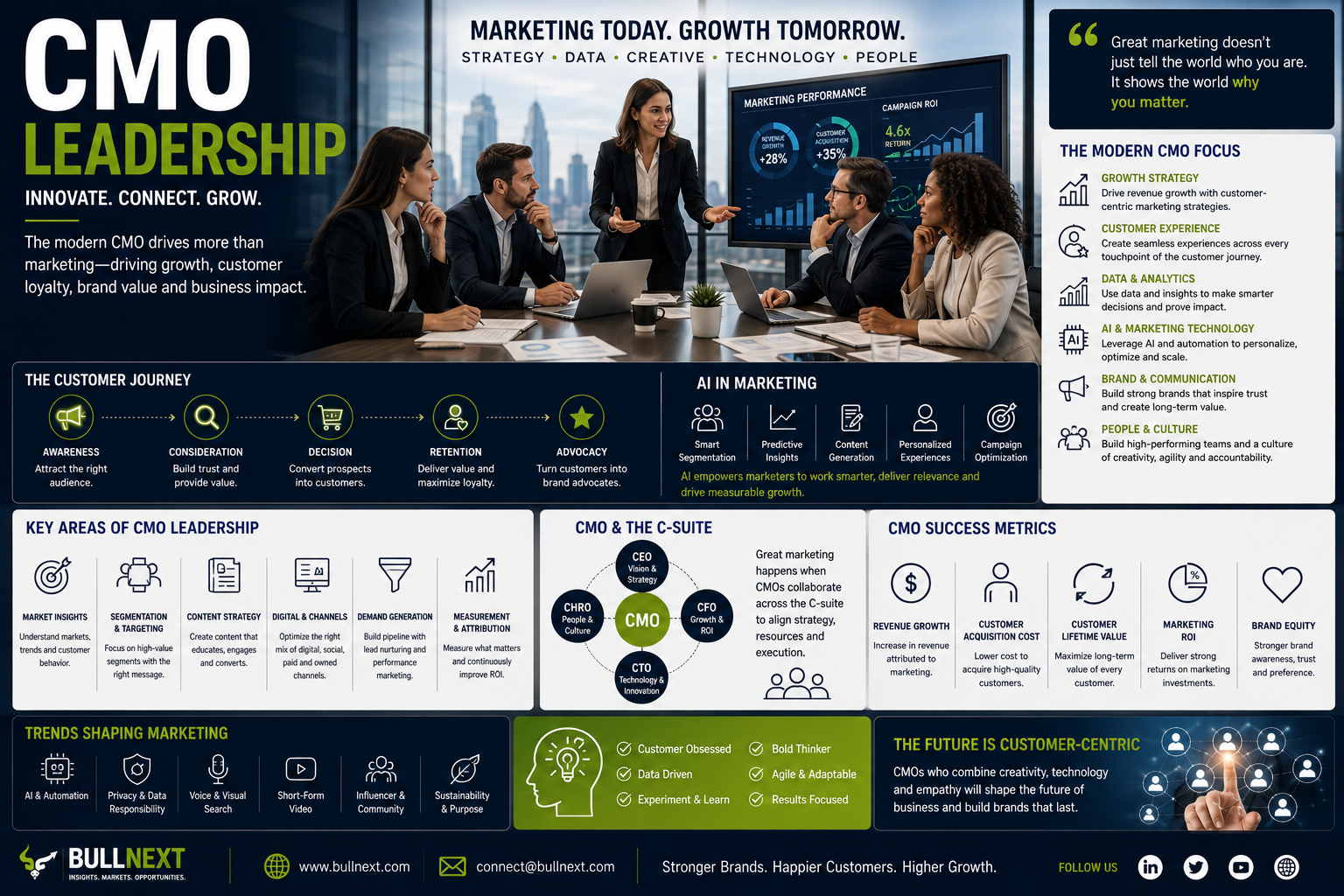
The role of the Chief Marketing Officer (CMO) is changing rapidly. Marketing is no longer limited to advertising, branding, social media, and promotional campaigns. Today's CMO is increasingly responsible for customer experience, data, artificial intelligence, brand strategy, digital transformation, revenue growth, and long-term customer relationships.
As businesses compete for attention in an increasingly crowded digital environment, CMOs must understand both people and technology. They need to know what customers want, where customers discover brands, which channels produce results, and how emerging technologies can improve marketing performance.
The modern CMO is therefore becoming a strategic member of the C-suite—connecting brand, customer, technology, data, and business growth.
What Is a CMO?
CMO stands for Chief Marketing Officer.
The CMO is the senior executive responsible for an organization's overall marketing strategy.
Traditional responsibilities can include:
Brand management
Advertising
Public relations
Content marketing
Social media
Customer acquisition
Market research
Campaign management
Product marketing
However, the modern CMO often has much broader responsibilities.
Today's CMOs may also oversee:
Customer experience
Marketing technology
Artificial intelligence
Data analytics
Personalization
Digital transformation
Revenue growth
Customer retention
Brand reputation
This makes the CMO an important contributor to overall business strategy.
The CMO as a Strategic Growth Leader
Marketing has always been connected to growth, but the modern CMO is increasingly expected to demonstrate how marketing contributes directly to business results.
Executives and boards want to understand:
How many customers did marketing acquire?
What did those customers cost?
How much revenue did they generate?
Which channels performed best?
Which customers are most valuable?
How effectively is the company retaining customers?
This shift is turning marketing from a primarily creative function into a combination of creativity, analytics, technology, and commercial strategy.
Artificial Intelligence Is Transforming Marketing
AI is one of the biggest opportunities for modern CMOs.
Marketing teams can use AI to support:
Content creation
Customer segmentation
Market research
Campaign optimization
Personalization
Predictive analytics
Customer service
Lead scoring
Advertising
Competitive analysis
AI can help marketers process large amounts of information faster.
For example, a marketing team might use AI to analyze customer behavior and identify different groups based on purchasing patterns.
The team can then create more relevant messaging for each audience.
However, AI should support marketing strategy rather than replace it.
A tool can generate content quickly, but the CMO still needs to determine whether the content reflects the brand and actually connects with customers.
The Rise of AI-Powered Personalization
Customers increasingly expect brands to understand their interests.
Personalization can include:
Product recommendations
Customized email campaigns
Personalized website experiences
Targeted advertising
Relevant offers
Content recommendations
AI can make personalization possible at a much larger scale.
Instead of creating one message for thousands of customers, businesses can potentially adapt experiences based on customer behavior and preferences.
The challenge is maintaining trust.
Too much personalization can feel intrusive.
The strongest CMOs therefore need to balance relevance with privacy and customer expectations.
Data-Driven Marketing
Modern marketing generates enormous amounts of data.
CMOs can analyze:
Website traffic
Conversion rates
Customer acquisition costs
Advertising performance
Email engagement
Social media activity
Customer lifetime value
Retention rates
Sales attribution
But data alone doesn't create a successful marketing strategy.
The CMO must turn data into insight.
For example, if a campaign receives many clicks but produces few sales, the problem may not be the advertisement.
The landing page, product, pricing, customer experience, or targeting may be responsible.
Data helps identify the problem, but leadership determines what to do next.
Customer Experience Becomes a Marketing Responsibility
Marketing doesn't end when a customer makes a purchase.
The customer's entire experience influences brand perception.
This includes:
Discovery → Consideration → Purchase → Delivery → Support → Retention → Advocacy
A customer who sees excellent advertising but receives poor service may never purchase again.
This is why modern CMOs increasingly collaborate with operations, customer service, product, and technology teams.
The goal is to create a consistent experience throughout the customer journey.
Brand Building in a Digital World
Digital advertising can generate immediate results, but strong brands are built over time.
A brand communicates:
What a company represents
Why it exists
What makes it different
What customers can expect
Why customers should trust it
The CMO is responsible for protecting this identity across multiple channels.
A brand may appear on:
Websites
Social media
Search engines
YouTube
Podcasts
Email
Digital advertising
Packaging
Events
Consistency becomes increasingly difficult as the number of channels grows.
Strong marketing leadership ensures that the brand remains recognizable while adapting its communication to each platform.
The New Customer Journey
The modern customer journey is rarely linear.
A customer might discover a company through social media, search for reviews, watch a YouTube video, compare competitors, ask an AI assistant for recommendations, visit the website, and finally purchase through a mobile device.
This creates a challenge for CMOs.
They need to understand how different touchpoints influence one another.
A single advertisement may not generate an immediate purchase, but it could introduce the customer to the brand.
Later, a search result or email may complete the conversion.
Understanding this journey requires both analytics and strategic thinking.
CMO and CEO Collaboration
The CMO needs a close relationship with the CEO.
The CEO establishes the broader direction of the company.
The CMO translates that direction into a market-facing strategy.
For example, if the company wants to become a premium brand, marketing must communicate quality and differentiation.
If the company wants rapid expansion, the CMO may focus on customer acquisition and market penetration.
If the company wants to enter a new country, marketing needs to understand local customers and competitors.
The CMO therefore plays a critical role in connecting corporate strategy with the customer.
CMO and CFO Collaboration
Marketing investment is increasingly measured through financial performance.
This makes the relationship between the CMO and CFO particularly important.
The CMO may want to increase advertising spending.
The CFO wants to understand the expected return.
Together they can evaluate:
Customer acquisition cost
Revenue growth
Marketing ROI
Customer lifetime value
Advertising efficiency
Brand investment
Long-term growth
The objective isn't necessarily to spend less.
It is to allocate marketing resources where they can create the greatest value.
CMO and CTO Collaboration
Technology has become essential to modern marketing.
Marketing teams rely on:
Customer relationship management systems
Analytics platforms
Advertising technology
Ecommerce platforms
AI tools
Automation software
Customer-data platforms
The CMO and CTO therefore need to work together.
The CMO understands customer and marketing requirements.
The CTO understands technology architecture, security, integration, and scalability.
Together they can build a marketing technology ecosystem that supports business growth.
CMO and CHRO Collaboration
Marketing also depends on people.
The CMO may work with the CHRO to build a strong marketing organization and develop future leaders.
Marketing teams increasingly require skills in:
Data analysis
AI
Content
Performance marketing
Brand strategy
Customer experience
Technology
Creativity
The CHRO can help develop talent strategies that support these changing requirements.
Social Media and the Modern CMO
Social media has transformed the relationship between brands and customers.
Customers can now publicly discuss products, share experiences, recommend brands, or criticize companies.
This makes social media both a marketing opportunity and a reputation-management challenge.
CMOs need to understand:
Audience behavior
Content formats
Creator partnerships
Community management
Social listening
Reputation
Platform trends
Successful social marketing isn't simply about posting frequently.
It is about creating content that people find useful, entertaining, informative, or worth sharing.
The Importance of Content
Content remains one of the most important marketing tools.
Businesses can use:
Articles
Videos
Guides
Podcasts
Newsletters
Case studies
Infographics
Social posts
Webinars
The challenge is that AI has made content creation much easier.
As a result, the internet can become increasingly crowded with generic content.
This creates an opportunity for brands that produce original, useful, credible, and distinctive content.
The CMO's job is not simply to produce more content.
It is to produce content that earns attention and builds trust.
CMO Networking
Marketing leaders can also benefit from strong professional networks.
A CMO network may include:
Other CMOs
CEOs
Agency leaders
Technology executives
Investors
Entrepreneurs
Media professionals
Brand strategists
Data specialists
These relationships can help CMOs exchange ideas about changing consumer behavior, AI, marketing technology, advertising, and brand strategy.
The best networks are based on knowledge sharing rather than simply exchanging business cards.
Measuring Marketing Success
A modern CMO needs clear performance metrics.
Important measurements may include:
Customer Acquisition Cost
How much does it cost to acquire a new customer?
Customer Lifetime Value
How much value does a customer generate over the entire relationship?
Conversion Rate
How effectively does marketing turn prospects into customers?
Retention
How many customers continue purchasing?
Return on Marketing Investment
What financial value does marketing generate relative to its cost?
Brand Awareness
How familiar are target customers with the brand?
Different businesses will prioritize different metrics.
The important point is to connect marketing measurements with actual business objectives.
The Future of Marketing Leadership
The CMO role will likely become even more connected to technology.
AI may assist with:
Market research
Content creation
Customer analysis
Campaign optimization
Predictive modeling
Personalization
Competitive intelligence
But creativity will remain important.
AI can generate possibilities.
Human marketers determine which ideas are meaningful, original, culturally appropriate, and aligned with the brand.
The future may therefore be less about humans versus AI and more about marketers using AI to become more capable.
What Makes a Great CMO?
Successful CMOs often combine several capabilities.
Strategic Thinking
Understand where the company is going and how marketing can support that direction.
Creativity
Develop ideas that capture attention and differentiate the brand.
Data Literacy
Understand metrics and use evidence to improve decisions.
Customer Understanding
Know what customers want, need, and value.
Technology Awareness
Understand how AI, automation, and marketing technology can improve performance.
Leadership
Build teams that can execute complex strategies.
Adaptability
Respond quickly as platforms, markets, and customer behavior change.
Final Thoughts
The modern CMO is much more than the head of advertising.
Today's CMO is a growth strategist, brand leader, customer advocate, data user, technology partner, and executive decision-maker.
AI is transforming how marketing teams work, but technology doesn't eliminate the need for human creativity and judgment.
The strongest marketing organizations will combine:
AI + Data + Creativity + Customer Understanding + Strategy
When these elements work together, marketing can become more than a source of traffic or awareness.
It can become a genuine engine for business growth.
The future of marketing belongs to leaders who can understand both sides of the equation: the technology that makes modern marketing possible and the human behavior that makes marketing effective.