
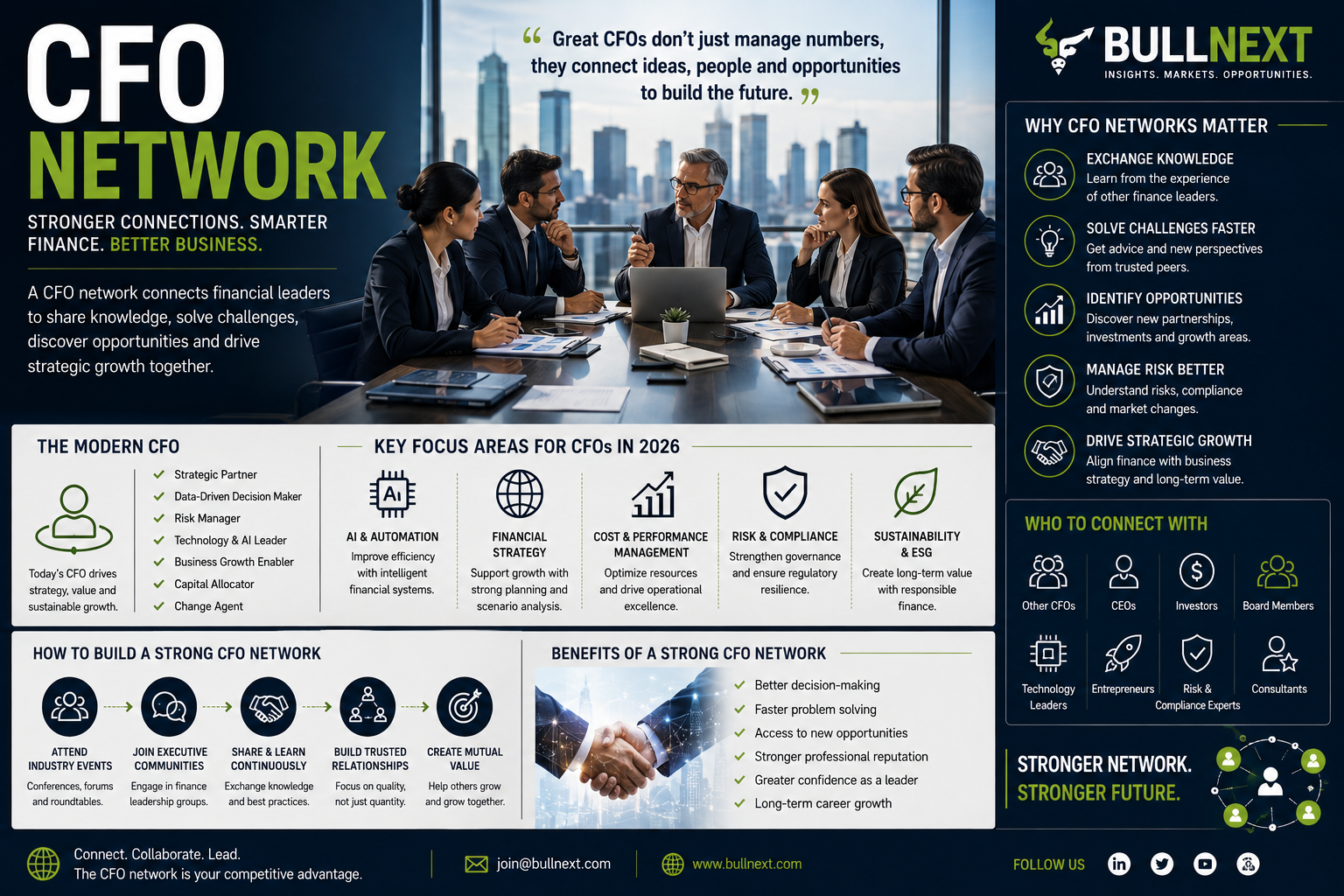
The role of the Chief Financial Officer (CFO) has changed significantly. Today's CFO is no longer focused only on budgets, financial statements, and cost control. Modern finance leaders are increasingly involved in business strategy, technology, artificial intelligence, investment decisions, risk management, sustainability, and long-term growth.
As these responsibilities expand, a strong CFO network can become a powerful source of knowledge and opportunity. Connecting with other CFOs, finance professionals, investors, entrepreneurs, technology leaders, and industry experts allows financial executives to exchange experiences and better understand the challenges shaping modern business.
What Is a CFO Network?
A CFO network is a professional community of finance leaders and business professionals who connect to exchange ideas, experiences, knowledge, and opportunities.
A strong CFO network can include:
Chief Financial Officers
Finance directors
Controllers
CEOs
Investors
Accountants
Financial analysts
Technology executives
Risk professionals
Consultants
Entrepreneurs
Board members
The purpose isn't simply to collect contacts.
The real value comes from building trusted professional relationships that can provide advice, perspective, and practical experience.
Why CFO Networks Matter
Financial leaders regularly face complex decisions.
A CFO may need to evaluate a major acquisition, manage cash flow during a downturn, implement a new financial system, or determine whether an expensive technology investment will generate sufficient returns.
There is rarely one perfect answer.
Speaking with another CFO who has faced a similar challenge can provide valuable insight.
A strong network can help finance leaders answer questions such as:
How did you approach this investment?
What financial risks did you discover?
Which technology delivered the best results?
How did you manage costs during a slowdown?
What would you do differently today?
These conversations can help executives make better-informed decisions.
The CFO's Expanding Role
Finance has traditionally been responsible for reporting, budgeting, forecasting, and financial controls.
Those responsibilities remain important.
But the CFO increasingly has a seat at the center of strategic decision-making.
Modern CFOs may participate in:
Corporate strategy
Mergers and acquisitions
Technology investments
AI adoption
International expansion
Risk management
Sustainability
Workforce planning
Investor relations
Business transformation
This broader role makes networking increasingly valuable.
A CFO needs to understand more than finance.
They need to understand the entire business.
CFO Networks and Artificial Intelligence
AI is one of the biggest opportunities and challenges for finance leaders.
Companies are using AI for:
Financial forecasting
Expense analysis
Fraud detection
Invoice processing
Financial reporting
Data analysis
Customer analytics
Risk management
Workflow automation
However, CFOs need to determine whether these investments actually create measurable value.
A technology project might sound impressive, but executives need to ask:
How much will it cost?
What will it save?
How quickly will we see a return?
What risks does it create?
How will employees use it?
How will we measure success?
Connecting with other CFOs who have already implemented AI can provide practical lessons that aren't always available in technology brochures.
The CFO as a Strategic Partner
Modern CFOs are increasingly expected to act as strategic partners to CEOs.
This means finance is no longer simply reporting what happened.
It is helping determine what should happen next.
For example, a CFO may analyze several potential growth strategies and evaluate:
Expected revenue
Required investment
Operating costs
Cash-flow implications
Risk
Potential return
Long-term scalability
This allows financial analysis to become part of strategic planning.
A strong CFO network can support this role by exposing executives to different approaches used by other organizations.
Connecting CFOs With CEOs
A CFO network should not exist separately from the broader executive community.
Relationships with CEOs can help finance leaders understand the strategic priorities of the organization.
The CEO may be focused on:
Growth.
The CFO may be focused on:
Financial sustainability.
The strongest leadership teams bring these perspectives together.
A CFO who understands the CEO's long-term vision can build financial strategies that support growth rather than simply limiting spending.
CFOs and COOs
The CFO and COO often work closely together.
The COO focuses on operational execution.
The CFO focuses on financial performance.
These perspectives are closely connected.
For example, reducing costs isn't always about spending less.
It can mean improving processes, reducing waste, automating repetitive tasks, or increasing productivity.
A strong CFO-COO relationship can therefore help businesses identify opportunities for operational improvement.
CFOs and Technology Leaders
Technology decisions increasingly have significant financial consequences.
A new cloud platform, AI system, cybersecurity program, or enterprise software solution can require substantial investment.
The CFO needs to understand the financial impact.
The CTO or CIO understands the technical requirements.
Working together allows the organization to evaluate technology more effectively.
A CFO network that includes technology leaders can make it easier for finance executives to understand emerging technologies before making major investments.
CFOs and Investors
Relationships with investors can provide another valuable perspective.
Investors evaluate businesses from the outside.
They may identify trends, risks, opportunities, and competitive pressures that executives inside the organization don't always see clearly.
For CFOs, relationships with investors can also strengthen communication around:
Financial performance
Capital allocation
Growth strategy
Business risks
Long-term objectives
Trust and transparency are particularly important in these relationships.
CFO Networks and Mergers & Acquisitions
Mergers and acquisitions can involve enormous financial and operational complexity.
A CFO may need to evaluate:
Purchase price
Valuation
Financing
Debt
Cash flow
Synergies
Integration costs
Tax considerations
Operational risks
Experience can be particularly valuable in M&A.
A CFO who has completed several acquisitions can provide insights that aren't obvious from a spreadsheet.
This is one reason experienced finance networks can be extremely valuable.
Managing Risk Through Relationships
Risk management is another area where networking can help.
Companies face many different types of risk:
Financial risk
Cybersecurity risk
Market risk
Supply-chain risk
Regulatory risk
Currency risk
Operational risk
Reputational risk
No CFO can be an expert in every area.
A network allows finance leaders to connect with specialists who understand specific risks.
The goal isn't to eliminate every risk.
The goal is to understand risks clearly enough to make informed decisions.
Global CFO Networks
Business has become increasingly international.
A company may operate in multiple countries, maintain international suppliers, sell to customers globally, or employ remote teams across different regions.
This creates additional financial complexity.
International CFO networks can provide insight into:
Currency management
Tax environments
Local regulations
International banking
Cross-border investment
Supply chains
Market expansion
Local knowledge can be especially valuable when entering a new country.
CFO Networks and Asian Markets
Asia offers major opportunities for businesses expanding internationally.
Countries such as India, China, Japan, South Korea, Singapore, Indonesia, and other Southeast Asian markets have different economic conditions and business environments.
A CFO considering expansion into Asia may benefit from connecting with finance leaders who already understand those markets.
Local executives can provide insight into:
Customer behavior
Business regulations
Financing
Hiring
Partnerships
Currency risks
Market competition
This can help companies avoid costly assumptions.
How to Build a Strong CFO Network
Attend Finance Conferences
Industry conferences provide opportunities to meet other finance professionals and learn about emerging trends.
Join Executive Communities
Professional CFO groups can create a more structured environment for peer learning.
Participate in Roundtables
Small executive discussions often provide more meaningful conversations than large networking events.
Build Relationships With Younger Finance Leaders
Future CFOs and finance executives can become valuable long-term connections.
Connect With Technology Leaders
Finance increasingly intersects with technology, making relationships with CIOs, CTOs, and technology entrepreneurs valuable.
Maintain Relationships
Networking shouldn't end after the first meeting.
Follow up, share useful information, and stay in touch.
Quality Over Quantity
A CFO doesn't need thousands of connections.
Ten strong relationships can sometimes provide more value than thousands of superficial contacts.
A useful CFO network should contain people who:
Challenge your thinking
Share honest experiences
Have different expertise
Provide useful perspectives
Introduce valuable opportunities
Offer constructive advice
The objective should be relationship quality rather than network size.
The Importance of Peer Learning
Finance leaders often learn from formal education, professional qualifications, reports, and industry publications.
Peer learning adds another dimension.
Another CFO can explain what happened when their company implemented a new ERP system.
Another can discuss lessons from a failed acquisition.
Another can share how they built a stronger forecasting process.
These practical experiences can be extremely valuable because they provide context that theoretical knowledge may not.
CFO Networking and Leadership
A CFO network can also help finance leaders become better executives.
Leadership isn't only about financial expertise.
CFOs increasingly need:
Communication skills
Negotiation
Strategic thinking
Team leadership
Technology awareness
Emotional intelligence
Decision-making
Change management
Relationships with other executives can provide opportunities to learn these skills.
Digital CFO Networking
Networking is no longer limited to conferences and business dinners.
Digital platforms allow CFOs to connect globally.
Online networking can involve:
Executive communities
Professional social networks
Finance newsletters
Virtual conferences
Podcasts
Webinars
Industry forums
Private leadership groups
However, digital networking works best when it eventually creates meaningful professional relationships.
A connection request is only the beginning.
Common CFO Networking Mistakes
Only Networking When You Need Help
This can make relationships feel transactional.
Talking Only About Your Company
Good networking requires listening.
Ignoring Other Industries
A CFO from another industry may have solutions to problems similar to yours.
Focusing Too Much on Titles
Useful ideas can come from people who aren't CEOs or CFOs.
Failing to Follow Up
A valuable conversation can quickly disappear without continued communication.
The Future of CFO Networks
The CFO role will likely become even more connected to technology and strategy.
AI could help finance leaders analyze large amounts of information, forecast scenarios, automate reporting, and identify financial risks.
But human relationships will remain important.
Technology can provide data.
A trusted CFO can provide perspective.
A peer can challenge assumptions.
An experienced mentor can share lessons from past decisions.
An investor can provide an outside view.
The combination of these perspectives can make executive decision-making stronger.
What Makes a Great CFO Network?
A great CFO network should provide more than introductions.
It should provide knowledge, challenge, trust, and opportunity.
The best networks contain people with different experiences.
A CFO might connect with:
Another CFO for peer advice.
A CEO for strategic perspective.
A CTO for technology insights.
An investor for capital-market knowledge.
A risk specialist for security and compliance perspectives.
An entrepreneur for innovation and growth ideas.
This diversity makes the network more valuable.
Final Thoughts
The modern CFO is becoming one of the most strategically important leaders within an organization.
Finance remains the foundation, but today's CFO must also understand technology, AI, operations, markets, people, and long-term strategy.
A strong CFO network can help leaders navigate these responsibilities by providing access to experience, expertise, relationships, and new perspectives.
The most valuable network isn't necessarily the biggest.
It is the network built on trust, generosity, knowledge sharing, and genuine professional relationships.
As businesses become more complex and technology continues to transform finance, CFOs who build strong networks will have an important advantage: they won't have to solve every problem alone.
Strong finance leadership isn't just about understanding the numbers. It's about understanding the people, technology, markets, and decisions behind them.
Short Summary
A CFO network connects finance leaders with CEOs, investors, technology executives, entrepreneurs, and industry experts. Strong networks help CFOs share financial knowledge, evaluate AI and technology investments, manage risk, discover opportunities, support business strategy, and make better decisions in an increasingly complex global economy.
SEO Information
SEO Title: CFO Network: Building Stronger Financial Leadership in 2026
Meta Description: Discover how CFO networks help finance leaders share knowledge, manage risk, evaluate AI investments, build partnerships and drive business strategy.
SEO Keywords:
CFO network, CFO networking, CFO leadership, finance executive network, financial leadership, CFO community, CFO strategy, C-suite networking, finance leadership 2026, CFO business strategy, executive networking
SEO Alt Text:
CFO network of financial executives discussing business strategy, AI investment, financial growth and risk management.
Suggested Image File Name:cfo-network-financial-leadership-business-strategy-2026.png