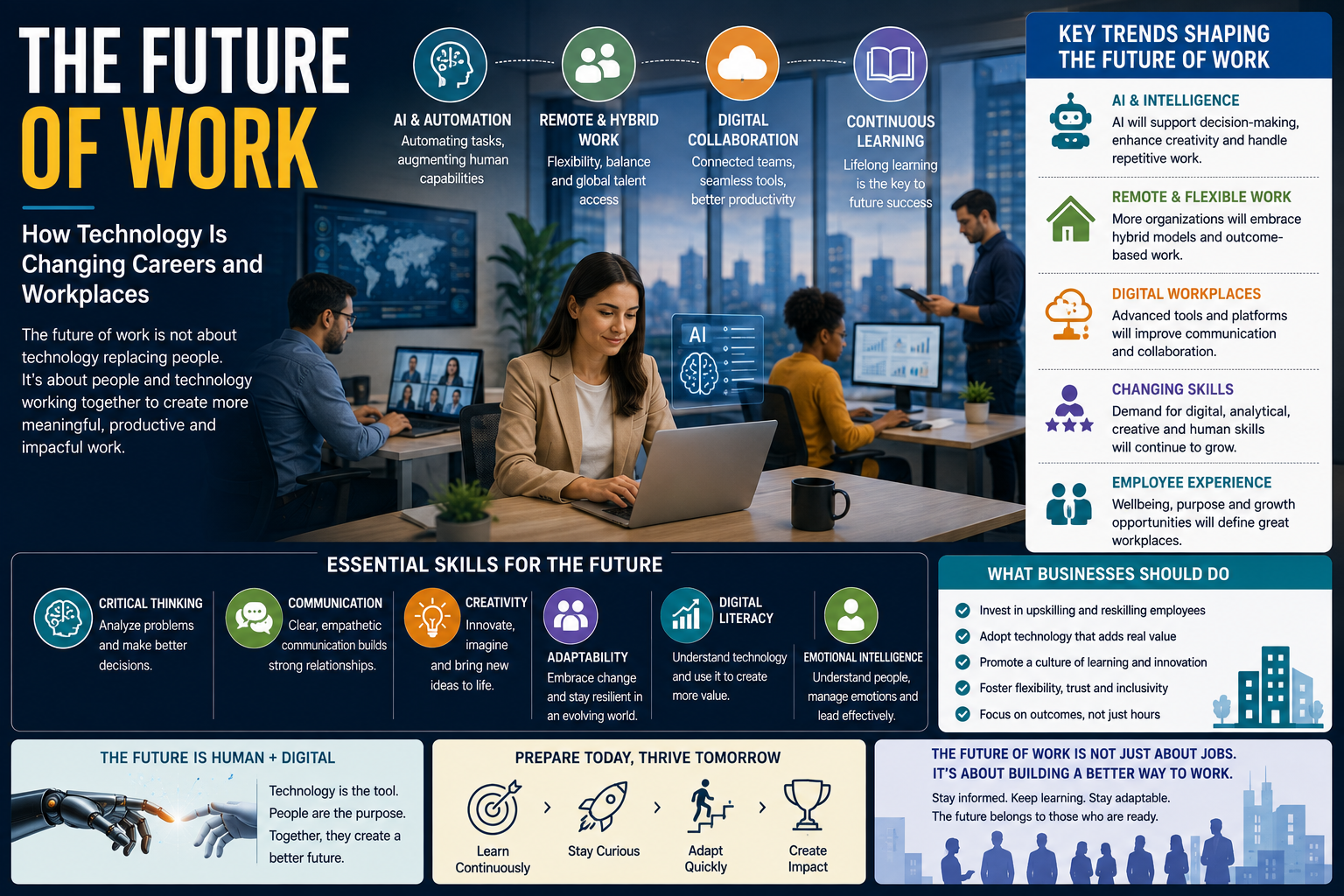
The world of work has always evolved alongside technology. From industrial machinery to computers and the internet, major technological developments have changed how people perform their jobs, communicate with colleagues, and build businesses.
Today, another major transformation is underway.
Artificial intelligence, automation, cloud computing, digital collaboration tools, and changing employee expectations are reshaping workplaces across industries. Some traditional tasks are becoming automated, while new responsibilities and career opportunities are emerging.
The future of work is therefore not simply about technology replacing people. It is about understanding how people, technology, and organizations can work together more effectively.
Professionals who develop adaptable skills and businesses that prepare their employees for change can be better positioned for the evolving workplace.
What Is the Future of Work?
The future of work describes how jobs, workplaces, skills, technologies, and employment practices are expected to evolve as society and businesses change.
Several developments are influencing this transformation:
Artificial intelligence
Automation
Remote and hybrid work
Digital collaboration
Continuous learning
Changing employee expectations
New business models
Global talent networks
These trends do not affect every industry in exactly the same way.
A software company may adopt AI differently from a manufacturing business, healthcare organization, school, or financial institution.
The important principle is that work is becoming increasingly adaptable.
Technology Is Changing Everyday Tasks
Technology doesn't always eliminate an entire job.
More often, it changes individual tasks within a job.
An employee may use software to automate data entry, AI to summarize documents, or digital tools to communicate with customers.
This can reduce repetitive work and create more time for activities requiring judgment, creativity, communication, and problem-solving.
The result may be a workplace where technology handles certain processes while employees focus on higher-value responsibilities.
Artificial Intelligence and the Workplace
Artificial intelligence is one of the most significant technologies influencing modern work.
AI can assist with:
Research
Writing
Data analysis
Customer service
Software development
Marketing
Document processing
Scheduling
Information management
The impact depends on how organizations implement these tools.
Companies should identify tasks where AI can provide genuine value while maintaining appropriate human oversight.
Employees also need training so they understand how to use AI effectively and responsibly.
Automation and Productivity
Automation can help organizations complete repetitive processes with greater consistency.
For example, businesses can automate certain administrative workflows, data processing tasks, notifications, and routine reporting.
Automation can potentially improve productivity by reducing manual work.
However, organizations should evaluate the entire process before automating it.
Automating an inefficient process may simply make an inefficient process happen faster.
The better approach is:
Understand the process → Improve the process → Automate where appropriate.
Remote and Hybrid Work
Digital communication tools have made it possible for many professionals to work outside traditional offices.
Remote and hybrid work can provide flexibility for employees while allowing businesses to access talent across wider geographic areas.
However, distributed work also creates challenges.
Organizations need clear expectations around:
Communication
Meetings
Collaboration
Deadlines
Availability
Performance
Information security
Remote work is most effective when employees understand how work should be organized and measured.
The Changing Workplace
The physical workplace is also evolving.
Traditional offices may increasingly focus on collaboration, meetings, creativity, and relationship building rather than simply providing desks for employees.
Organizations can design workplaces around the type of work people actually perform.
Some employees may need quiet spaces for concentration.
Others may need collaborative areas.
Flexible workplace design can support different working styles and business requirements.
Skills Are Becoming More Important
As technology changes tasks, the skills employees need can also change.
Technical knowledge remains valuable, but human skills are equally important.
Important capabilities include:
Communication
Critical thinking
Creativity
Problem-solving
Adaptability
Collaboration
Leadership
Emotional intelligence
These skills can help professionals work effectively even when specific tools and technologies change.
Continuous Learning Is Becoming Essential
A professional qualification can provide a strong foundation, but learning doesn't stop after graduation.
Technology can change job requirements over time.
Employees may need to develop new digital tools, understand AI, learn new business processes, or gain industry-specific knowledge.
Continuous learning can happen through:
Online courses
Certifications
Workshops
Books
Professional communities
Mentorship
Practical projects
The ability to learn may become one of the most valuable career skills.
AI Literacy for Employees
Professionals don't necessarily need to become AI specialists.
However, understanding basic AI concepts can become increasingly useful.
AI literacy includes knowing:
What AI can do
Where AI can make mistakes
How to evaluate AI-generated information
How to protect sensitive data
When human judgment is necessary
How AI can improve a workflow
Employees who understand these principles can use AI more effectively.
The Rise of Human-AI Collaboration
The future workplace may involve more collaboration between humans and intelligent systems.
AI can process information quickly.
Humans can provide context, empathy, creativity, ethical judgment, and strategic thinking.
For example, an AI system might analyze customer feedback and identify common complaints.
A human manager can then determine why those problems are occurring and decide how the organization should respond.
This combination can be more powerful than either approach alone.
New Career Opportunities
Technological change can create new types of work.
As organizations adopt AI and digital systems, they may need professionals with expertise in:
AI implementation
Data analysis
Cybersecurity
Digital transformation
Automation
AI governance
Technology management
Digital product development
New roles can also emerge that are difficult to predict today.
This is one reason professionals should focus on developing adaptable capabilities rather than preparing for only one specific job title.
Jobs That Require Human Skills
Some activities are particularly dependent on human interaction.
These can include:
Leadership
Negotiation
Relationship building
Mentoring
Complex communication
Creative direction
Emotional support
Strategic decision-making
Even when technology becomes more capable, people still value trust and human connection.
Businesses should therefore consider where human interaction creates unique value.
The Importance of Creativity
Creative thinking can become increasingly valuable in an automated workplace.
AI can generate ideas and content, but humans determine:
What is meaningful
What fits the audience
What reflects a brand
What solves the right problem
What should be created
Creativity involves judgment as well as generation.
Professionals who can combine creative thinking with technology may have new opportunities to produce better work more efficiently.
Leadership in the Future Workplace
Leaders will play an important role in managing technological change.
They need to understand how new tools affect:
Employees
Customers
Operations
Costs
Security
Business strategy
Leaders also need to communicate why changes are happening.
Employees are more likely to adapt when they understand the purpose behind a new system.
Technology adoption therefore requires both technical planning and effective leadership.
Employee Wellbeing
The future of work isn't only about productivity.
Employee wellbeing also matters.
Technology can make communication faster, but constant notifications and digital meetings can create pressure.
Organizations can support healthier work environments by establishing reasonable expectations around communication, workload, flexibility, and time away from work.
A productive workplace should also be sustainable for the people working in it.
The Global Talent Market
Digital communication allows organizations to collaborate with professionals across geographic boundaries.
This can expand access to specialized talent.
For employees, it can create opportunities to work with organizations outside their immediate location.
However, global teams also require strong communication, cultural awareness, appropriate legal arrangements, and effective coordination.
Technology makes global collaboration possible, but people make it work.
Cybersecurity in the Future Workplace
As more work moves through digital systems, cybersecurity becomes increasingly important.
Employees may access company information from different devices and locations.
Organizations should therefore establish appropriate security practices involving:
Strong authentication
Access controls
Data protection
Employee training
Secure devices
Regular security reviews
Cybersecurity is not only an IT responsibility.
Every employee who handles company information contributes to organizational security.
Rethinking Employee Performance
Traditional workplaces sometimes measure activity rather than outcomes.
Employees may be evaluated based on hours spent at a desk or the number of meetings attended.
Digital work can encourage organizations to focus more on results.
Useful performance measures can include:
Quality
Customer outcomes
Project completion
Productivity
Business impact
Team contribution
The right metrics depend on the role.
The goal should be measuring meaningful results rather than unnecessary activity.
Businesses Must Adapt
Organizations that want to remain competitive need to prepare for continuous change.
A future-ready company can:
Identify changing customer needs.
Evaluate new technologies.
Train employees.
Improve internal processes.
Encourage innovation.
Protect data.
Measure outcomes.
Adjust strategy when necessary.
Adaptability should become part of organizational culture.
Preparing Employees for Change
Employees may feel uncertain when technology changes their responsibilities.
Businesses can reduce this uncertainty through training and communication.
Instead of simply introducing a new tool, companies can explain:
Why is it being introduced?
What problem will it solve?
How will employees use it?
What training will be provided?
How will success be measured?
This approach can make technology adoption more collaborative.
The Role of Education
Education systems also have a role in preparing people for the future workplace.
Students need more than technical knowledge.
They should develop:
Critical thinking
Communication
Creativity
Digital literacy
Problem-solving
Collaboration
Adaptability
These skills can help students navigate career paths that may change considerably over time.
Entrepreneurship and the Future of Work
Technology is also making entrepreneurship more accessible.
Digital platforms allow individuals to build businesses, sell products, provide services, create content, and work with customers across different markets.
AI and automation can reduce the time required for some business tasks.
This can allow small teams and individual entrepreneurs to operate more efficiently.
However, successful entrepreneurship still depends on understanding customers and creating genuine value.
What Professionals Can Do Today
Professionals don't need to predict exactly which jobs will exist in the future.
Instead, they can prepare by developing adaptable skills.
Useful steps include:
Learn digital tools relevant to your industry.
Understand basic AI concepts.
Improve communication.
Develop critical thinking.
Build practical experience.
Strengthen professional relationships.
Continue learning.
Stay informed about industry changes.
These habits can increase career flexibility.
A Future-Ready Career Strategy
A simple approach to career development can be:
Learn → Experiment → Apply → Improve → Adapt
Learn new skills.
Experiment with technology.
Apply your knowledge to real problems.
Improve based on results.
Adapt when circumstances change.
This cycle can help professionals remain relevant even as specific technologies evolve.
The Future Is Human and Digital
The future workplace will likely combine technology with human capabilities.
AI and automation can increase efficiency.
Digital platforms can improve collaboration.
Data can support decision-making.
But people will continue to provide leadership, creativity, empathy, judgment, and relationships.
The question isn't whether technology will change work.
It already is.
The more important question is how individuals and organizations choose to respond.
Final Thoughts
The future of work is not a single destination.
It is an ongoing process of technological, organizational, and social change.
Artificial intelligence, automation, remote collaboration, digital platforms, and continuous learning are reshaping how people work and how businesses operate.
Professionals who remain curious and adaptable can develop the skills needed to navigate these changes.
Organizations can prepare by investing in employees, improving processes, adopting technology responsibly, and creating cultures that support learning.
The workplace of the future will not be defined by technology alone.
It will be defined by how effectively people use technology to solve problems, create value, and build better ways of working.
The most future-ready professionals will not necessarily be those who know every new tool.
They will be the people who can learn quickly, think critically, collaborate effectively, and adapt when the world of work changes.