The institutional digital-asset market is entering a more mature phase. Banks, asset managers, payment providers, custodians, and financial technology companies are increasingly exploring stablecoins, tokenized assets, blockchain settlement, and digital custody.
But institutional adoption comes with a fundamental requirement: compliance must work at the same speed as digital finance.
Traditional financial compliance systems were designed around conventional banking infrastructure. Blockchain-based markets introduce new characteristics, including pseudonymous addresses, 24/7 transactions, programmable assets, smart contracts, and activity across multiple networks.
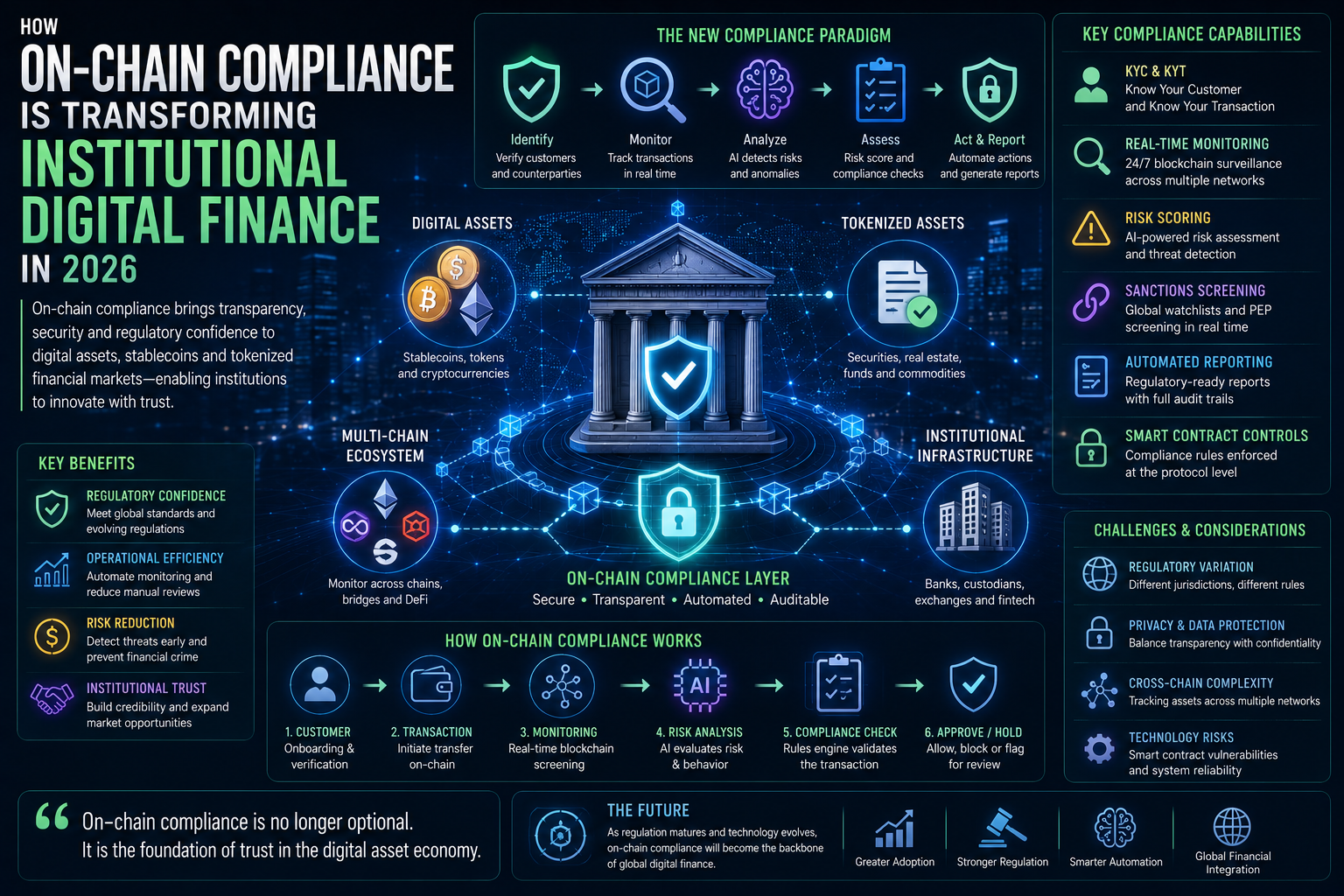
This is creating demand for on-chain compliance—a combination of blockchain analytics, identity verification, transaction monitoring, sanctions screening, smart-contract controls, and automated risk management designed specifically for digital financial infrastructure.
Recent industry research shows that compliance standards are tightening rapidly. Chainalysis reported in May 2026 that nearly half of organizations onboarded that year were operating at alerting standards that would have ranked among the top 10% of organizations in 2020.
For institutional finance, compliance is increasingly becoming part of the infrastructure itself rather than an administrative layer added afterward.
What Is On-Chain Compliance?
On-chain compliance refers to mechanisms that monitor, evaluate, and control blockchain-based financial activity.
These mechanisms can analyze:
Wallet addresses
Blockchain transactions
Smart contracts
Token transfers
Counterparty relationships
Transaction patterns
Sanctions exposure
Risk indicators
Digital identities
Unlike traditional compliance systems that may depend heavily on periodic reports, blockchain infrastructure can provide near-real-time transaction information.
This creates an opportunity for financial institutions to monitor digital-asset activity continuously.
Why Institutions Need New Compliance Models
Traditional financial institutions already have extensive AML, KYC, fraud prevention, and risk-management frameworks.
The challenge is extending those frameworks into blockchain environments.
A bank entering digital assets may need to understand not only its customer's identity but also the blockchain addresses associated with that customer and the source or destination of funds.
A single transaction can potentially involve multiple wallets, smart contracts, decentralized applications, exchanges, bridges, and networks.
Compliance therefore needs to understand relationships rather than simply individual transactions.
From KYC to KYT
Know Your Customer, or KYC, focuses primarily on identifying customers.
Digital-asset compliance increasingly adds Know Your Transaction (KYT) capabilities.
KYT examines transaction activity and evaluates whether funds or behavior present potential risks.
For example, an institution could analyze whether funds originate from or interact with addresses associated with:
Sanctioned entities
Fraud
Ransomware
Theft
Illicit marketplaces
High-risk services
Chainalysis' 2026 research shows that financial institutions are applying particularly strict monitoring thresholds and highlights indirect exposure as an area requiring additional attention.
Direct and Indirect Exposure
One of the more complicated issues in blockchain compliance is indirect exposure.
A wallet may not directly receive funds from a suspicious source but could receive funds that passed through several intermediary addresses.
This creates a difficult question:
How many transaction steps should an institution consider when evaluating risk?
Monitoring only direct exposure may miss sophisticated transaction patterns.
Monitoring every historical connection can generate excessive alerts.
Effective systems therefore need risk-based approaches that distinguish meaningful exposure from insignificant connections.
Real-Time Transaction Monitoring
Blockchain networks can operate continuously.
Transactions can occur at any hour, including weekends and holidays.
This creates an advantage for on-chain compliance because transaction information can potentially be monitored in real time.
A financial institution can establish automated rules that identify unusual activity and send high-risk transactions for review.
This can be particularly valuable for stablecoin payments and tokenized assets, where transactions may occur outside traditional banking hours.
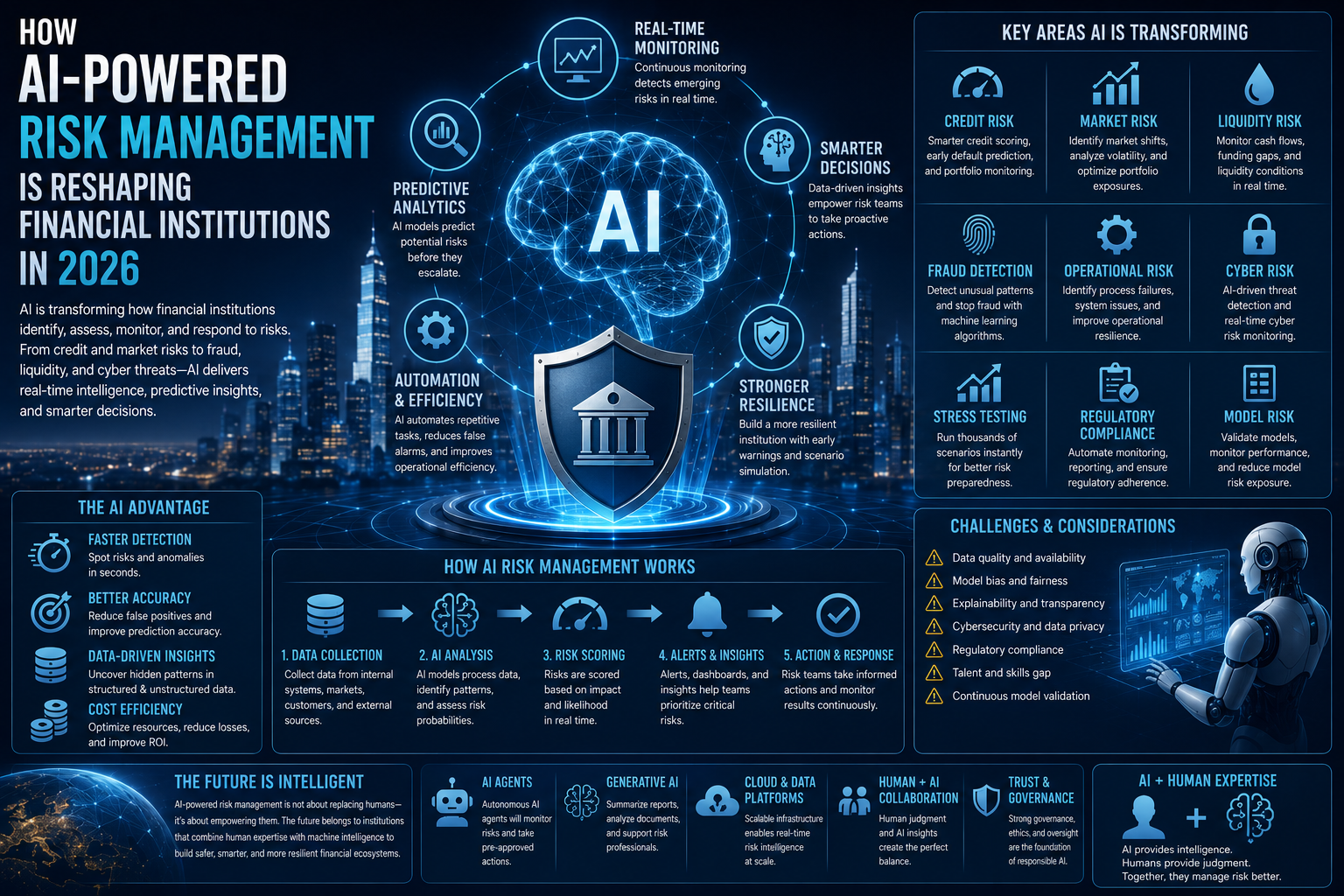
AI and On-Chain Compliance
Artificial intelligence is becoming an important part of blockchain compliance.
AI systems can analyze large volumes of transaction information and identify patterns that may be difficult to detect manually.
For example, AI can help identify unusual transaction behavior, relationships between wallets, rapidly changing risk patterns, and potential fraud indicators.
The goal is not to allow AI to make unrestricted regulatory decisions.
Instead, AI can help compliance teams prioritize investigations and reduce repetitive analytical work.
Automated Risk Scoring
On-chain compliance platforms can assign risk scores to transactions, wallets, or counterparties.
A risk score can incorporate multiple signals rather than relying on one indicator.
For example:
Transaction size + wallet history + counterparty risk + geographic exposure + behavioral pattern = overall risk assessment
This allows financial institutions to focus their resources on transactions that deserve deeper investigation.
Low-risk activity can move through normal processes, while higher-risk activity can trigger additional controls.
Smart Contracts and Compliance
Smart contracts introduce another opportunity.
Instead of checking compliance only after an asset has been transferred, certain compliance requirements can potentially be built directly into the token or transaction architecture.
This approach is increasingly being explored for regulated tokenized assets.
In July 2026, OpenZeppelin and T-REX Network announced work to advance ERC-3643 as an audited compliance infrastructure component for regulated assets, with compliance rules designed to be enforced at transfer level.
This represents a significant conceptual shift.
Compliance becomes part of how the asset operates.
Compliance-Enabled Tokenization
Tokenized securities need to satisfy financial-market requirements.
A token representing a regulated asset cannot necessarily be transferred freely to every wallet.
Eligibility, jurisdiction, identity, and investor restrictions may apply.
Compliance-aware token standards can potentially enforce these requirements automatically.
Polygon's July 2026 case study on T-REX describes a dedicated compliance layer for tokenized securities and real-world assets, highlighting how institutional tokenization is moving toward infrastructure where compliance and transfer controls are integrated into the asset environment.
Stablecoin Compliance
Stablecoins are another major application.
Institutional investors and businesses are increasingly exploring stablecoins for payments, cash management, and settlement.
A 2026 institutional-investor survey by Coinbase and EY-Parthenon found that 85% of respondents were using or interested in using stablecoins for internal cash management and money movement.
As stablecoin usage expands, compliance systems need to monitor:
Wallet activity
Transaction flows
Counterparties
Sanctions exposure
Fraud patterns
Source of funds
Redemption activity
This allows stablecoins to operate within institutional risk frameworks.
Privacy vs. Transparency
Blockchain creates an interesting compliance balance.
On one hand, transaction records can provide extensive visibility.
On the other hand, financial institutions cannot simply expose every customer's financial activity publicly.
This creates demand for privacy-preserving compliance.
Institutions need to demonstrate that transactions meet regulatory requirements while limiting unnecessary disclosure of sensitive information.
Future systems may increasingly use cryptographic proofs, permissioned data, selective disclosure, and trusted identity credentials to balance these competing requirements.
Digital Identity and Compliance
Digital identity can strengthen on-chain compliance.
A blockchain address by itself does not necessarily reveal the legal identity of its owner.
Institutional markets therefore need ways to connect blockchain activity with verified entities.
A compliant identity layer can establish relationships between:
Person or company → verified credential → wallet → transaction → regulated asset
This can make blockchain activity more understandable to banks, regulators, and institutional investors.
Compliance Across Multiple Blockchains
The multi-chain environment creates another challenge.
Assets and transactions can move across different networks.
A financial institution may need to monitor activity across several blockchains rather than maintaining separate compliance systems for each.
This makes interoperability important.
Compliance infrastructure increasingly needs to follow transactions across networks while maintaining consistent risk policies.
Without cross-chain visibility, institutions may have blind spots.
Regulatory Alignment
Regulatory expectations are becoming an important driver of institutional digital-asset infrastructure.
The Financial Stability Board's global framework for cryptoasset and stablecoin activities is based on the principle of “same activity, same risk, same regulation.” Its 2026 implementation review examines progress by jurisdictions in implementing regulatory frameworks and cross-border cooperation.
For institutions, this means digital-asset innovation cannot be separated from governance.
Technology providers need to design systems that can work within regulatory environments rather than assuming regulation will adapt automatically to technology.
Institutional Investors Are Raising the Compliance Bar
Institutional interest in digital assets is growing, but investors are becoming more disciplined.
The 2026 Coinbase/EY-Parthenon survey of 351 institutional decision-makers found that 49% had strengthened their focus on risk management, liquidity, and position sizing. It also found that regulatory compliance had become a key factor when institutions select custodians.
This suggests that institutional adoption is not simply about gaining access to digital assets.
Institutions increasingly want:
Strong governance
Secure custody
Reliable compliance
Operational resilience
Clear regulatory frameworks
Transparent risk management
Compliance as a Competitive Advantage
Compliance is often viewed as a cost.
In digital finance, it can become a competitive advantage.
A financial institution that can demonstrate strong controls may find it easier to work with institutional customers, regulators, banks, and major counterparties.
This can make compliance infrastructure part of the product itself.
A tokenized asset with built-in eligibility controls may be more attractive to institutional investors than an asset requiring extensive manual compliance procedures.
The Role of Human Compliance Teams
Automation does not eliminate the need for compliance professionals.
AI and blockchain analytics can identify patterns, but humans still need to evaluate complex situations.
A transaction may appear unusual for legitimate reasons.
An address may have indirect exposure without representing meaningful risk.
A regulatory decision may depend on jurisdiction and legal interpretation.
Human experts remain essential for investigation, judgment, escalation, and governance.
The strongest model is therefore:
Automated monitoring + AI analysis + human oversight.
Challenges Ahead
On-chain compliance still faces several challenges.
False Positives
Overly aggressive monitoring can generate large numbers of unnecessary alerts.
Cross-Chain Complexity
Risk information can become fragmented across multiple networks.
Privacy
Compliance systems may process sensitive financial information.
Regulatory Differences
Rules can vary across jurisdictions.
Smart-Contract Risk
Automated compliance logic can contain technical vulnerabilities.
Data Quality
Poor blockchain intelligence can produce unreliable risk assessments.
Businesses need to address these issues before scaling institutional digital-asset operations.
The Future of On-Chain Compliance
The future is likely to involve compliance becoming increasingly embedded in digital financial infrastructure.
Instead of checking an asset after every transaction, compliance requirements could be integrated into:
Tokens
Wallets
Smart contracts
Settlement systems
Trading platforms
Digital identities
Institutional custody systems
AI can continuously analyze activity while automated systems enforce predefined rules.
This creates the possibility of financial infrastructure that is compliant by design.
Conclusion
On-chain compliance is becoming one of the most important foundations of institutional digital finance.
As banks, asset managers, payment providers, and other institutions expand into stablecoins, tokenized assets, and blockchain-based settlement, they need compliance systems capable of operating at digital speed.
Blockchain analytics, AI-powered risk scoring, continuous transaction monitoring, digital identity, and programmable compliance can help institutions manage these new environments.
The most important change is that compliance is increasingly moving inside the infrastructure.
Rather than treating regulation as a manual process that happens after technology has been deployed, institutions are beginning to build compliance directly into tokens, transactions, wallets, and financial platforms.
This could create a new generation of digital financial markets that are simultaneously programmable, transparent, automated, and governed.
In 2026, institutional blockchain adoption is becoming less about proving that digital assets can work—and more about proving that they can work safely, transparently, and within robust financial controls.
That is why on-chain compliance may ultimately become one of the defining technologies connecting traditional finance with the digital-asset economy.