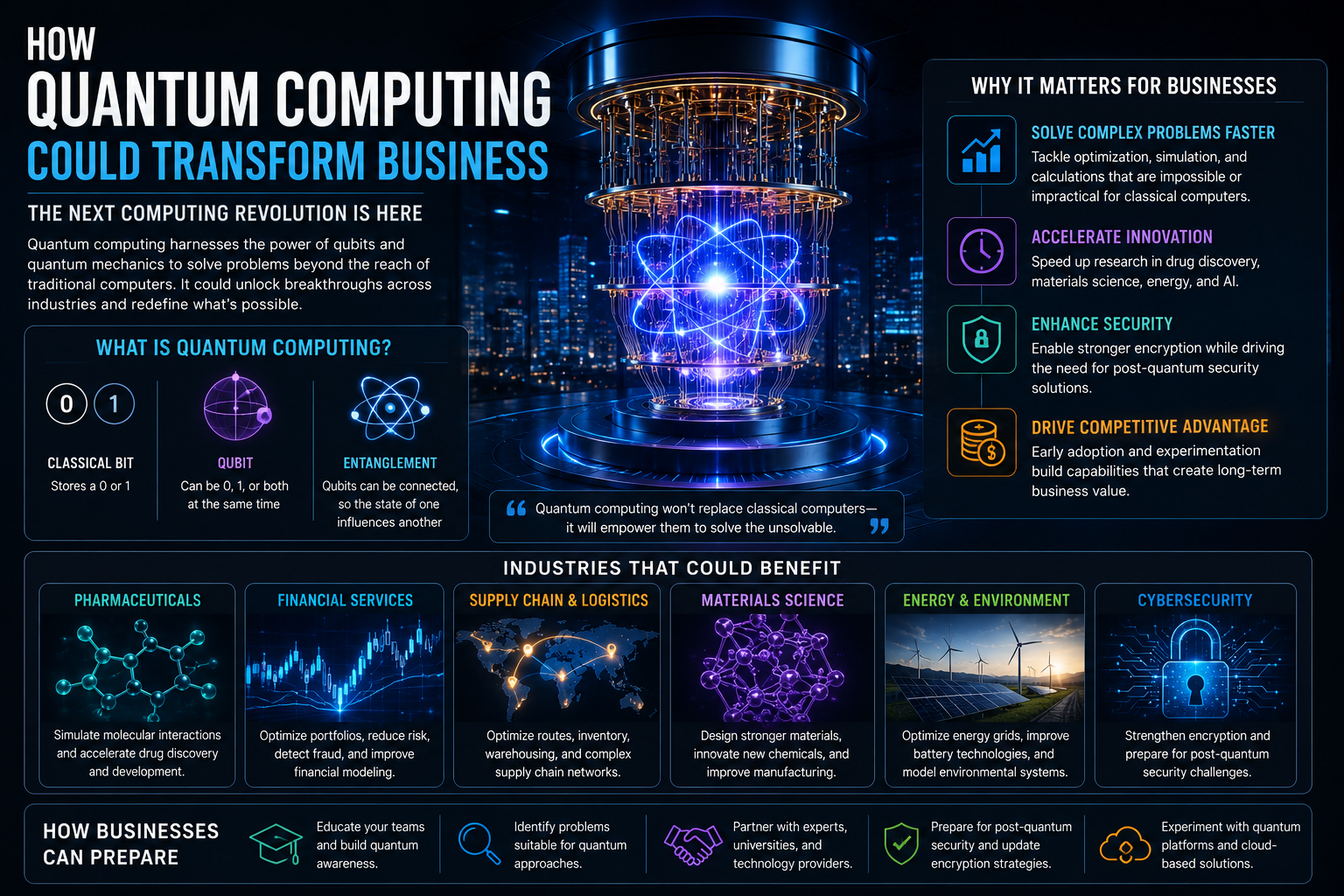
Quantum computing is moving from a highly specialized research field toward a technology that businesses are beginning to take seriously. While conventional computers process information using bits represented as zeros and ones, quantum computers use quantum bits, or qubits, to approach certain computational problems in fundamentally different ways.
The technology is still developing, and practical large-scale quantum computing remains challenging. However, companies across finance, pharmaceuticals, logistics, materials science, cybersecurity, and technology are already exploring potential applications.
For business leaders, the important question is no longer simply whether quantum computing will become commercially useful. It is how organizations should prepare for a technology that could eventually change the way some of the world's most difficult computational problems are addressed.
Understanding the Quantum Computing Opportunity
Traditional computers have become extraordinarily powerful, but some problems remain difficult because the number of possible combinations can become enormous.
Optimization is one example.
A logistics company may need to determine the most efficient routes for thousands of deliveries. An investment firm may need to evaluate countless portfolio combinations. A manufacturer may need to determine the most efficient allocation of materials and production resources.
Quantum computing could eventually provide new approaches to certain complex optimization and simulation problems.
This does not mean quantum computers will replace conventional computers. Instead, they are more likely to become specialized tools used alongside existing computing infrastructure.
Why Businesses Are Paying Attention
The potential value of quantum computing comes from its ability to address certain problems that become increasingly difficult as their complexity grows.
Industries that rely heavily on simulation, optimization, and advanced mathematical modeling could be particularly interested.
Pharmaceutical companies, for example, spend significant resources studying how molecules interact. Better computational methods could potentially accelerate parts of the drug-discovery process.
Financial institutions could explore quantum approaches to portfolio optimization and risk modeling.
Manufacturers could investigate complex production and supply-chain optimization.
Energy companies could examine new materials, grid optimization, and complex simulations.
These applications remain areas of research rather than guaranteed commercial outcomes, but their potential explains why businesses are investing in quantum readiness.
Quantum Computing and Drug Discovery
Pharmaceutical research is frequently mentioned as one of the most promising areas for quantum computing.
Understanding molecules and chemical interactions can require enormous computational resources. Traditional computing methods can simulate many systems, but increasingly complex molecular problems can become difficult to model efficiently.
Quantum computers may eventually provide new ways to simulate certain quantum-mechanical systems.
If these capabilities mature, researchers could potentially use quantum computing to explore molecular structures, chemical reactions, and potential drug candidates more efficiently.
The impact could extend beyond pharmaceuticals to materials science, agriculture, energy storage, and industrial chemistry.
However, businesses should recognize that useful quantum applications require significant advances in hardware, error correction, algorithms, and software.
Financial Services Could Be an Early Adopter
The financial industry has another reason to explore quantum computing: optimization.
Financial institutions regularly analyze enormous numbers of possible scenarios involving portfolios, risk, pricing, and investment strategies.
Quantum algorithms may eventually help solve certain optimization problems more efficiently.
For example, an investment manager might need to balance expected returns against risk while considering hundreds or thousands of constraints.
A sufficiently capable quantum system could potentially provide new approaches to these calculations.
Banks and financial institutions are therefore researching quantum technologies even though widespread commercial deployment remains uncertain.
The organizations that begin experimenting early may gain valuable expertise before the technology becomes mature.
Supply Chain Optimization
Global supply chains involve enormous numbers of variables.
Businesses need to determine where inventory should be stored, how products should be transported, which suppliers should be selected, and how production capacity should be allocated.
As the number of locations, products, vehicles, and constraints increases, finding an optimal solution becomes increasingly difficult.
Quantum computing could eventually provide new approaches to some of these optimization problems.
A future logistics system might combine conventional AI and optimization software with quantum processors to evaluate particularly complex calculations.
The result could be more efficient routing, inventory allocation, scheduling, and resource management.
This is one reason quantum computing may eventually become part of broader enterprise technology rather than operating as an isolated system.
Quantum Computing and Artificial Intelligence
Quantum computing and artificial intelligence are often discussed together, but they are different technologies.
AI systems learn patterns from data and perform tasks such as prediction, classification, language processing, and decision support.
Quantum computing focuses on performing certain computations using quantum mechanical principles.
However, there may be opportunities for the technologies to complement each other.
AI could help businesses determine which problems are suitable for quantum approaches. Quantum systems could potentially accelerate certain mathematical operations used in advanced machine-learning workflows.
Researchers are exploring quantum machine learning, although practical advantages over conventional AI remain an active area of investigation.
The broader opportunity may therefore be a hybrid computing environment in which CPUs, GPUs, AI accelerators, and quantum processors each perform the tasks they are best suited for.
Cybersecurity Is Becoming a Strategic Concern
Quantum computing also creates a cybersecurity challenge.
Some current encryption methods depend on mathematical problems that are extremely difficult for conventional computers to solve. A sufficiently powerful quantum computer could eventually threaten certain widely used cryptographic techniques.
This possibility is encouraging organizations to prepare for post-quantum cryptography.
Businesses do not need to wait for a large-scale quantum computer to appear before considering the issue.
Sensitive information may need to remain protected for many years. Data encrypted today could potentially be collected by attackers and targeted for decryption in the future if quantum capabilities become sufficiently advanced.
Organizations should therefore begin understanding their cryptographic dependencies and monitoring the transition toward quantum-resistant security standards.
The Hardware Challenge
One of the biggest obstacles to quantum computing is hardware.
Qubits are extremely sensitive to environmental interference. Maintaining stable quantum states is difficult, and quantum systems can experience errors during computation.
Researchers and technology companies are working on different approaches to building more reliable quantum computers.
Improving the number and quality of qubits is important, but simply increasing qubit counts does not automatically produce a commercially useful system.
Error correction is another major challenge.
Large-scale useful quantum computing may require sophisticated techniques that use additional physical resources to create more reliable logical qubits.
This means the path to practical quantum computing is likely to involve continued research and engineering breakthroughs.
Why Businesses Should Start Preparing Now
Although mainstream quantum computing may still be years away, businesses can begin preparing without purchasing quantum hardware.
The first step is education.
Technology leaders should understand the basic principles of quantum computing and identify areas of their business that involve complex optimization, simulation, or cryptography.
Organizations can also begin experimenting with quantum development environments and cloud-based quantum platforms where appropriate.
The objective is not necessarily to achieve immediate commercial results.
Early experimentation can help companies build internal expertise and understand which future applications may be relevant to their industries.
Quantum Readiness Will Become a Competitive Skill
As quantum technology develops, companies may face a growing skills gap.
Organizations will need professionals who understand quantum algorithms, software development, mathematics, cybersecurity, and industry-specific applications.
Businesses do not necessarily need large internal quantum teams today.
Instead, they can begin by developing partnerships with universities, technology providers, research organizations, and specialized consultants.
Building relationships early can make it easier to access expertise as the technology matures.
The Role of Cloud Computing
Cloud computing could make quantum technology more accessible.
Businesses may not need to own expensive quantum hardware. Instead, they could access quantum processors through cloud platforms when specific use cases become commercially viable.
This model is similar to how companies access conventional computing infrastructure today.
A hybrid architecture could eventually allow applications to send certain calculations to quantum processors while using conventional cloud infrastructure for data storage, AI, application management, and other tasks.
This could make quantum computing easier for businesses to experiment with.
Quantum Computing Will Not Replace Traditional Computing
One common misconception is that quantum computers will eventually replace today's computers.
That is unlikely.
Quantum computing is better understood as a specialized computational technology.
Most everyday business applications will continue to depend on conventional processors, cloud infrastructure, GPUs, and AI accelerators.
Quantum processors may be used for particular categories of problems where they offer meaningful advantages.
The future is therefore likely to be heterogeneous.
Businesses could use several types of computing infrastructure together, selecting the appropriate technology according to the problem being solved.
The Importance of Responsible Adoption
Businesses should avoid treating quantum computing as a guaranteed shortcut to solving every difficult problem.
The technology is still developing, and commercial benefits will depend on hardware progress, software maturity, algorithm development, and the availability of suitable business applications.
Companies should therefore approach quantum adoption strategically.
Pilot projects, research partnerships, employee education, and cybersecurity planning can provide useful preparation without requiring unrealistic investment.
The organizations that understand both the opportunities and limitations of quantum technology will be better positioned to make informed decisions.
The Future of Quantum-Powered Business
Over the next decade, quantum computing could become an important component of advanced enterprise technology.
Pharmaceutical companies may explore molecular simulation. Financial institutions may investigate complex optimization. Manufacturers could examine production problems. Logistics companies may experiment with routing and scheduling. Energy organizations could study materials and infrastructure challenges.
The technology may also influence cybersecurity as organizations transition toward quantum-resistant encryption.
However, the biggest transformation may not come from quantum computing alone.
Its real value could emerge when quantum processors operate alongside artificial intelligence, cloud computing, high-performance computing, and advanced analytics.
Businesses that begin learning about these technologies now can build the knowledge necessary to recognize valuable opportunities when the technology becomes more mature.
Conclusion
Quantum computing represents one of the most significant emerging technologies in the long-term evolution of business computing.
It is not yet a universal replacement for conventional computers, and many technical challenges remain. Nevertheless, its potential applications in optimization, drug discovery, finance, logistics, materials science, cybersecurity, and advanced simulation make it an area worth watching.
For businesses, preparation does not necessarily mean investing heavily in quantum hardware today. It means understanding the technology, identifying relevant use cases, developing specialized skills, preparing for post-quantum cybersecurity, and monitoring advances in the field.
As computing continues to evolve, competitive advantage may increasingly depend on using different forms of technology together.
Quantum computing could eventually become one part of that broader technological ecosystem, giving businesses new ways to approach problems that have traditionally been difficult or expensive to solve