Financial markets have always rewarded investors who can process information effectively. But in 2026, the competitive advantage is increasingly shifting from simply having access to data to being able to interpret and act on it quickly.
Markets generate enormous quantities of information every second. Prices change continuously, companies release new information, economic indicators are updated, earnings calls generate fresh signals, and alternative datasets provide new clues about business activity.
Artificial intelligence is making it possible to process much of this information at unprecedented speed.
Modern investment platforms can combine market data, company filings, news, earnings transcripts, alternative data, and AI-powered analytics to produce insights for portfolio managers and investors. Recent research from BlackRock highlights the expanding use of machine learning, large language models, text analytics, and alternative data in systematic investing.
This is changing the investment process from a largely periodic activity into a more continuous intelligence system.
What Is Real-Time Financial Data?
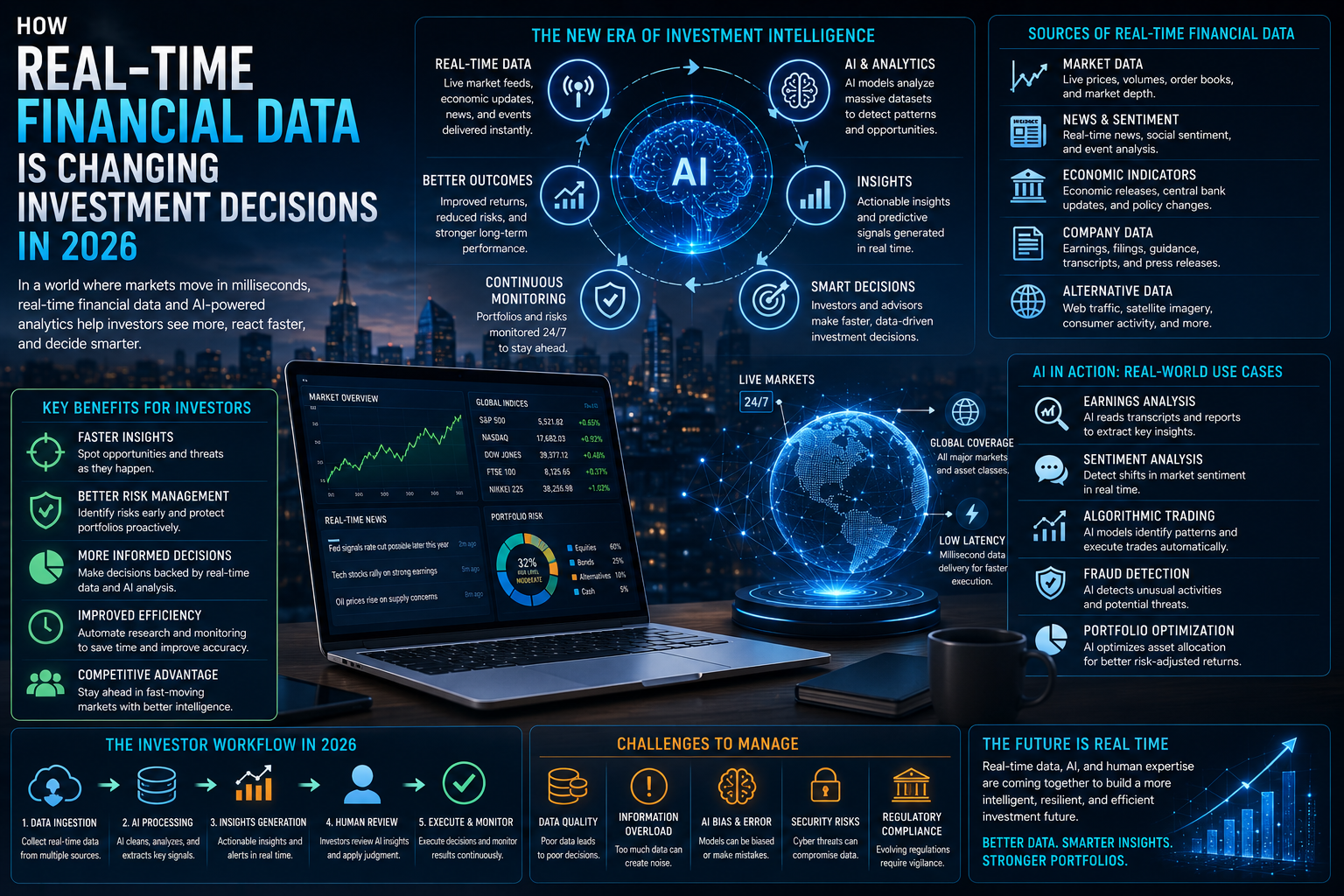
Real-time financial data refers to information that is delivered with minimal delay as market or economic events occur.
It can include:
Stock and bond prices
Trading volumes
Currency movements
Commodity prices
Economic indicators
Company announcements
Earnings information
Market sentiment
Order-book activity
Alternative datasets
Traditional investment research often relied on information that was updated periodically.
Today, investors can increasingly monitor financial conditions continuously.
The difference is important because markets can react within seconds or minutes to new information.
Why Speed Matters in Modern Markets
Investment decisions are influenced by changing information.
When a company announces unexpected earnings results, investors immediately reassess its outlook.
When central banks change monetary policy expectations, bond and currency markets can respond rapidly.
When geopolitical developments affect commodities or supply chains, prices can adjust before traditional research teams have completed their analysis.
Real-time data allows investors to see these changes sooner.
However, speed alone does not create better investment decisions.
The real advantage comes from combining speed with context, accuracy, and disciplined analysis.
AI Turns Data Into Intelligence
The biggest transformation is not simply faster data delivery.
It is the ability to process large quantities of information automatically.
AI models can analyze financial documents, earnings calls, market news, and other unstructured information and identify relevant themes.
MSCI described this shift in July 2026 as the closing of the gap between raw data and actionable investment intelligence.
An investment professional can therefore spend less time collecting information and more time evaluating what it means.
The Rise of Alternative Data
Alternative data has become increasingly important for institutional investors.
Instead of relying only on traditional financial statements and market prices, investors can examine information such as:
Web traffic
Consumer activity
Satellite imagery
Hiring trends
Product pricing
App usage
Supply-chain information
Social sentiment
Geolocation patterns
These datasets can provide signals about a company's performance before those developments appear in conventional financial reports.
T. Rowe Price notes that alternative data can provide more timely and granular information about companies and industries, while AI can accelerate the extraction of insights from these datasets.
AI-Powered Earnings Analysis
Corporate earnings announcements generate enormous amounts of information.
An earnings release may be accompanied by:
Financial statements
Management commentary
Investor presentations
Earnings-call transcripts
Analyst questions
Guidance updates
AI can process these materials rapidly.
Instead of manually reading every document, an analyst can use AI to identify changes in revenue, margins, guidance, management sentiment, and strategic priorities.
The analyst can then investigate the most important developments.
This can significantly reduce research time.
Real-Time Market Sentiment
Market sentiment can change quickly.
AI systems can analyze large volumes of text from financial news, company communications, and other permitted data sources to identify changing sentiment.
For example, an AI system may detect that discussion around a company has shifted from positive to negative.
This does not necessarily predict the stock's future performance.
But it can provide another signal for investment research.
The important principle is to treat sentiment as one input among many, rather than as a standalone trading signal.
AI and Portfolio Monitoring
Portfolio managers cannot manually monitor every position continuously.
AI can help by tracking portfolios against predefined objectives.
It can identify:
Unexpected concentration
Changing correlations
Volatility increases
Sector exposure
Currency exposure
Liquidity changes
Emerging risk factors
A portfolio manager can receive an alert when an important characteristic changes.
This creates a more proactive approach to risk management.
Real-Time Risk Management
Investment risk can change rapidly.
A portfolio that appears well diversified under normal conditions may become more correlated during market stress.
AI can monitor relationships between assets and identify unusual changes.
It can also run scenario analyses.
For example:
What happens if interest rates rise sharply?
What happens if oil prices increase significantly?
What happens if a major currency falls?
Scenario analysis can help investors understand vulnerabilities before a market event occurs.
Algorithmic Trading
Real-time data is especially important for algorithmic trading.
Trading systems can analyze market information and execute predefined strategies automatically.
AI can potentially improve these systems by identifying more complex patterns.
However, faster automated trading can also increase market interconnectedness.
The IMF has warned that AI is increasingly embedded in trading and investment decisions and that the same technologies that improve efficiency during normal conditions could amplify market stress when many participants respond similarly.
This makes risk controls essential.
AI-Powered Investment Research
Investment research is moving toward interactive systems.
Instead of searching through multiple databases, an analyst can ask an AI system questions about a company or sector.
For example:
“What changed in this company's outlook over the last four quarters?”
The system can analyze relevant documents and summarize the changes.
AI research copilots are already being introduced for institutional investment workflows. Nasdaq reported the launch of an AI-powered investment research copilot designed to synthesize proprietary data and provide more immediate investment intelligence.
The Importance of Data Quality
More data does not automatically mean better decisions.
Bad data can produce bad conclusions.
Alternative data can contain:
Errors
Duplicates
Missing information
Outdated information
Manipulated content
Sampling bias
This makes data validation critical.
Institutional investors need to understand where datasets come from, how frequently they are updated, and what their limitations are.
The Problem of AI-Generated Noise
AI itself is creating a new challenge.
The internet contains increasingly large quantities of AI-generated content.
This can make alternative data more difficult to trust.
Institutional Investor highlighted concerns in 2026 about AI-generated misinformation, deepfakes, and malicious AI-driven activity contaminating the digital ecosystems that investors increasingly use for alternative-data signals.
This means future investment systems will need not only powerful analytics but also strong data-authenticity controls.
Real-Time Data and Institutional Investing
Large asset managers are increasingly integrating AI and alternative data into investment processes.
BlackRock describes systematic investing as a combination of alternative data, data science, scientific testing, and human investment expertise.
The model is not simply:
AI makes the investment decision.
It is closer to:
Data → AI analysis → investment signal → human evaluation → portfolio decision.
This combination can provide scale while retaining professional judgment.
AI and Human Investment Professionals
AI does not eliminate the need for investment professionals.
Instead, it changes what they spend their time doing.
An analyst who previously spent hours collecting and organizing information can focus more on:
Investment thesis development
Company meetings
Scenario analysis
Risk assessment
Portfolio construction
Client communication
The technology effectively becomes a research assistant.
The human remains responsible for judgment.
Real-Time Data for Retail Investors
The benefits of real-time financial intelligence are also becoming more accessible to individual investors.
Modern investment applications can provide:
Live market information
Portfolio analytics
News alerts
AI research tools
Risk dashboards
Personalized explanations
This can make sophisticated information easier to understand.
However, greater access also creates a risk of information overload.
Retail investors may be tempted to react to every market movement.
Better technology should therefore encourage disciplined decision-making rather than constant trading.
The Danger of Overreaction
Real-time information can create behavioral problems.
If investors receive notifications every time an asset moves, they may make decisions based on short-term noise.
AI systems can potentially help by putting events into context.
Instead of simply saying:
“The stock is down 4%.”
an intelligent platform could explain:
What caused the move
Whether the change is unusual
How the movement compares with the sector
Whether long-term fundamentals have changed
This can help investors distinguish information from noise.
AI Agents in Investment Management
The next step is the rise of AI agents.
An AI investment agent could continuously monitor approved datasets, analyze portfolio changes, identify risks, and prepare recommendations.
For example, an agent could detect that a portfolio's exposure to one industry has increased significantly and prepare a report for the portfolio manager.
The manager could review the recommendation before making a decision.
This model combines automation with human control.
Alternative Data and Private Markets
Real-time data is also becoming increasingly relevant to private markets.
Private companies do not publish the same quantity of information as public companies.
Alternative data can provide additional clues about:
Customer demand
Hiring
Product adoption
Website activity
Pricing
Supply-chain conditions
AI can analyze these signals to help investors understand private companies and industries.
BlackRock notes that AI-driven approaches are increasingly being used to analyze less-liquid asset classes such as private equity and real estate.
The Role of Governance
As AI becomes more influential in investment decisions, governance becomes essential.
Financial institutions need to know:
Which data sources models use
How models generate outputs
Who approves investment decisions
How models are tested
How errors are identified
How decisions are documented
The CFA Institute's 2026 research emphasizes the importance of model validation, accountability, oversight, and professional standards as AI becomes more deeply integrated into finance.
Cybersecurity and Data Protection
Real-time financial systems can become attractive targets for attackers.
Investment firms need to protect:
Market data
Proprietary research
Trading strategies
Client information
AI models
Data pipelines
A compromised data feed could potentially influence investment decisions.
Security therefore becomes part of investment intelligence.
The Future of Investment Decisions
The future investment workflow could become increasingly continuous.
Instead of reviewing portfolios at fixed intervals, AI systems can monitor markets around the clock.
Instead of waiting for analysts to discover important information, AI can identify relevant developments automatically.
Instead of manually reading thousands of documents, investors can receive prioritized summaries.
The human role moves toward judgment, strategy, and accountability.
Conclusion
Real-time financial data is changing investment decisions by giving investors faster access to market information and enabling AI systems to transform large quantities of data into actionable insights.
Alternative data, machine learning, large language models, sentiment analysis, and automated portfolio monitoring are increasingly becoming part of institutional investment workflows.
But speed is not enough.
Investment decisions still depend on data quality, context, risk management, governance, and human judgment.
The biggest opportunity is therefore not to create systems that react to every market movement.
It is to create intelligent platforms that identify which information matters, why it matters, and what investors should investigate next.
As financial markets become faster and more interconnected, the firms that can combine real-time information with reliable AI, disciplined investment processes, and strong governance may gain a significant advantage.
In 2026, investment intelligence is becoming less about collecting more information and more about turning information into trusted decisions.