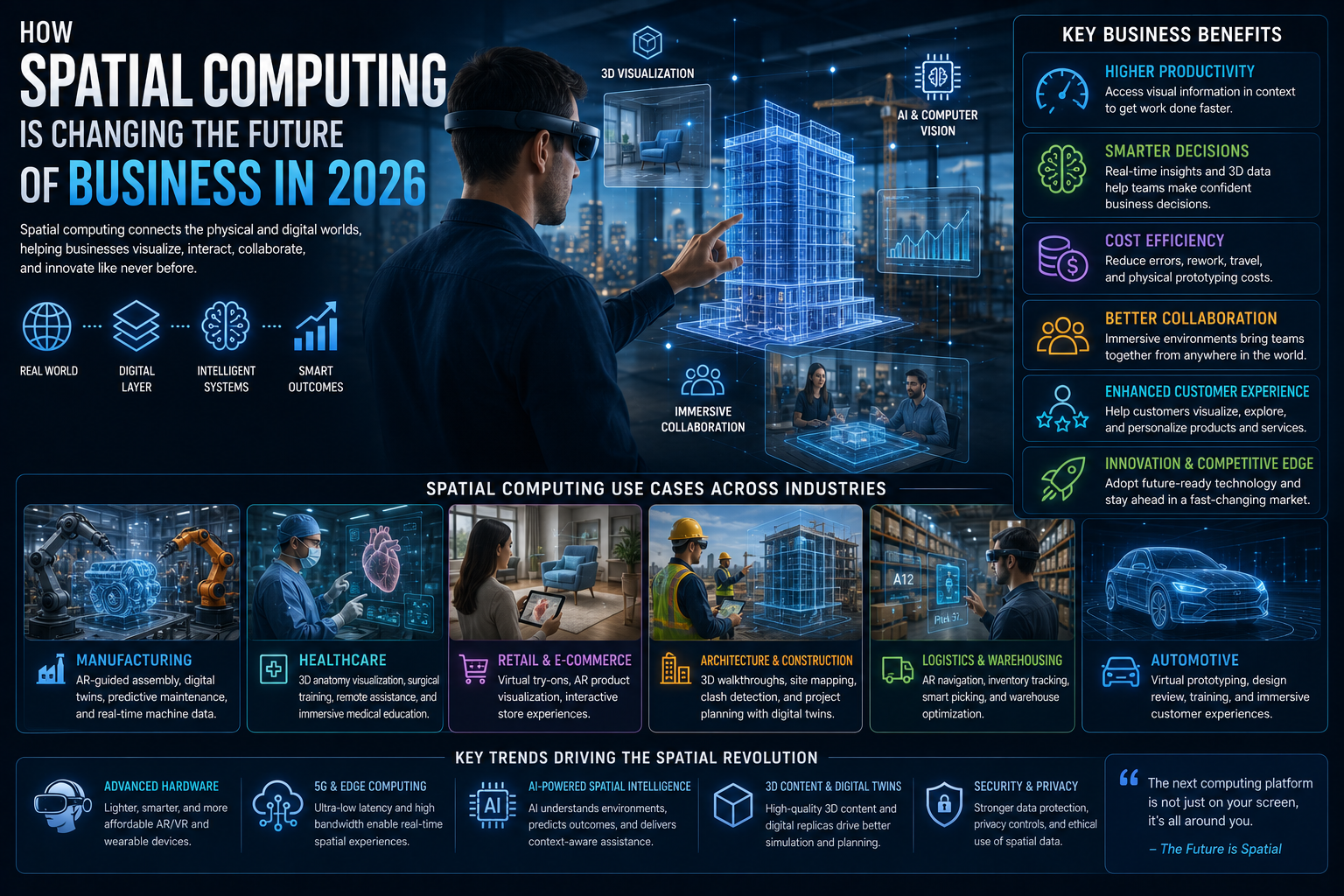
Spatial computing is moving from an emerging technology concept toward a practical business tool. By combining augmented reality, virtual reality, mixed reality, computer vision, artificial intelligence, sensors, and three-dimensional digital environments, spatial computing allows people and machines to interact with digital information in physical space.
For businesses, this represents a significant shift. Traditional software operates primarily through screens, windows, menus, and dashboards. Spatial computing can place digital information directly into the environment where work is happening.
A technician could see repair instructions overlaid on a machine. An architect could examine a building before construction begins. A retailer could allow customers to visualize products in their homes. A global team could collaborate around a shared three-dimensional model.
In 2026, spatial computing is becoming increasingly relevant to industries looking for more immersive, efficient, and intelligent ways to work.
What Is Spatial Computing?
Spatial computing refers to technologies that allow computers to understand and interact with physical environments while presenting digital information in spatial contexts.
It can involve:
Augmented reality
Virtual reality
Mixed reality
Computer vision
3D modeling
Artificial intelligence
Spatial mapping
Sensors
Wearable devices
Instead of treating digital information as something confined to a flat screen, spatial computing connects digital content with physical surroundings.
This creates a more natural interaction between humans, software, and machines.
Why Businesses Are Paying Attention
Businesses are constantly searching for ways to improve productivity, training, customer experiences, product development, and collaboration.
Spatial computing can provide new approaches to all of these areas.
A manufacturing company, for example, could use a three-dimensional digital model to identify design problems before producing a physical prototype.
A healthcare organization could use immersive visualization for training.
A logistics company could provide warehouse workers with digital navigation and product information.
The technology can therefore have practical applications across multiple industries.
Spatial Computing and AI
Artificial intelligence is making spatial computing significantly more powerful.
Computer vision can help systems understand objects and environments.
AI can interpret visual information and recognize patterns.
Generative AI can create digital content.
Together, these technologies can produce more intelligent spatial experiences.
Imagine a technician wearing smart glasses while repairing equipment.
The system could identify the machine, understand the technician's task, retrieve the appropriate documentation, and display relevant instructions in the technician's field of view.
This is more than displaying information.
It is contextual computing.
Transforming Manufacturing
Manufacturing is one of the strongest use cases for spatial computing.
Factories contain complex machinery, production lines, components, and safety procedures.
Spatial technologies can help workers understand these environments.
Digital overlays can display instructions directly on equipment.
Workers can potentially identify components without constantly consulting manuals or separate screens.
Engineers can also use 3D environments to evaluate factory layouts.
This can help organizations identify potential inefficiencies before making expensive physical changes.
Digital Twins and Spatial Computing
Digital twins are closely connected to spatial computing.
A digital twin is a digital representation of a physical object, system, or environment.
Spatial computing can make these digital models easier to visualize and interact with.
For example, a company could create a digital representation of a factory.
Managers could explore the virtual factory, examine equipment, analyze production flows, and simulate changes.
AI could then analyze the digital environment and identify potential improvements.
This combination of AI + digital twins + spatial computing could become an important technology stack for industrial businesses.
Improving Employee Training
Employee training can be expensive and time-consuming, particularly when employees need to learn complex procedures.
Spatial computing allows organizations to create immersive training environments.
An employee could practice operating machinery in a simulated environment before working with the actual equipment.
A technician could practice emergency procedures without creating real-world risks.
A healthcare worker could train using realistic virtual scenarios.
This creates opportunities for repeated practice without requiring physical equipment or facilities for every training session.
Retail and Customer Experience
Retailers are also exploring spatial technologies.
Customers increasingly want to understand how products will look and function before purchasing them.
Augmented reality can allow customers to visualize products within their own environments.
For example, someone buying furniture could see how a sofa might appear in their living room.
A fashion retailer could offer virtual product visualization.
Automotive companies can create immersive experiences that allow customers to explore vehicle interiors and features.
Spatial computing can therefore reduce the distance between digital shopping and physical product experiences.
Architecture and Construction
Architecture and construction can benefit significantly from three-dimensional visualization.
Traditional blueprints can communicate important information, but three-dimensional environments can make complex designs easier to understand.
Architects can walk through virtual buildings before construction begins.
Construction teams can compare digital models with physical environments.
Project managers can identify potential conflicts before they become expensive construction problems.
This can reduce errors and improve communication between designers, engineers, contractors, and clients.
Healthcare Applications
Healthcare is another area where spatial computing can provide value.
Medical professionals can use three-dimensional visualizations to understand complex anatomical structures.
Training programs can create immersive simulations.
Surgeons and specialists may use advanced visualization systems to support planning and education.
The technology can also support remote collaboration by allowing specialists in different locations to interact with shared digital models.
Healthcare applications require particularly strong safety, privacy, and regulatory controls, but the potential is substantial.
Remote Collaboration
Hybrid work has created demand for better collaboration tools.
Video meetings provide communication, but they remain largely two-dimensional.
Spatial computing can create shared virtual environments where participants interact with digital objects.
An engineering team in different countries could examine the same 3D product model.
A design team could review a virtual prototype together.
Executives could explore an interactive visualization of a business environment.
This could create richer collaboration experiences for teams working across geographical boundaries.
Spatial Computing and Product Development
Product development often requires repeated prototyping.
Physical prototypes can be expensive and slow to produce.
Spatial computing can help teams visualize concepts digitally before manufacturing physical versions.
Designers can evaluate size, shape, functionality, and interaction.
AI can generate design variations and help identify potential improvements.
This can accelerate experimentation.
Companies can test more ideas before committing resources to physical production.
Logistics and Warehousing
Warehouses contain large amounts of inventory that employees need to locate, move, and manage efficiently.
Spatial computing can provide workers with visual guidance.
Smart glasses could potentially show where an item is located or which route should be followed.
Computer vision can identify products and storage areas.
AI can optimize workflows based on inventory movement and operational conditions.
This combination could improve warehouse efficiency while reducing the amount of time employees spend searching for information.
Automotive and Transportation
Automotive companies are increasingly using digital environments throughout the product lifecycle.
Designers can visualize vehicles in three dimensions.
Engineers can simulate components.
Manufacturers can train employees using immersive systems.
Customers can explore vehicles virtually before purchasing.
Spatial computing can therefore connect design, engineering, manufacturing, marketing, and customer experience.
The same principles can apply to aerospace, transportation infrastructure, and other complex industries.
Spatial Computing in Education
Businesses are not the only organizations that can benefit.
Education and corporate learning can use spatial environments to create interactive experiences.
Instead of reading about a complex machine, students could explore a virtual version.
Employees could practice procedures in simulated environments.
This approach can make certain forms of learning more engaging and experiential.
The Rise of Spatial AI
The next stage of spatial computing is likely to involve spatial AI.
Spatial AI combines artificial intelligence with an understanding of physical environments.
A spatial AI system does not simply recognize an object.
It can potentially understand where the object is, how it relates to other objects, and what is happening around it.
For businesses, this could enable more intelligent automation.
A warehouse robot could understand its environment.
An industrial AI system could identify abnormal equipment conditions.
An AR assistant could provide context-sensitive instructions.
This creates a bridge between digital intelligence and the physical world.
Smart Glasses and Wearable Computing
Wearable devices could become one of the most important interfaces for spatial computing.
Smart glasses can provide digital information without requiring users to constantly look at a phone or computer.
For workers, this can be particularly valuable.
A technician can keep their hands available while accessing instructions.
A warehouse worker can receive navigation information while moving through the facility.
A field engineer can communicate with a remote specialist while viewing equipment.
As hardware becomes smaller and more capable, enterprise adoption could increase.
Challenges for Businesses
Despite its potential, spatial computing has challenges.
Hardware Costs
Advanced headsets and enterprise devices can still be expensive.
Employee Adoption
Workers need comfortable and intuitive interfaces.
Data Privacy
Spatial systems can collect information about environments, people, and behavior.
Security
Connected devices create additional cybersecurity risks.
Content Creation
Companies need high-quality 3D models and digital content.
Integration
Spatial systems need to connect with existing enterprise software.
Businesses therefore need to evaluate whether a particular use case provides enough value to justify the investment.
Privacy and Security
Spatial computing introduces new privacy questions.
Cameras and sensors can capture detailed information about physical environments.
Devices may also collect information about user movement, gaze, voice, and interaction.
Organizations need clear policies about what information is collected, where it is stored, and who can access it.
Security controls should protect both corporate data and employee information.
Responsible deployment will become increasingly important as spatial technologies become more capable.
The Business Case for Spatial Computing
Companies should not adopt spatial computing simply because it is technologically impressive.
The strongest business cases will focus on measurable outcomes.
Potential metrics include:
Reduced training time
Lower equipment downtime
Faster product development
Fewer operational errors
Improved employee productivity
Reduced travel
Higher customer engagement
Lower prototyping costs
A focused pilot can help companies determine whether the technology delivers real value.
How Companies Can Start
Businesses can begin with a single high-value use case.
For example:
Identify a process that depends heavily on visual information.
Determine whether 3D or immersive interaction could improve it.
Create a small pilot.
Measure productivity and user experience.
Connect the system with existing enterprise data.
Expand only after measurable results are demonstrated.
This approach reduces unnecessary technology spending and creates a clearer path toward adoption.
The Future of Business Computing
The long-term impact of spatial computing could be significant because it changes how people interact with software.
For decades, businesses have primarily interacted with digital systems through keyboards, mice, touchscreens, and flat displays.
Spatial computing introduces another possibility.
Digital information can become part of the physical environment.
AI can understand the environment.
Sensors can capture context.
Wearable devices can display information.
Robots and machines can respond.
Together, these technologies create a more connected relationship between the physical and digital worlds.
Conclusion
Spatial computing is becoming an important part of the next generation of business technology.
By combining augmented reality, virtual reality, mixed reality, artificial intelligence, computer vision, digital twins, and 3D environments, businesses can create new ways to train employees, design products, manage operations, collaborate, and engage customers.
The technology is especially promising in industries where visual information and physical environments are central to everyday work.
Manufacturing, healthcare, retail, construction, logistics, automotive, education, and professional services can all explore different applications.
However, successful adoption will depend on more than advanced hardware.
Companies will need strong data governance, cybersecurity, privacy protections, employee training, and clear business objectives.
The biggest opportunity may come from combining spatial computing with AI.
AI can understand what is happening.
Spatial computing can show that intelligence where it matters.
Together, they can transform software from something employees simply look at into something they can see, interact with, and experience within the real world.
In 2026, spatial computing is moving closer to that vision—and businesses that begin experimenting with practical use cases today could gain an advantage as computing increasingly moves beyond the screen.
in 2026