Online dating has become an important way for LGBTQ people to meet potential partners, make friends, and connect with communities that may be difficult to find through everyday social circles. Today, there are dating platforms specifically designed for LGBTQ users as well as mainstream apps that offer inclusive gender and sexuality options.
Choosing the right platform depends on what you are looking for. Some people want a serious relationship, while others are interested in friendship, community, casual dating, or meeting people with similar identities and interests.
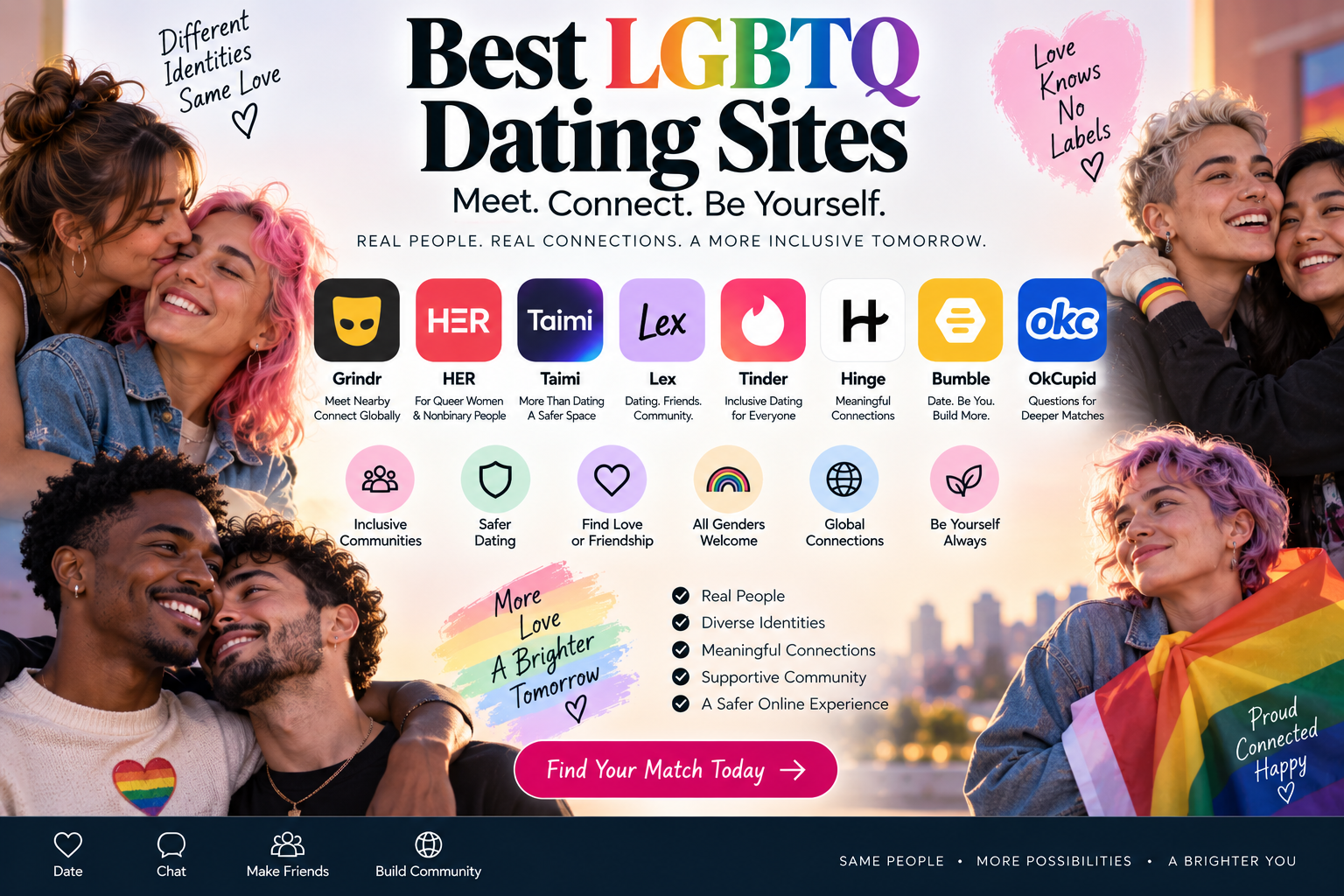
Several platforms have developed strong LGBTQ communities, including Grindr, HER, Taimi, Lex, Tinder, Bumble, Hinge, and OkCupid. Each has a different approach to profiles, matching, communication, and community features.
According to Pew Research Center, 51% of lesbian, gay and bisexual adults in the United States had used a dating site or app as of its 2022 survey, compared with 28% of straight adults. Among LGB adults who had a current or past online dating experience, platform preferences also varied considerably by gender and community. [Source 1]
What Are LGBTQ Dating Sites?
LGBTQ dating sites and apps are online platforms that help lesbian, gay, bisexual, transgender, queer, nonbinary, and other users meet people for dating, relationships, friendship, or community.
Some platforms are designed primarily for particular groups. Others welcome a broad range of LGBTQ identities.
Common features include:
Dating profiles
Gender and sexuality options
Location-based matching
Search filters
Private messaging
Video or voice communication
Profile verification
Blocking and reporting
Community groups
Events and social activities
The most useful platform for one person may be very different from another person's choice because LGBTQ communities are diverse and relationship goals vary.
Why LGBTQ People Use Dating Apps
Online dating can make it easier to find people who share similar identities, experiences, or relationship expectations.
For people living in areas with smaller LGBTQ populations, dating apps can also expand the potential dating pool.
Pew Research Center found that LGBTQ adults are considerably more likely than straight adults to have used online dating. Its research also found that about one-quarter of partnered LGB adults said they met their significant other through online dating. [Source 1]
Dating platforms can also help users identify important information before meeting someone in person.
For example, users may be able to learn about:
Pronouns
Gender identity
Sexual orientation
Relationship goals
Interests
Location
Lifestyle
Dating preferences
This can make initial conversations more comfortable and reduce uncertainty.
Popular LGBTQ Dating Platforms
There is no single dating app that works for every LGBTQ person. The following platforms have different communities and purposes.
Grindr
Grindr is a location-based social networking and dating app serving gay, bisexual, transgender, and queer adults.
The platform uses location information to organize nearby profiles and provides messaging, photo, video, and voice communication features. Grindr also offers search and filtering tools. [Source 2]
Grindr may be relevant for people interested in meeting LGBTQ people nearby, particularly gay and bisexual men, although its broader LGBTQ community includes other identities as well.
Because location-based dating can reveal sensitive information, users should review privacy settings carefully.
HER
HER focuses on queer women, bisexual women, trans women, nonbinary people, and other members of the LGBTQIA+ community.
The platform combines dating with community features, allowing people to meet potential partners, make friends, participate in groups, and communicate with other queer users.
HER says it has more than 15 million users across more than 114 countries and offers profile options that allow users to share information such as pronouns, gender identity, sexual orientation, and Pride-related interests. [Source 3]
HER can therefore be useful for people who want dating and community experiences centered around sapphic and queer communities.
Taimi
Taimi describes itself as an inclusive LGBTQ dating app serving lesbian, gay, bisexual, transgender, queer, and other identities.
The platform combines dating and social networking features and offers users different ways to present their identities and relationship preferences.
Taimi currently reports millions of users worldwide and availability in more than 100 countries. These figures are company-reported and may change over time. [Source 4]
The platform can appeal to users who want a broader LGBTQ environment rather than a service focused on only one specific identity.
Lex
Lex takes a somewhat different approach to online dating.
Rather than relying entirely on traditional swipe-based matching, Lex emphasizes text-based posts, local LGBTQ community connections, friendships, dating, events, and social interaction.
The platform describes itself as a social app for LGBTQ people and says it operates in hundreds of cities worldwide. Users can create posts to look for dates, friends, relationships, activities, or other types of queer connections. [Source 5]
This approach can be particularly interesting for people who prefer starting conversations around interests or community activities rather than relying only on photographs and swiping.
Tinder
Tinder is a mainstream dating app rather than an LGBTQ-only platform, but LGBTQ users are an important part of its user base.
Pew Research found that 26% of LGB adults surveyed had used Tinder, compared with 12% of straight adults. Among LGB women who had used online dating, Tinder was the most commonly reported platform in the Pew study. [Source 1]
Tinder may therefore be useful for LGBTQ users who want access to a large mainstream dating environment while using inclusive profile and discovery options.
Bumble
Bumble is another mainstream dating platform that includes LGBTQ users.
Its broader user base means that experiences can vary depending on location, age group, gender, and relationship goals.
When considering Bumble or another mainstream app, LGBTQ users should review the available gender, sexuality, matching, and privacy settings to determine whether they fit their needs.
Hinge
Hinge focuses heavily on detailed profiles and conversation prompts.
The platform has also introduced updates to its gender options and says it has worked with GLAAD on developing a more inclusive dating experience. Hinge's current help documentation describes efforts to support gender diversity and LGBTQ users. [Source 6]
Hinge may appeal to people who prefer learning more about someone's personality and interests before beginning a conversation.
OkCupid
OkCupid is a mainstream dating platform known for detailed profiles and questions designed to help users describe their preferences and compatibility.
It has historically offered a broad range of gender and orientation options, making it an option for LGBTQ users who want more detailed profile information.
The main advantage of a broad platform can be a larger overall dating pool, although the actual number of suitable matches depends heavily on location.
LGBTQ Dating Sites for Different Goals
Instead of asking which platform is universally best, consider which type of dating experience you want.
Looking for a Serious Relationship
If your goal is a long-term relationship, look for platforms that allow detailed profiles and relationship intentions.
A profile should give you enough information to understand someone's interests, lifestyle, values, and expectations.
Platforms such as Hinge, Taimi, HER, and OkCupid may be worth exploring depending on your identity and location.
Looking for Gay Dating
Gay and bisexual men have several options, including Grindr, Taimi, Lex, Tinder, and other platforms.
Grindr has a particularly large presence within gay, bisexual, trans, and queer communities, while other platforms offer broader social or relationship-focused experiences.
Looking for Lesbian or Sapphic Dating
HER is specifically built around queer women and sapphic communities.
Other options include Lex, Taimi, Tinder, Hinge, and OkCupid.
The right choice may depend on whether you want a dedicated queer community or a larger mainstream dating pool.
Looking for Trans or Nonbinary Dating
Users who are transgender or nonbinary may want to pay particular attention to gender identity options, pronoun fields, profile visibility, and reporting tools.
HER, Taimi, Lex, Hinge, and other platforms provide varying degrees of identity customization.
Before joining, review the platform's current settings and community policies rather than assuming every dating app handles gender identity in the same way.
Looking for LGBTQ Friendship
Dating does not have to be the only goal.
Some LGBTQ platforms include community groups, social discussions, local events, and friendship features.
Lex particularly emphasizes community interaction and local LGBTQ activities, while HER also provides community groups alongside dating features. [Sources 3 and 5]
How to Choose an LGBTQ Dating Site
1. Define Your Goal
Start by deciding what you want.
You might be looking for:
A serious relationship
Marriage
Casual dating
Friendship
LGBTQ community
Travel companions
Local social activities
Knowing your goal makes it easier to select a suitable platform.
2. Consider the Community
Different apps attract different groups.
A platform designed around queer women may not provide the same experience as one heavily used by gay men or a general LGBTQ platform.
Look at the actual profiles available in your location before committing to a paid membership.
3. Check Gender and Sexuality Options
If identity representation matters to you, check how a platform allows users to describe themselves.
Look for:
Gender identity
Pronouns
Sexual orientation
Relationship style
Dating preferences
Profile visibility
These details can make a significant difference to the user experience.
4. Examine Communication Features
Some people prefer traditional messaging.
Others may prefer:
Voice messages
Video calls
Community discussions
Public posts
Comments
Events
Group conversations
Choose the communication style that makes you comfortable.
5. Review Privacy Controls
LGBTQ dating can involve additional privacy considerations for people who are not publicly out or who live in places where LGBTQ identities may face discrimination.
Before using an app, review:
Location settings
Profile visibility
Blocking tools
Reporting systems
Photo privacy
Account security
Data policies
Do not share information publicly that you would not want strangers to know.
LGBTQ Online Dating Safety
Safety is important for everyone using dating platforms.
Pew Research Center found that LGB online dating users reported several unwanted experiences, including unsolicited sexual messages or images, unwanted continued contact, and offensive name-calling. Half of LGB online dating users surveyed also said they had encountered someone they believed was attempting to scam them. [Source 7]
Never Send Money to an Online Match
A person you meet online should not pressure you to send money.
Be particularly cautious about requests involving:
Emergency expenses
Travel costs
Medical bills
Cryptocurrency
Investments
Gift cards
Bank transfers
Romantic interest should never require financial assistance.
Avoid Sharing Sensitive Information
Do not immediately share:
Home address
Banking information
Passwords
Government identification
Workplace security details
Private photographs
Financial documents
You can build trust gradually.
Be Careful With Location Features
Location-based apps can make it easier to meet people nearby, but they can also reveal information about where you live or spend time.
Review the app's location settings and decide how much information you are comfortable sharing.
Use Video Calls Before Meeting
A video call can help confirm that someone is who they claim to be.
It does not guarantee someone's identity or intentions, but it can provide another useful layer of verification.
Meet in Public
For a first meeting, choose a busy public location.
Tell a trusted person where you are going and consider arranging your own transportation.
If the person pressures you to meet somewhere private, reconsider the meeting.
How to Create a Strong LGBTQ Dating Profile
A good dating profile should represent you honestly.
Use recent photographs and write a description that gives potential matches something to talk about.
You might mention:
Your hobbies
Favorite music
Travel interests
Pets
Career interests
Favorite foods
Weekend activities
Relationship goals
Community interests
Avoid putting sensitive personal information in your public profile.
A profile does not need to reveal everything about you immediately.
LGBTQ Dating Across Different Countries
Online dating can connect LGBTQ people internationally, which may be especially useful for people living in smaller communities.
However, international dating requires additional caution.
Before traveling to meet someone:
Verify their identity
Have video conversations
Research the destination
Understand local LGBTQ laws and social conditions
Keep control of your travel documents
Arrange independent accommodation when appropriate
Avoid financial dependence on a new romantic partner
Local laws and social attitudes toward LGBTQ people differ significantly between countries, so research is important before arranging an international meeting.
Free vs Paid LGBTQ Dating Apps
Many dating apps offer free accounts with optional paid features.
Paid plans may provide features such as:
Additional filters
Unlimited interactions
Enhanced discovery
See-who-liked-you features
More profile visibility
Additional messaging tools
However, paying for a subscription does not guarantee better matches or a successful relationship.
Try a free version first when available and determine whether there are enough relevant users in your area.
Common Mistakes to Avoid
Online dating can be more enjoyable when you avoid several common mistakes.
Moving Too Quickly
Strong emotions can develop quickly online, but it is better to allow trust to develop gradually.
Ignoring Red Flags
Do not ignore behavior that makes you uncomfortable simply because you are attracted to someone.
Sharing Too Much
Personal information should be revealed progressively.
Sending Money
Never allow an online romantic connection to pressure you into financial transactions.
Relying Only on Photos
A profile photograph tells you very little about someone's personality or intentions.
Take time to communicate and learn about the person.
Final Thoughts
The best LGBTQ dating site for you depends on your identity, location, relationship goals, preferred communication style, and comfort with different types of online communities.
Grindr serves a large gay, bisexual, trans, and queer community; HER focuses strongly on queer women and sapphic communities; Taimi offers a broad LGBTQ environment; Lex emphasizes local queer community and text-based connections; while Tinder, Bumble, Hinge, and OkCupid provide mainstream dating environments with varying degrees of LGBTQ inclusivity.
Pew Research Center's findings show that LGBTQ adults are active users of online dating and that different groups within the LGBTQ community use different platforms. [Source 1]
Rather than choosing an app based solely on popularity, explore its user base, identity options, privacy controls, communication tools, and relationship focus.
Most importantly, protect your privacy, take your time, and meet new people safely. Online dating can open the door to meaningful relationships and friendships, but a successful connection should develop through mutual trust, honest communication, and respect.
Frequently Asked Questions
1. What are the best LGBTQ dating sites?
Popular LGBTQ-focused and LGBTQ-inclusive options include Grindr, HER, Taimi, Lex, Tinder, Hinge, Bumble, and OkCupid. The most suitable platform depends on identity, location, and relationship goals.
2. Is Grindr only for gay men?
Grindr serves gay, bisexual, transgender, and queer adults. Its community is particularly associated with gay and bisexual men, but the platform describes itself more broadly as an LGBTQ social networking service.
3. What is HER dating?
HER is a dating and community platform focused on queer women, bisexual women, trans women, nonbinary people, and other LGBTQIA+ users.
4. Is Taimi an LGBTQ dating app?
Yes. Taimi describes itself as an inclusive LGBTQ dating app serving lesbian, gay, bisexual, transgender, queer, and other identities.
5. What is Lex dating?
Lex is an LGBTQ social and dating app that emphasizes text-based posts, local community connections, dating, friendship, and events.
6. Can LGBTQ people use Tinder?
Yes. Tinder is a mainstream dating platform used by LGBTQ people. Pew Research found that LGB adults were more likely than straight adults to report having used Tinder in its 2022 survey.
7. Are LGBTQ dating apps safe?
They can be used safely, but no dating platform eliminates all risks. Protect personal information, use privacy controls, watch for scams, and meet new people in public places.
8. How can I identify an LGBTQ dating scam?
Warning signs include requests for money, investment opportunities, repeated emergencies, refusal to video chat, inconsistent stories, pressure to move quickly, or attempts to isolate you from friends and family.
9. Should I share my real name on a dating app?
You can decide how much identifying information you are comfortable sharing. Avoid publishing sensitive information such as your home address, workplace security details, financial information, or identification documents.
10. Can LGBTQ dating apps be used for friendship?
Yes. Several LGBTQ platforms include friendship and community features in addition to dating.
11. Are there LGBTQ dating apps for transgender people?
Several inclusive platforms provide options for transgender and nonbinary users. Check the current gender identity, pronoun, filtering, privacy, and reporting features before choosing an app.
12. What should I put in an LGBTQ dating profile?
Include your genuine interests, hobbies, personality, relationship goals, and the type of connection you are seeking. Avoid sharing sensitive personal information publicly.
13. Are LGBTQ dating apps free?
Many platforms offer free registration or basic features, while optional premium subscriptions may provide additional features. Pricing and features can change, so check the current terms before subscribing.
14. Can I find a serious relationship through an LGBTQ dating app?
Yes. Online dating is used for serious relationships as well as friendship and casual dating. Pew Research found that 24% of partnered LGB adults surveyed said they met their significant other through online dating.
15. What should I do before meeting an online match?
Talk for a reasonable amount of time, consider a video call, avoid sharing sensitive information, meet in a public location, tell someone you trust about your plans, and arrange your own transportation.