
Artificial intelligence is becoming increasingly important to businesses, governments, researchers, and technology companies, but one challenge continues to limit the development of advanced AI systems: access to high-quality data.
AI models need large amounts of information to learn patterns, understand situations, and produce useful results. Yet real-world data can be difficult to collect, expensive to process, restricted by privacy requirements, or unavailable in sufficient quantities.
In 2026, synthetic data is emerging as an important solution.
Synthetic data is artificially generated information designed to reproduce useful characteristics of real-world datasets without necessarily exposing the original information. It can be created using statistical models, simulations, generative AI, and other computational techniques.
For businesses developing AI applications, synthetic data can provide a way to experiment, train systems, test software, and simulate unusual scenarios while reducing some of the limitations associated with traditional datasets.
What Is Synthetic Data?
Synthetic data is information generated artificially rather than collected directly from real-world events.
It can take many forms, including text, images, video, financial transactions, customer records, sensor readings, and simulated environments.
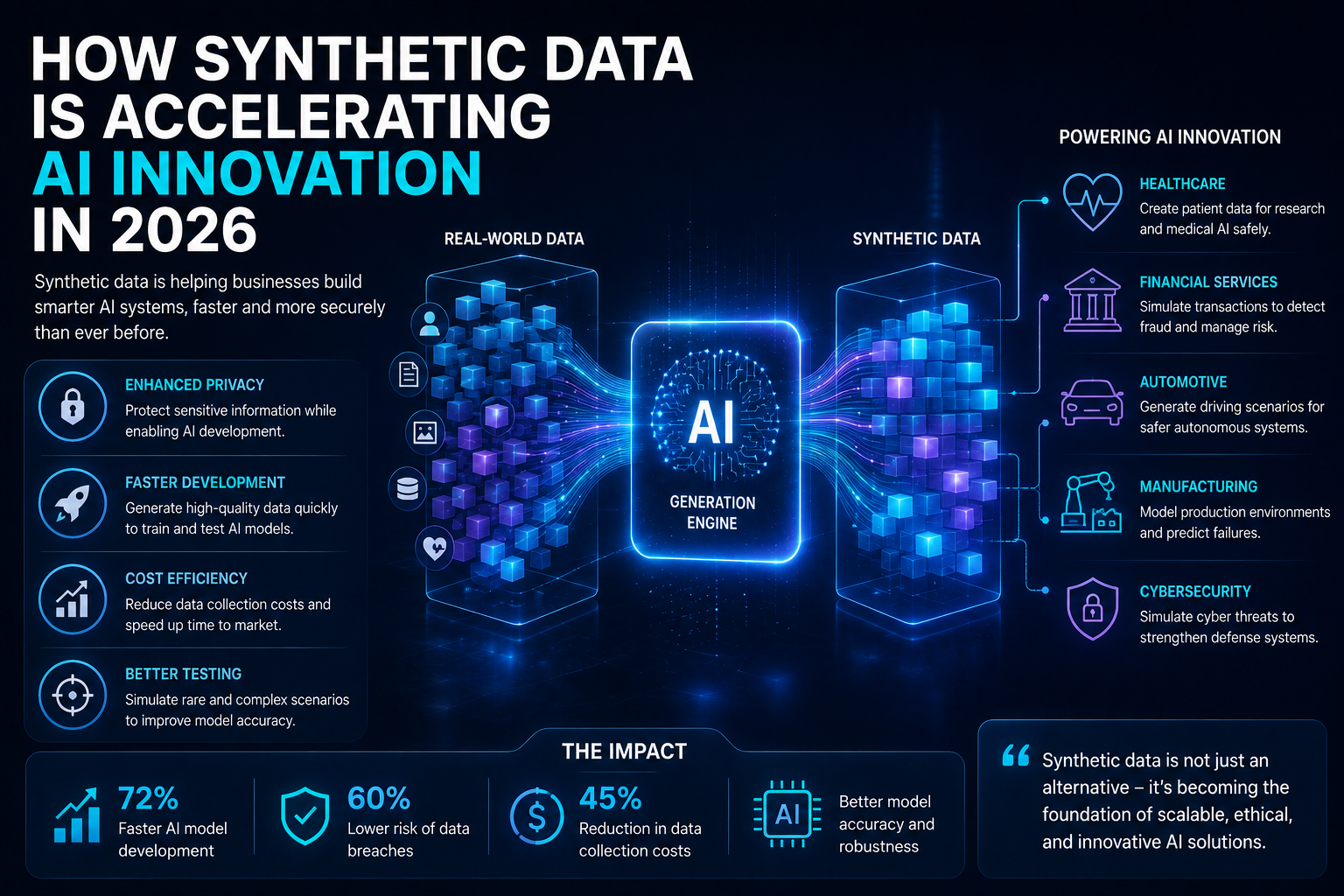
For example, an automotive company developing an AI-powered driving system could generate simulated road conditions, weather patterns, traffic situations, and unexpected events. Instead of waiting for every possible situation to occur in the real world, developers can create thousands of simulated scenarios.
Similarly, a financial institution could generate synthetic transaction patterns to test fraud-detection systems without exposing sensitive customer records.
The objective is not simply to create random information. Effective synthetic data should reproduce relevant patterns and relationships that make the dataset useful for a specific AI application.
Why Synthetic Data Matters in 2026
The growth of AI is increasing demand for specialized datasets.
Many companies have large amounts of internal information, but that data may contain sensitive customer details, confidential business information, or personally identifiable information.
Privacy requirements can make it difficult to use such information freely for AI development.
Synthetic data can provide an alternative environment for testing and experimentation.
Organizations can potentially create datasets that preserve important statistical characteristics while reducing direct exposure to sensitive records.
This can make AI development more flexible, particularly in industries where data access is heavily restricted.
Reducing Data Privacy Risks
Privacy is one of the biggest reasons businesses are exploring synthetic data.
Healthcare, banking, insurance, telecommunications, and government organizations handle information that requires careful protection.
Developers may need realistic datasets to test applications, but giving them unrestricted access to actual customer or patient records may create unnecessary risks.
Synthetic datasets can allow teams to work with realistic-looking information without directly distributing original records.
However, synthetic data is not automatically private or risk-free. Poorly generated datasets may still reveal information about the original data, particularly if the generation process reproduces rare or unique characteristics too closely.
Organizations therefore need appropriate privacy testing and governance before using synthetic data in sensitive environments.
Accelerating AI Model Development
Training AI models can require large and specialized datasets.
When suitable real-world information is unavailable, developers may spend considerable time collecting, cleaning, labeling, and organizing data.
Synthetic data can accelerate this process.
Developers can generate targeted examples for specific use cases and use them to test whether an AI model can recognize particular patterns.
This can be especially useful during the early stages of product development.
Instead of waiting for a large real-world dataset to become available, a development team can create simulated information and begin testing the system immediately.
This can shorten development cycles and allow companies to experiment with more ideas.
Creating Rare and Difficult Scenarios
One of the most valuable applications of synthetic data is the ability to generate situations that are rare in the real world.
Consider cybersecurity.
A company may want to test whether an AI security system can recognize unusual attack patterns. Waiting for those attacks to occur naturally would be inefficient and potentially dangerous.
Synthetic environments can simulate potential threats and allow security systems to be tested under controlled conditions.
The same principle applies to autonomous vehicles, industrial robotics, financial risk management, and disaster-response systems.
AI developers can intentionally create unusual scenarios and evaluate how models respond.
This ability to generate edge cases can help improve system resilience.
Synthetic Data in Healthcare
Healthcare is another area where synthetic data could become increasingly important.
Medical AI systems require high-quality information to identify patterns and support research. However, patient data is highly sensitive and subject to strict privacy requirements.
Synthetic medical datasets can potentially help researchers develop and test algorithms while reducing their reliance on directly sharing identifiable patient information.
Researchers can simulate patient characteristics, medical records, imaging data, or disease patterns for specific research purposes.
The technology does not replace clinical validation. Real-world medical data remains essential for evaluating whether an AI system performs accurately in practice.
Nevertheless, synthetic datasets can provide an additional development and testing resource.
Financial Services and Synthetic Transactions
Financial institutions are also exploring synthetic data for risk analysis and security testing.
Banks and payment providers need to identify suspicious transaction patterns, test fraud-detection systems, and evaluate financial models.
Synthetic transactions can help developers create controlled examples of normal and abnormal activity.
A financial AI system could be tested against thousands of simulated scenarios, including unusual payment behavior, account activity, or transaction patterns.
This provides an opportunity to evaluate system performance without exposing large amounts of real customer information during every stage of development.
Synthetic Data and Robotics
Robotics requires AI systems to understand physical environments.
Training robots entirely through real-world experimentation can be expensive, slow, and potentially unsafe.
Synthetic environments allow developers to simulate factories, warehouses, roads, homes, and other locations.
A robot can then be trained or tested in these virtual environments before being deployed in the physical world.
Developers can also simulate conditions that would be difficult or dangerous to reproduce in reality.
This combination of simulation and AI can help accelerate robotics development while reducing testing costs.
Improving AI Testing
Synthetic data is not only useful for training AI models. It can also improve testing.
Businesses need to know how AI systems behave when conditions change.
Synthetic datasets can be designed to test specific weaknesses.
For example, developers can create data containing missing information, unusual customer behavior, unexpected inputs, or extreme conditions.
The AI system can then be evaluated under those circumstances.
This creates a more systematic approach to testing than relying only on naturally occurring examples.
The Limitations of Synthetic Data
Despite its advantages, synthetic data is not a universal replacement for real-world information.
The quality of synthetic data depends heavily on the methods used to generate it.
If a synthetic dataset fails to capture important characteristics of reality, an AI model trained on it may perform poorly when deployed in real environments.
There is also a risk of reinforcing biases present in the original data. If the generation process learns biased patterns, synthetic datasets may reproduce those problems rather than eliminate them.
For this reason, businesses should evaluate synthetic datasets carefully and compare them with relevant real-world information.
The Importance of Human Oversight
Synthetic data generation increasingly involves sophisticated AI systems, but human expertise remains important.
Data scientists and domain specialists need to determine whether generated information is realistic and useful.
A synthetic dataset may appear statistically convincing while still failing to represent important real-world conditions.
Human reviewers can identify missing scenarios, unrealistic assumptions, or unintended biases.
Organizations should therefore treat synthetic data as a tool that supports data strategy rather than an automatic solution.
Building a Synthetic Data Strategy
Businesses interested in synthetic data can start with specific, measurable use cases.
The first step is identifying a data problem. This could involve privacy restrictions, limited training examples, expensive data collection, or insufficient edge cases.
Next, organizations should determine what characteristics the synthetic dataset needs to reproduce.
The dataset should then be tested against real-world benchmarks where appropriate.
Security, privacy, and governance requirements should also be established.
Finally, companies should measure whether synthetic data actually improves development speed, testing quality, model performance, or operational efficiency.
A focused approach can help organizations understand where the technology delivers genuine value.
The Future of Synthetic Data
As AI systems become more sophisticated, demand for specialized training and testing information is likely to increase.
Synthetic data could become an important component of modern AI infrastructure alongside real-world datasets.
Future AI development may combine multiple sources of information: real-world data, synthetic datasets, simulated environments, and continuously generated examples.
This hybrid approach could give businesses greater flexibility while helping them address privacy, cost, availability, and testing challenges.
The technology could also become increasingly specialized. Instead of generating generic datasets, companies may create highly targeted information for healthcare, finance, manufacturing, robotics, cybersecurity, retail, and other industries.
Conclusion
Synthetic data is becoming an increasingly important part of the AI development landscape in 2026.
By generating realistic information for training, testing, simulation, and experimentation, organizations can address some of the limitations associated with traditional datasets.
Its greatest potential may come from applications where real-world data is expensive, sensitive, difficult to obtain, or too limited to cover rare scenarios.
However, synthetic data should not be treated as a perfect substitute for reality. Effective implementation requires careful validation, privacy controls, quality assessment, and human oversight.
The organizations that use synthetic data strategically can potentially accelerate AI development while creating more flexible and secure testing environments.
As artificial intelligence continues to expand into new industries, synthetic data may become one of the technologies helping businesses move from AI experimentation toward scalable, reliable innovation.