The financial world is entering a new phase of digital transformation. Blockchain technology is moving beyond cryptocurrencies and decentralized applications into areas traditionally dominated by banks, investment firms, payment providers, and capital markets.
One of the most important developments is asset tokenization.
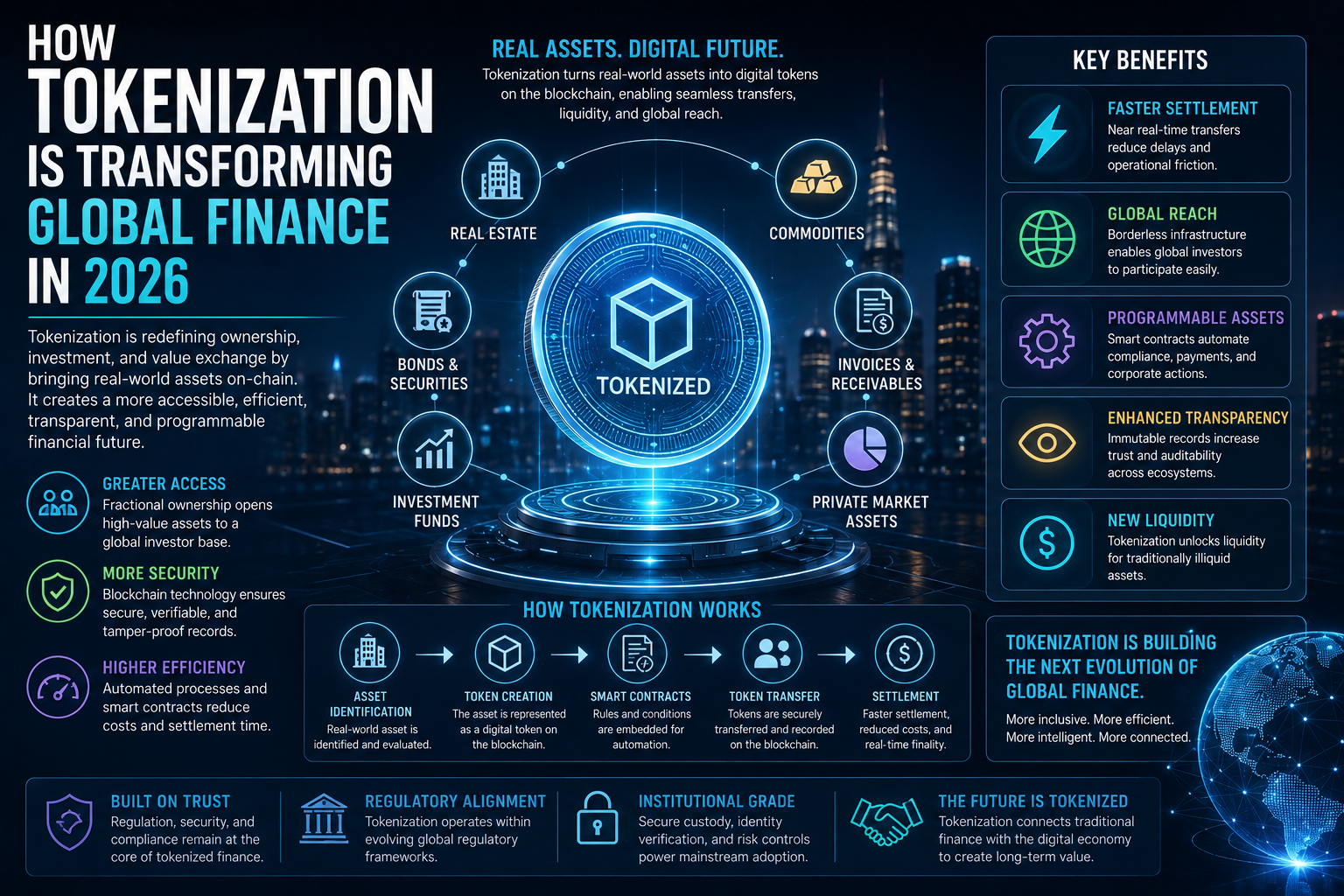
Tokenization refers to representing ownership or economic rights in an asset through digital tokens recorded on a blockchain or similar distributed ledger. These assets can include financial instruments, real estate, commodities, private-market interests, invoices, funds, and other forms of value.
For businesses, tokenization could change how assets are issued, transferred, tracked, and settled.
BullNext already has significant coverage of blockchain and digital-asset infrastructure, including recent reporting on digital trading infrastructure and efforts to connect traditional finance with digital assets.
In 2026, the bigger question is no longer whether assets can become digital. It is how tokenization could reshape the infrastructure of global finance.
What Is Asset Tokenization?
Asset tokenization is the process of creating a digital representation of an asset or financial interest.
A token can represent a claim on an underlying asset, ownership interest, or contractual right, depending on the structure and applicable legal framework.
For example, a real-estate investment could potentially be divided into digital units, allowing investors to hold smaller interests in an underlying property.
Similarly, a fund, bond, or other financial instrument could be represented through blockchain-based tokens.
The technology can provide a programmable record of ownership and transactions while potentially reducing some administrative processes.
Why Tokenization Matters
Traditional financial markets rely on multiple intermediaries.
A transaction can involve brokers, custodians, clearing systems, settlement providers, registrars, and other institutions.
These layers exist for important reasons, including regulation, security, verification, and risk management.
However, they can also create complexity.
Tokenization can potentially combine ownership records, transfer rules, and transaction logic within digital infrastructure.
This could make certain financial processes faster and more automated.
The technology does not necessarily eliminate intermediaries. Instead, it may change the role they play.
Tokenizing Real-World Assets
One of the most discussed applications is the tokenization of real-world assets.
Real estate is a particularly interesting example.
Large properties can be difficult to divide into smaller investment interests using traditional infrastructure.
Tokenization can potentially represent fractional interests digitally.
This could allow investment platforms to create new structures around property ownership, subject to applicable laws and regulations.
The same concept could apply to other asset classes.
Potential examples include:
Real estate
Government securities
Corporate bonds
Investment funds
Private-market assets
Commodities
Receivables
Intellectual property rights
The key opportunity is creating a digital representation that can interact with modern financial infrastructure.
Fractional Ownership
Tokenization could make fractional ownership more practical in certain markets.
Traditionally, investing directly in expensive assets can require substantial capital.
Digital tokens can potentially divide economic interests into smaller units.
This does not automatically make an asset suitable for every investor. Regulation, liquidity, custody, investor eligibility, and legal ownership structures remain important.
However, fractionalization could create new financial products and distribution models.
For businesses, it could also open access to a wider pool of potential capital.
Faster Settlement
Settlement is another area where tokenization could create meaningful changes.
Traditional financial transactions can involve multiple stages between trade execution and final settlement.
Blockchain-based infrastructure can potentially allow ownership and transaction records to be updated through a shared digital system.
In some designs, settlement can occur much more directly.
This could reduce reconciliation requirements and potentially improve operational efficiency.
However, real-world financial settlement also involves legal, regulatory, banking, and custody requirements.
Technology alone cannot remove those requirements.
Programmable Assets
One of tokenization's most powerful features is programmability.
A token can potentially contain rules governing how it can be transferred or used.
For example, a tokenized financial instrument could be designed so that transfers occur only between eligible participants.
Smart contracts can automate certain conditions.
This creates the possibility of programmable financial assets.
Instead of simply representing ownership, digital assets can interact with financial applications and automated processes.
Tokenization and Smart Contracts
Smart contracts are software programs deployed on blockchain networks that can execute predefined instructions.
They are an important component of many tokenization systems.
For example, a smart contract could automatically record a transfer when specified conditions are satisfied.
Another application could involve automated distribution of payments according to predefined rules.
This can reduce the need for manual processing in certain workflows.
However, smart contracts must be carefully designed and audited because programming errors can create financial and operational risks.
Tokenized Bonds and Securities
Financial securities are another major potential application.
A bond can contain information about ownership, payments, maturity, and transfer conditions.
Tokenization can potentially represent these characteristics digitally.
A tokenized bond could interact with blockchain-based settlement and custody infrastructure.
This could create a more integrated digital lifecycle for financial instruments.
The potential benefits include improved transparency, automation, and operational efficiency, although regulatory compliance remains essential.
Tokenization and Private Markets
Private-market investments can involve complicated administrative processes.
Private equity, private credit, venture capital, and other alternative assets often have limited liquidity and complex ownership structures.
Tokenization could provide new ways to represent these interests digitally.
It may also support more efficient recordkeeping and controlled transfers.
However, tokenization does not automatically create liquidity.
An asset still needs buyers and sellers, appropriate legal structures, market infrastructure, and regulatory permission.
Creating a token is relatively straightforward compared with creating a trusted and liquid market around that token.
Improving Transparency
Blockchain technology can provide shared transaction records that are visible to authorized participants.
For tokenized assets, this could improve transparency around ownership and transfers.
Businesses may be able to reduce reconciliation between different internal and external records.
This could be particularly valuable when many organizations participate in the same transaction.
However, transparency must be balanced with privacy.
Financial institutions cannot simply expose sensitive customer information on a public network.
Tokenization systems therefore need appropriate privacy and permission controls.
Tokenization and Cross-Border Finance
International finance involves multiple currencies, jurisdictions, banking systems, and regulatory frameworks.
Tokenization could potentially make certain cross-border transactions more efficient by creating digital representations that can move across compatible infrastructure.
For businesses operating internationally, this could create opportunities for faster settlement and more automated financial workflows.
But cross-border tokenization remains complicated.
Different jurisdictions have different rules governing securities, payments, taxation, custody, and digital assets.
Global interoperability will therefore require cooperation between financial institutions, technology providers, regulators, and market infrastructures.
Stablecoins and Tokenized Money
Tokenized assets are closely connected to digital forms of money.
A tokenized security still needs an efficient mechanism for payment and settlement.
Stablecoins and other forms of digital money can potentially provide blockchain-based settlement mechanisms.
This creates a broader financial architecture in which tokenized assets and tokenized money operate on compatible infrastructure.
The development of regulated digital money could therefore influence the growth of tokenized financial markets.
Tokenization for Businesses
The impact of tokenization is not limited to banks.
Businesses could potentially use tokenized infrastructure for areas such as financing, payments, asset management, loyalty programs, supply-chain transactions, and digital ownership.
For example, a company could explore tokenized receivables as part of a financing structure.
Another business could use blockchain-based tokens to represent access rights or membership.
The appropriate application depends heavily on the underlying business model and regulatory environment.
New Opportunities for Financial Institutions
Banks and financial institutions are increasingly interested in blockchain-based infrastructure because tokenization could modernize parts of the financial system.
Instead of viewing blockchain purely as an alternative to traditional finance, institutions can use it as another layer of financial infrastructure.
Banks could potentially provide custody, compliance, settlement, issuance, and other services for tokenized assets.
This could create new revenue opportunities while allowing established institutions to remain part of an increasingly digital financial ecosystem.
The Importance of Regulation
Tokenization cannot develop successfully without regulatory clarity.
An asset does not stop being a regulated financial instrument simply because it has been represented digitally.
Businesses must determine whether a token represents a security, payment instrument, commodity interest, ownership right, or another regulated category.
Requirements can vary significantly between jurisdictions.
Companies entering tokenization therefore need legal and compliance expertise from the beginning.
Security and Custody
Digital assets create new security considerations.
Traditional financial institutions have long-established processes for protecting assets and maintaining records.
Tokenized systems require secure wallets, private-key management, identity controls, smart-contract security, and transaction monitoring.
A technical failure or compromised credential can potentially create serious consequences.
Institutional adoption will therefore depend heavily on secure custody infrastructure.
Interoperability Will Be Critical
The tokenization ecosystem could become fragmented if different platforms cannot communicate with one another.
Imagine a tokenized bond operating on one blockchain while payment infrastructure exists on another network.
Without interoperability, the benefits of digital finance may be limited.
Standards and compatible infrastructure will therefore become increasingly important.
The long-term goal is likely to be a financial ecosystem where tokenized assets can interact across multiple systems while maintaining appropriate security and compliance.
Tokenization Does Not Automatically Create Liquidity
One common misconception is that tokenization automatically makes assets liquid.
It does not.
Liquidity depends on market demand, trading infrastructure, regulatory access, pricing, and investor participation.
A token representing an illiquid asset remains illiquid if there are no buyers.
The real opportunity is that tokenization can potentially make market infrastructure more flexible and lower some barriers to participation.
But successful markets still require trust and demand.
The Future of Financial Infrastructure
The long-term significance of tokenization may be larger than any individual tokenized asset.
It could contribute to a broader transformation of financial infrastructure.
Instead of separate systems for issuance, ownership records, settlement, compliance, and payments, financial institutions could increasingly connect these processes through programmable digital infrastructure.
This could create a more integrated financial environment.
The transition will likely be gradual.
Traditional systems will coexist with blockchain-based infrastructure for many years.
What Businesses Should Consider
Companies exploring tokenization should begin with a specific use case rather than adopting blockchain simply because it is fashionable.
Potential questions include:
What problem does tokenization solve?
Who legally owns the underlying asset?
Who can hold or transfer the token?
What regulations apply?
How will custody work?
Where will settlement occur?
How will identity be verified?
What happens if the underlying asset changes?
How will investors or customers exit?
Answering these questions early can help businesses avoid costly implementation problems.
Conclusion
Tokenization is becoming one of the most important developments in the evolution of digital finance.
By representing assets through programmable digital tokens, businesses and financial institutions can explore new approaches to ownership, settlement, investment, financing, and financial infrastructure.
The potential benefits include greater automation, fractional ownership, improved transparency, faster settlement, and more flexible financial products.
But tokenization is not simply a technology upgrade.
Successful adoption requires regulation, secure custody, strong identity systems, interoperability, market liquidity, and trust.
The most important development may therefore be the gradual integration of tokenized assets with traditional financial institutions rather than the replacement of traditional finance.
As blockchain infrastructure matures, tokenization could become an important bridge between physical assets, financial markets, and the digital economy.
In 2026, businesses should not only ask whether an asset can be tokenized.
They should ask a more strategic question:
Can tokenization create a better, more transparent, programmable, and efficient way to manage that asset?
For organizations that find the right answer, tokenization could become a major part of the next generation of global financial infrastructure.