
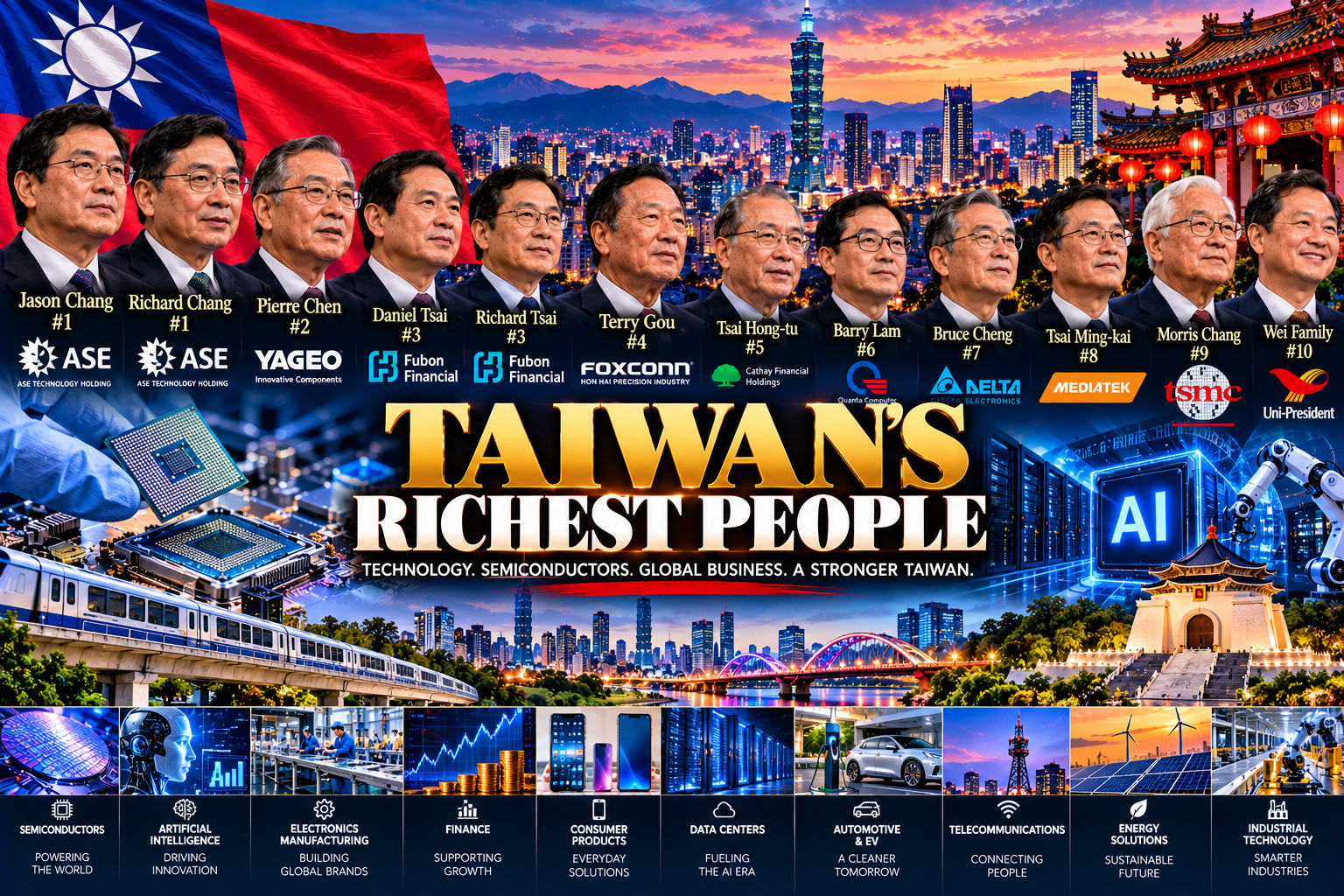
Taiwan is one of the world's most important technology and semiconductor hubs, and its wealthiest people are closely connected to the companies powering the global electronics industry.
From semiconductor packaging and testing to electronic components, computer hardware, smartphones, power systems, telecommunications, and consumer products, Taiwan has produced some of Asia's most influential business fortunes.
The country's billionaire landscape changed significantly in 2026. According to Forbes' Taiwan's 50 Richest 2026, the combined wealth of the 50 richest people in Taiwan reached a record $308 billion, up from $197 billion the previous year. Forbes attributed much of the increase to strong semiconductor exports, economic growth, and an artificial-intelligence-driven rally in technology stocks.
The 2026 ranking was led by Jason and Richard Chang, the brothers behind ASE Technology Holding, with a combined fortune of $22.4 billion. Pierre Chen ranked second with $18.2 billion, followed by Daniel and Richard Tsai at $16.7 billion. Terry Gou ranked fourth with $15.5 billion.
Who Are Taiwan’s Richest People?
Taiwan's wealthiest individuals and families come from several industries, but technology and electronics dominate the country's billionaire economy.
Major sources of wealth include:
Semiconductors
Electronics manufacturing
Semiconductor packaging and testing
Electronic components
Power management
Computer hardware
Telecommunications
Finance
Food and consumer products
Industrial manufacturing
Artificial intelligence infrastructure
The 2026 Forbes list also illustrates how the global AI boom is creating opportunities beyond companies that directly develop AI software. Businesses supplying power systems, cooling equipment, connectors, circuit-board materials, storage components, and other hardware used in data centers have benefited from rising demand.
1. Jason and Richard Chang: Semiconductor Manufacturing
Jason and Richard Chang claimed the No. 1 position on Forbes' 2026 Taiwan rich list for the first time.
The brothers are chairman and vice chairman of ASE Technology Holding, one of the world's major semiconductor packaging, assembly, and testing companies.
Forbes estimated their combined fortune at approximately $22.4 billion for the 2026 ranking. Their wealth increased by $14.5 billion compared with the previous year as semiconductor and AI-related demand pushed up the company's valuation.
ASE operates in a crucial part of the semiconductor supply chain.
Chip designers and manufacturers rely on packaging and testing before semiconductors can be incorporated into electronic devices. As chips become increasingly sophisticated, packaging technology has become an important component of advanced computing.
The growth of artificial intelligence has therefore benefited companies operating throughout the semiconductor ecosystem, not just chip designers.
2. Pierre Chen: Electronic Components and Yageo
Pierre Chen ranked second on the 2026 Taiwan rich list with an estimated fortune of $18.2 billion.
Chen is the chairman of Yageo, an electronic-components manufacturer whose products are used in smartphones, tablets, automobiles, computers, and other electronic devices.
Chen founded Yageo in 1977 and took the company public 16 years later.
The business has expanded through acquisitions and international growth. In January 2026, Yageo completed the acquisition of Japan's Shibaura Electronics for approximately $700 million, strengthening its position in electronic components.
Yageo's business demonstrates the importance of relatively specialized components within the global electronics supply chain.
A modern smartphone, automobile, server, or industrial system can contain thousands of individual electronic components. Companies supplying these components can therefore participate in the growth of multiple technology markets simultaneously.
3. Daniel and Richard Tsai: Finance and Business
Daniel and Richard Tsai ranked third on Forbes' 2026 Taiwan list with a combined fortune of approximately $16.7 billion.
The Tsai family has long been associated with financial services and diversified business interests in Taiwan.
Financial institutions play a significant role in Taiwan's economy by supporting businesses, consumers, investment, insurance, and capital markets.
The family's wealth also illustrates that Taiwan's billionaire economy extends beyond semiconductors.
While technology dominates many of the country's most visible fortunes, finance remains an important source of long-term wealth.
4. Terry Gou: Foxconn and Global Electronics
Terry Gou ranked fourth on the 2026 Taiwan rich list with an estimated fortune of $15.5 billion.
Gou founded Hon Hai Precision Industry, better known internationally as Foxconn, in 1974. The company became one of the world's largest electronics contract manufacturers.
Foxconn manufactures and assembles electronics for major global technology companies.
Forbes describes Hon Hai as the world's largest electronics contract manufacturer and says it has more than 40% market share in its sector. The company employs hundreds of thousands of people, with peak employment reaching about 900,000.
Gou's fortune illustrates the scale that can be achieved by building a manufacturing network serving international technology brands.
Foxconn's operations have expanded beyond Taiwan into multiple countries, making the company an important part of global electronics production.
5. Tsai Hong-tu and Cheng-ta: Financial Services
Tsai Hong-tu and Cheng-ta ranked fifth on the 2026 list with a combined fortune of approximately $15 billion.
Their wealth is associated with Taiwan's financial-services sector.
The financial industry has historically been an important part of the country's private wealth landscape, with large family groups maintaining stakes in banks, insurance businesses, investment companies, and other financial institutions.
Their position among Taiwan's richest people demonstrates that financial wealth remains significant even as semiconductor-related fortunes grow rapidly.
6. Barry Lam: Computer Hardware and Technology
Barry Lam ranked sixth with an estimated fortune of $14.9 billion in Forbes' 2026 Taiwan list.
Lam is associated with Quanta Computer, one of Taiwan's major electronics manufacturing companies.
Quanta has played an important role in the production of notebooks, servers, cloud-computing hardware, and other technology products.
The company's position illustrates another important feature of Taiwan's economy: many leading businesses operate behind the scenes as suppliers and manufacturers for global technology companies.
These businesses may not always be household names, but their manufacturing capabilities are essential to the world's technology supply chain.
7. Bruce Cheng: Power Systems and AI Infrastructure
Bruce Cheng ranked seventh on the 2026 Taiwan rich list with approximately $14.5 billion.
He is the founder of Delta Electronics, a major provider of power-management systems, cooling technology, and electronic components.
Delta became a significant beneficiary of the AI data-center expansion because modern data centers require enormous amounts of electricity and sophisticated cooling systems.
Forbes reported that Delta's 2025 revenue increased 32% to NT$555 billion, while net profit rose by more than two-thirds to NT$60 billion.
This is an example of how AI can create wealth throughout an entire infrastructure ecosystem.
AI companies require:
Semiconductors → servers → power systems → cooling → data centers → networking → storage.
Taiwanese companies participate in many of these layers.
8. Tsai Ming-kai: MediaTek and Chip Design
Tsai Ming-kai ranked eighth on the 2026 Taiwan list with an estimated fortune of $10.9 billion.
He is chairman of MediaTek, one of the world's major semiconductor design companies.
MediaTek develops chips used in smartphones, connected devices, networking equipment, televisions, and other electronics.
Forbes describes Tsai as a major figure in Taiwan's chip-design industry. He began his career at United Microelectronics before moving into leadership positions and eventually becoming closely associated with MediaTek.
Unlike contract manufacturers, chip-design companies focus on developing semiconductor architectures and intellectual property.
This creates another important layer of Taiwan's technology economy.
9. Morris Chang: The Semiconductor Pioneer
Morris Chang ranked ninth on the 2026 Taiwan list with an estimated fortune of $9.4 billion.
Chang is the founder of Taiwan Semiconductor Manufacturing Company, widely known as TSMC.
Although his fortune is smaller than some of the entrepreneurs currently benefiting from the AI boom, his influence on Taiwan's technology industry is enormous.
TSMC helped establish the modern foundry model, allowing companies to design chips while relying on specialized manufacturers to produce them.
This model became a foundation of the global semiconductor industry.
Today, advanced semiconductor manufacturing supports artificial intelligence, smartphones, automobiles, cloud computing, high-performance computing, and numerous other technologies.
10. The Wei Family: Food and Consumer Products
Wei Ing-Chou, Ying-Chiao, Yin-Chun, and Yin-Heng ranked tenth on the 2026 Taiwan list with a combined fortune of approximately $9 billion.
The Wei family is associated with Uni-President Enterprises, one of Taiwan's major food and consumer-products groups.
The company operates across food manufacturing, beverages, retail, logistics, and other consumer businesses.
Their inclusion in the top 10 highlights the diversity of Taiwan's billionaire economy.
While semiconductors dominate the country's wealth headlines, food, beverages, retail, and consumer goods continue to generate substantial business value.
Taiwan’s Semiconductor Wealth
Semiconductors are at the center of Taiwan's modern economy.
Companies connected to chip manufacturing, packaging, testing, design, electronic components, power systems, and server hardware appear throughout the 2026 rich list.
The rise of artificial intelligence has intensified demand for advanced computing equipment.
AI models require large data centers containing enormous numbers of high-performance processors and supporting systems.
This has created opportunities for Taiwanese businesses that supply:
Semiconductor packaging
Chip testing
Electronic components
Circuit boards
Server hardware
Power supplies
Cooling equipment
Connectors
Storage devices
Networking equipment
Forbes reported that several new entrants to the 2026 Taiwan rich list came from semiconductor and AI-related businesses.
AI Is Creating New Billionaire Wealth
The AI boom has changed Taiwan's wealth landscape.
Unlike previous technology cycles, AI demand affects a very large portion of the technology supply chain.
For example, Delta Electronics benefits from power and cooling demand. ASE benefits from semiconductor packaging and testing. Electronic-component manufacturers benefit from the increasing complexity of servers and computing systems.
Forbes reported that the shares of Delta Electronics increased more than fivefold over the year covered by its 2026 analysis, while Bruce Cheng's estimated fortune rose to $14.5 billion.
Another example is King Slide Works. Founder Lin Tsung-Chi's wealth surged as the company expanded from furniture hardware into AI server rail kits and cable-management systems.
These developments show how new technology can transform businesses that may not directly produce AI software.
Taiwan’s Electronics Manufacturing Advantage
Taiwan has developed a highly specialized electronics ecosystem.
The country has companies involved in almost every stage of modern electronics production.
The ecosystem includes:
Chip design
Semiconductor manufacturing
Packaging
Testing
Electronic components
Printed circuit boards
Connectors
Power systems
Cooling equipment
Computer assembly
This concentration creates a powerful industrial network.
When demand for smartphones increases, several Taiwanese companies may benefit. When demand for AI servers increases, another collection of Taiwanese businesses can benefit.
This interconnected structure has helped Taiwan become one of the world's most important technology manufacturing centers.
The Role of Global Supply Chains
Many of Taiwan's richest people built companies that operate internationally.
Foxconn manufactures electronics for global brands.
Yageo supplies components used around the world.
MediaTek develops chips for international markets.
ASE provides semiconductor services to global chip companies.
Delta Electronics supplies power and cooling systems to technology companies internationally.
Taiwan's wealth is therefore closely connected to global trade.
International demand means these companies are exposed not only to technology trends but also to currency movements, trade policies, geopolitical developments, and changes in consumer demand.
Finance and Traditional Businesses
Technology does not represent the entire Taiwanese economy.
Finance, food, retail, manufacturing, real estate, and other traditional sectors continue to create substantial fortunes.
The presence of financial families and consumer-business families among the country's richest people demonstrates the importance of diversified business groups.
Some of Taiwan's largest private fortunes have also been built over several generations.
Family ownership can provide long-term capital and continuity while allowing businesses to expand across multiple industries.
How Taiwan’s Billionaire Wealth Is Measured
Forbes' Taiwan 50 Richest ranking uses information from individuals, analysts, government agencies, stock exchanges, databases, and other sources.
For the 2026 ranking, net worth calculations were based on stock prices and exchange rates as of the market close on May 22, 2026. Private companies were valued using financial ratios and comparisons with similar publicly traded businesses.
This is important because a billionaire's estimated wealth can change after the publication date.
For example, Forbes' profile for Pierre Chen showed a real-time estimate of about $15.9 billion in September 2026, compared with $18.2 billion used for the June 2026 Taiwan 50 Richest ranking.
Similarly, Terry Gou's Forbes profile showed a September 2026 real-time estimate of about $15.2 billion compared with $15.5 billion for the Taiwan list.
Why Taiwan’s Richest People Rankings Change
Billionaire rankings are constantly changing because wealth is often tied to company ownership.
Important factors include:
Stock Market Movements
Publicly traded companies can gain or lose billions in market value.
Semiconductor Cycles
Technology companies are affected by demand for chips, servers, smartphones, automobiles, and other electronics.
AI Investment
Rising demand for AI infrastructure can increase valuations for companies supplying the technology ecosystem.
Currency Exchange Rates
International billionaire rankings are often calculated in U.S. dollars, meaning exchange-rate movements can affect reported fortunes.
Private Company Valuations
Businesses that are not publicly traded require estimates based on financial performance and comparable companies.
Taiwan’s Global Technology Influence
Taiwan's richest people have businesses that connect the island to almost every major technology market.
Their companies contribute to:
Artificial intelligence
Smartphones
Cloud computing
Data centers
Electric vehicles
Consumer electronics
Networking
Industrial automation
High-performance computing
The importance of Taiwan's technology sector extends well beyond the country's borders.
A semiconductor or electronic component manufactured by a Taiwanese company can ultimately become part of a device sold anywhere in the world.
The Future of Taiwan’s Billionaire Economy
Several industries could remain important to Taiwan's wealth creation in the coming years.
Artificial Intelligence
AI infrastructure is increasing demand for processors, servers, networking, storage, power systems, and cooling.
Advanced Semiconductors
More powerful computing systems require increasingly sophisticated chips.
Data Centers
Global cloud and AI companies are expanding data-center capacity, creating opportunities throughout the hardware supply chain.
Electric Vehicles
EVs require large quantities of semiconductors, sensors, power electronics, and electronic components.
Robotics
Automation and robotics require advanced chips, sensors, motors, controllers, and industrial systems.
Green Technology
Energy efficiency, power management, and renewable-energy infrastructure could create additional opportunities for Taiwanese technology companies.
Final Thoughts
Taiwan's richest people reflect the country's extraordinary position in the global technology economy.
Jason and Richard Chang built their wealth through semiconductor packaging and testing. Pierre Chen developed a major electronic-components business. Terry Gou transformed Foxconn into a global electronics manufacturing giant. Tsai Ming-kai became a major figure in chip design, while Morris Chang played a foundational role in Taiwan's semiconductor industry.
The 2026 Forbes list shows how strongly AI and semiconductor demand have influenced Taiwanese wealth. The combined fortune of the country's 50 richest people reached a record $308 billion, while several semiconductor and AI-related businesses experienced major increases in value.
At the same time, Taiwan's billionaire economy remains diversified. Finance, food, consumer products, manufacturing, and other industries continue to contribute significant wealth.
As artificial intelligence, advanced computing, robotics, electric vehicles, and data centers expand, Taiwan's specialized technology ecosystem is likely to remain an important part of the global economy.
FAQs
Who is the richest person in Taiwan in 2026?
According to Forbes' 2026 Taiwan's 50 Richest list, Jason and Richard Chang ranked first with a combined estimated fortune of $22.4 billion.
Who are Jason and Richard Chang?
They are brothers who lead ASE Technology Holding, a major semiconductor packaging, assembly, and testing company.
Who is Pierre Chen?
Pierre Chen is the founder and chairman of Yageo, a major Taiwanese electronic-components company. Forbes valued his fortune at $18.2 billion for its 2026 Taiwan ranking.
Is Terry Gou still one of Taiwan's richest people?
Yes. Terry Gou ranked fourth on Forbes' 2026 Taiwan list with $15.5 billion and is the founder of Hon Hai Precision Industry, better known as Foxconn.
Why are so many Taiwanese billionaires connected to semiconductors?
Taiwan has developed a highly specialized semiconductor and electronics ecosystem. Companies operate across chip design, manufacturing, packaging, testing, components, power systems, cooling, and electronics assembly.
How has AI affected Taiwan's richest people?
AI has increased demand for semiconductors, servers, power systems, cooling equipment, connectors, storage, and other infrastructure. Forbes reported that this AI-driven demand contributed significantly to the increase in Taiwan's billionaire wealth in 2026.
Who is Tsai Ming-kai?
Tsai Ming-kai is chairman of MediaTek, a major Taiwanese semiconductor-design company. Forbes estimated his 2026 Taiwan-list fortune at $10.9 billion.
Who is Morris Chang?
Morris Chang is the founder of TSMC and one of the central figures in the development of Taiwan's semiconductor industry. Forbes placed his fortune at $9.4 billion in its 2026 Taiwan ranking.
How much are Taiwan's 50 richest people worth?
Forbes reported that the combined wealth of Taiwan's 50 richest reached approximately $308 billion in 2026, compared with $197 billion in 2025.
Why can billionaire net worth figures differ between sources?
Different rankings use different valuation dates and methodologies. Forbes' 2026 Taiwan list used market data from May 22, 2026, while real-time billionaire profiles can change daily as stock prices and exchange rates move.