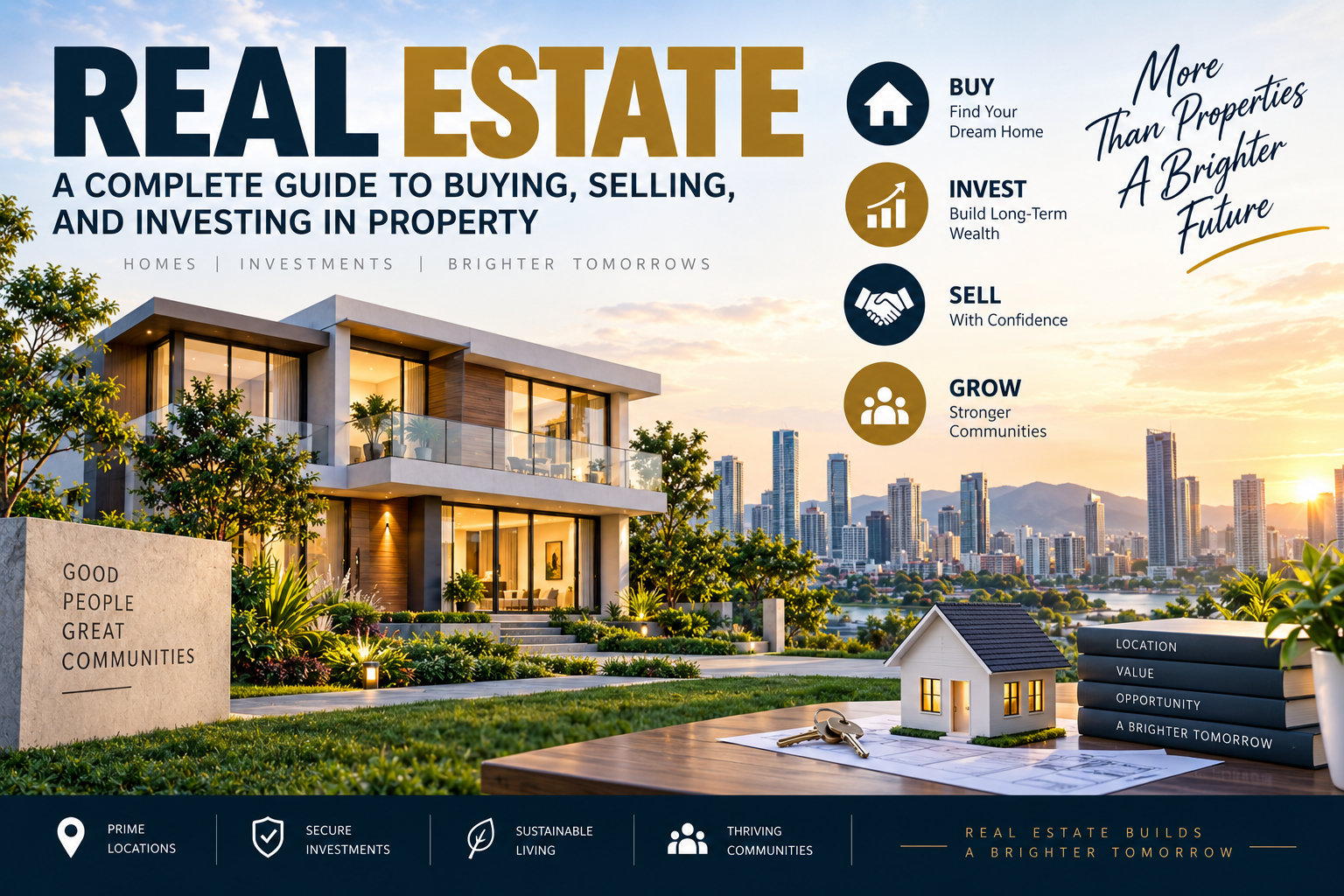
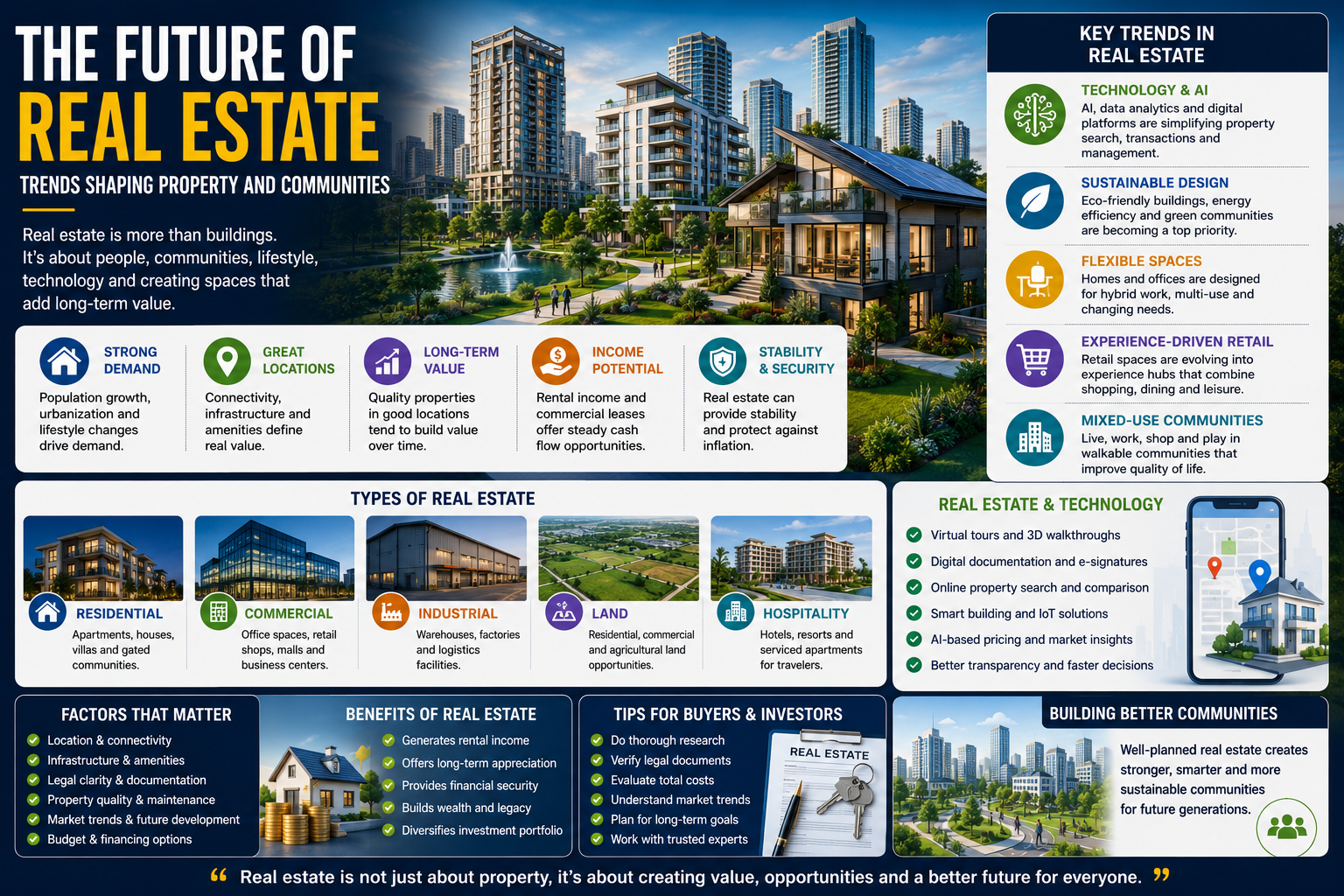
Real estate is one of the most important parts of the global economy. Homes provide places for people to live, offices support businesses, retail spaces serve consumers, and industrial properties help companies produce and distribute goods.
But real estate is about more than buildings.
It is also about communities, infrastructure, transportation, technology, investment, employment, and the way people choose to live and work.
As lifestyles and technologies change, the real estate industry is evolving as well. Developers, property owners, investors, businesses, and consumers are increasingly paying attention to flexibility, sustainability, digital tools, accessibility, and changing patterns of demand.
Understanding these developments can help people make more informed decisions about property and the communities they live in.
Why Real Estate Matters
Property plays a central role in everyday life.
For individuals, a home can represent stability and long-term financial planning.
For businesses, commercial property can influence operations, employee experience, customer access, and expansion.
For investors, real estate can represent an asset with potential income and long-term value.
At the community level, development decisions influence transportation, infrastructure, employment, public spaces, and quality of life.
Because of these connections, real estate decisions can have effects far beyond a single building.
Changing Housing Preferences
The way people use their homes continues to evolve.
Modern households may place greater emphasis on:
Flexible living spaces
Home offices
Natural light
Energy efficiency
Convenient locations
Reliable internet connectivity
Outdoor areas
Access to services
The ideal home is different for every household.
Families may prioritize schools and space, while professionals may value transportation and proximity to business districts.
Understanding these differences is important for developers and property owners.
The Growth of Flexible Spaces
Flexibility has become an important consideration in property design.
A room may serve as an office during the day and a living or recreational space later.
Commercial buildings can also be designed to support different types of work.
Flexible spaces can help properties remain useful as people's needs change.
Instead of designing buildings for only one purpose, developers can increasingly consider how spaces may evolve over time.
Technology in Real Estate
Technology is changing nearly every stage of the property process.
Digital platforms can help people:
Search for properties
Compare listings
Research neighborhoods
Communicate with agents
Schedule viewings
Review documents
Property managers can use digital systems to manage maintenance requests, payments, communications, and building operations.
Technology can make real estate transactions and property management more convenient, although professional judgment remains important.
Artificial Intelligence and Property
Artificial intelligence is becoming another tool within the real estate industry.
AI can assist with:
Market research
Data analysis
Property descriptions
Customer communication
Administrative tasks
Forecasting
Property management
AI can process large amounts of information quickly, but its results still need appropriate review.
Real estate decisions involve financial, legal, physical, and local considerations that cannot always be understood from data alone.
Smart Buildings
Smart-building technology allows properties to use connected systems to monitor and manage different functions.
These may include:
Lighting
Heating and cooling
Security
Energy consumption
Building access
Maintenance
Smart systems can potentially improve efficiency and convenience.
For property owners, they may also provide useful information about how buildings are being used.
Sustainability in Real Estate
Environmental considerations are becoming increasingly relevant to property development.
Energy-efficient buildings can reduce resource consumption and operating costs.
Sustainable approaches may include:
Efficient lighting
Better insulation
Energy-conscious heating and cooling
Water management
Renewable energy
Sustainable materials
Waste reduction
Sustainability is not only an environmental issue.
It can also influence operating costs, tenant preferences, property design, and long-term value.
Location Still Matters
Technology may change how people interact with properties, but location remains fundamental.
A property's surroundings can influence its usefulness and desirability.
Important factors can include:
Transportation
Employment
Schools
Healthcare
Shopping
Entertainment
Infrastructure
Safety
Community services
A well-designed property may struggle if it is disconnected from the services people need.
Transportation and Property Value
Transportation infrastructure can influence development patterns.
Access to roads, public transportation, airports, and other networks can affect how convenient a location is for residents and businesses.
New infrastructure can also encourage development in previously less-connected areas.
For real estate professionals, understanding transportation patterns can therefore be an important part of location analysis.
Urban Development
Cities are constantly changing.
Population growth, economic activity, infrastructure investment, and changing consumer preferences can influence how neighborhoods develop.
Urban development can involve:
Residential buildings
Offices
Retail
Public spaces
Transportation
Parks
Community facilities
Successful development requires balancing economic activity with livability.
Mixed-Use Communities
Mixed-use developments combine different functions within the same area.
A community might include:
Homes
Offices
Shops
Restaurants
Services
Recreation
The goal is to create places where people can live, work, shop, and spend leisure time within relatively convenient distances.
Mixed-use planning can support walkability and create more active communities.
The Changing Office
Workplaces are also evolving.
Businesses may no longer require every employee to work in a traditional office every day.
This has encouraged organizations to reconsider how office space is used.
Modern offices may focus more heavily on:
Collaboration
Meetings
Creativity
Team building
Client interaction
Rather than simply providing individual desks, businesses can design spaces around the activities employees actually perform.
Retail Real Estate
Retail property is changing alongside consumer behavior.
Online shopping has altered how consumers discover and purchase products.
Physical stores therefore increasingly need to offer experiences that digital platforms cannot easily reproduce.
Retail properties may combine shopping with:
Restaurants
Entertainment
Services
Events
Community experiences
The role of physical retail can therefore evolve from simple transactions toward broader experiences.
Property Management
Owning property is only one part of real estate.
Managing it effectively can influence long-term performance.
Property management may involve:
Maintenance
Tenant communication
Repairs
Security
Financial administration
Inspections
Vendor management
Technology can simplify many of these responsibilities.
However, good property management still depends on communication, responsiveness, and attention to detail.
The Importance of Property Maintenance
Maintenance is often overlooked when people think about property value.
Regular maintenance can help preserve a building's condition and reduce the likelihood of expensive problems.
Maintenance may include:
Plumbing
Electrical systems
Roofing
Heating and cooling
Landscaping
Structural inspections
Safety systems
Preventive maintenance can often be more effective than waiting for major problems to appear.
Real Estate and Community
A successful property isn't isolated from its surroundings.
People care about the wider community.
Access to schools, healthcare, parks, transportation, shopping, and public services can influence how attractive an area becomes.
Developers and planners should therefore consider the relationship between individual properties and the communities around them.
Affordable Housing
Housing affordability remains an important consideration in many markets.
The challenge involves balancing:
Construction costs
Land availability
Household income
Financing
Rental demand
Infrastructure
Solutions can vary by location.
Affordable housing strategies may involve different property types, development approaches, financing structures, and public-private partnerships.
Real Estate and Demographic Change
Population patterns can influence property demand.
Changes in household size, age, employment, migration, and lifestyle can affect what types of properties people need.
For example, a growing population of older residents may increase demand for accessible housing and nearby healthcare services.
A growing population of young professionals may create demand for smaller homes and properties near employment centers.
Understanding demographic changes can help property professionals plan more effectively.
Real Estate and Remote Work
Remote and hybrid work have changed how some people think about location.
Some workers may prefer larger homes with dedicated workspaces.
Others may prioritize access to urban amenities and occasional office travel.
The impact differs between individuals and markets.
There is no single definition of the ideal location in a changing work environment.
Digital Real Estate Transactions
Technology is making property transactions increasingly digital.
Potential buyers and tenants can access information online before visiting a property.
Digital tools can support:
Property searches
Virtual tours
Document sharing
Communication
Scheduling
Transaction management
These tools can make the process more efficient.
However, important legal and financial documents should still be reviewed carefully.
Real Estate Data
Data has become an important resource for the property industry.
Professionals can analyze information related to:
Property prices
Rental rates
Vacancy
Demographics
Construction
Transportation
Local economic activity
Data can support better decisions, but it must be interpreted within the correct local context.
A national trend may not accurately describe a particular neighborhood.
The Importance of Due Diligence
Whether buying, selling, developing, or renting property, research is essential.
Due diligence may involve reviewing:
Ownership records
Property condition
Local regulations
Zoning
Financing
Taxes
Rental conditions
Development plans
The exact requirements depend on the property and jurisdiction.
Professional legal, financial, and technical advice can be valuable when making major property decisions.
Real Estate and Investment
Real estate can play different roles within an investment strategy.
Some investors focus on rental income.
Others focus on long-term appreciation.
Some use property as part of a diversified portfolio.
Investment decisions should consider potential returns alongside costs and risks.
There is no property investment that is automatically suitable for every investor.
The Role of Real Estate Professionals
Real estate professionals can provide valuable expertise.
Depending on the transaction, professionals may include:
Real estate agents
Property managers
Appraisers
Lawyers
Mortgage professionals
Architects
Engineers
Developers
Different professionals provide different types of knowledge.
Working with appropriate experts can help buyers, sellers, and investors understand complex decisions.
Designing for the Future
One of the biggest challenges in real estate is predicting how properties will be used years from now.
Buildings can have long lifespans.
Developers therefore need to consider flexibility.
A property designed for one specific purpose may become difficult to adapt.
Flexible layouts, modern infrastructure, efficient systems, and adaptable spaces can help buildings remain useful as needs change.
The Future of Real Estate
The future of real estate will likely involve a combination of technology, changing lifestyles, sustainability, and community-focused development.
Artificial intelligence and data analytics may improve decision-making.
Smart-building systems may improve property management.
Digital platforms may simplify transactions.
Sustainable design may become increasingly important.
At the same time, location, quality, affordability, accessibility, and community will remain fundamental.
Technology can improve real estate.
It cannot replace the importance of creating places where people genuinely want to live, work, and spend time.
Final Thoughts
Real estate is constantly evolving because society itself is evolving.
The homes people want, the offices businesses need, the retail spaces consumers visit, and the communities people value can all change over time.
Successful real estate strategies therefore require flexibility and long-term thinking.
Technology can improve efficiency.
Data can support better decisions.
Sustainable design can create more efficient buildings.
Flexible spaces can respond to changing needs.
But the fundamentals remain important.
Good locations, useful properties, responsible planning, strong management, and a clear understanding of people will continue to shape successful real estate.
The future of real estate isn't simply about building more properties.
It is about creating better spaces, stronger communities, and environments that can adapt to the needs of future generations.