Artificial intelligence is becoming deeply integrated into modern business, but not every AI application needs to send information to a centralized cloud system. As organizations demand faster decisions, lower latency, greater privacy, and more reliable operations, another approach is gaining momentum: edge AI.
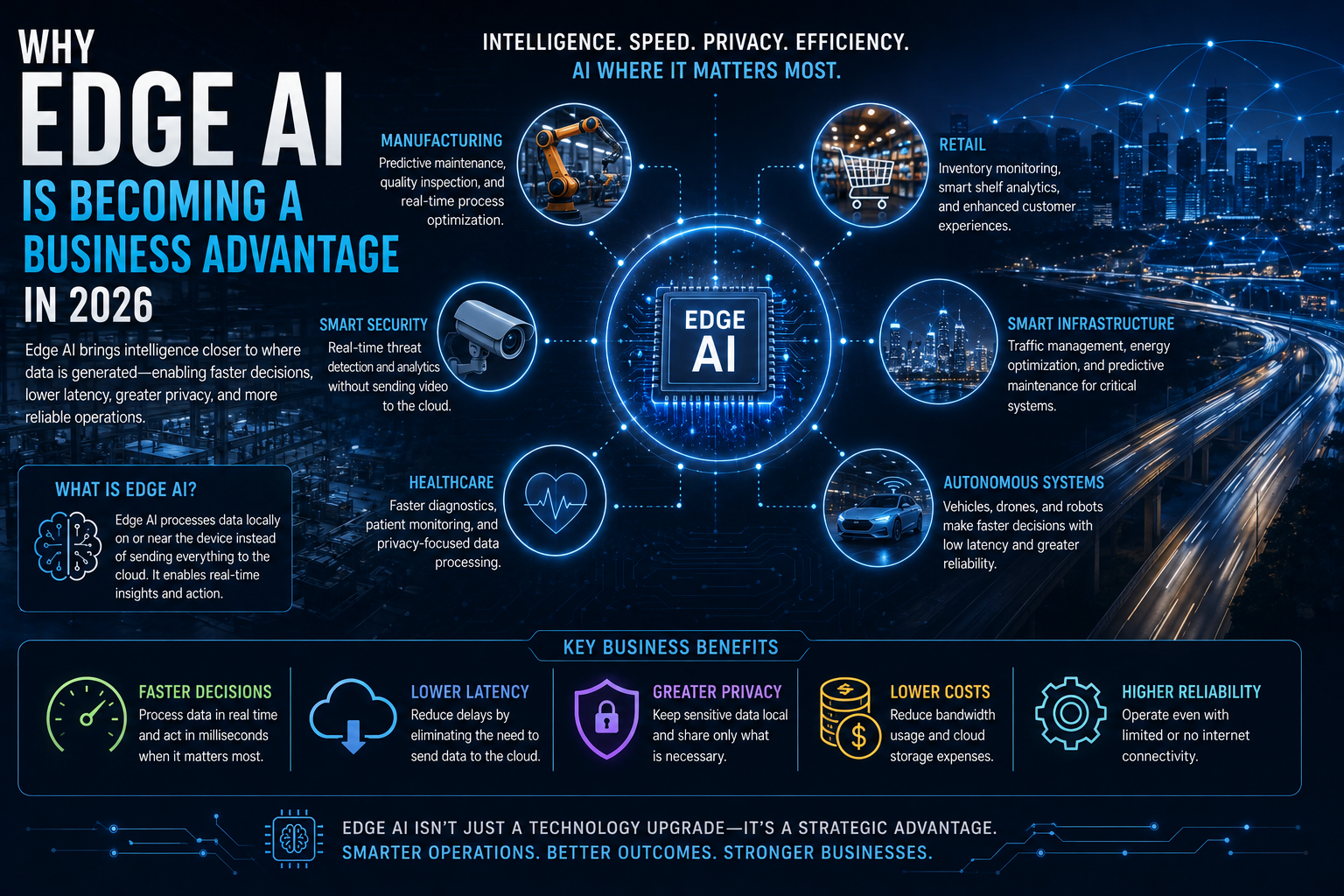
Edge AI refers to artificial intelligence systems that process data closer to where it is generated rather than sending every piece of information to a distant cloud or data center. This can involve smartphones, industrial machines, cameras, vehicles, retail devices, medical equipment, sensors, and other connected systems.
In 2026, edge AI is becoming increasingly important because businesses are looking for ways to make AI faster, more efficient, and more practical in real-world environments.
What Is Edge AI?
Traditional cloud-based AI generally sends data to centralized computing infrastructure for processing. The results are then delivered back to the device or application.
Edge AI changes this model by allowing some processing to happen directly on or near the device generating the information.
For example, an industrial machine equipped with AI capabilities could analyze sensor information locally and identify unusual behavior without sending every data point to a remote server.
Similarly, a smart camera could analyze visual information locally and identify a specific event without continuously uploading raw video.
This reduces the distance between data generation and decision-making.
Why Speed Matters
One of the biggest advantages of edge AI is speed.
Some business applications require decisions within milliseconds. Sending information to a remote cloud environment, processing it, and returning a response can introduce latency.
For everyday applications, that delay may be insignificant. For industrial automation, autonomous systems, security monitoring, robotics, or real-time equipment management, it can become much more important.
Edge AI allows certain decisions to happen locally.
A machine can detect a potential problem immediately. A vehicle can respond to its surroundings without waiting for a remote server. A retail device can analyze activity in real time.
The result is faster response and potentially more reliable operations.
Edge AI and Manufacturing
Manufacturing is one of the industries where edge AI can provide significant value.
Factories contain machines, sensors, cameras, robots, and production systems that continuously generate information.
Sending all of this information to the cloud can require substantial network capacity.
Edge AI can process important information directly within the manufacturing environment.
For example, an AI-enabled camera could identify defects on a production line as products move through the facility. An intelligent machine could monitor vibration, temperature, or other signals to identify possible equipment problems.
Workers could receive alerts immediately instead of waiting for centralized analysis.
This can support predictive maintenance, quality control, and production optimization.
Smarter Retail Operations
Retail businesses are also exploring intelligent devices that can analyze information closer to the point where it is generated.
Stores may use cameras, sensors, smart shelves, point-of-sale systems, and connected devices to understand inventory and customer activity.
Edge AI can process some of this information locally.
For example, an intelligent inventory system could identify when products are running low and alert employees. Computer vision could assist with monitoring shelves or identifying operational issues.
Because some processing occurs locally, businesses may also reduce the amount of raw data that needs to be transmitted to centralized systems.
This can improve efficiency while supporting more responsive store operations.
Edge AI Can Improve Privacy
Data privacy is another reason businesses are considering edge AI.
AI applications can involve sensitive information, including images, audio, customer activity, location information, and operational data.
When data is processed locally, organizations may not need to transmit all raw information to a centralized server.
Instead, a device can process the information and send only the relevant result.
For example, a smart device could identify a specific event and transmit an alert rather than continuously uploading all raw sensor information.
This does not automatically guarantee privacy. Businesses still need appropriate security, data policies, access controls, and compliance measures.
However, local processing can reduce the amount of sensitive information moving across networks.
Lowering Cloud Costs
Cloud computing has made AI deployment easier, but processing enormous quantities of data can become expensive.
Organizations with thousands of connected devices may generate massive amounts of information.
If every data point is transmitted to centralized infrastructure, businesses may face significant storage, bandwidth, and processing costs.
Edge AI provides another option.
Devices can process information locally and send only important results to centralized systems.
This can reduce unnecessary data transmission and potentially lower infrastructure costs.
The best architecture may not be entirely edge-based or entirely cloud-based. Many organizations are likely to use a hybrid approach in which edge devices handle immediate decisions while cloud platforms manage large-scale analytics, training, storage, and coordination.
Edge AI and Smart Infrastructure
Cities, buildings, transportation networks, and energy systems are becoming increasingly connected.
Sensors can monitor traffic, energy consumption, equipment performance, environmental conditions, and infrastructure activity.
Processing some of this information locally can make these systems more responsive.
A smart building, for example, could use edge AI to analyze occupancy and environmental conditions and adjust lighting, ventilation, or temperature.
A transportation system could analyze traffic conditions locally and adjust signals or provide alerts.
Energy infrastructure could monitor equipment for unusual behavior and identify potential problems before they become more serious.
These applications demonstrate how AI can move beyond software and become part of the physical environment.
The Role of Edge AI in Healthcare
Healthcare is another area where fast and private data processing can be valuable.
Medical devices can generate large amounts of information that may require immediate analysis.
Edge AI could potentially support applications such as monitoring devices, medical imaging systems, and connected equipment by processing certain information locally.
For example, a monitoring device could identify an unusual pattern and alert healthcare professionals quickly.
However, healthcare applications require particularly strong safeguards.
Accuracy, privacy, security, regulatory requirements, and human oversight are critical when AI is involved in medical environments.
Edge AI can support healthcare professionals, but it should not be treated as an unquestionable replacement for professional judgment.
Edge AI and Autonomous Systems
Autonomous machines need to make decisions quickly.
Robots, drones, vehicles, and industrial systems may need to interpret their surroundings and respond immediately.
Depending entirely on a remote cloud connection can introduce delays or create operational problems when connectivity is interrupted.
Edge AI allows autonomous systems to perform certain functions locally.
A robot can process sensor information and adjust its movement. A vehicle can interpret its surroundings. A drone can identify objects or obstacles.
Cloud infrastructure can still play an important role in these systems, particularly for training models, managing large datasets, updating software, and analyzing long-term performance.
The combination of edge and cloud computing can therefore provide both local responsiveness and centralized intelligence.
Edge AI Is Changing Business Architecture
The rise of edge AI is also changing how companies think about technology infrastructure.
Instead of designing systems around a single centralized computing environment, businesses may increasingly distribute intelligence across multiple locations.
Some decisions can happen on devices. Others can occur at regional computing facilities, while more complex analysis can be handled by centralized cloud platforms.
This creates a layered architecture.
Businesses need to determine which information should be processed locally, which data should be transferred, and which decisions require centralized coordination.
This can make technology strategy more complex, but it can also create greater flexibility.
Security Challenges
Edge AI introduces new cybersecurity considerations.
Traditional centralized systems allow organizations to concentrate security controls around a smaller number of infrastructure components.
Edge environments may involve thousands of devices distributed across different locations.
Each device can potentially become a target.
Businesses therefore need strong device authentication, software updates, encryption, access controls, monitoring, and secure deployment processes.
Physical security can also matter because edge devices may be located in environments where unauthorized individuals can access them.
Security must be considered throughout the lifecycle of an edge AI system.
Managing AI Models at the Edge
Deploying AI models across large numbers of devices creates another challenge: model management.
AI models may need to be updated as new information becomes available or as business requirements change.
Organizations need reliable methods for testing, deploying, monitoring, and updating these models.
They also need to understand how model performance changes over time.
A model that performs well in one environment may not perform equally well in another.
This makes monitoring and governance essential.
The Hybrid Future of AI
The future of AI infrastructure is unlikely to be purely centralized or purely distributed.
Instead, businesses are likely to combine edge computing, cloud platforms, and other forms of distributed infrastructure.
Edge systems can handle immediate processing and real-time decisions. Cloud systems can provide large-scale computing, storage, model training, and long-term analytics.
This hybrid approach allows organizations to use each environment for the tasks it handles best.
The result can be faster, more flexible, and more cost-effective AI deployment.
How Businesses Can Prepare
Companies considering edge AI should begin with a clear operational problem.
Potential starting points include manufacturing quality control, predictive maintenance, inventory monitoring, security systems, transportation, energy management, and connected equipment.
Businesses should determine how quickly decisions need to be made, how much data is generated, whether privacy requirements favor local processing, and what infrastructure is already available.
A small pilot project can help determine whether edge processing provides measurable benefits.
Organizations should also evaluate cybersecurity, device management, model updates, and long-term maintenance before expanding deployments.
The Future of Edge AI
Edge AI is moving artificial intelligence closer to the physical world.
As more devices become connected and capable of local processing, businesses can increasingly place intelligence directly where decisions need to happen.
The technology could support faster manufacturing, smarter retail operations, more responsive infrastructure, efficient energy systems, autonomous machines, and privacy-conscious applications.
The greatest opportunity will come from combining edge intelligence with cloud computing rather than treating the two as competing technologies.
In 2026, businesses are beginning to recognize that AI is not only about powerful centralized models. It is also about where intelligence lives and how quickly it can act.
Companies that strategically combine edge AI, cloud infrastructure, reliable data, and strong cybersecurity can create more responsive operations and gain an important advantage in an increasingly connected economy.