Digital technology is changing how businesses store information, transfer money, manage transactions, and build trust with customers. One technology attracting significant attention is blockchain.
Originally popularized through Bitcoin, blockchain has developed into a technology with applications far beyond cryptocurrency. Businesses are exploring it for financial transactions, supply chain management, digital identity, healthcare records, smart contracts, and secure information sharing.
But what makes blockchain different from traditional databases?
The answer lies in its structure. Blockchain allows information to be recorded in connected blocks and shared across a network. Depending on the design, participants can verify transactions without relying on one central organization to maintain the entire record.
In 2026, blockchain continues to be explored across finance, logistics, technology, healthcare, and digital services. However, understanding its actual capabilities, limitations, and business value is essential before adopting it.
This comprehensive guide explains what blockchain technology is, how it works, its different types, major benefits, challenges, and real-world business applications.
What Is Blockchain Technology?
Blockchain is a type of distributed digital ledger that records information in groups called blocks. These blocks are connected in chronological order using cryptographic techniques, creating a chain of records.
Instead of storing information in only one central database, a blockchain network can maintain synchronized copies of its ledger across multiple participating computers, commonly called nodes.
When a transaction is submitted, the network follows its agreed validation process before adding the transaction to the ledger.
Once a block is accepted, changing its contents can be difficult because doing so may require changing subsequent records and satisfying the network's validation rules.
This makes blockchain useful for applications where multiple participants need a shared and verifiable record.
A Simple Example
Imagine a company that purchases products from a supplier.
In a traditional system, the buyer, supplier, shipping company, and payment provider may each maintain separate records.
These records can become inconsistent, creating delays and disputes.
With a shared blockchain-based system, authorized participants can access relevant transaction records and verify important events, such as:
Purchase orders
Product dispatch
Shipping updates
Delivery confirmation
Payment completion
The shared record can improve transparency and reduce the need to repeatedly reconcile information between separate systems.
However, blockchain does not automatically guarantee that information entered into it is accurate. The quality of the original information still matters.
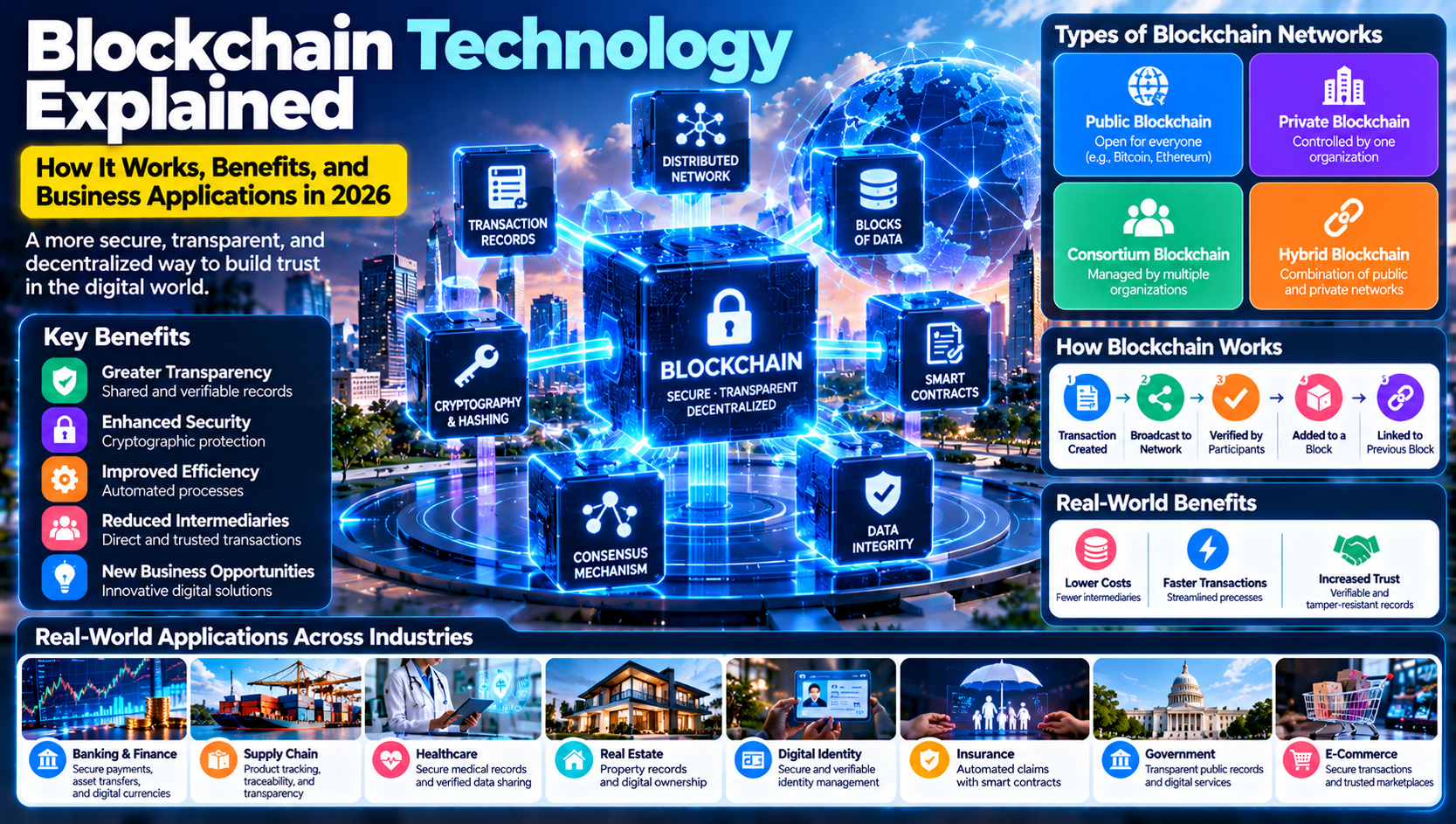
How Does Blockchain Technology Work?
Blockchain operates through a combination of cryptography, network participants, transaction validation, and distributed data storage.
Although different blockchains use different technical designs, the general process follows several stages.
1. A Transaction Is Created
A user or organization initiates a transaction.
For example, someone may transfer digital currency, register an asset, or record a business transaction.
2. The Transaction Is Broadcast to the Network
The transaction is shared with participating computers in the blockchain network.
These computers receive transaction information and prepare to validate it according to the network's rules.
3. The Transaction Is Verified
Network participants or designated validators check whether the transaction satisfies the required conditions.
Depending on the blockchain, verification may involve digital signatures, account balances, authorization rules, or other validation procedures.
4. Transactions Are Grouped Into Blocks
Validated transactions are organized into a block.
A block generally contains:
Transaction information
A timestamp or other ordering information
A reference to the previous block
A cryptographic hash
Additional network-specific information
5. Consensus Is Reached
The blockchain network uses a consensus mechanism to agree on which transactions or blocks should be accepted.
Common mechanisms include Proof of Work and Proof of Stake.
6. The Block Is Added to the Chain
Once accepted according to the network's rules, the block becomes part of the blockchain.
The new block references the previous block, helping maintain the chain's chronological structure.
7. The Ledger Is Updated
Participating nodes update their records according to the network protocol.
The transaction can then be verified through the blockchain's available data and tools.
The basic blockchain process:
Transaction Created → Network Broadcast → Verification → Block Formation → Consensus → Block Added → Ledger Updated
Main Components of Blockchain Technology
Several technical components work together to make blockchain systems function.
Component | Purpose |
|---|---|
Blocks | Store groups of transaction records |
Cryptographic Hashes | Create digital fingerprints of data |
Distributed Ledger | Maintains shared transaction records |
Nodes | Participate in the blockchain network |
Consensus Mechanism | Helps participants agree on valid records |
Public and Private Keys | Support digital identity and transaction authorization |
Smart Contracts | Execute programmed rules automatically |
1. Blocks
Blocks are the basic units of blockchain data storage.
Each block contains information about transactions and usually includes a reference to an earlier block.
2. Cryptographic Hashes
A cryptographic hash is a fixed-length digital output generated from input data.
A small change in the original information generally produces a different hash.
Blockchain systems use hashes to connect blocks and help detect changes to recorded information.
3. Distributed Ledger
A distributed ledger is a record shared across multiple network participants.
Instead of depending entirely on one central database, the network maintains records according to its protocol.
4. Nodes
Nodes are computers or devices that participate in a blockchain network.
Depending on their roles, nodes may store blockchain data, validate transactions, relay information, or participate in consensus.
5. Consensus Mechanisms
Consensus mechanisms are rules that help blockchain participants agree on the accepted state of the ledger.
Different networks use different approaches depending on their security, performance, and decentralization requirements.
6. Cryptographic Keys
Public and private keys support digital ownership and transaction authorization.
A public key or associated address can be shared to receive digital assets, while a private key must remain confidential because it may authorize transactions.
7. Smart Contracts
Smart contracts are programs stored and executed on compatible blockchain networks.
They can automatically perform actions when predefined conditions are satisfied.
For example, a smart contract may release a payment after receiving the required confirmation from an authorized system.
Types of Blockchain Networks
Blockchain networks are commonly divided into four categories based on who can access and participate in them.
1. Public Blockchain
A public blockchain is generally open for anyone to access and participate in according to its network rules.
Examples include Bitcoin and Ethereum.
Common characteristics include:
Open participation
Distributed network infrastructure
Publicly verifiable transaction records
Network-based consensus mechanisms
Public blockchains are commonly used for cryptocurrency, decentralized applications, and digital asset systems.
2. Private Blockchain
A private blockchain is controlled by a single organization or authorized operator.
Access is restricted to approved participants.
Businesses may use private blockchain systems when they need controlled access, defined responsibilities, and shared records among selected users.
3. Consortium Blockchain
A consortium blockchain is managed by multiple selected organizations rather than one organization alone.
For example, several financial institutions may collaborate on a shared network for transaction records or settlement processes.
4. Hybrid Blockchain
A hybrid blockchain combines selected private and public blockchain features.
Organizations can keep certain information restricted while making specific records or verification information publicly accessible.
Comparison of Blockchain Types
Type | Access | Control | Common Applications |
|---|---|---|---|
Public | Open | Distributed network | Cryptocurrency and decentralized applications |
Private | Restricted | One organization | Internal business records |
Consortium | Restricted | Multiple organizations | Banking and supply chains |
Hybrid | Mixed | Combination | Enterprise and public verification systems |
The best blockchain model depends on the organization's privacy requirements, governance structure, performance needs, and business objectives.
What Are the Main Consensus Mechanisms?
A consensus mechanism helps blockchain participants agree on the accepted state of the network.
Two widely discussed mechanisms are Proof of Work and Proof of Stake.
1. Proof of Work (PoW)
Proof of Work requires participating miners to perform computational work to compete for the opportunity to add a block.
Bitcoin is the best-known example of a blockchain using Proof of Work.
Advantages:
Established security model
Strong resistance to certain types of attacks
Open participation in mining, subject to network requirements
Challenges:
Significant energy consumption
Specialized hardware requirements
Limited transaction throughput compared with some alternatives
2. Proof of Stake (PoS)
Proof of Stake selects validators based partly on cryptocurrency they have committed or staked under the network's rules.
Ethereum is an example of a blockchain that uses Proof of Stake.
Advantages:
Generally lower energy consumption than Proof of Work
Does not require the same mining competition
Supports different approaches to network participation
Challenges:
Requires careful validator and economic incentive design
Concentration of stake can create governance concerns
Security depends on the network's protocol and implementation
Proof of Work vs. Proof of Stake
Feature | Proof of Work | Proof of Stake |
|---|---|---|
Validation | Computational mining | Staking and validator selection |
Energy Use | Generally high | Generally lower |
Participants | Miners | Validators |
Example | Bitcoin | Ethereum |
Main Consideration | Mining resources | Stake and validator security |
Neither mechanism is automatically best for every application. Network design and the specific use case matter.
What Are Smart Contracts?
Smart contracts are computer programs that execute predefined instructions when specified conditions are met.
They can operate on blockchain networks that support programmable transactions.
For example, imagine a digital agreement between a buyer and a supplier.
A smart contract could be programmed to release a payment after receiving an approved delivery confirmation.
Potential applications include:
Automated payments
Digital asset transfers
Insurance claim workflows
Supply chain agreements
Decentralized finance
Digital identity systems
Benefits of Smart Contracts
Automation: They can execute predefined rules without requiring every step to be manually processed.
Transparency: Contract logic may be available for participants to inspect, depending on the network.
Efficiency: They can reduce certain administrative tasks and transaction delays.
Consistency: Programmed conditions execute according to the contract's code.
Limitations of Smart Contracts
Smart contracts are not automatically legally enforceable agreements in every jurisdiction.
They can also contain programming errors, security vulnerabilities, and flawed assumptions.
Some applications depend on external information supplied by oracles. If the external information is inaccurate, the smart contract may execute an incorrect action.
Professional legal and technical reviews are important before using smart contracts for significant business transactions.
Real-World Applications of Blockchain Technology
Blockchain has applications beyond cryptocurrency. Different industries are exploring its ability to support shared records, transaction verification, and programmable digital agreements.
1. Banking and Financial Services
Financial institutions can explore blockchain for digital payments, settlement systems, asset transfers, and shared transaction records.
Potential applications include:
Cross-border payment systems
Digital asset settlement
Trade finance
Transaction record management
Tokenized financial assets
Blockchain-based financial systems may reduce certain reconciliation requirements, although regulatory compliance, liquidity, privacy, and integration remain important considerations.
2. Supply Chain Management
Supply chains involve multiple organizations, including manufacturers, suppliers, distributors, shipping companies, and retailers.
Blockchain can provide a shared record of selected product movements and transactions.
For example, a food distributor may record information about product origin, processing, transportation, and delivery.
Authorized participants can use these records to improve traceability and investigate problems.
3. Healthcare
Healthcare organizations manage sensitive information across hospitals, laboratories, pharmacies, and other institutions.
Blockchain may support selected healthcare applications, such as:
Verification of medical records
Pharmaceutical supply chain tracking
Research data coordination
Medical credential verification
Consent and access management
However, sensitive medical information should not automatically be stored directly on a public blockchain. Privacy, legal compliance, access controls, and secure off-chain storage must be considered.
4. Real Estate
Property transactions involve ownership records, documentation, verification, and multiple parties.
Blockchain-based systems may help manage digital property records, transaction histories, and certain tokenized ownership arrangements.
Potential benefits include improved record traceability and more efficient coordination.
However, legal ownership still depends on applicable property laws and recognized registration systems.
5. Digital Identity
Blockchain can support certain digital identity solutions by allowing individuals or organizations to verify credentials through cryptographic methods.
Potential applications include:
Educational certificates
Professional credentials
Identity verification
Digital access credentials
Verifiable digital records
These systems may help reduce reliance on repeated manual verification, depending on their design and adoption.
6. Voting and Governance
Blockchain-based voting systems have been proposed as a way to create verifiable digital records of votes.
However, secure voting requires more than an immutable ledger.
Voter authentication, ballot secrecy, coercion resistance, accessibility, device security, and independent auditing remain major challenges.
Blockchain alone does not guarantee a secure or trustworthy election.
7. Intellectual Property and Digital Ownership
Blockchain can record information about digital assets, licensing, and ownership claims.
Artists, creators, and businesses may use blockchain-based systems to manage digital collectibles and certain licensing arrangements.
A blockchain record does not automatically prove legal copyright ownership or prevent unauthorized copying.
8. Insurance
Insurance companies may explore smart contracts and shared transaction records to automate selected administrative processes.
For example, a system could initiate a predefined payment after receiving verified information about an insured event.
Actual claims still require suitable verification, regulatory compliance, and appropriate contractual terms.
9. Government and Public Records
Government agencies may investigate blockchain for document verification, digital credentials, asset records, and selected public services.
Such applications require careful attention to data privacy, legal authority, accessibility, and public accountability.
Benefits of Blockchain Technology
Blockchain offers several potential advantages when its architecture is appropriate for the problem being solved.
1. Transparency
Some blockchain networks allow participants to inspect transaction records and verify how information is recorded.
This can improve visibility among organizations sharing a common ledger.
2. Data Integrity
Cryptographic links between blocks make unauthorized changes easier to detect.
However, blockchain cannot guarantee that incorrect information was not entered in the first place.
3. Decentralization
Public blockchain networks distribute certain responsibilities across multiple participants.
This can reduce dependence on a single central operator, although the actual degree of decentralization varies between networks.
4. Improved Traceability
Blockchain can provide a chronological record of selected transactions and asset movements.
This may be useful for supply chains, digital assets, and other applications requiring traceable records.
5. Automation Through Smart Contracts
Smart contracts can execute predefined actions when required conditions are satisfied.
This may reduce manual work in suitable business processes.
6. Secure Transaction Verification
Cryptographic signatures and network validation help verify whether transactions were authorized according to the protocol.
7. Shared Recordkeeping
Organizations that need to coordinate transactions may benefit from maintaining a shared record rather than repeatedly reconciling separate databases.
8. New Digital Business Models
Blockchain enables applications involving tokenized assets, decentralized applications, and programmable digital transactions.
These models may create opportunities for businesses, developers, and financial service providers.
Challenges and Risks of Blockchain Technology
Despite its advantages, blockchain is not suitable for every business problem.
Organizations should understand its limitations before investing in implementation.
1. Scalability
Some blockchain networks face limitations in transaction throughput, confirmation times, or network capacity.
As usage increases, performance and transaction costs may become significant concerns.
Layer 2 networks and other scaling approaches aim to address some of these limitations.
2. Energy Consumption
Proof of Work networks can require substantial computational resources.
This has raised concerns about electricity consumption and environmental impact.
Proof of Stake and other consensus mechanisms generally have different energy requirements.
3. Regulatory Uncertainty
Digital assets and blockchain applications operate within different legal and regulatory frameworks across countries.
Businesses must consider applicable financial regulations, data protection requirements, consumer protection rules, and licensing obligations.
4. Implementation Costs
Building a blockchain solution may require specialized developers, security reviews, infrastructure, integrations, and ongoing maintenance.
The total cost can be higher than using a conventional database.
5. Privacy Concerns
Public blockchain transactions may be visible to network participants.
Even when personal information is not directly displayed, transaction patterns can sometimes reveal sensitive details.
Organizations should carefully design privacy controls and avoid placing confidential information directly on public networks without an appropriate legal and technical basis.
6. Irreversible Transactions
Many blockchain transactions are difficult or impossible to reverse once confirmed.
Mistaken transfers, compromised keys, and fraudulent transactions can therefore create serious financial losses.
7. Private Key Management
Private keys are critical to controlling blockchain accounts and digital assets.
Losing a private key or exposing it to an attacker may result in permanent loss of access or unauthorized transactions.
8. Integration With Existing Systems
Businesses often use established databases, accounting software, enterprise platforms, and payment systems.
Integrating blockchain with these systems can be technically complex.
9. Smart Contract Vulnerabilities
Smart contract errors can create opportunities for exploitation.
Independent code audits, testing, secure development practices, and monitoring are important safeguards.
Blockchain vs. Traditional Databases
One of the most common questions is whether blockchain is better than a traditional database.
The answer depends on the business requirement.
Traditional databases are generally efficient for applications where one organization controls data management.
Blockchain may be useful when multiple participants need a shared record and want to verify transactions according to common network rules.
Feature | Blockchain | Traditional Database |
|---|---|---|
Data Management | Distributed or shared | Usually centrally managed |
Record Changes | Often difficult after confirmation | Can be updated by authorized users |
Transparency | Depends on network permissions | Depends on database access controls |
Performance | Varies by network | Often high for conventional workloads |
Governance | Network protocol and participants | Database owner or administrator |
Best Use | Shared verifiable records | General data storage and management |
Complexity | Often higher | Usually lower for standard applications |
When Should a Business Use Blockchain?
Blockchain may be worth considering when:
Multiple organizations need a shared transaction record.
Participants need independent verification.
Auditability and traceability are important.
No single participant should have complete control over the record.
Smart contracts can simplify a suitable multi-party process.
When Is a Traditional Database Better?
A traditional database may be more suitable when:
One organization controls the system.
Data needs frequent updates or deletion.
High transaction performance is essential.
Privacy requirements demand centralized access controls.
Blockchain would add unnecessary technical complexity.
Businesses should choose technology according to the problem rather than adopting blockchain simply because it is popular.
Blockchain vs. Cryptocurrency
Blockchain and cryptocurrency are closely connected, but they are not the same thing.
Blockchain is the underlying technology used to maintain distributed digital records.
Cryptocurrency is a form of digital asset that may operate on a blockchain network.
For example, Bitcoin is a cryptocurrency that operates on the Bitcoin blockchain.
Other blockchain networks support additional applications, including smart contracts, decentralized finance, and digital asset systems.
Feature | Blockchain | Cryptocurrency |
|---|---|---|
Definition | Distributed ledger technology | Digital asset |
Purpose | Records and verifies information | Enables digital value transfer or other asset functions |
Examples | Bitcoin blockchain, Ethereum network | Bitcoin, Ether |
Applications | Supply chains, records, smart contracts | Payments, transfers, digital asset use |
Not every blockchain application requires a cryptocurrency, and not every digital payment system uses blockchain.
Popular Blockchain Platforms and Technologies
Different blockchain platforms offer different features, programming environments, governance models, and performance characteristics.
Platform or Technology | Main Purpose |
|---|---|
Bitcoin | Decentralized digital currency network |
Ethereum | Smart contracts and decentralized applications |
Hyperledger Fabric | Permissioned enterprise blockchain |
Solana | High-throughput blockchain applications |
Polygon | Ethereum scaling and blockchain infrastructure |
Corda | Distributed ledger solutions for businesses |
Avalanche | Blockchain networks and smart contract applications |
Bitcoin
Bitcoin is a decentralized digital currency system introduced in 2009.
Its blockchain records transactions and uses Proof of Work to help secure the network.
Ethereum
Ethereum is a programmable blockchain platform that supports smart contracts and decentralized applications.
Developers use it to build systems involving digital assets, decentralized finance, and other blockchain-based services.
Hyperledger Fabric
Hyperledger Fabric is an open-source enterprise blockchain framework designed for permissioned networks.
It allows organizations to build applications with controlled participation and configurable governance.
Solana
Solana is a blockchain platform designed to support high-throughput applications and digital asset transactions.
It uses a combination of technical mechanisms to support transaction ordering and network consensus.
Polygon
Polygon provides blockchain infrastructure and scaling technologies associated with the Ethereum ecosystem.
Its products and architecture have evolved, so businesses should evaluate the specific solution rather than treating every Polygon product as identical.
How Businesses Can Implement Blockchain Technology
Organizations interested in blockchain should first identify a problem that genuinely benefits from a shared and verifiable ledger.
The following steps provide a practical starting point.
Step 1: Identify the Business Problem
Determine what the organization wants to improve.
Examples include transaction verification, supply chain traceability, shared recordkeeping, or automated agreements.
Step 2: Evaluate Whether Blockchain Is Necessary
Ask whether a conventional database could solve the problem more simply.
Blockchain is not always the most efficient or economical option.
Step 3: Select the Appropriate Blockchain Type
Choose between public, private, consortium, and hybrid networks according to participation, privacy, and governance requirements.
Step 4: Select a Suitable Platform
Evaluate technical capabilities, security, performance, development support, integrations, and long-term maintenance.
Step 5: Design Security and Governance
Define participant permissions, transaction validation rules, key management, data access, and incident response procedures.
Step 6: Develop and Test a Prototype
Build a limited proof of concept before deploying a large-scale solution.
Test transaction performance, security, reliability, and usability.
Step 7: Conduct Independent Security Reviews
Smart contracts and blockchain applications should undergo appropriate testing and security assessments.
Step 8: Integrate With Existing Systems
Connect the blockchain solution with relevant business software, databases, payment systems, or enterprise applications.
Step 9: Monitor Performance
Review network costs, transaction speed, security, user adoption, and business outcomes.
Continue improving the solution as requirements evolve.
The Future of Blockchain Technology in 2026 and Beyond
Blockchain technology continues to develop as businesses explore practical applications beyond cryptocurrency.
Several important trends are shaping its future.
1. Real-World Asset Tokenization
Tokenization involves representing rights or interests in real-world assets through digital tokens.
Potential applications include financial instruments, real estate interests, commodities, and other assets.
Legal ownership, custody, investor protections, and regulatory compliance remain essential.
2. Decentralized Finance (DeFi)
Decentralized finance uses blockchain-based applications to provide financial services through smart contracts.
Examples include lending, borrowing, trading, and other digital financial activities.
DeFi systems also introduce risks such as smart contract vulnerabilities, market volatility, and liquidity problems.
3. Blockchain and Artificial Intelligence
AI and blockchain can complement each other in selected applications.
AI can analyze information, while blockchain may provide verifiable records of selected transactions, permissions, or data exchanges.
4. Supply Chain Transparency
Organizations may continue exploring blockchain-based systems to improve product traceability and coordination between suppliers, manufacturers, and distributors.
5. Digital Identity
Blockchain-based identity systems may support the verification of selected credentials and digital records.
Privacy-preserving approaches will be important for responsible adoption.
6. Interoperability
As more blockchain networks develop, the ability to communicate and transfer information between different systems becomes increasingly important.
Interoperability solutions aim to connect otherwise separate networks, although security risks must be carefully evaluated.
7. Improved Scalability
Layer 2 networks and other scaling technologies are being developed to improve transaction capacity, speed, and cost.
8. Enterprise Blockchain Adoption
Businesses may continue evaluating permissioned networks for applications involving shared records, settlement, asset tracking, and business automation.
The long-term success of blockchain will depend on practical value, security, usability, regulation, and integration with existing technology.
Frequently Asked Questions About Blockchain Technology
1. What is blockchain technology in simple words?
Blockchain is a digital recordkeeping technology that stores information in connected blocks. Multiple network participants can maintain and verify shared records according to agreed rules.
2. How does blockchain work?
Transactions are submitted to a network, verified according to its rules, grouped into blocks, and added to the existing chain after the required consensus process.
3. What are the four main types of blockchain?
The four commonly discussed types are public blockchain, private blockchain, consortium blockchain, and hybrid blockchain.
4. Is blockchain the same as Bitcoin?
No. Bitcoin is a cryptocurrency that operates using blockchain technology. Blockchain is the underlying technology that can support many other applications.
5. What are smart contracts?
Smart contracts are programs that execute predefined instructions when specified conditions are met on a compatible blockchain network.
6. Is blockchain secure?
Blockchain uses cryptographic techniques and network validation to protect records. However, security depends on the network design, software, key management, and user practices. Blockchain applications can still contain vulnerabilities.
7. Can businesses use blockchain without cryptocurrency?
Yes. Permissioned and enterprise blockchain systems can operate without requiring a publicly traded cryptocurrency.
8. What industries use blockchain technology?
Industries exploring blockchain include finance, banking, supply chain management, healthcare, insurance, real estate, logistics, and digital identity.
9. What is the difference between blockchain and a database?
A traditional database is generally managed by a central administrator, while blockchain can maintain shared records across multiple participants. Traditional databases are often more suitable for general-purpose data management.
10. What is the future of blockchain technology?
Future developments may include asset tokenization, decentralized finance, digital identity, supply chain traceability, interoperability, enterprise applications, and improved scalability.
Conclusion
Blockchain technology has introduced a different approach to recording, verifying, and sharing digital information.
Its combination of cryptography, distributed ledgers, consensus mechanisms, and smart contracts creates opportunities across finance, supply chains, healthcare, digital identity, and business operations.
However, blockchain is not a universal replacement for traditional databases. Organizations must evaluate scalability, security, privacy, regulatory requirements, implementation costs, and actual business value before adopting it.
As the technology continues to evolve, practical applications will matter more than hype. Businesses that understand where blockchain offers genuine advantages will be better positioned to evaluate its role in their digital transformation strategies.