Supply chains have become one of the most important strategic areas for modern businesses. Companies depend on complex networks of manufacturers, suppliers, warehouses, transportation providers, retailers, and customers. When one part of that network experiences a disruption, the effects can quickly spread across the entire operation.
In 2026, artificial intelligence is changing how businesses manage this complexity.
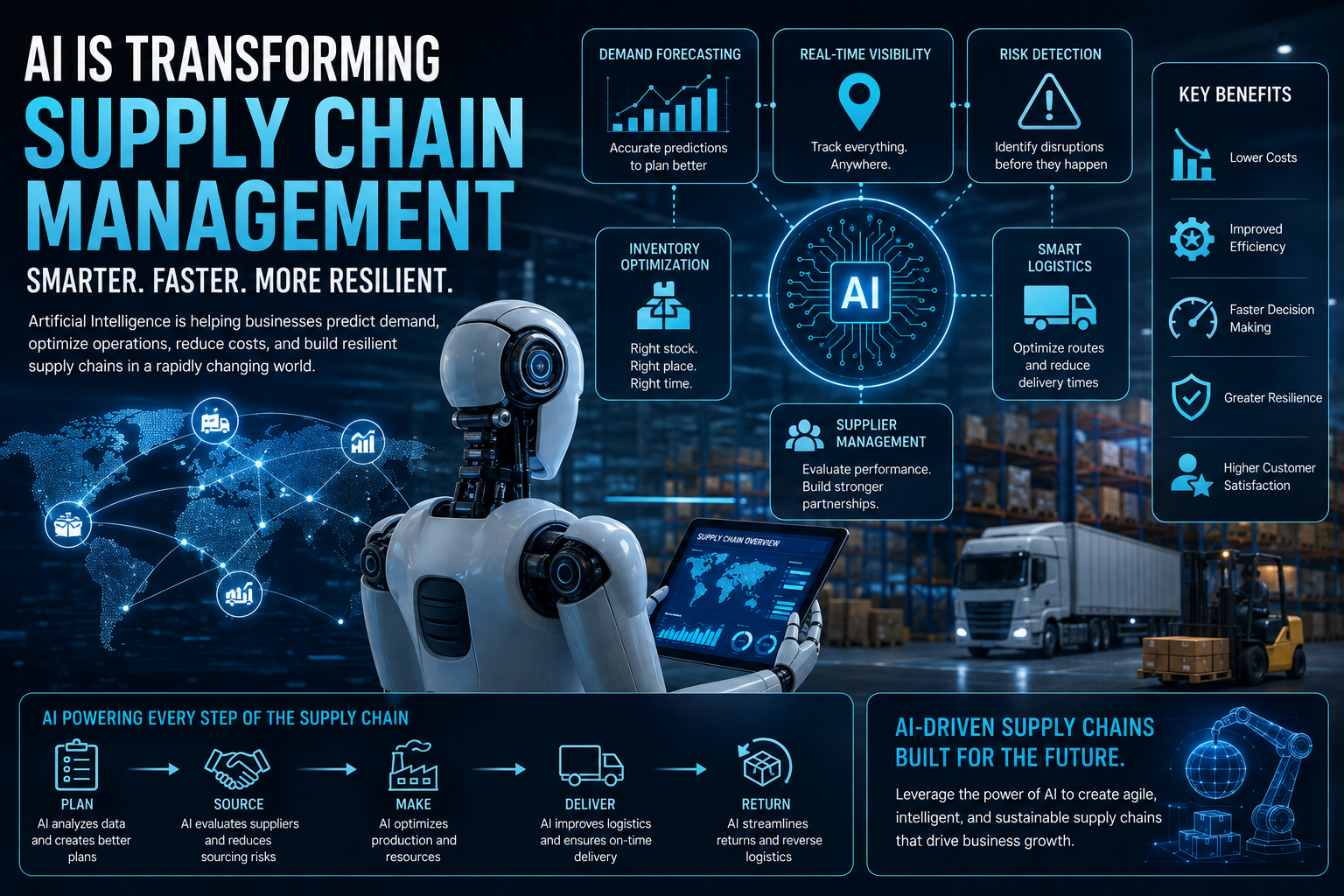
AI-powered supply chain systems can analyze large amounts of operational data, identify patterns, forecast demand, detect potential disruptions, and help companies make faster decisions. Instead of relying primarily on historical reports and manual planning, organizations can increasingly use intelligent systems to understand what is happening across their supply networks in near real time.
The result is a shift toward supply chains that are more visible, responsive, and adaptable.
Why Traditional Supply Chains Struggle
Traditional supply chain management often depends on spreadsheets, disconnected software platforms, manual communication, and historical forecasting.
These methods can work under stable conditions, but modern markets are rarely predictable. Customer demand can change quickly, transportation costs can fluctuate, suppliers can experience delays, and unexpected disruptions can affect production.
A business may know that a shipment is late only after the delay has already created a problem.
AI can change this process by continuously analyzing information from multiple sources and identifying warning signals earlier.
Instead of simply reporting what happened, intelligent systems can help businesses understand what may happen next.
AI Improves Demand Forecasting
One of the most valuable applications of AI in supply chain management is demand forecasting.
Businesses need to determine how much inventory they should purchase or produce. Ordering too much can increase storage costs and create excess inventory, while ordering too little can result in stockouts and lost sales.
Traditional forecasting often relies heavily on previous sales data.
AI can analyze a broader range of signals, including historical demand, seasonal patterns, pricing changes, promotions, customer behavior, market conditions, and other relevant information.
This can help businesses create more dynamic forecasts.
For example, a retailer could identify an unexpected increase in demand for a product and adjust purchasing decisions before inventory becomes critically low.
The goal is not perfect prediction. Instead, AI can give supply chain teams better information for making timely decisions.
Real-Time Supply Chain Visibility
Visibility is essential for modern supply chain management.
Businesses need to know where products are, which shipments are delayed, how much inventory is available, and whether suppliers are meeting expectations.
AI can help bring information from different systems into a more connected view.
A company could potentially combine warehouse information, transportation updates, supplier data, sales activity, and customer demand into a single analytical environment.
AI can then identify relationships between these signals.
For example, a transportation delay combined with rising demand could indicate a higher risk of inventory shortages.
Without connected analysis, these signals might remain isolated across different departments.
Predicting Supply Chain Disruptions
Another major advantage of AI is its ability to identify potential risks before they become major problems.
Supply chain disruptions can come from many sources, including supplier delays, transportation problems, inventory shortages, changing demand, infrastructure issues, or unexpected market conditions.
AI systems can analyze historical patterns and current information to identify potential warning signs.
A company could use these insights to investigate alternative suppliers, adjust inventory levels, change delivery schedules, or prioritize certain shipments.
This creates a more proactive approach to supply chain management.
Rather than waiting for a disruption to happen and then responding, businesses can prepare for several possible scenarios.
Smarter Inventory Management
Inventory is one of the largest operational costs for many businesses.
Companies need enough products to satisfy customers while avoiding unnecessary stock.
AI can help optimize inventory by analyzing demand patterns and identifying which products are likely to move quickly or slowly.
This can allow businesses to establish more intelligent inventory strategies.
Fast-moving products may require greater availability, while slower-moving products can be managed differently.
AI can also help identify unusual changes in purchasing behavior.
If demand for a particular product suddenly increases, the system can alert the appropriate team and support faster replenishment decisions.
AI Is Changing Warehouse Operations
Warehouses are also becoming more intelligent.
Modern warehouses generate large amounts of operational information through inventory systems, scanners, connected equipment, robotics, and order-management platforms.
AI can analyze this information to improve workflows.
For example, intelligent systems can help determine where frequently ordered products should be positioned, how workers can move more efficiently through a facility, and how inventory should be organized.
When combined with robotics and automation, AI can support increasingly sophisticated warehouse operations.
However, the value of AI is not limited to physical automation. Better information can also help managers make more efficient decisions about staffing, inventory placement, and order processing.
Smarter Transportation Management
Transportation is another area where AI can improve efficiency.
Businesses need to determine how products should move between suppliers, warehouses, stores, and customers.
AI can analyze delivery schedules, transportation capacity, routes, demand patterns, and operational constraints to support better planning.
If conditions change, businesses can potentially evaluate alternative options more quickly.
For example, if a shipment faces a delay, an intelligent system may help identify which orders are most important and which alternative transportation options could reduce the impact.
This can make logistics operations more responsive.
Supplier Management Becomes More Data-Driven
Suppliers play a critical role in supply chain performance.
Businesses need to evaluate supplier reliability, delivery performance, product quality, pricing, and capacity.
AI can analyze supplier performance over time and identify patterns that may require attention.
A company might discover that a particular supplier frequently experiences delays during specific periods. That information could influence purchasing decisions or encourage the business to develop alternative sourcing options.
AI can therefore support more data-driven supplier relationships.
Human negotiation and relationship management remain important, but better information can improve the quality of those decisions.
The Importance of Supply Chain Resilience
Efficiency is not the only objective.
Recent years have demonstrated that businesses also need resilient supply chains capable of adapting to unexpected conditions.
A supply chain designed only for maximum efficiency may have limited flexibility when something goes wrong.
AI can support resilience by helping businesses model different scenarios.
Companies can examine what might happen if demand rises sharply, a supplier becomes unavailable, transportation capacity decreases, or inventory levels fall below expectations.
Scenario analysis can help organizations prepare contingency plans before they are needed.
This can turn supply chain management from a reactive function into a strategic capability.
AI Helps Reduce Operational Waste
Supply chain inefficiencies can create significant waste.
Excess inventory, unnecessary transportation, inefficient warehouse movements, delayed production, and poor demand planning can all increase costs.
AI can help identify areas where resources are being used inefficiently.
For example, a business may discover that certain products are repeatedly transported between facilities because inventory is not positioned according to actual demand.
By identifying these patterns, companies can redesign processes and potentially reduce unnecessary costs.
The environmental impact can also matter. More efficient transportation, inventory planning, and production can contribute to lower resource consumption.
Data Quality Is Critical
AI cannot solve supply chain problems if the underlying information is unreliable.
Businesses often operate multiple systems for inventory, purchasing, sales, transportation, finance, and supplier management.
If these systems contain inconsistent or outdated information, AI-generated recommendations may become less useful.
Companies therefore need strong data-management practices.
Information should be accurate, updated regularly, securely stored, and accessible to the appropriate teams.
Integrating previously disconnected systems can be one of the most important steps toward building an intelligent supply chain.
Human Expertise Still Matters
AI may improve analysis and automation, but supply chain professionals remain essential.
Experienced managers understand supplier relationships, operational constraints, customer priorities, and business strategy.
AI can identify patterns and recommend actions, but humans need to evaluate those recommendations within the broader business context.
The strongest supply chains will therefore combine machine intelligence with human decision-making.
Employees can use AI to reduce repetitive analysis and focus more attention on strategic planning, supplier relationships, risk management, and problem-solving.
Building an AI-Ready Supply Chain
Businesses do not need to transform their entire supply chain overnight.
A practical approach is to begin with a specific problem where AI can provide measurable value.
Demand forecasting, inventory optimization, supplier analysis, warehouse operations, and transportation planning can all be potential starting points.
Companies should establish clear objectives and measure outcomes such as inventory costs, forecast accuracy, delivery performance, stockout rates, and operational efficiency.
Successful applications can then expand to additional areas.
Employee training should also be included in the transformation process. Workers need to understand how AI recommendations are generated and when human review is necessary.
The Future of Intelligent Supply Chains
AI is turning supply chains into increasingly intelligent and connected business systems.
Future supply chains may use AI agents to continuously monitor operations, identify potential disruptions, recommend adjustments, and coordinate activities across multiple departments.
The most competitive businesses will not necessarily be those with the largest supply networks. They may be those that can understand their networks most effectively and respond to change the fastest.
AI provides an opportunity to move from reactive supply chain management toward predictive and adaptive operations.
In 2026, supply chain transformation is no longer only about moving products faster. It is about building systems that can understand demand, identify risk, optimize resources, and respond intelligently to changing conditions.
Businesses that combine AI, reliable data, automation, and human expertise can build supply chains that are not only more efficient but also more resilient and prepared for the future.