Energy has become a strategic issue for businesses. Rising operating costs, sustainability targets, increasing electricity demand, and the expansion of data centers and digital infrastructure are forcing organizations to rethink how they consume and manage energy.
In 2026, artificial intelligence is emerging as an important tool for solving this challenge.
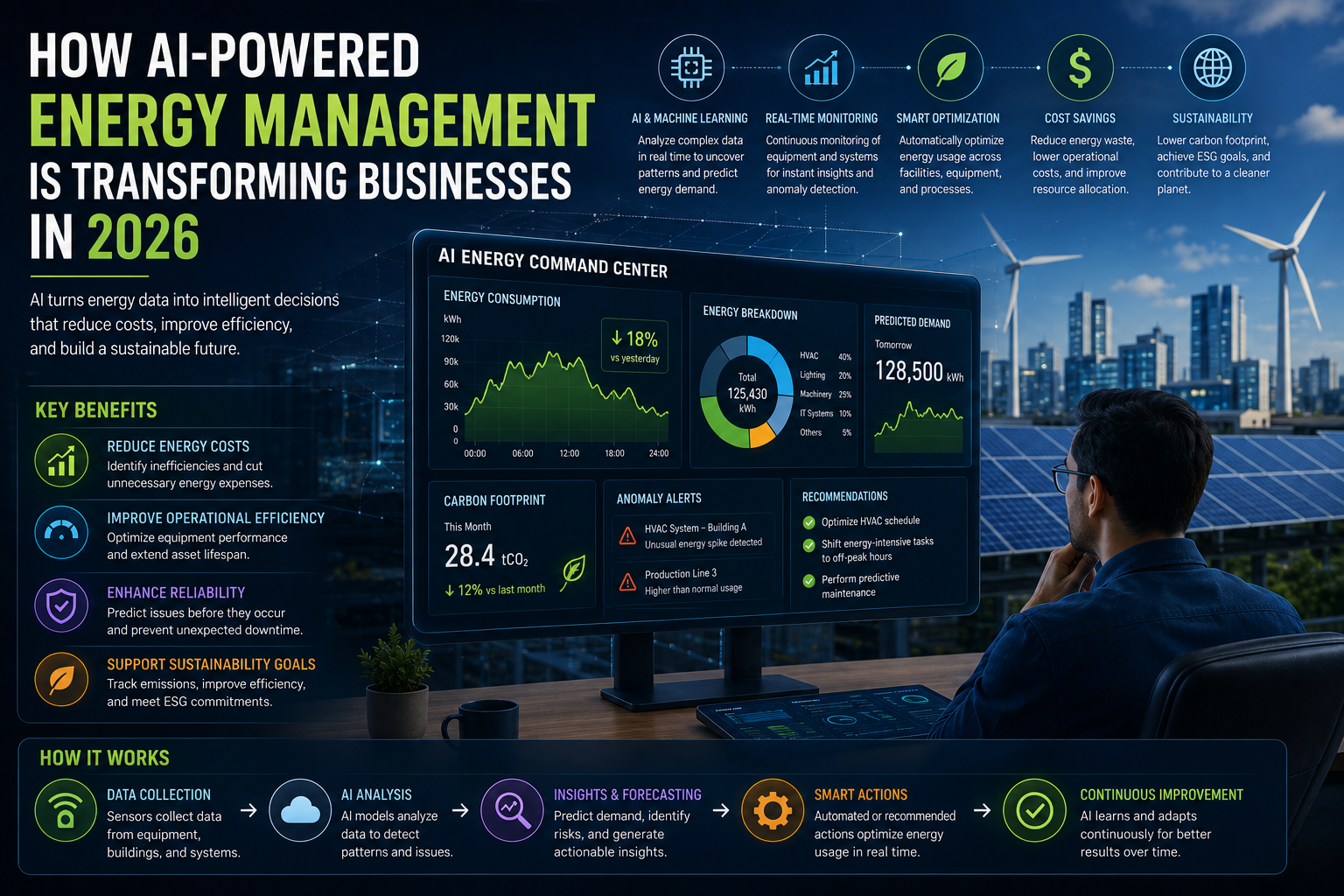
AI-powered energy management systems can analyze consumption patterns, predict demand, identify inefficiencies, optimize equipment, and help businesses make smarter decisions about when and how energy is used. Instead of simply measuring electricity consumption after it happens, organizations can use AI to continuously understand energy behavior and recommend actions.
This shift is transforming energy management from a basic cost-control function into a strategic component of modern business operations.
What Is AI-Powered Energy Management?
AI-powered energy management combines artificial intelligence, machine learning, sensors, connected devices, and real-time data to optimize how organizations consume energy.
Traditional energy-management systems often provide dashboards showing electricity usage, peak demand, and historical consumption.
AI systems can go further.
They can analyze multiple variables simultaneously, including weather conditions, building occupancy, production schedules, equipment performance, energy prices, and historical consumption.
By identifying relationships between these factors, AI can forecast future energy demand and recommend ways to reduce unnecessary consumption.
For businesses operating large buildings, factories, warehouses, retail locations, or data centers, this can create significant opportunities for efficiency.
Why Energy Management Matters in 2026
Businesses are under increasing pressure to control operating expenses while maintaining productivity.
Energy is a major expense for many industries, particularly manufacturing, logistics, hospitality, healthcare, retail, and technology.
At the same time, organizations are becoming more dependent on energy-intensive digital infrastructure.
AI itself can increase electricity demand because advanced computing systems require significant processing power.
This creates an interesting challenge: businesses are using AI to improve efficiency while also needing to manage the energy requirements associated with expanding digital operations.
AI-powered energy management can help address both sides of this equation.
Real-Time Energy Monitoring
One of the most important advantages of AI-based energy management is continuous monitoring.
Connected sensors can collect information from equipment, buildings, electrical systems, heating and cooling systems, and production lines.
AI can analyze this information in real time and identify unusual patterns.
For example, if an office building suddenly begins consuming significantly more electricity outside normal working hours, an AI system could identify the anomaly and alert facility managers.
The problem might be a malfunctioning HVAC system, lighting equipment that was left running, or another operational issue.
Instead of discovering the problem through a monthly energy bill, the business can respond much earlier.
Predicting Energy Demand
Energy demand is rarely constant.
Businesses may consume more electricity during certain working hours, seasons, production cycles, or weather conditions.
AI can analyze historical and real-time information to forecast future demand.
A manufacturing company, for example, could use AI to estimate electricity requirements based on its production schedule.
A commercial building could forecast energy consumption based on occupancy and weather conditions.
A data center could analyze computing workloads and cooling requirements to anticipate energy demand.
More accurate forecasting can help businesses plan resources and avoid unnecessary consumption.
Optimizing Heating and Cooling
Heating, ventilation, and air conditioning systems are major energy consumers in many commercial buildings.
Traditional systems may operate according to fixed schedules or temperature settings.
AI can make these systems more responsive.
An intelligent building-management system can analyze occupancy, weather, indoor temperature, historical usage, and building conditions.
If an area of a building is unoccupied, the system can adjust heating or cooling accordingly.
If weather conditions are expected to change, the system can prepare in advance.
This can improve comfort while reducing unnecessary energy use.
Smart Manufacturing
Manufacturing companies can benefit significantly from AI-powered energy optimization.
Factories use energy across machinery, lighting, heating, cooling, compressed-air systems, and production equipment.
AI can identify which processes consume the most energy and determine when inefficiencies occur.
For example, an AI system may discover that a particular machine consumes unusually high amounts of electricity during certain operating conditions.
Maintenance teams can investigate the equipment, while operations managers can evaluate whether production schedules can be adjusted.
Over time, these insights can help factories improve both energy efficiency and operational performance.
AI and Data Centers
Data centers are becoming increasingly important as businesses expand cloud computing, AI, and digital services.
However, data centers can require enormous amounts of electricity.
AI can help optimize their energy consumption by analyzing computing workloads, cooling requirements, server utilization, and environmental conditions.
Cooling is particularly important because data centers generate substantial heat.
AI systems can dynamically adjust cooling operations based on real-time conditions rather than relying entirely on fixed settings.
This can potentially reduce wasted energy while maintaining appropriate operating conditions.
As AI workloads continue to expand, intelligent energy management could become increasingly important to the economics of digital infrastructure.
Integrating Renewable Energy
Businesses are also investing in renewable energy sources such as solar and wind.
However, renewable generation can fluctuate depending on weather and environmental conditions.
AI can help organizations manage this variability.
An energy-management system can forecast renewable generation and compare it with expected consumption.
If solar generation is expected to be high during a particular period, the business could schedule certain energy-intensive activities during that window where operationally appropriate.
AI can also help coordinate energy storage systems.
This creates a more flexible approach to using renewable power.
Reducing Energy Costs
One of the most direct benefits of AI-powered energy management is potential cost reduction.
Energy prices can vary depending on location, demand, time of day, and market conditions.
AI can analyze pricing information alongside operational requirements.
A business may then identify opportunities to shift flexible energy consumption away from expensive periods.
For example, certain industrial processes, charging operations, or computing workloads may be scheduled during lower-cost periods when business requirements allow.
The objective is not simply to use less energy.
It is to use energy more intelligently.
Detecting Energy Waste
Energy waste can be difficult to identify because it may occur across many small inefficiencies.
A machine may remain active when it is not needed. Lighting may operate in empty areas. HVAC systems may run inefficiently. Equipment may consume more energy because of maintenance problems.
AI can compare current behavior with expected patterns and identify anomalies.
When multiple small inefficiencies are addressed, the combined savings can become significant.
This is particularly valuable for organizations operating large facilities where small improvements can scale across multiple locations.
Supporting Sustainability Goals
Energy efficiency is increasingly connected to corporate sustainability strategies.
Businesses are setting targets related to emissions, renewable energy, resource efficiency, and environmental performance.
AI can help organizations measure progress toward these goals.
By continuously monitoring energy consumption, companies can identify which operations contribute most significantly to their environmental footprint.
AI can then help evaluate potential improvements.
This provides businesses with more detailed information for sustainability planning while also connecting environmental objectives with operational efficiency.
AI and Smart Buildings
The concept of smart buildings is expanding as sensors and connected systems become more accessible.
AI can connect information from lighting, HVAC, security, occupancy sensors, elevators, energy meters, and other building systems.
Instead of managing each system independently, businesses can create a more coordinated environment.
For example, occupancy information could influence lighting and temperature settings.
Weather forecasts could influence HVAC operations.
Energy prices could influence charging schedules.
This creates a building that responds dynamically to changing conditions.
The Role of AI Agents
The growth of AI agents could make energy management even more sophisticated.
An AI energy agent could continuously monitor consumption, identify unusual patterns, evaluate forecasts, and recommend actions.
In controlled environments, it could potentially execute predefined changes automatically.
For example, an AI system could adjust building settings when occupancy changes or recommend maintenance when equipment performance deteriorates.
Human oversight would remain important for major decisions, but routine optimization could become increasingly automated.
Challenges Businesses Must Consider
Despite its potential, AI-powered energy management also creates challenges.
Organizations need reliable sensors and high-quality data. Incorrect or incomplete measurements can produce poor recommendations.
Cybersecurity is another concern. Connected energy systems can become potential targets if they are not properly protected.
Businesses also need to consider integration. Energy-management platforms may need to connect with building systems, industrial equipment, cloud platforms, and enterprise software.
Finally, organizations should establish clear human-approval rules for automated actions that could affect critical operations.
Building an AI Energy Strategy
Companies interested in AI-powered energy management should begin with measurable use cases.
They can start by identifying facilities or processes with high energy consumption.
Next, organizations can evaluate available energy data and determine where additional sensors may be required.
A pilot project can then focus on a specific area such as HVAC optimization, manufacturing equipment, lighting, or data-center cooling.
Businesses should measure outcomes including energy consumption, operating costs, equipment performance, and productivity.
Successful projects can gradually expand across other facilities and operations.
The Future of Intelligent Energy Management
The future of energy management will likely involve increasingly autonomous systems.
AI platforms could connect energy consumption with production schedules, weather forecasts, energy markets, renewable generation, storage systems, and business requirements.
Instead of simply reporting energy usage, these systems could continuously optimize how energy is consumed.
This could create a new type of business infrastructure where energy decisions become part of everyday operational intelligence.
Companies that adopt this approach may gain advantages in both cost efficiency and sustainability.
Conclusion
AI-powered energy management is becoming an important business technology in 2026.
By combining real-time monitoring, predictive analytics, connected sensors, and intelligent automation, organizations can better understand how energy is consumed and identify opportunities to improve efficiency.
The benefits extend beyond lower electricity bills. Smarter energy management can support operational reliability, sustainability goals, equipment performance, and long-term business resilience.
As businesses expand their digital infrastructure and AI capabilities, managing energy intelligently will become increasingly important.
The organizations that successfully connect AI with energy data can turn consumption from a largely passive expense into an actively optimized business resource.
In the years ahead, the competitive advantage may not simply come from using more technology. It may come from using technology more intelligently—and using every unit of energy as efficiently as possible.