Financial fraud is becoming more sophisticated as the global economy becomes increasingly digital. Online banking, digital payments, e-commerce, cryptocurrencies, mobile applications, and instant transactions have created enormous opportunities for businesses and consumers, but they have also created new targets for criminals.
Traditional fraud detection systems often depend on predefined rules. A transaction may be flagged because it exceeds a certain amount, occurs in an unusual location, or matches a known suspicious pattern.
These systems remain useful, but modern financial activity is too complex for rules alone to identify every threat.
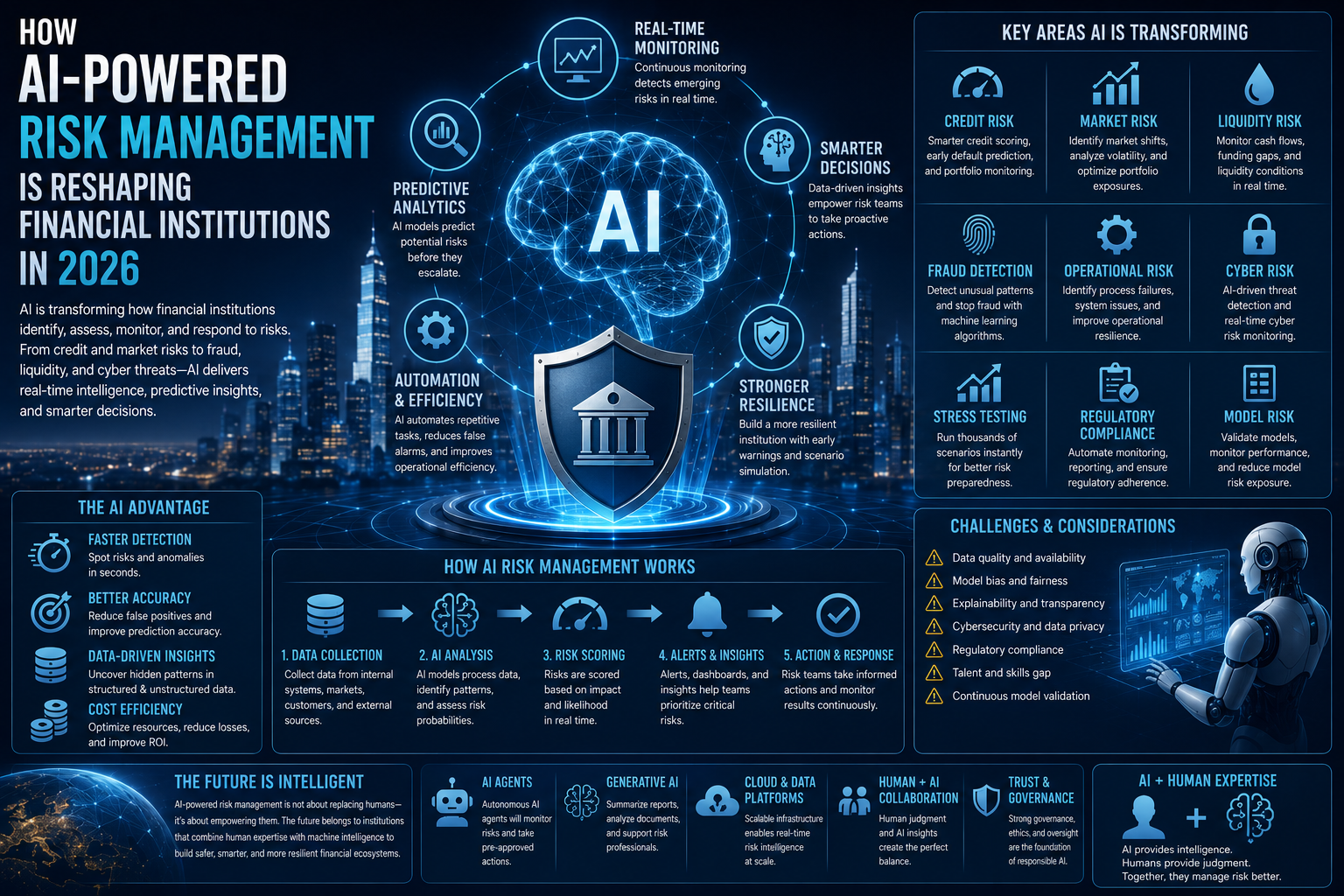
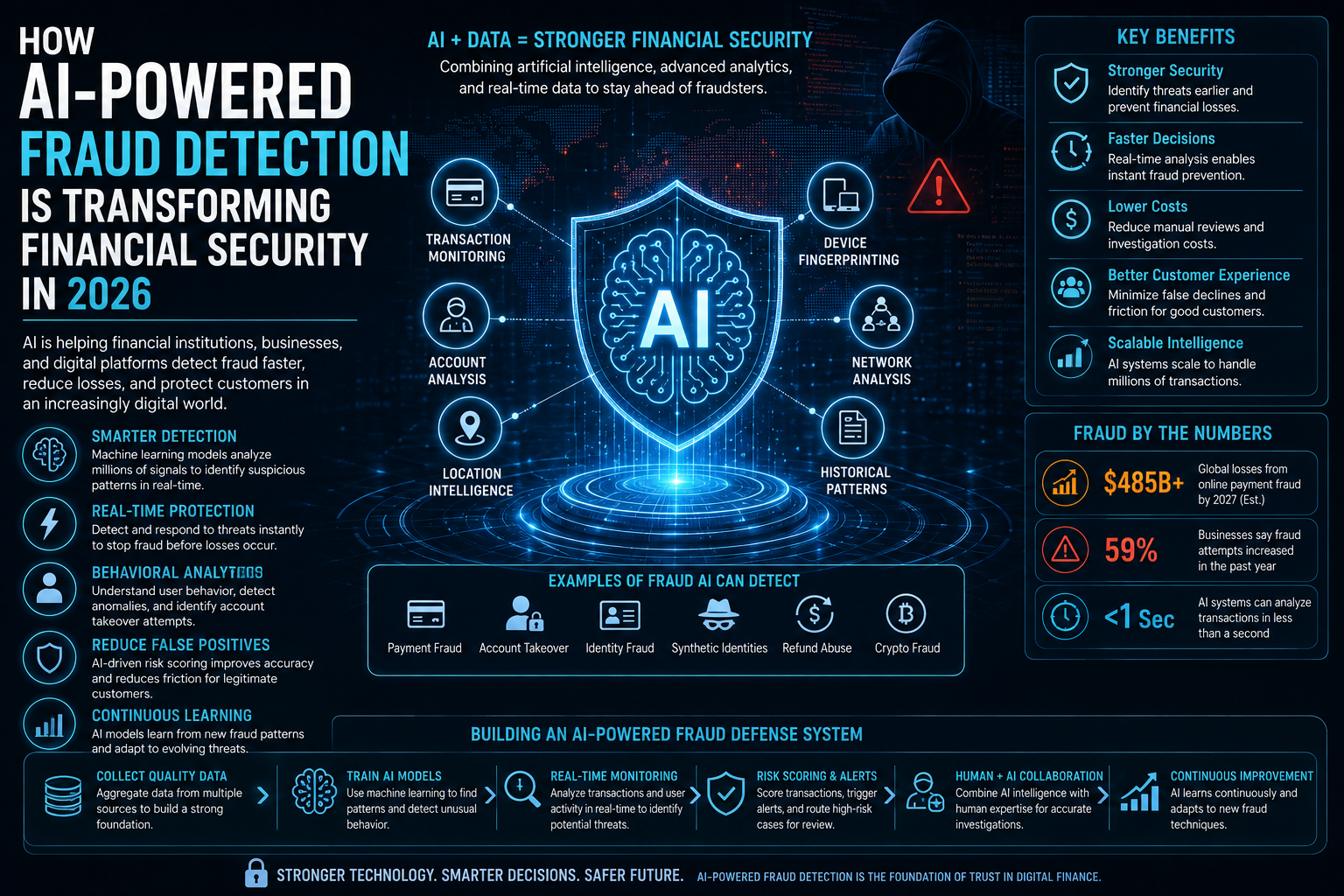
AI-powered fraud detection is changing this model by using machine learning, behavioral analytics, anomaly detection, and real-time data processing to identify potentially suspicious activity.
In 2026, financial institutions, payment providers, online businesses, and digital-asset platforms are increasingly looking toward AI to detect fraud faster while reducing unnecessary disruption to legitimate customers.
What Is AI-Powered Fraud Detection?
AI-powered fraud detection uses artificial intelligence to analyze transactions and behavioral signals and identify patterns that may indicate fraudulent activity.
Instead of relying entirely on fixed rules, AI models can learn from historical data and recognize relationships between different signals.
A system may analyze factors such as:
Transaction amount
Transaction frequency
Device information
Account behavior
Geographic signals
Login activity
Payment history
Network relationships
Timing and transaction patterns
The system can then assign a risk score or trigger additional verification when activity appears unusual.
Why Traditional Fraud Detection Is Changing
Fraudsters continuously adapt their methods.
If criminals discover that a particular rule triggers an alert, they may modify their behavior to avoid it.
Static systems can therefore struggle with constantly changing attack patterns.
AI can help by identifying unusual combinations of behavior rather than relying solely on predetermined conditions.
For example, a transaction might appear normal when considered individually.
But if it occurs alongside an unusual login, a new device, rapid account changes, and a series of transfers, an AI system may recognize the broader pattern.
Real-Time Fraud Detection
Speed is becoming increasingly important.
Digital payments can happen within seconds.
A fraudulent transaction may move money through multiple accounts before a traditional investigation begins.
AI systems can analyze transactions in real time and potentially identify suspicious activity before additional transactions occur.
For financial institutions and payment providers, this can reduce the time between detection and intervention.
Real-time systems can also help protect digital commerce platforms where thousands of transactions occur every minute.
Behavioral Analysis
One of AI's strongest capabilities is identifying behavioral patterns.
A system can learn what normal activity looks like for a particular account or customer.
If behavior suddenly changes, the system can investigate the difference.
For example, a customer who normally makes small domestic purchases may suddenly attempt multiple high-value transactions from unfamiliar devices.
This does not necessarily mean fraud has occurred.
However, the unusual behavior can increase the risk score and trigger additional verification.
Machine Learning and Anomaly Detection
Machine learning models can identify patterns across large datasets.
Anomaly detection is particularly useful when organizations need to identify activity that differs significantly from normal behavior.
The system does not necessarily need to know exactly what type of fraud is occurring.
It can identify unusual activity and send it for further investigation.
This can be valuable when criminals develop new techniques that are not yet included in traditional fraud rules.
AI and Account Takeover
Account takeover is another major concern.
Attackers may obtain passwords or other credentials and attempt to access legitimate accounts.
AI can analyze login behavior and identify unusual activity.
Signals can include:
New devices
Unusual locations
Abnormal login times
Rapid password changes
Multiple failed attempts
Unexpected account activity
Combining these signals can help organizations identify potentially compromised accounts.
Additional authentication can then be required before sensitive actions are allowed.
Fighting Payment Fraud
Payment fraud is a major challenge for financial institutions and merchants.
Fraudulent card transactions, unauthorized transfers, fake purchases, and other schemes can create significant losses.
AI can analyze transaction characteristics and compare them with historical patterns.
A payment that appears unusual can be assigned a higher risk score.
Organizations can then choose how to respond.
Depending on the situation, the system could approve the payment, request additional authentication, temporarily hold it, or send it to a fraud analyst.
AI and E-Commerce Fraud
Online retailers face multiple types of fraud.
These can include stolen payment information, fake accounts, refund abuse, promotional abuse, and fraudulent orders.
AI can evaluate customer behavior throughout the purchasing journey.
For example, the system can analyze account age, order patterns, device information, payment signals, and previous activity.
This creates a broader view than simply checking whether a payment method appears valid.
Fraud Detection in Cryptocurrency
Digital-asset platforms face unique fraud and financial-crime risks.
Blockchain transactions are recorded on distributed ledgers, creating large datasets that can potentially be analyzed using AI.
AI systems can examine transaction relationships and identify unusual patterns across addresses and wallets.
For example, a platform may investigate rapid movement of assets across multiple addresses or unusual transaction relationships.
Blockchain analytics combined with AI can therefore support monitoring and risk assessment.
However, blockchain transaction data must be interpreted carefully because unusual activity does not automatically mean illegal activity.
Detecting Fraud Rings
Fraud is not always committed by one individual.
Organized groups can operate networks of accounts, devices, payment methods, and identities.
AI can help identify relationships between these entities.
Network analysis can reveal connections that may not be obvious when examining transactions individually.
For example, several accounts may appear unrelated but share devices, behavioral patterns, addresses, or transaction destinations.
AI can help investigators identify these relationships.
Synthetic Identities
Synthetic identity fraud involves creating identities using combinations of real and fabricated information.
These identities can sometimes appear legitimate because individual pieces of information may not immediately look suspicious.
AI can analyze identity behavior across multiple interactions.
This can help organizations identify inconsistencies and unusual patterns that traditional verification processes may miss.
Strong identity verification remains important, particularly for financial institutions.
Reducing False Positives
One of the biggest problems with fraud detection is false positives.
If legitimate customers are constantly blocked, businesses can lose revenue and customer trust.
AI can help improve risk scoring by considering more contextual information.
Instead of automatically blocking every unusual transaction, the system can estimate the likelihood of fraud.
Lower-risk transactions can proceed normally, while higher-risk transactions receive additional scrutiny.
The goal is not simply to detect more fraud.
It is to detect fraud more accurately.
AI and Customer Authentication
Fraud detection is increasingly connected with identity verification.
AI can support risk-based authentication by determining when additional verification may be necessary.
A customer making a normal transaction may not need additional steps.
A transaction with multiple unusual signals could trigger stronger authentication.
This creates a more flexible security experience.
Customers can receive stronger protection without being forced through unnecessary verification for every transaction.
Generative AI and Fraud
Generative AI is creating both opportunities and risks.
Businesses can use generative AI to help fraud analysts summarize cases, investigate patterns, and generate reports.
At the same time, criminals can use generative AI to create more convincing phishing messages, fake documents, social-engineering campaigns, and other fraudulent content.
This means financial security teams need to use AI defensively while also preparing for AI-enabled attacks.
The Human Role in Fraud Detection
AI does not eliminate the need for fraud investigators.
Complex cases often require human judgment.
An AI system can identify suspicious patterns, but an investigator may need to understand the broader context.
Human analysts can also investigate unusual cases, review evidence, and determine appropriate actions.
The strongest fraud-prevention strategies combine automated detection with experienced professionals.
Privacy and Responsible AI
Fraud detection systems process sensitive information.
Financial data, identity information, device signals, and behavioral patterns require strong security and appropriate governance.
Businesses should collect only information necessary for legitimate purposes and protect it using appropriate technical controls.
AI models should also be monitored for unfair outcomes.
A fraud model that incorrectly flags certain groups of customers could create serious problems.
Organizations need testing, auditing, and governance processes to maintain responsible AI systems.
Cybersecurity and Fraud Are Converging
Fraud and cybersecurity are increasingly connected.
A compromised account can lead to financial fraud.
A phishing attack can lead to stolen credentials.
A cyberattack can manipulate business processes.
AI-powered fraud detection therefore needs to operate alongside broader cybersecurity systems.
Organizations can combine fraud analytics, identity security, endpoint monitoring, and network intelligence to create a more complete defense strategy.
AI Agents for Fraud Investigation
AI agents could eventually assist investigators by handling repetitive analytical tasks.
An agent could receive a suspicious transaction alert, examine related activity, summarize the available evidence, compare the behavior against historical patterns, and prepare a case for human review.
This could allow investigators to focus on complex cases rather than manually collecting information.
However, autonomous actions should be carefully controlled.
High-impact financial decisions should remain subject to appropriate human and organizational oversight.
The Future of Financial Security
Fraud detection is moving toward continuous intelligence.
Instead of checking transactions only after problems occur, organizations can continuously monitor activity and identify potential risks as they emerge.
AI systems can combine transaction data, behavioral signals, identity information, and network relationships.
This creates a more comprehensive approach to financial security.
As digital payments and financial platforms continue to expand, this capability will become increasingly important.
How Businesses Can Prepare
Companies interested in AI fraud detection should begin with a clear assessment of their current fraud risks.
Useful starting points include:
Payment monitoring
Account takeover detection
Identity verification
Transaction anomaly detection
Refund and e-commerce fraud
Digital-asset monitoring
Fraud investigation workflows
Organizations should establish clear performance metrics.
Important measurements can include fraud losses, false-positive rates, detection speed, investigation time, and customer friction.
The objective should be to improve security without unnecessarily damaging the customer experience.
Conclusion
AI-powered fraud detection is becoming a critical component of modern financial security.
By analyzing transactions, behavioral patterns, identity signals, and relationships between accounts, AI can help organizations identify suspicious activity faster and more accurately.
The technology can support banks, payment providers, e-commerce businesses, fintech companies, and digital-asset platforms.
But AI is not a complete security solution on its own.
Strong cybersecurity, identity controls, data governance, human expertise, regulatory compliance, and continuous monitoring remain essential.
The future of fraud prevention will likely involve a combination of intelligent software and human investigators.
AI can process enormous amounts of information and identify patterns at machine speed.
People can provide context, judgment, and accountability.
As financial activity becomes increasingly digital, businesses that invest in intelligent fraud prevention can improve security while protecting customer trust.
In 2026, the competitive advantage may increasingly belong to organizations that can detect suspicious behavior quickly without making legitimate customers feel suspicious.
That balance between security, speed, and customer experience will define the next generation of financial protection.