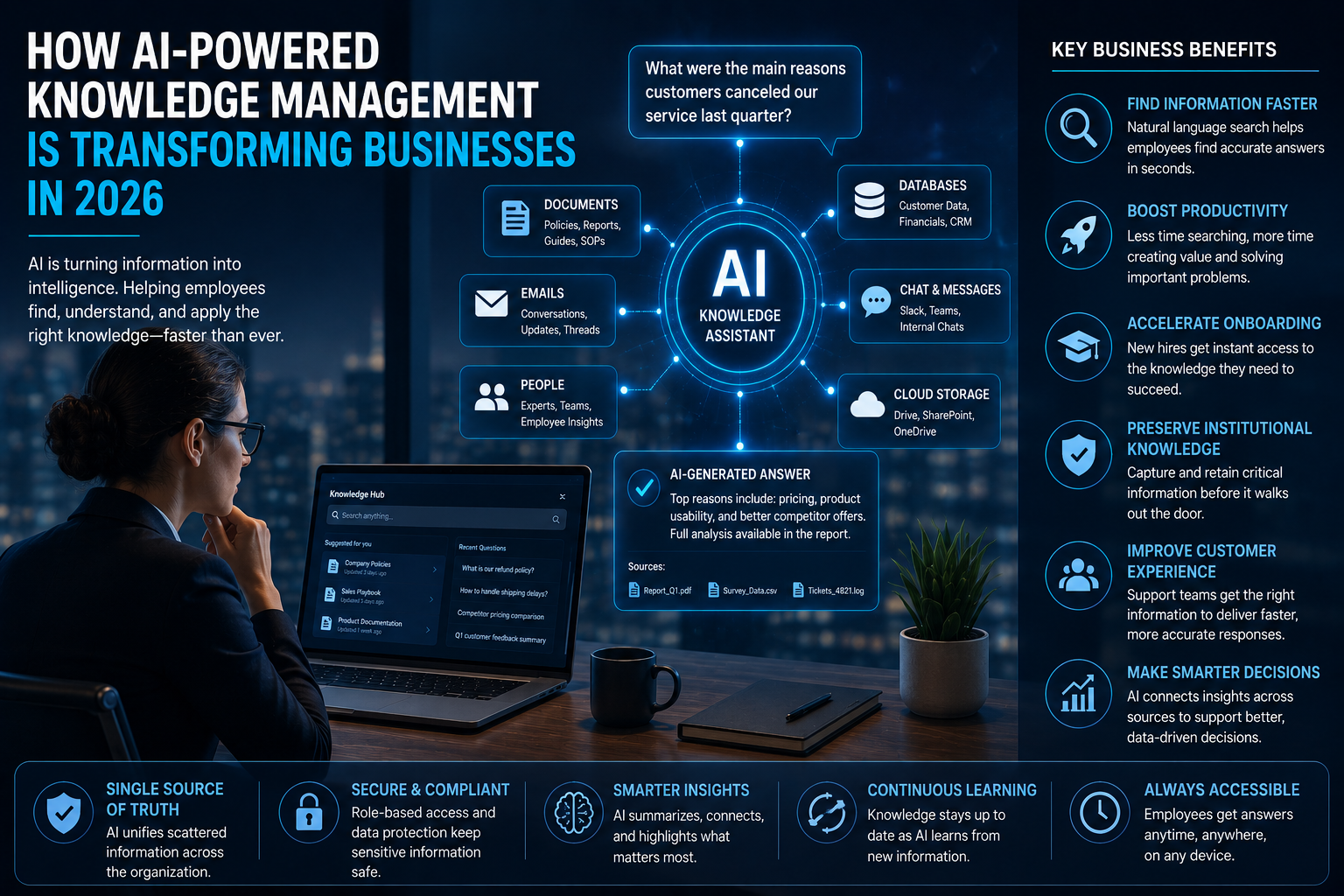
Businesses have more information than ever before. Customer records, internal documents, emails, research reports, product information, meeting notes, financial data, and operational records are continuously being created across organizations.
Yet having more information does not necessarily mean having better knowledge.
Many companies still struggle to find the right information at the right time. Employees may spend hours searching through documents, asking colleagues for answers, or recreating information that already exists somewhere inside the organization.
In 2026, artificial intelligence is changing this situation.
AI-powered knowledge management is emerging as a new way for businesses to organize, understand, search, and use their collective knowledge. Instead of simply storing information in databases and folders, intelligent systems can connect information, understand context, answer questions, and help employees turn organizational knowledge into action.
What Is AI-Powered Knowledge Management?
Traditional knowledge management focuses on collecting and organizing information so employees can access it when needed.
AI-powered knowledge management adds an intelligent layer to this process.
AI systems can analyze documents, understand relationships between different pieces of information, summarize complex material, identify relevant content, and provide answers based on an organization's internal knowledge.
For example, an employee looking for information about a company policy may no longer need to search through dozens of documents.
An AI knowledge assistant could understand the employee's question, locate the relevant policy, summarize it, and provide the source information for verification.
This creates a more natural way for employees to interact with organizational knowledge.
Why Businesses Need Better Knowledge Systems
Information is often scattered across different platforms.
A company's knowledge may exist in cloud storage, email systems, customer relationship management platforms, project-management tools, internal websites, and communication applications.
This fragmentation creates what businesses often call knowledge silos.
Employees may know that information exists but still struggle to locate it.
AI can help connect these different sources and create a more unified knowledge environment.
When properly integrated, employees can search across multiple systems using natural language instead of learning where every piece of information is stored.
This can significantly reduce the time spent searching for answers.
AI Search Is Changing Enterprise Productivity
One of the most important developments is the rise of intelligent enterprise search.
Traditional search systems usually depend on keywords. If employees use the wrong words, they may not find the information they need.
AI-powered search can understand the meaning behind a question.
An employee might ask, “What were the main reasons customers cancelled our service last quarter?”
Instead of searching for individual keywords, an AI system could analyze customer records, support conversations, survey results, and internal reports to identify recurring themes.
This transforms enterprise search from a document-finding tool into an information-analysis system.
Faster Employee Onboarding
AI-powered knowledge management can also improve employee onboarding.
New employees often need to learn large amounts of information about company processes, products, customers, tools, and policies.
Traditionally, onboarding depends heavily on training sessions, manuals, and experienced employees.
An AI knowledge assistant can provide new employees with an interactive resource for learning.
They can ask questions about internal processes and receive explanations based on approved company information.
This does not eliminate human training, but it can provide employees with continuous support after formal onboarding ends.
The result can be a faster and more consistent learning experience.
Preserving Institutional Knowledge
One of the biggest challenges for businesses is losing knowledge when experienced employees leave.
Employees often possess valuable knowledge that is never formally documented. They may understand customer relationships, operational processes, technical problems, or historical decisions that are difficult to capture in traditional databases.
AI-powered knowledge systems can help organizations preserve some of this institutional knowledge.
Meeting records, project documentation, support conversations, and internal communications can be organized and connected so important information remains accessible.
This can reduce the risk of knowledge disappearing when employees change roles or leave the company.
Improving Customer Support
AI knowledge management can have a direct impact on customer service.
Support employees need access to accurate product information, troubleshooting procedures, customer policies, and previous interactions.
If information is difficult to find, customers may experience delays or inconsistent answers.
An AI-powered support system can retrieve relevant information while an employee handles the customer interaction.
It can suggest potential solutions, summarize previous conversations, and identify relevant documentation.
This can help support teams respond faster while maintaining greater consistency.
AI Knowledge Management and Decision-Making
Knowledge management is not only about answering questions.
It can also support business decision-making.
Executives and managers frequently need to combine information from different parts of an organization before making strategic decisions.
AI can help summarize relevant reports, identify trends, compare historical information, and highlight potential risks.
For example, a manager considering a new product launch could ask an AI system to summarize customer feedback, previous product performance, market research, and internal sales information.
The system could organize the information into a decision-support report.
Human leaders would still make the final decision, but AI could reduce the time required to gather and interpret information.
Creating a Single Source of Truth
Businesses often have multiple versions of the same information.
One department may use an outdated document while another uses a newer version.
This can create confusion and operational errors.
AI-powered knowledge management can help identify duplicate or outdated information and prioritize approved sources.
Organizations can establish authoritative documents and information repositories that AI systems use when generating responses.
This is particularly important for areas such as compliance, financial policies, product specifications, and customer-service procedures.
The goal is to create greater consistency across the organization.
Protecting Sensitive Information
AI knowledge systems also introduce important security considerations.
An AI assistant connected to internal company information should not automatically have unrestricted access to every document.
Organizations need permission systems that determine what information each employee or AI application can access.
Sensitive financial data, customer information, employee records, and confidential business documents may require additional controls.
Businesses should also monitor how AI systems retrieve and use information.
Security therefore needs to be designed into AI knowledge management from the beginning rather than added later.
The Importance of Accurate Information
AI-powered knowledge management is only useful when the underlying information is reliable.
If a company's internal documents contain outdated or contradictory information, an AI system may produce an incorrect answer.
Businesses should therefore establish processes for reviewing and updating important knowledge.
Information should have clear ownership, version control, and appropriate approval processes.
AI can make information easier to access, but it cannot automatically guarantee that every piece of information is correct.
Human oversight remains essential.
AI Agents and Organizational Knowledge
The growth of AI agents makes knowledge management even more important.
AI agents can perform tasks, interact with business applications, and make decisions based on available information.
For an agent to operate effectively, it needs access to reliable organizational knowledge.
For example, an AI agent handling customer onboarding may need information about company policies, pricing, compliance requirements, product details, and customer records.
A well-organized knowledge layer can provide the information required for the agent to complete its tasks.
This means knowledge management may become a foundational component of agentic business systems.
Building an AI Knowledge Strategy
Businesses do not need to transform every information system at once.
A practical approach is to begin with a specific business problem.
Companies can identify areas where employees spend significant time searching for information or repeatedly answering the same questions.
Customer support, employee onboarding, technical assistance, sales enablement, and internal operations are potential starting points.
Organizations can then connect trusted information sources, establish access controls, and measure whether the AI system actually saves time or improves outcomes.
Successful use cases can later be expanded across the organization.
The Future of Enterprise Knowledge
The future of knowledge management is likely to become increasingly intelligent and interactive.
Employees may interact with company knowledge through conversational AI rather than traditional websites, folders, and search boxes.
AI systems could proactively surface information when employees need it.
A sales representative might automatically receive relevant customer insights before a meeting. A manager could receive a summary of operational risks before a weekly review. A support employee could receive recommended solutions as a customer describes a problem.
This would transform knowledge from something employees search for into something that actively supports their work.
Conclusion
AI-powered knowledge management is becoming an important part of business transformation in 2026.
Organizations are no longer simply trying to store more information. They are looking for ways to make their existing knowledge more accessible, useful, and actionable.
AI can help businesses connect fragmented information, improve enterprise search, accelerate employee onboarding, preserve institutional knowledge, support customer service, and strengthen decision-making.
However, successful implementation requires more than an AI chatbot. Businesses need accurate data, reliable knowledge sources, strong security controls, clear permissions, and ongoing human oversight.
As AI agents and intelligent business applications become more common, organizational knowledge will become increasingly valuable.
The companies that can turn their information into accessible, trusted, and actionable knowledge may gain an important advantage in productivity and innovation.
In 2026, the competitive question is no longer simply how much information a company has. It is how intelligently that company can use what it knows.