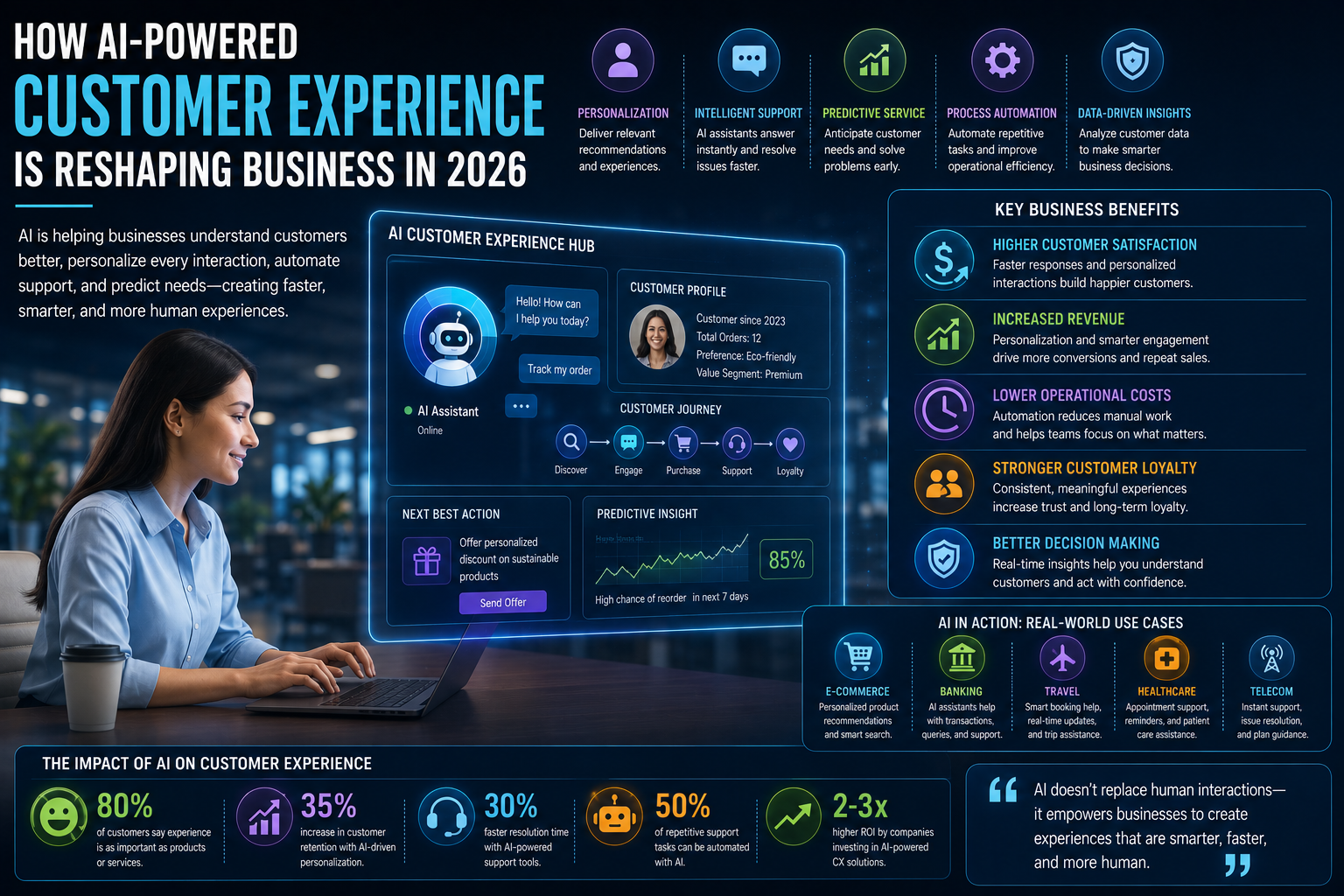
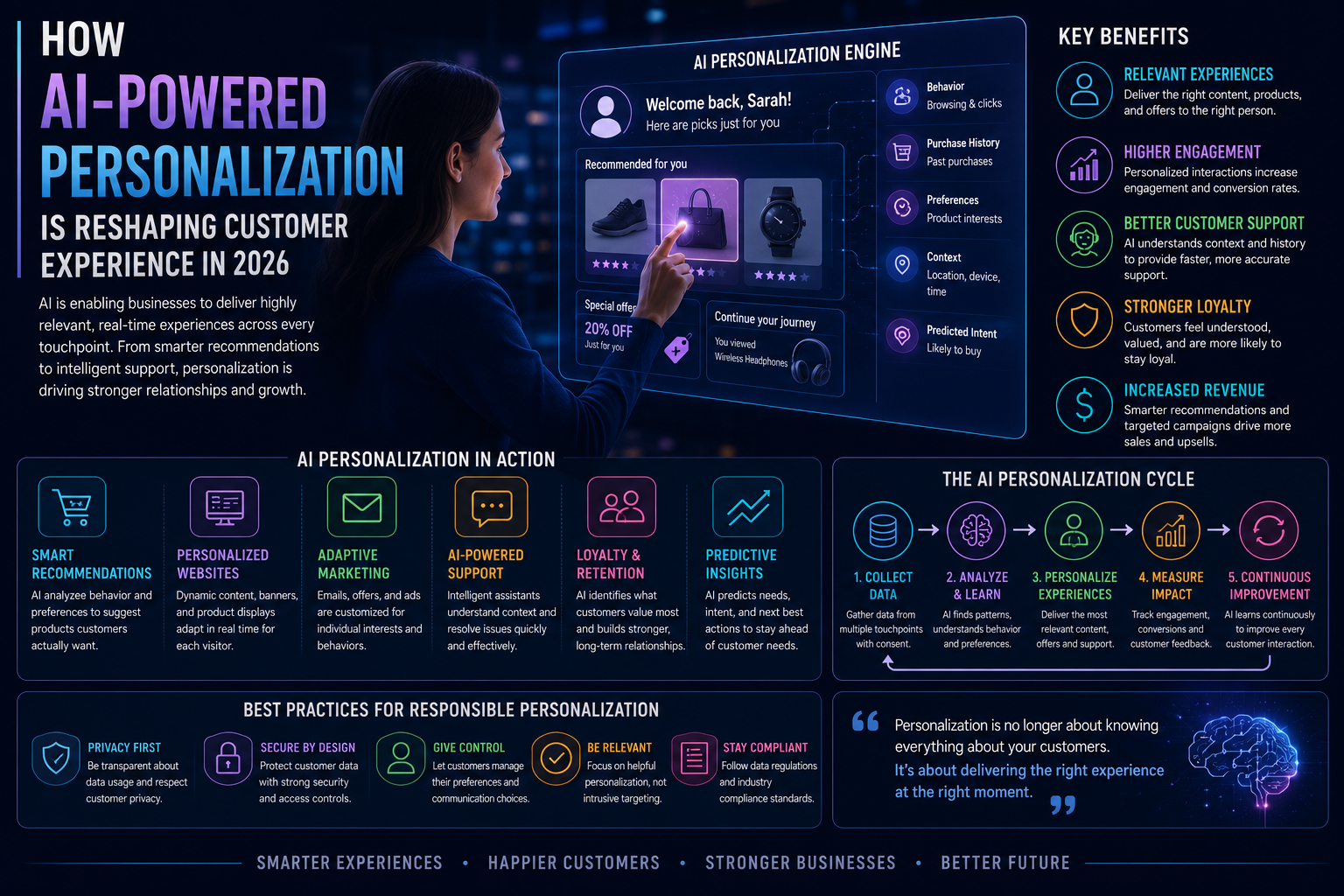
Artificial intelligence is changing the way businesses understand and interact with their customers. For years, companies relied on broad customer segments, historical purchasing data, and manually designed marketing campaigns to create personalized experiences. Today, AI is making it possible to deliver more dynamic and individualized interactions across digital channels.
AI-powered personalization uses machine learning, customer data, behavioral signals, predictive analytics, and generative AI to determine what information, products, services, or experiences may be most relevant to a particular customer.
In 2026, personalization is moving beyond simply recommending products. Businesses are using AI to customize websites, marketing messages, customer support, product recommendations, pricing experiences, and digital journeys.
The result is a shift from segment-based marketing toward continuously adaptive customer experiences.
What Is AI-Powered Personalization?
AI-powered personalization refers to the use of artificial intelligence to tailor customer experiences according to individual preferences, behavior, context, and predicted needs.
Traditional personalization might categorize customers into groups such as new customers, returning customers, or high-value customers.
AI can work at a much more detailed level.
It can analyze browsing behavior, previous purchases, search activity, interactions, preferences, location signals, and other permitted information to determine what experience may be most relevant.
Instead of treating thousands of customers as one segment, AI can help businesses create experiences that adapt to individual users.
Why Personalization Matters
Customers are exposed to enormous amounts of digital content every day.
Businesses compete for attention across search engines, social media, websites, email, mobile applications, and digital advertising platforms.
Generic experiences can easily become irrelevant.
Personalization allows companies to reduce information overload by presenting customers with products, content, and services that are more closely aligned with their interests.
When implemented responsibly, this can improve engagement and make digital experiences easier to navigate.
AI Is Changing Product Recommendations
Product recommendations are one of the most visible applications of AI personalization.
E-commerce businesses can analyze previous purchases, browsing behavior, product interactions, and other signals to identify products that may interest a customer.
Modern AI systems can go beyond simple “customers who bought this also bought” recommendations.
They can consider context.
A customer searching for travel equipment, for example, may receive different recommendations depending on the products they have already viewed, the type of trip they appear to be planning, and their previous purchasing behavior.
This can create a more relevant shopping experience.
Personalizing Websites in Real Time
AI can also change how websites present information.
Different visitors may see different product categories, content recommendations, offers, or navigation options based on their behavior.
A returning customer could immediately see products related to previous interests, while a first-time visitor might receive educational content designed to explain the company's services.
The objective is not necessarily to change every element of a website.
Instead, AI can help businesses identify which parts of the customer journey would benefit most from personalization.
AI-Powered Customer Support
Customer service is another area undergoing major change.
AI assistants can analyze customer questions and use contextual information to provide more relevant responses.
Instead of giving every customer the same scripted answer, an AI system can potentially consider the customer's previous interactions, product information, and current issue.
For example, a customer contacting an online retailer about an order may receive an answer based on their specific order status rather than a generic explanation of shipping policies.
This can make support faster and more useful.
Human employees can then focus on complex cases requiring judgment or empathy.
Personalized Marketing Campaigns
AI is also changing digital marketing.
Traditional campaigns often involve creating one message for a large audience.
AI can help marketers generate different versions of content for different customer groups or individual contexts.
An email campaign, for example, could adapt its product recommendations, messaging, timing, and offers according to customer behavior.
Generative AI can also help create variations of headlines, product descriptions, promotional messages, and visual concepts.
However, businesses still need human oversight to ensure that automated content remains accurate, appropriate, and aligned with brand identity.
Predicting What Customers Need Next
One of the most valuable aspects of AI personalization is prediction.
Instead of only responding to what customers have already done, AI can attempt to identify what they may need next.
A software company might identify when a customer is likely to need an upgraded service.
A retailer might predict when a customer is likely to reorder a frequently purchased product.
A financial platform might identify educational information that could help customers understand a service.
Predictive personalization can make businesses more proactive.
However, predictions should be used carefully, especially when they involve sensitive information or important decisions.
Personalization in Financial Services
Financial institutions can use AI to customize digital experiences for customers.
A banking application could organize information based on the customer's usage patterns and provide relevant educational resources.
AI could help customers understand spending patterns or identify financial products that may be relevant.
However, financial personalization requires strong regulatory controls.
AI-generated recommendations should not become misleading or inappropriate financial advice.
Transparency and human oversight remain important when personalization affects significant financial decisions.
Personalization in Healthcare
Healthcare also has potential applications for AI personalization.
Digital healthcare platforms can use permitted information to customize educational content, appointment experiences, reminders, and other non-clinical interactions.
AI may help patients find relevant information more efficiently.
However, healthcare personalization must be handled with particular care because health information is highly sensitive.
AI systems should not make unsupported medical claims or replace professional medical judgment.
Privacy, security, clinical validation, and appropriate regulation are essential.
The Importance of First-Party Data
As privacy expectations increase, businesses are placing greater importance on first-party data.
First-party data is information collected directly through a company's interactions with its customers, such as website activity, purchases, subscriptions, or customer-service interactions.
AI can help organizations understand this information and identify useful patterns.
Companies that build strong relationships with customers may therefore have an advantage because they can create better experiences using data customers have knowingly shared.
However, businesses should clearly communicate how information is collected and used.
Privacy Must Remain a Priority
Personalization creates a major responsibility for businesses.
Customers may appreciate relevant experiences, but they can become uncomfortable when personalization feels intrusive.
Companies need to establish clear rules around data collection, storage, access, and usage.
Businesses should avoid collecting information simply because technology makes it possible.
The better approach is to determine what information is genuinely necessary to provide a useful service.
Privacy-conscious personalization can help companies build long-term trust.
Avoiding the “Creepy” Factor
There is a fine line between helpful personalization and excessive personalization.
A customer may appreciate a recommendation based on a product they recently viewed.
But they may feel uncomfortable if a company appears to know unrelated details about their personal life.
AI systems should therefore be designed around relevance and restraint.
The best personalization often feels natural rather than obvious.
Customers should receive useful information without feeling that they are being constantly monitored.
AI and Loyalty Programs
Loyalty programs can become more intelligent through AI.
Instead of offering identical rewards to every customer, businesses can use AI to understand individual preferences.
One customer may value discounts, another may prefer early access to products, while another may respond better to exclusive experiences.
AI can help companies determine which rewards are most likely to create meaningful engagement.
This can make loyalty programs more flexible and potentially increase customer retention.
Personalization Across Multiple Channels
Modern customers interact with businesses across many platforms.
They may discover a product through social media, research it on a website, ask questions through a chatbot, and complete a purchase using a mobile application.
Customers expect these interactions to feel connected.
AI can help businesses create continuity across channels.
For example, information from an earlier interaction could help personalize a later experience, subject to appropriate privacy and consent requirements.
This creates a more unified customer journey.
The Role of Generative AI
Generative AI is expanding personalization beyond recommendations.
Businesses can potentially generate customized text, product explanations, summaries, marketing messages, and support responses in real time.
An AI system could explain the same product differently depending on the customer's level of knowledge.
A beginner might receive a simple explanation, while an experienced customer could receive more technical information.
This creates opportunities for highly adaptive communication.
Measuring Personalization
Personalization should be measured using meaningful business outcomes.
Companies can track metrics such as conversion rates, customer engagement, retention, support resolution times, average order value, and customer satisfaction.
However, businesses should avoid assuming that more personalization automatically produces better results.
An overly personalized experience can sometimes reduce trust or overwhelm customers.
Testing is therefore important.
Organizations should compare different approaches and continuously evaluate customer responses.
The Future of AI Personalization
AI personalization is likely to become increasingly dynamic.
Future systems may continuously adapt experiences based on real-time context rather than relying primarily on historical profiles.
AI agents could potentially assist customers across multiple stages of a purchasing or service journey.
Websites, applications, customer support platforms, and marketing systems could work together to provide more consistent experiences.
The goal will be to make digital interactions feel more useful and relevant without sacrificing privacy.
Conclusion
AI-powered personalization is becoming an important part of the modern customer experience.
Businesses can use AI to improve product recommendations, customer support, marketing, websites, loyalty programs, and digital journeys.
The technology offers significant opportunities, but responsible implementation is essential.
Companies need strong data governance, privacy protections, transparency, security, and human oversight.
The most successful businesses will not simply personalize everything they can. They will personalize the experiences where AI can create genuine value for customers.
In 2026, the competitive advantage may increasingly come from understanding customers without overwhelming them.
AI can help businesses move from generic digital experiences toward interactions that are more relevant, responsive, and useful—creating a future where technology adapts to customers rather than forcing customers to adapt to technology.