Global supply chains have become increasingly complex. Businesses today depend on networks of suppliers, manufacturers, logistics providers, warehouses, transportation companies, and technology platforms spread across multiple regions.
A disruption in one part of this network can quickly affect the rest of the business.
Unexpected demand, transportation delays, supplier problems, geopolitical events, extreme weather, raw-material shortages, and changing market conditions can all create operational challenges. Traditional supply-chain management systems can provide visibility into what is happening, but they may struggle to predict what could happen next.
In 2026, artificial intelligence is changing this equation.
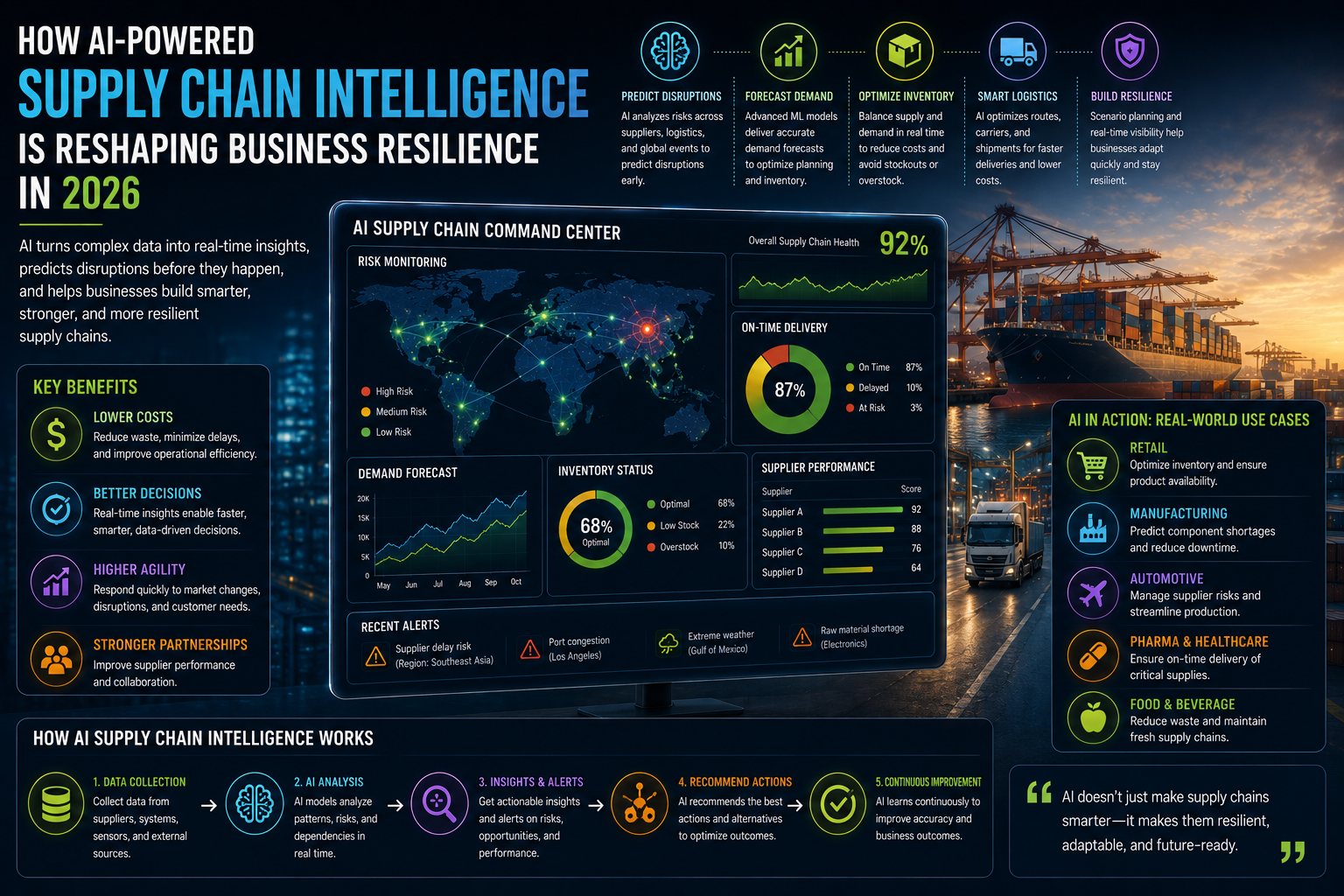
AI-powered supply chain intelligence is helping businesses analyze massive amounts of operational data, identify potential risks, forecast demand, optimize inventory, and make faster decisions. Instead of responding to disruptions after they occur, organizations can increasingly use AI to anticipate problems and prepare alternative strategies.
This is transforming supply chains from reactive systems into more intelligent and resilient business networks.
What Is AI-Powered Supply Chain Intelligence?
AI-powered supply chain intelligence combines artificial intelligence, machine learning, predictive analytics, automation, and real-time data to help businesses understand and optimize their supply chains.
Traditional supply-chain systems often focus on tracking orders, inventory, shipments, and suppliers.
AI adds a predictive layer.
An AI system can analyze historical purchasing data, supplier performance, transportation information, market conditions, weather patterns, customer demand, and other relevant signals.
It can then identify relationships and patterns that may indicate future risks or opportunities.
For example, if a supplier's delivery performance begins deteriorating while transportation delays are increasing in the same region, an AI system could identify the combined risk and alert supply-chain managers.
Why Supply Chain Resilience Matters in 2026
Supply-chain resilience has become a strategic business priority.
Companies cannot always prevent disruptions, but they can improve their ability to detect, respond to, and recover from them.
A resilient supply chain needs more than backup suppliers.
Businesses need visibility into dependencies and the ability to understand how one disruption could affect multiple operations.
AI can help create this visibility.
Instead of examining thousands of individual events manually, supply-chain teams can use AI to identify the issues most likely to affect business continuity.
This allows decision-makers to focus their attention where it matters most.
Predicting Supply Chain Disruptions
One of the biggest opportunities for AI is disruption prediction.
Supply chains generate enormous amounts of information. Suppliers provide performance data, logistics providers generate shipment information, and businesses collect inventory and demand data.
AI can analyze these signals continuously.
If a supplier begins missing delivery targets, transportation times increase, or market conditions change, the system can recognize the pattern.
The business can then investigate alternative suppliers, adjust inventory levels, or modify delivery schedules before the disruption becomes critical.
AI does not guarantee perfect predictions, but earlier warnings can provide businesses with valuable time to respond.
Smarter Demand Forecasting
Demand forecasting is another major application.
Businesses need to know how much inventory they will require in the future. Ordering too much can increase storage costs and create excess inventory, while ordering too little can result in shortages.
AI can analyze historical sales, seasonal trends, customer behavior, market signals, promotions, and other variables to generate more dynamic demand forecasts.
For example, a retailer preparing for a seasonal shopping period can use AI to estimate demand across different locations and product categories.
A manufacturer can use similar technology to anticipate future requirements for raw materials.
The result can be a more responsive inventory strategy.
Optimizing Inventory
Inventory management is closely connected to demand forecasting.
AI can help businesses determine where inventory should be stored, how much should be maintained, and when replenishment should occur.
Instead of applying the same inventory rules to every product, AI can identify differences in demand patterns and supply risks.
Products with unpredictable demand may require different strategies from products with stable demand.
Similarly, products supplied by high-risk vendors may require additional safety stock.
AI can help businesses make these distinctions automatically.
Improving Supplier Intelligence
Supplier management is another area where AI can create value.
Businesses often work with hundreds or thousands of suppliers, making it difficult to monitor every relationship manually.
AI can analyze supplier performance across multiple dimensions.
These may include delivery reliability, quality, pricing, lead times, contract performance, and other operational indicators.
The system can identify suppliers whose performance is improving or deteriorating and highlight relationships that require attention.
This creates a more continuous approach to supplier management.
Finding Hidden Dependencies
Supply chains can contain dependencies that are difficult to see.
A company may believe that it has multiple suppliers for a particular product, only to discover that several suppliers depend on the same manufacturer or geographic region.
AI can analyze relationships across the supply network and identify these hidden dependencies.
This can help businesses understand where concentration risk exists.
For example, if several important suppliers rely on the same transportation route, the business may still face significant disruption risk despite having multiple vendors.
AI-driven network analysis can bring these vulnerabilities to the surface.
AI and Logistics Optimization
Transportation is another major area for AI-driven optimization.
Businesses need to determine how products should move between suppliers, warehouses, distribution centers, and customers.
AI can analyze routes, delivery times, fuel costs, inventory locations, demand, and transportation constraints.
It can then recommend more efficient logistics strategies.
If a transportation route becomes unavailable, AI can evaluate alternative routes and estimate their potential impact.
This can help logistics teams respond faster to changing conditions.
Real-Time Supply Chain Visibility
Traditional supply-chain reports may provide information only after an event has occurred.
AI-powered platforms can provide more continuous visibility.
Businesses can monitor shipments, inventory, supplier performance, and operational conditions in near real time.
When something changes, the system can identify the event and evaluate its potential impact.
This creates a more proactive management model.
Instead of waiting for a weekly report to reveal a problem, supply-chain teams can receive alerts when important conditions change.
AI and Sustainability
Supply-chain intelligence is also becoming connected to sustainability.
Businesses increasingly want to understand the environmental impact of sourcing, manufacturing, transportation, and distribution.
AI can analyze supply-chain data to identify opportunities to reduce waste, optimize transportation, and improve resource utilization.
For example, AI could help businesses evaluate whether shipments can be consolidated or whether alternative logistics routes could reduce unnecessary transportation.
This can support both efficiency and sustainability objectives.
Scenario Planning With AI
One of the most powerful capabilities of AI is the ability to evaluate hypothetical situations.
Business leaders can ask questions such as:
What happens if a major supplier becomes unavailable?
What happens if customer demand increases by 20%?
What happens if transportation costs rise?
What happens if a distribution center becomes unavailable?
AI can model different scenarios and estimate their potential effects.
This allows companies to prepare contingency plans before disruptions occur.
Scenario planning can therefore turn uncertainty into something that can be analyzed and managed.
AI Agents in Supply Chain Operations
The rise of AI agents could take supply-chain automation further.
An AI agent can monitor information, perform analysis, communicate with systems, and take predefined actions.
For example, an AI agent could detect that inventory for an important product is falling below a certain threshold.
It could check supplier availability, evaluate pricing, review delivery times, and prepare a replenishment recommendation.
With appropriate controls, some routine procurement or logistics actions could potentially be automated.
Human employees would remain responsible for important decisions and exceptions.
The Human Role Remains Critical
AI can analyze information faster than humans, but supply-chain decisions often involve business judgment.
A supplier may have a higher price but provide better quality.
A faster shipping route may have higher environmental costs.
A particular supplier may be strategically important for long-term reasons that are not visible in historical data.
Human expertise is therefore essential.
The best approach is to use AI as a decision-support system while allowing experienced professionals to evaluate strategic trade-offs.
Cybersecurity and Data Protection
Connected supply chains also create cybersecurity considerations.
AI-powered systems may connect to supplier information, inventory platforms, logistics systems, financial applications, and operational technology.
Unauthorized access to these systems could create serious risks.
Businesses need strong identity controls, data protection, network security, monitoring, and access policies.
AI systems should also receive only the permissions necessary to perform their assigned tasks.
Security must remain a fundamental part of supply-chain modernization.
Building an AI Supply Chain Strategy
Businesses should not attempt to transform their entire supply chain immediately.
A practical approach is to begin with one high-value problem.
Companies can start with demand forecasting, inventory optimization, supplier monitoring, or logistics planning.
The organization can then measure outcomes such as forecast accuracy, inventory costs, delivery performance, and disruption response times.
Once a successful use case is established, AI capabilities can be expanded across additional areas.
This gradual approach allows businesses to demonstrate value while managing implementation risk.
The Future of Intelligent Supply Chains
The supply chain of the future is likely to become increasingly autonomous and predictive.
AI systems may continuously monitor suppliers, demand, transportation, inventory, and market conditions.
When potential disruptions appear, intelligent systems could recommend alternative strategies automatically.
AI agents may eventually coordinate across procurement, logistics, inventory, finance, and customer-service systems.
This could create an interconnected business environment where supply-chain decisions are continuously optimized based on changing conditions.
Human leaders would remain responsible for strategy, governance, and high-impact decisions.
Conclusion
AI-powered supply chain intelligence is becoming an important competitive capability in 2026.
By analyzing real-time information, predicting disruptions, forecasting demand, optimizing inventory, monitoring suppliers, and evaluating scenarios, AI can help businesses build more resilient operations.
The biggest advantage is not simply automation.
It is visibility.
Businesses that understand their supply networks more deeply can respond to disruptions faster, identify hidden risks earlier, and make better decisions about inventory, suppliers, and logistics.
As global supply chains become more interconnected, resilience will increasingly depend on the ability to anticipate change rather than simply react to it.
AI can provide that intelligence.
The future of supply-chain management will therefore be defined not only by moving products efficiently, but by building intelligent networks that can sense risks, adapt quickly, and continue operating when conditions change.