
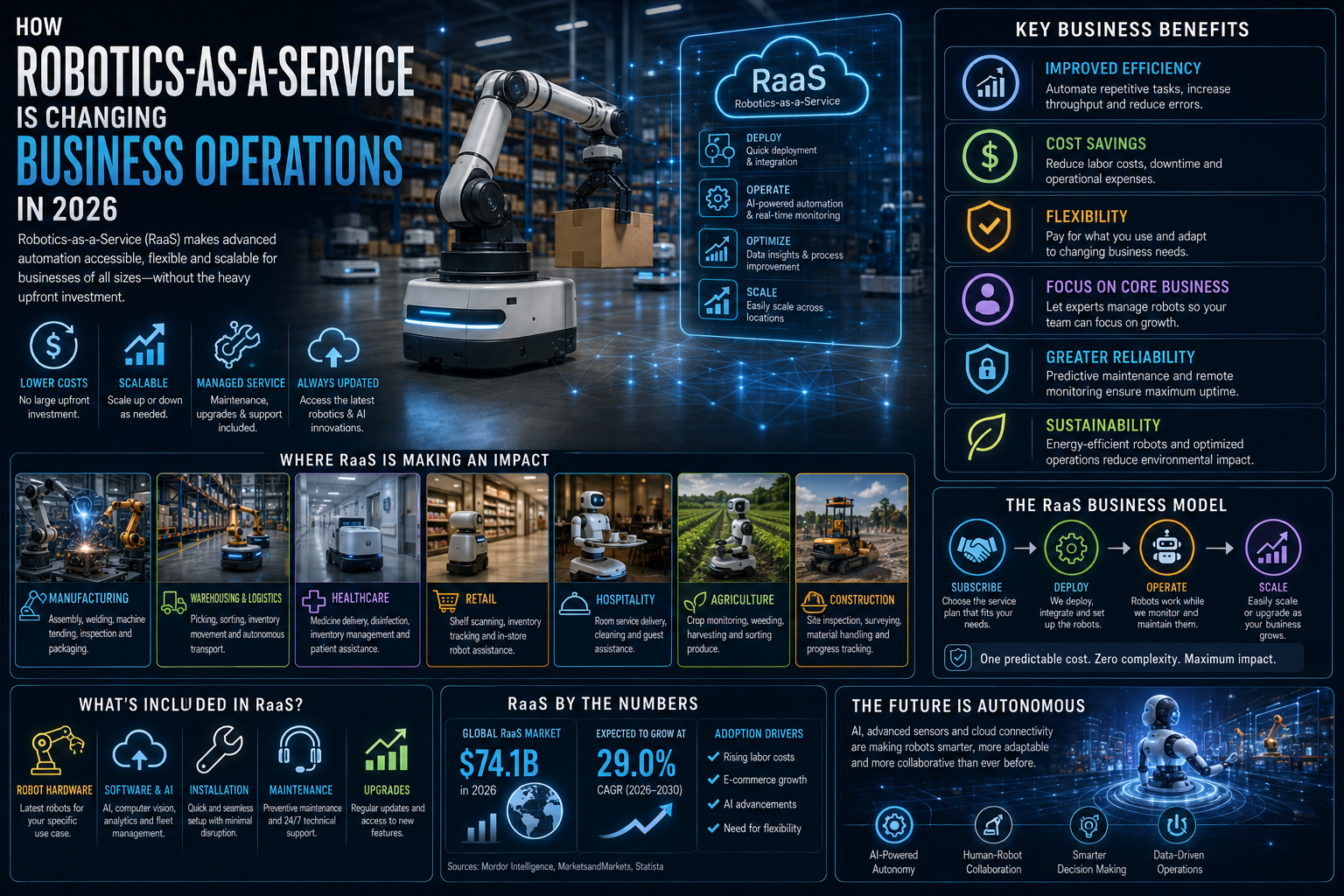
Robotics is no longer limited to large factories with expensive automated production lines. Advances in artificial intelligence, sensors, cloud computing, computer vision, and robotics hardware are making automation accessible to a much broader range of businesses.
One of the most important developments is Robotics-as-a-Service (RaaS).
Instead of purchasing robots and building an entire automation infrastructure upfront, businesses can increasingly access robotic capabilities through subscription, leasing, usage-based, or managed-service models.
This changes the economics of automation.
A company does not necessarily need to make a large capital investment before experimenting with robotics. It can deploy robotic systems for a specific operational requirement and scale the service as demand changes.
In 2026, Robotics-as-a-Service is becoming an important business model connecting physical automation with the broader shift toward cloud-based and subscription technology.
What Is Robotics-as-a-Service?
Robotics-as-a-Service is a model in which businesses access robotic hardware and related software as a service rather than purchasing and managing the entire system themselves.
Depending on the provider and application, an RaaS offering may include:
Robotic hardware
Software
Installation
Maintenance
Remote monitoring
AI capabilities
Fleet management
Technical support
System upgrades
The customer typically pays through a subscription, lease, usage-based arrangement, or another recurring commercial model.
This makes robotics more similar to modern cloud software.
Instead of buying a complete technology stack, businesses can purchase an ongoing automation capability.
Why RaaS Is Growing
Traditional robotics deployments can require significant upfront investment.
Businesses may need to purchase robots, redesign facilities, integrate software, train employees, and hire specialists to maintain the equipment.
This can make automation difficult for smaller companies.
RaaS reduces some of these barriers.
Businesses can start with a specific use case and evaluate results before expanding.
This creates a lower-risk pathway toward automation.
From Capital Expenditure to Operating Expense
One of the biggest changes created by RaaS is the financial model.
Traditional automation often requires a significant capital expenditure.
RaaS can move more of the cost into recurring operating expenses.
This can make budgeting easier for some organizations.
Instead of purchasing a robot that may become outdated over several years, a company can potentially access newer capabilities through an ongoing service arrangement.
The economics will vary by provider and application, but the basic idea is simple:
Businesses pay for robotic capability rather than simply owning robotic equipment.
Warehouse Automation
Warehousing is one of the strongest markets for RaaS.
E-commerce has increased pressure on businesses to process orders quickly while controlling labor and operating costs.
Robots can assist with:
Picking
Sorting
Transportation
Inventory movement
Packing
Shelf scanning
Warehouse inspection
RaaS allows businesses to deploy robotic systems without necessarily building an entire in-house robotics department.
This can be particularly valuable for companies with seasonal demand.
Handling Seasonal Demand
Many businesses experience significant changes in demand throughout the year.
Retailers may need additional warehouse capacity during holiday periods.
Logistics companies may experience temporary increases in shipping volumes.
Manufacturers may receive short-term production contracts.
Purchasing permanent automation for peak demand may not always make financial sense.
RaaS provides a potential alternative.
Businesses can scale robotic capacity according to operational requirements.
This flexibility is one of the strongest reasons companies may choose service-based robotics.
Manufacturing
Manufacturing remains a major application for robotics.
Robots can perform repetitive tasks with high consistency.
These can include:
Assembly
Welding
Packaging
Inspection
Material handling
Machine tending
Palletizing
RaaS can make these capabilities accessible to manufacturers that may not have the capital or expertise required for traditional automation projects.
Small and medium-sized manufacturers could particularly benefit.
AI Makes Robots More Flexible
Earlier generations of industrial robots often performed narrowly defined tasks.
Modern robotic systems are increasingly integrating AI.
Computer vision allows robots to identify objects.
Machine learning can help systems recognize patterns.
AI can improve navigation and decision-making.
This means robots can potentially operate in less structured environments.
A warehouse robot, for example, can use cameras and sensors to understand its surroundings and navigate around changing obstacles.
AI therefore expands the range of situations in which robotic systems can operate.
Robotics and Computer Vision
Computer vision is particularly important for modern robotics.
Cameras and sensors allow robots to perceive their environment.
AI models can identify objects, surfaces, people, and potential obstacles.
In manufacturing, computer vision can inspect products for defects.
In warehouses, it can identify packages and inventory.
In healthcare, it can potentially support navigation and equipment management.
Computer vision effectively gives robots a digital perception system.
Healthcare Robotics
Healthcare is another area where RaaS could have significant potential.
Hospitals operate complex environments and often face pressure to improve efficiency.
Robotic systems can potentially assist with:
Transporting supplies
Delivering medications
Cleaning
Disinfection
Inventory management
Patient-facing logistics
Healthcare organizations may prefer service models because they can access robotic capabilities without taking on all of the technical maintenance responsibilities themselves.
Healthcare robotics also requires particularly strong safety and regulatory controls.
Hospitality and Restaurants
Robotics-as-a-Service is also expanding into hospitality.
Hotels and restaurants can use robots for selected operational tasks.
Examples include:
Room-service delivery
Cleaning
Food transportation
Inventory movement
Reception assistance
The purpose is not necessarily to replace hospitality workers.
Instead, robots can handle repetitive logistical activities while employees focus on customer service.
Retail Automation
Retailers can use robots for inventory management and store operations.
A robotic system can scan shelves, identify missing products, monitor inventory, or transport goods.
This can provide retailers with more frequent visibility into store conditions.
AI can analyze the collected information and identify operational issues.
RaaS can make these capabilities easier to deploy across multiple locations.
Agriculture and Food Production
Agriculture is another potential RaaS market.
Robotic systems can assist with:
Crop monitoring
Harvesting
Weed detection
Autonomous equipment
Sorting
Packaging
AI-powered computer vision can help robots identify crops and distinguish them from weeds or damaged products.
Service-based robotics could allow agricultural businesses to access automation without owning an entire robotic fleet.
Construction Robotics
Construction environments are complex and constantly changing.
Robots can potentially assist with surveying, material movement, inspection, bricklaying, drilling, and other specialized activities.
RaaS may be particularly useful in construction because equipment requirements can vary between projects.
A company may not need to permanently own every robotic system it uses.
Instead, it can access specific robotic capabilities when a project requires them.
Robotics and the Future of Work
The rise of RaaS raises an important question:
What happens to human jobs?
The answer is more complex than simple replacement.
Robots are particularly effective at repetitive, physically demanding, or hazardous tasks.
Humans remain essential for creativity, communication, judgment, supervision, and complex problem-solving.
As robotics expands, workers may increasingly supervise robotic systems rather than perform every repetitive task manually.
This can create demand for new skills in robotics operations, maintenance, data analysis, and automation management.
AI Agents and Robotic Systems
The combination of autonomous AI agents and physical robots could become particularly important.
An AI agent can make plans and coordinate software tasks.
A robot can perform physical actions.
Together, they create the possibility of intelligent physical automation.
For example, an AI system could monitor warehouse demand and determine that additional inventory needs to be moved.
It could then coordinate robotic systems to complete the required tasks within predefined rules.
This creates a bridge between digital intelligence and physical action.
Fleet Management
Businesses using multiple robots need effective fleet management.
RaaS providers can offer centralized systems that monitor robotic fleets.
Businesses can track:
Robot location
Battery status
Task completion
Maintenance requirements
Errors
Productivity
Utilization
AI can analyze fleet data and identify potential performance problems.
This makes robotics management more similar to managing cloud infrastructure.
Predictive Maintenance
Robotic systems require maintenance.
Unexpected failures can disrupt operations.
AI-powered monitoring can identify unusual changes in motor performance, vibration, battery behavior, or other operating conditions.
This allows service providers to predict potential maintenance requirements.
RaaS providers have an incentive to keep their robotic fleets operational because service availability directly affects customer value.
This can create a stronger focus on uptime.
The Economics of RaaS
The financial benefits of RaaS depend on the specific application.
Businesses should evaluate:
Subscription costs
Usage fees
Maintenance
Installation
Integration
Training
Downtime
Productivity gains
The key measurement is return on investment.
If a robotic system reduces labor requirements, improves productivity, reduces errors, or increases capacity, the financial value can justify the service cost.
Businesses should therefore compare total operational savings rather than focusing only on the monthly subscription price.
Cybersecurity Risks
Connected robots introduce cybersecurity concerns.
Robots may communicate with cloud platforms, enterprise software, sensors, and other machines.
If these systems are compromised, attackers could potentially disrupt physical operations.
Businesses need strong authentication, network segmentation, encryption, access controls, software updates, and monitoring.
RaaS providers will increasingly need to treat cybersecurity as part of the service itself.
Data and Privacy
Robotic systems can collect significant amounts of information.
Cameras and sensors may capture information about facilities, employees, customers, and operational processes.
Organizations need policies governing how this information is collected, stored, and used.
Privacy considerations are particularly important when robots operate around customers or employees.
The Challenge of Integration
Robotics cannot operate effectively in isolation.
Businesses need robots to communicate with existing systems.
A warehouse robot may need information from inventory software.
A manufacturing robot may need production schedules.
A retail robot may need access to product databases.
Successful RaaS deployments therefore depend heavily on software integration.
APIs and cloud-based platforms can help connect robotic systems to existing enterprise applications.
How Businesses Can Adopt RaaS
Companies considering Robotics-as-a-Service should start with a clearly defined problem.
Instead of asking:
“Where can we use robots?”
business leaders should ask:
“Which operational problem would benefit most from robotic automation?”
Potential starting points include repetitive material handling, inventory scanning, cleaning, inspection, or warehouse transportation.
Companies can then run a pilot and measure:
Productivity
Cost savings
Error reduction
Robot utilization
Employee impact
Customer experience
If the results are positive, the company can scale the deployment.
The Future of Robotics-as-a-Service
RaaS could become to physical automation what cloud computing became to digital infrastructure.
Businesses may increasingly access robotic capabilities on demand rather than purchasing and maintaining every system themselves.
The next generation of RaaS could include more intelligent robots, autonomous fleet management, AI agents, predictive maintenance, and flexible usage-based pricing.
As robotic hardware becomes more capable and AI improves machine perception, robots may become useful in increasingly diverse environments.
Conclusion
Robotics-as-a-Service is changing the economics of automation.
By combining robotic hardware with software, maintenance, AI, monitoring, and recurring service models, RaaS allows businesses to access automation without necessarily making large upfront investments.
The technology has applications across manufacturing, logistics, retail, healthcare, agriculture, hospitality, construction, and other industries.
AI is making robots more flexible, while cloud platforms and fleet-management systems are making them easier to operate at scale.
However, successful adoption requires careful attention to integration, cybersecurity, safety, employee training, and financial performance.
The future of business automation may not be defined by companies owning the largest number of robots.
Instead, it may be defined by companies that can access the right robotic capabilities at the right time and integrate them intelligently into their operations.
In 2026, Robotics-as-a-Service is helping move robotics from expensive specialized infrastructure toward a more flexible business technology model.
As AI and robotics continue converging, the workplace could increasingly become a collaborative environment where humans provide judgment and creativity while intelligent machines handle repetitive physical work.
That transformation could make RaaS one of the most important emerging models in the future of industrial automation