Artificial intelligence is becoming increasingly important to modern businesses, but successful AI systems depend on something even more fundamental: data.
Companies need large amounts of high-quality information to train, test, and improve AI models. However, obtaining useful real-world data is not always easy. Businesses may face privacy restrictions, limited datasets, expensive collection processes, security concerns, or insufficient examples of rare events.
Synthetic data is emerging as one potential solution.
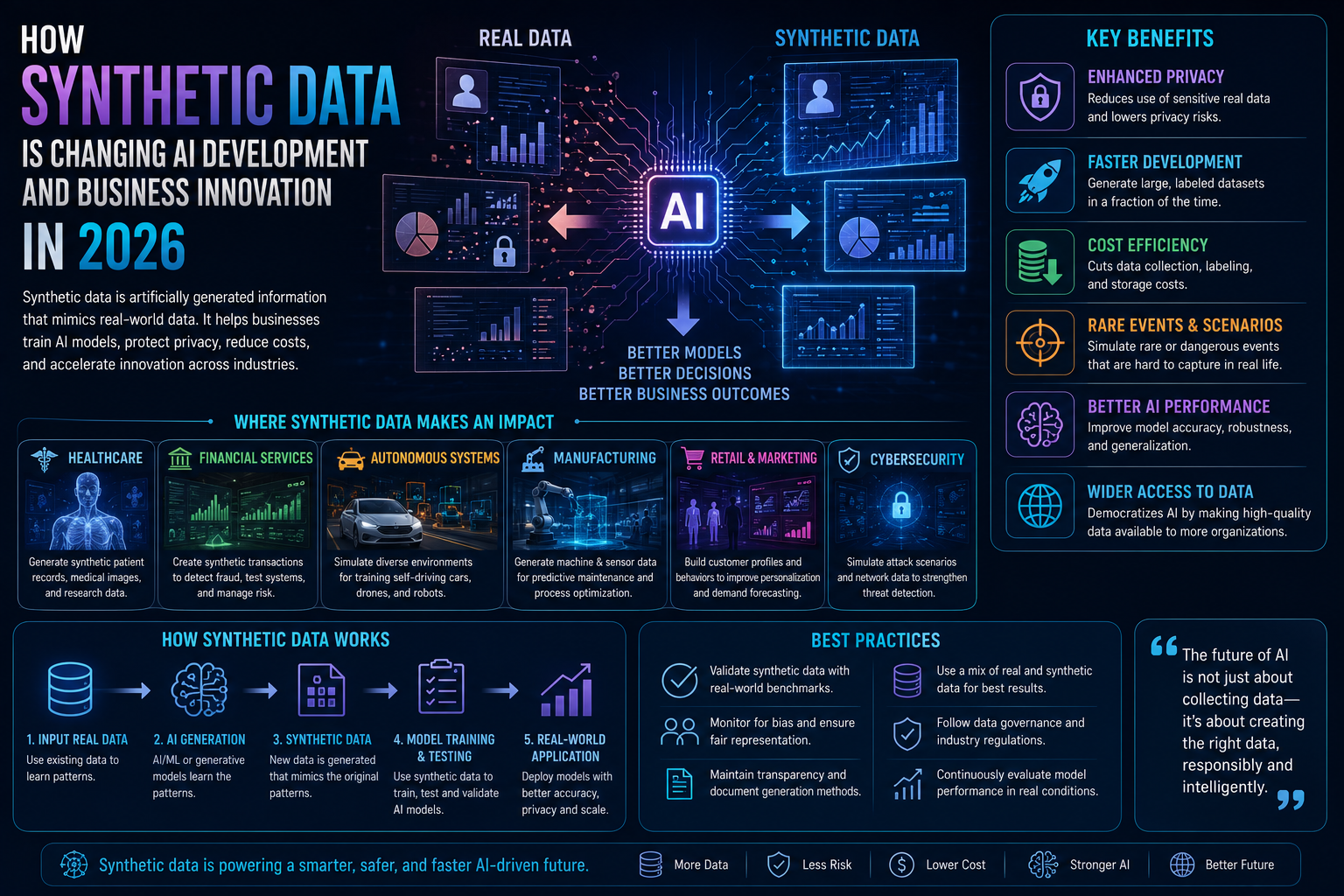
Synthetic data is artificially generated information designed to resemble real-world data while reducing the need to directly use sensitive or difficult-to-obtain datasets. It can include synthetic images, text, financial transactions, customer profiles, sensor readings, medical records, and other forms of information.
In 2026, synthetic data is becoming an increasingly important part of the AI development ecosystem because organizations need more data while also facing growing requirements around privacy, security, and responsible data use.
What Is Synthetic Data?
Synthetic data is information generated by algorithms rather than directly collected from real-world individuals or events.
A synthetic dataset can be designed to reproduce important statistical characteristics of real data.
For example, a business developing an AI fraud-detection system may not have enough examples of unusual fraudulent transactions. A synthetic-data system can generate additional scenarios that resemble realistic fraud patterns.
Similarly, an autonomous-machine developer could generate simulated images of objects in different lighting and environmental conditions.
The objective is not necessarily to create identical copies of real information. Instead, synthetic data is designed to provide useful examples for specific AI tasks.
Why Businesses Need More Data
Modern AI models can require enormous amounts of information.
Businesses using AI for computer vision, forecasting, customer analytics, cybersecurity, robotics, or automation may need datasets covering thousands of different situations.
Real-world data collection can be expensive and time-consuming.
Some situations are also naturally rare.
A company developing an AI system for detecting equipment failures may have years of normal operating data but only a small number of actual failure events.
Training an AI system exclusively on common situations can make it difficult to recognize unusual ones.
Synthetic data can help organizations create additional examples for these less-common scenarios.
Synthetic Data and Privacy
Privacy is one of the most important reasons organizations are exploring synthetic data.
Businesses often possess sensitive information about customers, employees, patients, and financial transactions.
Using such information for AI development may create privacy and compliance challenges.
Synthetic data can provide an alternative in certain applications.
Instead of giving developers direct access to sensitive customer records, an organization could potentially create a synthetic dataset that reproduces useful patterns without directly exposing individual records.
This can reduce some privacy risks, although synthetic data is not automatically anonymous or risk-free.
Organizations still need to evaluate whether generated datasets could reveal information about the original data and establish appropriate security controls.
Accelerating AI Development
Synthetic data can also speed up AI development.
Collecting and labeling real-world information can take months or years.
Images may need to be categorized manually. Documents may require human annotation. Sensor data may need to be collected across different environments.
Synthetic data can generate large quantities of labeled information automatically.
For example, a computer-vision developer could create synthetic images where the location and identity of every object are already known.
This can reduce some of the manual labeling work required to create training datasets.
Developers can then use the generated information to train and test models more efficiently.
AI for Rare Events
Rare events are particularly difficult for traditional machine-learning systems.
Consider a cybersecurity company trying to train an AI model to detect unusual attacks. Most network activity may be legitimate, while truly malicious events are relatively uncommon.
A model trained primarily on normal activity may not encounter enough examples of sophisticated attacks.
Synthetic data can help create additional attack scenarios for testing.
The same principle can apply to manufacturing, transportation, financial fraud, healthcare research, and autonomous systems.
By generating unusual but realistic scenarios, organizations can test whether AI systems respond appropriately to situations they rarely encounter in the real world.
Synthetic Data in Healthcare
Healthcare is one area where synthetic data could have significant potential.
Medical datasets can contain highly sensitive information, making access and sharing complicated.
Researchers and technology companies need large datasets to develop medical AI applications, but privacy requirements can limit how patient information is used.
Synthetic medical data could potentially provide researchers with realistic examples for developing and testing certain algorithms.
For example, researchers might generate synthetic patient records that reproduce statistical relationships found in real populations.
However, synthetic healthcare data must be carefully validated.
A generated dataset that does not accurately represent real medical conditions could produce misleading results.
Human expertise and clinical validation therefore remain essential.
Synthetic Data for Financial Services
Financial institutions can also use synthetic data for testing and AI development.
Banks and financial technology companies process large quantities of sensitive information.
Synthetic transactions can provide safe environments for testing fraud-detection systems, payment platforms, risk models, and financial applications.
For example, a bank could generate synthetic transaction patterns that include normal spending, unusual purchases, account takeovers, and other scenarios.
Developers can then test how an AI system responds without necessarily exposing real customer transactions during every stage of development.
This can support both security testing and product development.
Training Autonomous Systems
Autonomous vehicles, drones, robots, and industrial machines need to understand physical environments.
Collecting real-world training data can be expensive.
A vehicle may need to encounter thousands of different road conditions, weather situations, objects, and traffic patterns before an AI system can be properly evaluated.
Synthetic environments can generate these scenarios.
Developers can simulate roads, buildings, pedestrians, vehicles, weather, lighting conditions, and other elements.
AI systems can then be trained and tested in virtual environments before being exposed to real-world conditions.
This does not eliminate the need for physical testing, but it can expand the range of scenarios developers can explore.
Synthetic Data and Digital Twins
Synthetic data also connects closely with digital twins.
A digital twin represents a physical object, facility, or system in a virtual environment.
Once a digital twin exists, organizations can simulate different conditions and generate data based on those scenarios.
For example, a manufacturer could simulate how a machine behaves under different temperatures, workloads, or operating conditions.
The resulting synthetic information could help train predictive-maintenance models.
This creates a powerful combination:
Digital twin + simulation + synthetic data + AI
Together, these technologies can allow businesses to test potential situations before they occur in the physical world.
Reducing AI Development Costs
AI development can be expensive because of data collection, storage, labeling, and processing requirements.
Synthetic data can potentially reduce some of these costs.
Instead of manually collecting millions of examples, organizations can generate targeted datasets based on specific requirements.
This is particularly useful for startups and smaller businesses that may not have access to massive proprietary datasets.
Synthetic data can help level the playing field by allowing organizations to develop AI systems without requiring enormous quantities of proprietary real-world information.
However, generating useful synthetic data also requires computing resources and technical expertise.
Synthetic Data Does Not Replace Real Data
One of the biggest misconceptions about synthetic data is that it can completely replace real-world information.
In many cases, it cannot.
Real data contains unexpected behaviors, imperfections, edge cases, and relationships that may be difficult to reproduce artificially.
If a model is trained entirely on synthetic information, it may fail to perform well in real environments.
This problem is sometimes described as a gap between simulated and real-world conditions.
The strongest strategy is often a combination of real and synthetic data.
Real information provides grounding, while synthetic information can expand coverage and create additional scenarios.
Quality Is More Important Than Quantity
Generating millions of synthetic records does not automatically create a useful dataset.
Synthetic information must reflect the characteristics that matter for the AI application.
If the generated data contains unrealistic patterns, the model may learn the wrong behaviors.
Businesses therefore need processes for validating synthetic datasets.
They can compare statistical characteristics, test model performance, and evaluate how well systems trained with synthetic data perform on real-world examples.
The goal should be useful diversity rather than simply producing a larger dataset.
The Role of Generative AI
Generative AI is making synthetic-data creation more sophisticated.
Generative models can create realistic text, images, audio, video, and structured information.
Businesses can use these capabilities to produce customized datasets for specific applications.
For example, a company developing an AI vision system could generate images with specific objects, environments, and lighting conditions.
A language-model developer could generate examples of customer conversations representing different scenarios.
As generative AI improves, synthetic data may become easier to create and customize.
Governance and Responsible Use
Synthetic data still requires governance.
Organizations should document how datasets were generated, what source information influenced them, and what limitations they have.
Businesses should also monitor whether generated data introduces bias.
If the original dataset contains underrepresented groups or inaccurate assumptions, synthetic generation may reproduce those problems.
Responsible synthetic-data programs therefore require testing, documentation, privacy assessments, and human oversight.
The Future of Synthetic Data
Synthetic data is likely to become increasingly integrated into AI development pipelines.
Future AI systems may be trained using a mixture of real-world information, simulated environments, synthetic examples, and continuously generated test scenarios.
Businesses could create customized datasets for specific industries without relying entirely on massive collections of raw customer information.
This could make AI development more flexible while supporting privacy and security objectives.
Synthetic data may also become particularly important as businesses deploy AI into areas where real-world examples are difficult or expensive to collect.
How Businesses Can Start
Companies interested in synthetic data should begin with a clearly defined problem.
Possible applications include:
Fraud-detection testing
Computer-vision training
Cybersecurity simulations
Predictive maintenance
Robotics
Customer-service AI
Financial modeling
Healthcare research
Autonomous systems
Organizations should compare synthetic data against real-world benchmarks before relying on it for important decisions.
The objective should be measurable improvement in model performance, privacy protection, development speed, or testing coverage.
Conclusion
Synthetic data is becoming an important tool in the development of modern artificial intelligence.
It can help businesses overcome data shortages, support privacy-conscious development, generate rare scenarios, accelerate AI training, and test systems in controlled environments.
However, synthetic data is not a universal replacement for real-world information.
Its greatest value comes from combining generated datasets with reliable real data, strong validation, responsible governance, and human expertise.
As AI becomes more deeply integrated into business operations, organizations will need new ways to develop and test intelligent systems at scale.
Synthetic data could become one of those essential technologies, providing businesses with a flexible way to create more diverse training environments while reducing some of the challenges associated with collecting sensitive or rare real-world information.
In 2026, the competitive advantage may increasingly belong to businesses that do not simply collect more data, but know how to create, validate, protect, and intelligently use the right data for AI.