
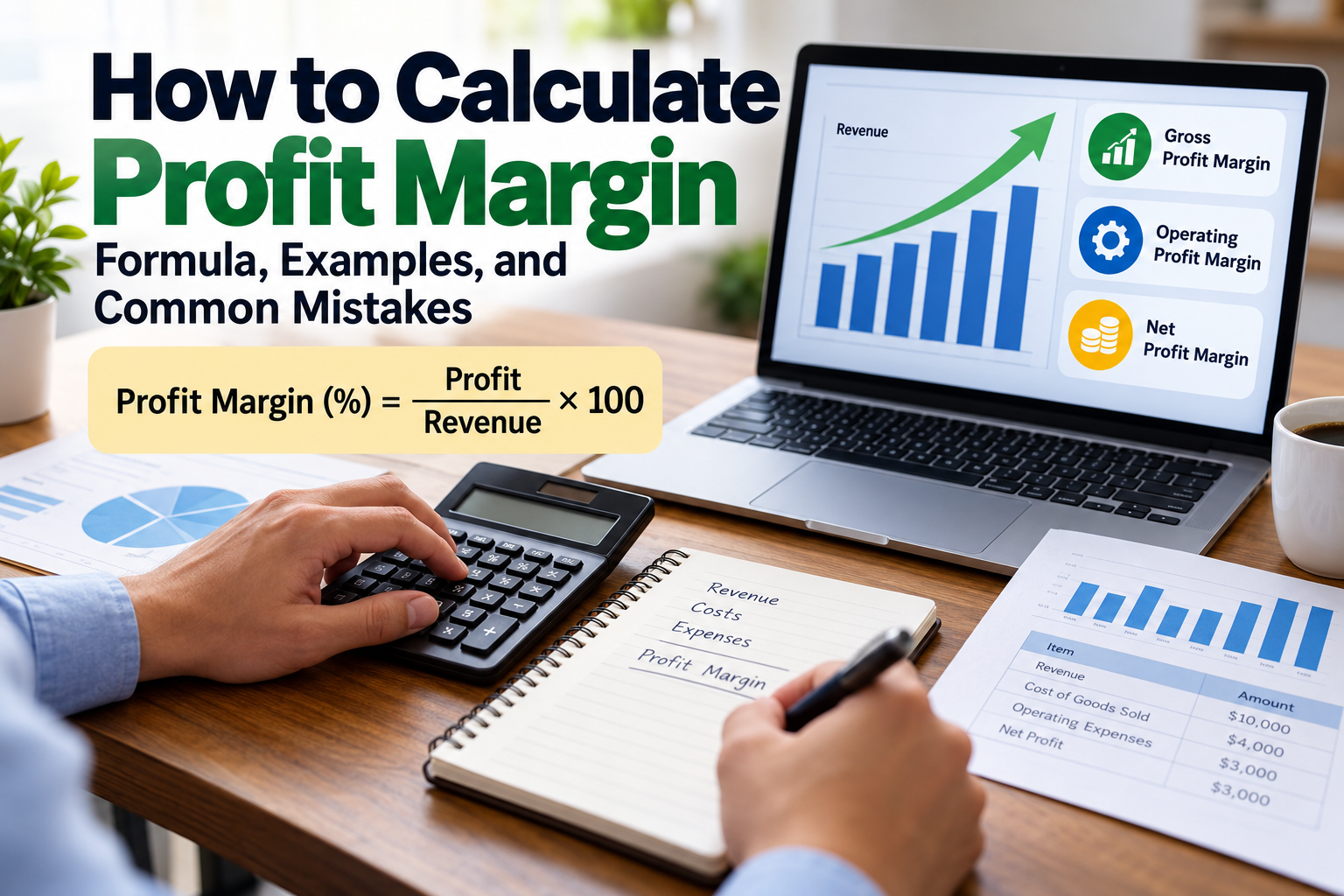
Understanding how much money a business actually earns is essential for making informed financial decisions. A company might generate thousands of dollars in sales every month, but high revenue does not automatically mean high profits. After paying for products, employee salaries, rent, marketing, shipping, software, and other operating expenses, the amount left over can be much smaller than expected.
This is where profit margin becomes important.
Profit margin helps business owners understand how much profit they generate from every dollar of revenue. It can help entrepreneurs evaluate pricing decisions, control expenses, compare business performance, and identify opportunities to improve profitability.
Whether you run an e-commerce store, operate a consulting business, sell products through an online marketplace, or manage a traditional retail company, knowing how to calculate profit margin can improve your financial decision-making.
In this guide, you will learn the profit margin formula, how to calculate gross, operating, and net profit margins, how to interpret the results, and which mistakes to avoid when analyzing business performance.
What Is Profit Margin?
Profit margin is a financial measurement that shows what percentage of a company's revenue remains as profit after accounting for a particular set of costs.
It is usually expressed as a percentage.
For example, imagine an online business generates $10,000 in revenue during one month and earns $2,000 in net profit after all its expenses.
Its net profit margin is 20%.
This means the business keeps $0.20 in net profit for every $1 it earns in revenue.
Profit margin is useful because it measures profitability relative to sales rather than simply looking at the total amount of money earned.
Consider two businesses:
Business A generates $100,000 in revenue and earns $10,000 in profit.
Business B generates $50,000 in revenue and earns $10,000 in profit.
Both businesses earn the same amount of profit, but Business A has a 10% profit margin, while Business B has a 20% profit margin.
Business B generates more profit from each dollar of revenue, although additional factors such as growth potential, risk, and business expenses should also be considered.
How to Calculate Profit Margin: The Formula
The basic profit margin formula is:
Profit Margin (%) = (Profit ÷ Revenue) × 100
To use this formula, you need two figures:
Profit: The amount remaining after deducting the relevant costs and expenses.
Revenue: The total income generated from selling products or services, generally excluding sales taxes collected on behalf of authorities.
The type of profit you use determines which profit margin you calculate.
For example, using gross profit gives you the gross profit margin. Using operating profit gives you the operating profit margin. Using net profit gives you the net profit margin.
Step-by-Step Example
Suppose a small business reports the following figures for one month:
Total revenue: $20,000
Total expenses included in its net profit calculation: $16,000
Net profit: $4,000
Step 1: Identify the revenue.
Revenue is $20,000.
Step 2: Calculate the net profit.
Net profit = Revenue − Total expenses
Net profit = $20,000 − $16,000 = $4,000.
Step 3: Divide net profit by revenue.
$4,000 ÷ $20,000 = 0.20.
Step 4: Multiply by 100.
0.20 × 100 = 20%.
The company's net profit margin is 20%.
This means the company earns $0.20 in net profit for every dollar of revenue.
Remember that the expenses used in the calculation must match the type of profit margin you want to measure.
The Three Main Types of Profit Margin
Businesses commonly use three types of profit margin to understand different aspects of financial performance: gross profit margin, operating profit margin, and net profit margin.
Each measurement provides different information.
1. Gross Profit Margin
Gross profit margin measures how much revenue remains after deducting the direct cost of producing or purchasing the products or services sold.
These direct costs are commonly reported as the cost of goods sold (COGS). Depending on the business, they may include product purchase costs, manufacturing materials, and direct production labor.
The formula is:
Gross Profit Margin = (Gross Profit ÷ Revenue) × 100
First, calculate gross profit:
Gross Profit = Revenue − Cost of Goods Sold
For example, imagine an online retailer generates $30,000 in monthly revenue and spends $12,000 purchasing the products it sells.
Gross profit = $30,000 − $12,000 = $18,000.
Gross profit margin = ($18,000 ÷ $30,000) × 100 = 60%.
The gross profit margin is 60%.
This means the business retains $0.60 from each dollar of revenue after accounting for its cost of goods sold, before operating expenses and other costs are deducted.
A higher gross profit margin may indicate effective sourcing, pricing, or production cost management. However, a good margin depends on the company's industry, product mix, and operating model.
2. Operating Profit Margin
Operating profit margin measures how much revenue remains after deducting both the cost of goods sold and operating expenses.
Operating expenses may include rent, employee salaries, advertising, administrative costs, and other expenses related to running the business. The exact treatment depends on the company's accounting policies.
The formula is:
Operating Profit Margin = (Operating Profit ÷ Revenue) × 100
Suppose a company has:
Revenue: $50,000
Cost of goods sold: $20,000
Operating expenses: $22,000
First, calculate gross profit:
$50,000 − $20,000 = $30,000.
Next, calculate operating profit:
$30,000 − $22,000 = $8,000.
Finally, calculate operating profit margin:
($8,000 ÷ $50,000) × 100 = 16%.
The operating profit margin is 16%.
This indicates how effectively the business generates operating profit from its sales before accounting for items such as interest and income taxes, subject to its accounting treatment.
It is especially useful when reviewing operating efficiency and comparing results across reporting periods.
3. Net Profit Margin
Net profit margin measures the percentage of revenue remaining after all expenses included in net income have been deducted.
These expenses generally include the cost of goods sold, operating expenses, interest, taxes, and other applicable income statement items.
The formula is:
Net Profit Margin = (Net Profit ÷ Revenue) × 100
Suppose a business generates $80,000 in revenue and reports $8,000 in net profit after all relevant expenses.
Net profit margin = ($8,000 ÷ $80,000) × 100 = 10%.
The net profit margin is 10%.
This means the business earns $0.10 in net profit for every dollar of revenue.
Net profit margin is particularly useful for understanding the company's overall profitability. However, it can be affected by financing arrangements, taxes, unusual expenses, and other items that do not directly reflect day-to-day operating performance.
Gross vs. Operating vs. Net Profit Margin
The three measures provide different views of the same business.
Metric | Costs deducted | What it tells you |
|---|---|---|
Gross profit margin | Cost of goods sold | How much remains after direct product or service costs |
Operating profit margin | Cost of goods sold and operating expenses | How efficiently the core business generates operating profit |
Net profit margin | All expenses included in net income | How much of revenue remains as final profit |
Example Using All Three Formulas
Suppose a business has the following financial results:
Financial item | Amount |
|---|---|
Revenue | $100,000 |
Cost of goods sold | $40,000 |
Operating expenses | $35,000 |
Interest and taxes, plus other applicable expenses | $10,000 |
Net profit | $15,000 |
Gross profit = $100,000 − $40,000 = $60,000.
Gross profit margin = ($60,000 ÷ $100,000) × 100 = 60%.
Operating profit = $60,000 − $35,000 = $25,000.
Operating profit margin = ($25,000 ÷ $100,000) × 100 = 25%.
Net profit = $25,000 − $10,000 = $15,000.
Net profit margin = ($15,000 ÷ $100,000) × 100 = 15%.
The example shows why it is important to identify the correct profit measure. A business can have a strong gross margin but a much lower net margin because of its operating costs, financing expenses, taxes, or other charges.
How to Calculate Profit Margin in Excel or Google Sheets
You do not need specialized accounting software to calculate profit margin. A spreadsheet can perform the calculation in seconds.
Follow these steps.
Step 1: Enter your financial figures.
Create a simple spreadsheet with the following columns:
Cell | Description | Example |
|---|---|---|
A1 | Revenue | $10,000 |
A2 | Total expenses used for net profit | $7,500 |
A3 | Net profit | $2,500 |
A4 | Net profit margin | 25% |
Step 2: Calculate net profit.
If revenue is in cell B1 and expenses are in cell B2, enter this formula in B3:
=B1-B2
The result will be $2,500.
Step 3: Calculate profit margin.
Enter this formula in B4:
=B3/B1
Then format the cell as a percentage.
The result will be 25%.
You can also use:
=(B3/B1)*100
If you use this second formula, format the cell as a regular number rather than a percentage to avoid multiplying by 100 twice.
For businesses tracking several months, create separate columns for each month. This makes it easier to identify trends in revenue, expenses, and profit margin.
For more accurate results, use consistent accounting definitions and comparable reporting periods.
What Is a Good Profit Margin?
There is no single profit margin that is considered good for every business.
An appropriate margin depends on the industry, business model, operating costs, competition, pricing strategy, and stage of development.
For example, a high-volume retailer may operate with relatively low net margins, while a specialized service provider may have higher margins because it does not need to purchase physical inventory for every sale.
A software company may also have a different cost structure from a manufacturing company.
Instead of relying on one universal benchmark, businesses should evaluate their margins using three comparisons.
1. Compare Your Margin With Previous Periods
Review monthly, quarterly, and annual financial results to identify whether margins are improving or declining.
If revenue increases but profit margin falls, costs may be growing faster than sales.
If both revenue and profit margin increase, the business may be improving its pricing, cost management, or operating efficiency.
Consider seasonal patterns and unusual expenses before drawing conclusions.
2. Compare With Similar Businesses
Industry comparisons can help you understand whether your results are typical for your business model.
Use credible industry reports, financial statements, or published company data when possible.
Compare businesses with similar products, customer groups, geographic markets, and accounting definitions. A gross profit margin should not be compared directly with another company's net profit margin.
3. Evaluate Your Business Goals
A growing company may deliberately accept lower margins while investing in marketing, technology, product development, or expansion.
An established business may prioritize predictable earnings and stronger cash generation.
The right target should support the company's long-term strategy while maintaining enough financial flexibility to handle unexpected expenses.
Profit Margin vs. Markup: What's the Difference?
Profit margin and markup are related, but they are not the same.
Profit margin measures profit as a percentage of the selling price or revenue. Markup measures profit as a percentage of cost.
Confusing the two can lead to pricing mistakes.
Profit Margin Formula
Profit Margin = (Profit ÷ Selling Price) × 100
Markup Formula
Markup = (Profit ÷ Cost) × 100
Consider a product that costs $60 and sells for $100.
Profit = $100 − $60 = $40.
Profit margin = ($40 ÷ $100) × 100 = 40%.
Markup = ($40 ÷ $60) × 100 = 66.67%.
The product has a 40% gross margin before any additional expenses, but its markup on cost is approximately 66.67%.
This distinction matters when setting prices. A business that wants a specific profit margin must calculate the selling price using revenue as the denominator rather than simply adding the same percentage to its costs.
For example, if a product costs $60 and the business wants a 40% gross profit margin, the required selling price is:
Selling Price = Cost ÷ (1 − Desired Margin)
Selling Price = $60 ÷ (1 − 0.40) = $100.
This calculation assumes the $60 represents the relevant cost and excludes other expenses that may affect net profitability.
Common Profit Margin Calculation Mistakes
Even a simple formula can produce misleading results when the underlying financial information is incomplete or inconsistent.
Here are common mistakes to avoid.
1. Confusing Revenue With Profit
Revenue is the income generated from sales. Profit is what remains after the relevant costs are deducted.
A company that generates $100,000 in revenue does not necessarily earn $100,000 in profit.
Always subtract the appropriate expenses before calculating the relevant margin.
2. Using the Wrong Type of Profit
Gross profit, operating profit, and net profit are different measurements.
Using gross profit when you intend to calculate net profit margin will overstate the company's final profitability.
Choose the correct profit figure for the question you want to answer.
3. Forgetting Operating Expenses
A product may appear profitable when you consider only its purchase price, but the business may also pay for advertising, payment processing, shipping, customer support, rent, and software.
When estimating net profitability, account for all relevant expenses.
Also ensure that costs are not counted twice.
4. Confusing Profit Margin With Markup
A 50% markup does not produce a 50% profit margin.
Always check whether the percentage is calculated using cost or revenue.
This is particularly important when establishing retail prices and comparing supplier offers.
5. Comparing Different Reporting Periods
Comparing one month's revenue with another month's expenses can produce an inaccurate margin.
Use financial figures from the same reporting period and apply consistent accounting methods.
For seasonal businesses, compare similar periods when appropriate.
6. Ignoring Discounts and Returns
Discounts, refunds, and product returns can reduce the revenue a business actually retains from sales.
If these adjustments are not properly reflected, profit margin calculations may be overstated.
Use net sales revenue consistently with the accounting figures used to calculate profit.
7. Assuming a Higher Margin Always Means a Better Business
A company with a high margin may have limited sales, while a company with a lower margin may generate more total profit through greater sales volume.
For example, a business earning a 30% margin on $10,000 in revenue generates $3,000 in profit at that margin level. Another business earning a 10% margin on $100,000 in revenue generates $10,000 in profit.
Neither metric alone tells the entire story. Consider revenue, total profit, cash flow, growth, and risk together.
How Businesses Can Improve Profit Margins
Improving profit margin does not always require increasing prices. Businesses can also review costs, operational processes, product selection, and sales strategy.
1. Review Product and Service Pricing
Evaluate whether current prices adequately cover relevant costs and support the desired margin.
Consider customer demand, competitors, product value, and willingness to pay before changing prices.
A price increase that significantly reduces sales may not improve total profit.
2. Reduce Unnecessary Expenses
Review recurring expenses such as software subscriptions, advertising tools, office costs, and supplier contracts.
Identify expenses that provide little value and negotiate better terms where possible.
The goal is to reduce waste without damaging product quality or customer experience.
3. Negotiate With Suppliers
Businesses that purchase inventory can review supplier prices, shipping arrangements, payment terms, and order quantities.
Bulk purchasing may reduce unit costs, but it can also tie up cash and increase storage expenses. Evaluate the complete cost rather than focusing only on the purchase price.
4. Focus on Profitable Products and Customers
Not every product, service, or customer generates the same contribution to business profitability.
Analyze sales, direct costs, returns, discounts, and the resources required to serve each customer group.
This can help businesses prioritize offerings that contribute more effectively to overall profit.
5. Improve Operational Efficiency
Automation, inventory management, better scheduling, and streamlined workflows can help reduce avoidable costs.
For example, an online retailer may improve profitability by reducing shipping errors, preventing stockouts, and processing returns more efficiently.
Any investment in automation should be evaluated against its cost and expected benefits.
6. Monitor Margins Regularly
Track gross, operating, and net profit margins at consistent intervals.
Use a spreadsheet or accounting platform to monitor changes and investigate unusual results.
Regular reviews can help identify problems earlier, support better budgeting, and improve business planning.
Why Profit Margin Matters for Small Businesses
Profit margin is especially useful for small businesses because their financial resources may be limited.
Understanding profitability helps owners make more informed decisions about pricing, hiring, inventory, marketing, and expansion.
For example, an online store may experience rapid sales growth while spending heavily on advertising and fulfillment. If its net margin continues to fall, higher revenue may not translate into stronger financial performance.
A service business may have fewer direct product costs but significant expenses related to employee time, software, subcontractors, and customer acquisition.
By monitoring profit margin, owners can identify where their revenue is going and whether their business model is financially sustainable.
However, profit margin should not be considered in isolation. Cash flow, debt obligations, working capital, customer retention, and future investment needs are also important.
A profitable business can still experience cash shortages if customers pay late or too much money is tied up in inventory.
Final Thoughts
Learning how to calculate profit margin is an important step toward understanding business profitability. The basic formula is straightforward: divide the relevant profit figure by revenue and multiply by 100.
However, the most useful analysis goes beyond a single calculation.
Gross profit margin helps evaluate direct product or service costs. Operating profit margin shows how efficiently the core business operates. Net profit margin reveals how much revenue remains after expenses included in net income.
By using the correct formulas, comparing consistent reporting periods, and reviewing margins regularly, business owners can make more informed decisions about pricing, cost control, and growth.
Whether you operate a small online store, a consulting business, or a larger company, understanding profit margin can help you evaluate financial performance and build a more sustainable business.
Frequently Asked Questions (FAQs)
1. How do you calculate profit margin?
Divide profit by revenue and multiply the result by 100.
Formula: Profit Margin (%) = (Profit ÷ Revenue) × 100.
For example, if a business earns $5,000 in profit from $25,000 in revenue, its profit margin is 20%.
2. What is the formula for net profit margin?
Net profit margin is calculated by dividing net profit by revenue and multiplying by 100.
Formula: Net Profit Margin (%) = (Net Profit ÷ Revenue) × 100.
Net profit is calculated after deducting the expenses included in net income.
3. What is the difference between gross profit margin and net profit margin?
Gross profit margin measures the percentage of revenue remaining after the cost of goods sold is deducted.
Net profit margin measures the percentage remaining after all expenses included in net income are deducted, including applicable operating expenses, interest, and taxes.
Net profit margin generally provides a broader view of overall profitability.
4. Is a 20% profit margin good?
A 20% profit margin can be strong for some businesses, but whether it is good depends on the industry, business model, and type of margin being measured.
A 20% gross margin is very different from a 20% net profit margin. Compare the result with similar businesses and your own financial goals.
5. How do you calculate profit margin in Excel?
If net profit is in cell B3 and revenue is in cell B1, enter:
=B3/B1
Then format the result as a percentage.
Alternatively, use =(B3/B1)*100 and format the result as a regular number.
6. What is the difference between profit margin and markup?
Profit margin calculates profit as a percentage of selling price, while markup calculates profit as a percentage of cost.
For example, a product costing $60 and selling for $100 has a 40% gross profit margin and a 66.67% markup.
7. Can profit margin be negative?
Yes. Profit margin is negative when the relevant profit figure is below zero.
For example, if a business generates $10,000 in revenue but records a net loss of $2,000, its net profit margin is −20%.
A negative margin indicates that the business recorded a loss for the period under the accounting measure used.
8. What is the difference between profit margin and revenue?
Revenue is the income generated from sales before deducting business expenses. Profit is the amount remaining after deducting the relevant expenses.
Profit margin expresses that profit as a percentage of revenue.
9. How often should a business calculate profit margin?
Many businesses review profit margins monthly and also analyze quarterly and annual results.
The ideal frequency depends on the business's size, transaction volume, seasonality, and reporting needs. Businesses with changing costs or fast-moving inventory may benefit from more frequent monitoring.
10. How can a small business increase its profit margin?
A small business can work to improve profit margin by reviewing prices, negotiating supplier costs, reducing unnecessary expenses, improving operational efficiency, and focusing on products or services with stronger profitability.
The best approach depends on the reasons behind the current margin and how customers respond to potential changes.
11. Does a higher profit margin always mean higher profit?
No. Profit margin measures profit relative to revenue, while total profit measures the amount earned.
A company with a lower margin may earn more total profit if it generates substantially higher revenue.
Both measurements are useful when evaluating business performance.
12. Can I calculate profit margin without an accountant?
Yes. You can calculate profit margin using a calculator, spreadsheet, or accounting software if you have accurate revenue and expense figures.
However, complex businesses may need professional accounting support to classify expenses correctly, prepare reliable financial statements, and meet tax or reporting requirements.