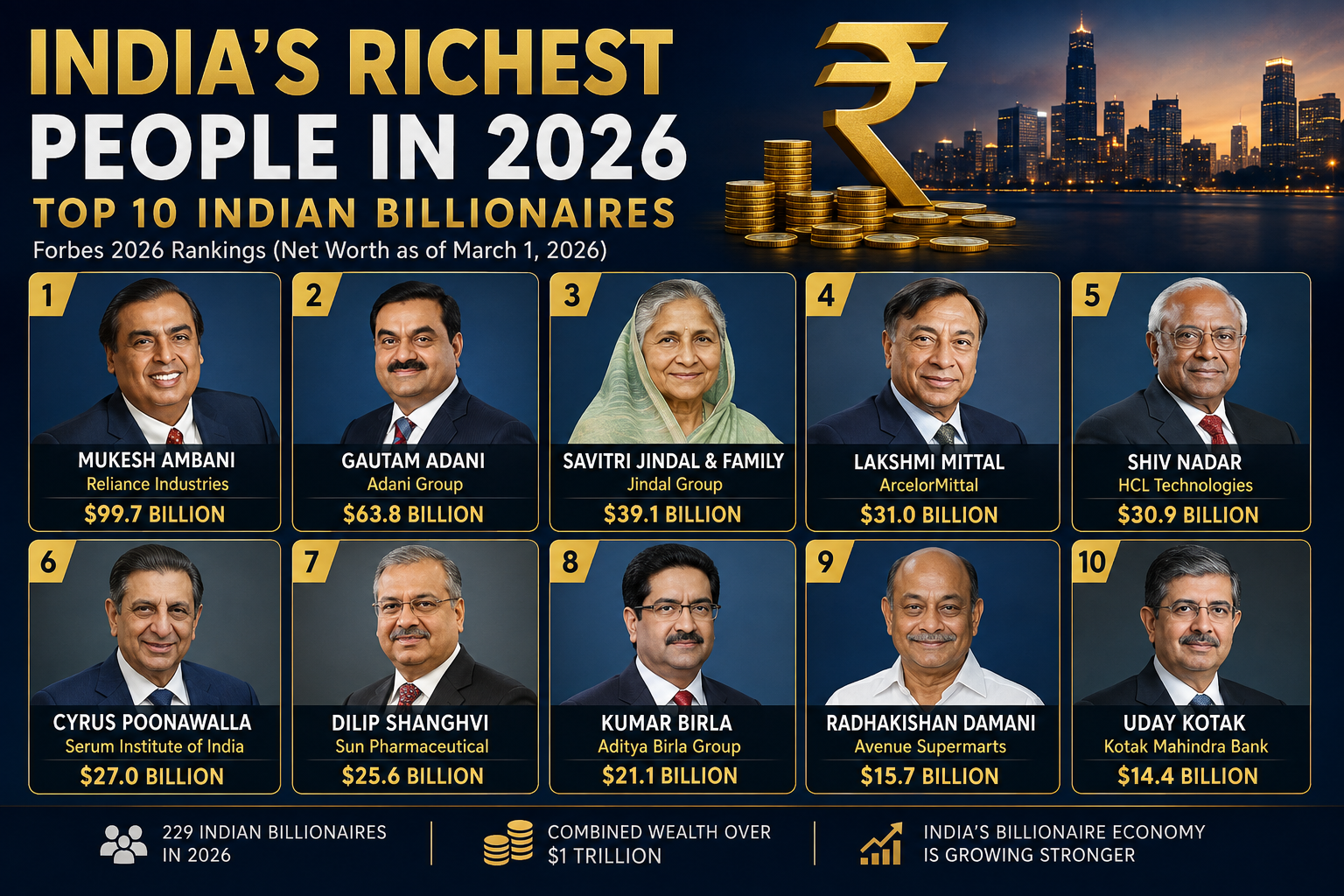
India has become one of the world’s most important homes for billionaires, with entrepreneurs and business families building enormous fortunes across technology, energy, retail, pharmaceuticals, steel, finance, and infrastructure.
According to Forbes’ 2026 World’s Billionaires list, India had a record 229 billionaires, compared with 205 the previous year. Their combined wealth surpassed $1 trillion, highlighting the growing economic influence of India’s wealthiest business leaders. The country’s 10 richest billionaires alone were worth approximately $368 billion based on Forbes’ March 1, 2026 calculations.
At the top of the ranking was Mukesh Ambani, chairman and managing director of Reliance Industries. His business empire spans energy, petrochemicals, telecommunications, retail, media, and financial services.
Who Is the Richest Person in India?
Mukesh Ambani remains one of India's most prominent billionaires and was ranked the country's richest person on Forbes' 2026 annual billionaire list.
Forbes estimated Ambani's net worth at $99.7 billion as of March 1, 2026. His fortune is closely connected to his ownership and leadership of Reliance Industries, one of India's largest and most diversified conglomerates.
Ambani inherited the foundations of Reliance from his father, Dhirubhai Ambani, but has transformed the company into a much broader business empire. Reliance now has major operations in energy, retail, telecommunications, digital services, media, and financial services.
The company's telecommunications business, Jio, has become particularly influential. Reuters reported in June 2026 that Jio had more than 500 million subscribers and was preparing for a potential IPO that could become India's largest-ever initial public offering.
Top 10 Richest People in India in 2026
Forbes' 2026 World’s Billionaires list ranked India's richest individuals as follows, using net worth figures calculated on March 1, 2026:
Rank | Billionaire | Main Source of Wealth | Net Worth |
|---|---|---|---|
1 | Mukesh Ambani | Diversified | $99.7 billion |
2 | Gautam Adani | Infrastructure | $63.8 billion |
3 | Savitri Jindal & family | Steel | $39.1 billion |
4 | Lakshmi Mittal | Steel | $31.0 billion |
5 | Shiv Nadar | Software Services | $30.9 billion |
6 | Cyrus Poonawalla | Vaccines | $27.0 billion |
7 | Dilip Shanghvi | Pharmaceuticals | $25.6 billion |
8 | Kumar Birla | Commodities | $21.1 billion |
9 | Radhakishan Damani | Retail & Investments | $15.7 billion |
10 | Uday Kotak | Banking | $14.4 billion |
Net worth figures above are Forbes estimates as of March 1, 2026 and can change daily with market prices.
1. Mukesh Ambani
Mukesh Ambani is the chairman and managing director of Reliance Industries and India's richest billionaire on Forbes' 2026 annual list.
His business interests cover some of India's most important consumer and industrial sectors. Reliance operates businesses involving petrochemicals, oil and gas, telecommunications, retail, media, and financial services.
One of Ambani's biggest strategic moves has been the expansion of Jio. The company disrupted India's telecommunications industry with affordable data and mobile services and subsequently expanded into digital platforms, cloud computing, artificial intelligence, and other technologies.
Reliance has also been investing heavily in renewable energy and other new businesses as it seeks to reduce its dependence on traditional energy.
2. Gautam Adani
Gautam Adani built his fortune through the Adani Group, a sprawling business conglomerate involved in infrastructure, ports, airports, energy, logistics, and other industries.
Forbes ranked Adani as India's second-richest person on its March 2026 list, with an estimated fortune of $63.8 billion.
Adani's companies have played a major role in India's infrastructure development, particularly in ports, airports, electricity generation, renewable energy, and logistics.
His position in the wealth rankings has also fluctuated significantly with changes in Adani Group share prices.
3. Savitri Jindal & Family
Savitri Jindal and her family occupy the third position on Forbes' 2026 ranking, with a combined estimated fortune of $39.1 billion.
The Jindal family's wealth is closely associated with the steel and industrial businesses established by the late O.P. Jindal.
The family's companies have expanded across steel, power, mining, and other industrial sectors, making the Jindals one of India's most influential business families.
4. Lakshmi Mittal
Lakshmi Mittal is one of the world's best-known steel entrepreneurs and the chairman and executive chairman of ArcelorMittal.
Forbes estimated his wealth at approximately $31 billion in its March 2026 ranking.
Unlike many billionaires on the list who primarily built businesses in India, Mittal has developed a major international steel empire with operations and investments across multiple countries.
His career demonstrates how India's business leaders have increasingly built global companies rather than limiting their activities to the domestic market.
5. Shiv Nadar
Shiv Nadar is the founder of HCL Technologies and one of India's most successful technology entrepreneurs.
Forbes estimated Nadar's fortune at $30.9 billion in March 2026.
Nadar helped build HCL from an early technology company into a global IT services business. His wealth reflects the enormous growth of India's technology and software-services sector.
He has also devoted significant resources to education and philanthropy through the Shiv Nadar Foundation.
6. Cyrus Poonawalla
Cyrus Poonawalla built his fortune through the vaccine industry and is associated with the Serum Institute of India, one of the world's largest vaccine manufacturers.
Forbes placed his net worth at approximately $27 billion in its 2026 annual ranking.
The growth of India's pharmaceutical and biotechnology industries has helped create several major fortunes, but the Poonawalla family's position is particularly notable because of the global scale of vaccine manufacturing.
7. Dilip Shanghvi
Dilip Shanghvi is the founder of Sun Pharmaceutical Industries and one of India's most successful pharmaceutical entrepreneurs.
His estimated fortune was $25.6 billion according to Forbes' March 2026 ranking.
Shanghvi started Sun Pharma with a relatively small operation and expanded it into a major global pharmaceutical company.
His story demonstrates how India's pharmaceutical sector has produced billionaires by combining domestic growth with international expansion.
8. Kumar Birla
Kumar Mangalam Birla leads the Aditya Birla Group, one of India's major multinational business groups.
Forbes estimated his wealth at $21.1 billion in March 2026.
The Aditya Birla Group has interests in sectors including metals, cement, financial services, textiles, chemicals, and other businesses.
Birla represents a new generation of leadership within one of India's oldest major business families.
9. Radhakishan Damani
Radhakishan Damani is best known as the founder of Avenue Supermarts, the company behind India's popular DMart retail chain.
Forbes estimated his wealth at $15.7 billion in March 2026.
DMart has built its reputation around efficient operations and competitive pricing, helping Damani become one of India's most successful retail entrepreneurs.
His rise also highlights the enormous wealth-creation potential of India's rapidly expanding consumer market.
10. Uday Kotak
Uday Kotak is the founder of Kotak Mahindra Bank and a major figure in India's financial-services industry.
Forbes estimated his fortune at $14.4 billion on March 1, 2026.
Kotak's journey illustrates the growth of India's private banking sector and the increasing importance of financial services in the country's economy.
Why Does India Have So Many Billionaires?
India's billionaire population has grown because of several major economic trends.
Rapid Economic Growth
India's expanding economy has created opportunities across manufacturing, technology, financial services, retail, infrastructure, and consumer industries.
Technology and Digital Transformation
The growth of software, digital payments, telecommunications, artificial intelligence, and e-commerce has created new sources of wealth.
Infrastructure Investment
Large investments in airports, ports, roads, renewable energy, logistics, and electricity have created enormous businesses and fortunes.
Family Businesses
Many of India's largest companies began as family businesses and have been expanded across generations.
Global Expansion
Indian companies increasingly operate internationally, giving entrepreneurs access to much larger markets.
India’s Billionaire Economy Is Becoming More Diverse
India's wealthiest people no longer come exclusively from traditional industries.
Energy and infrastructure remain extremely important, but technology, pharmaceuticals, retail, financial services, telecommunications, and digital businesses now play major roles.
Mukesh Ambani's expansion into telecommunications and AI, Shiv Nadar's technology empire, Dilip Shanghvi's pharmaceutical business, and Radhakishan Damani's retail success all demonstrate how different industries can create enormous fortunes.
At the same time, established industrial families such as the Jindals, Birlas, and Mittals continue to maintain major positions among India's wealthiest business leaders.
The Future of India's Billionaires
The next phase of India's billionaire economy could be shaped by artificial intelligence, renewable energy, digital infrastructure, electric vehicles, biotechnology, financial technology, and advanced manufacturing.
Both Mukesh Ambani and Gautam Adani have been making major investments related to AI infrastructure. Forbes reported that the two business groups had pledged a combined $210 billion toward AI infrastructure ambitions in India.
This suggests that India's wealthiest entrepreneurs are not simply protecting traditional businesses. They are also competing to build businesses around technologies that could define the next decade.
Final Thoughts
India's richest people represent a broad range of industries and entrepreneurial strategies. From Mukesh Ambani's diversified Reliance empire to Gautam Adani's infrastructure network, Shiv Nadar's technology success, and Cyrus Poonawalla's global vaccine business, these billionaires have helped shape India's modern economy.
Forbes' 2026 ranking shows just how significant India's billionaire population has become, with 229 Indian billionaires and combined wealth exceeding $1 trillion.
As India's economy continues to expand, new billionaires are likely to emerge from technology, artificial intelligence, clean energy, healthcare, manufacturing, and other fast-growing industries.
FAQs
Who is the richest person in India in 2026?
Mukesh Ambani was India's richest person on Forbes' 2026 World’s Billionaires list, with a net worth of $99.7 billion calculated as of March 1, 2026.
Who is the second-richest person in India?
Gautam Adani ranked second on Forbes' March 2026 list with an estimated net worth of $63.8 billion.
How many billionaires does India have in 2026?
Forbes counted 229 Indian billionaires on its 2026 World’s Billionaires list, compared with 205 in 2025.
What is Mukesh Ambani's main source of wealth?
Ambani's wealth comes primarily from his stake in and leadership of Reliance Industries, whose businesses span energy, telecommunications, retail, media, and financial services.
Who is India's richest woman?
Savitri Jindal and her family ranked third overall on Forbes' 2026 India list, making her the highest-ranked woman on the list.
Which industries have produced India's richest people?
India's richest billionaires have built fortunes in diversified conglomerates, infrastructure, steel, technology, pharmaceuticals, vaccines, retail, commodities, and banking.
Can India's richest-person ranking change?
Yes. Billionaire rankings can change frequently because much of their wealth is tied to publicly traded company shares. Real-time estimates can therefore differ from Forbes' annual ranking.