Imagine waking up in the morning as your smart thermostat adjusts the room temperature, your smartwatch tracks your sleep, and your coffee machine starts preparing your coffee automatically. Meanwhile, your smartphone receives updates from connected devices around your home.
These technologies are not science fiction. They are examples of the Internet of Things (IoT), a rapidly developing technology that connects everyday physical objects to the internet, allowing them to collect, exchange, and process data.
From smart homes and wearable devices to industrial machinery and connected vehicles, IoT is changing how people live, work, and interact with technology.
In 2026, connected technology continues to create new opportunities for individuals, businesses, and entire industries. Understanding IoT is becoming increasingly important as more devices become connected and intelligent.
This guide explains what the Internet of Things is, how it works, its major components, benefits, challenges, and practical applications across different sectors.
What Is the Internet of Things (IoT)?
The Internet of Things (IoT) refers to a network of physical objects connected to the internet that collect and exchange information through sensors, software, and communication technologies.
These objects are commonly called connected devices or smart devices. They can include:
Smartwatches and fitness trackers
Smart televisions and speakers
Connected home security cameras
Smart refrigerators and washing machines
Industrial machines and sensors
Connected cars and traffic systems
Agricultural monitoring equipment
Medical monitoring devices
Unlike traditional devices that operate independently, IoT devices can communicate with other systems, share information, and sometimes perform actions automatically.
For example, a smart irrigation system can monitor soil moisture and activate watering when the soil becomes too dry. This helps farmers manage water more efficiently without constantly checking their fields.
In simple terms, IoT connects the physical world with digital technology.
How Does the Internet of Things Work?
IoT works through a combination of connected devices, sensors, internet connectivity, data processing, and software applications.
The process generally follows five stages.
1. Data Collection Through Sensors
IoT devices use sensors to collect information from their surroundings.
Depending on the device, sensors can measure:
Temperature
Humidity
Movement
Light
Pressure
Location
Heart rate
Air quality
For example, a smart thermostat uses temperature sensors to monitor room conditions.
2. Internet Connectivity
After collecting information, the device sends data through a communication network.
Common connectivity technologies include:
Wi-Fi
Bluetooth
Cellular networks such as 4G and 5G
Zigbee
Z-Wave
LoRaWAN
Ethernet
The appropriate connection depends on the device's power requirements, range, data volume, and environment.
3. Data Processing
Collected information is sent to a local system, gateway, or cloud platform for processing.
Software analyzes the information and determines whether an action is necessary.
For example, a connected security camera may identify movement and send an alert to the homeowner.
4. User Interaction
Users can monitor connected devices through mobile applications, websites, or control panels.
These interfaces allow people to:
View device information
Change settings
Receive notifications
Monitor performance
Control connected equipment remotely
5. Automated Actions
Some IoT systems can perform tasks automatically based on predefined rules or analyzed data.
For instance, a smart lighting system can switch on when it detects movement and turn off when a room becomes empty.
The basic IoT process:
Device and Sensors → Data Collection → Internet Connectivity → Data Processing → User Notifications or Automated Actions
Main Components of an IoT System
An IoT solution usually contains several interconnected components that work together.
Component | Purpose | Example |
|---|---|---|
Sensors | Collect information | Temperature sensor |
Connectivity | Transfer data | Wi-Fi or 5G |
Gateway | Connect devices to networks | IoT gateway |
Cloud Platform | Store and process data | Cloud-based IoT platform |
Software | Analyze information | Device management application |
User Interface | Allow users to interact | Smartphone application |
Actuators | Perform physical actions | Smart door lock |
Each component plays an important role in ensuring that connected devices communicate and function properly.
Types of Internet of Things (IoT)
IoT can be divided into several categories depending on where and how connected devices are used.
1. Consumer IoT
Consumer IoT includes smart devices designed for personal and household use.
Examples include smart speakers, wearable fitness trackers, connected televisions, and home security systems.
These devices make everyday activities more convenient and allow users to manage different aspects of their homes through connected applications.
2. Industrial IoT (IIoT)
Industrial Internet of Things, commonly called IIoT, connects industrial equipment, sensors, and manufacturing systems.
Factories use connected devices to monitor machine performance, detect equipment problems, and improve production processes.
For example, sensors installed in industrial machines can identify unusual vibration or temperature changes before equipment failure occurs.
3. Commercial IoT
Commercial IoT is used by businesses to improve services, manage resources, and understand customer behavior.
Examples include:
Smart retail inventory systems
Connected payment terminals
Building management systems
Smart office equipment
Asset tracking solutions
4. Healthcare IoT (IoMT)
Healthcare IoT, also known as the Internet of Medical Things (IoMT), connects medical devices and healthcare systems.
Examples include connected blood pressure monitors, wearable health trackers, remote patient monitoring equipment, and smart medical devices.
These technologies can help healthcare professionals access relevant patient information and support remote monitoring.
5. Agricultural IoT
Agricultural IoT uses connected sensors and monitoring systems to improve farming operations.
Farmers can monitor soil conditions, weather, water consumption, and crop environments.
Smart irrigation systems can also use sensor information to manage water delivery according to field conditions.
6. Smart City IoT
Smart city technology connects infrastructure, transportation systems, utilities, and public services.
Examples include:
Smart traffic signals
Connected streetlights
Smart parking systems
Environmental monitoring sensors
Intelligent waste management
These technologies can help cities manage resources and improve public services.
Real-World Applications of IoT
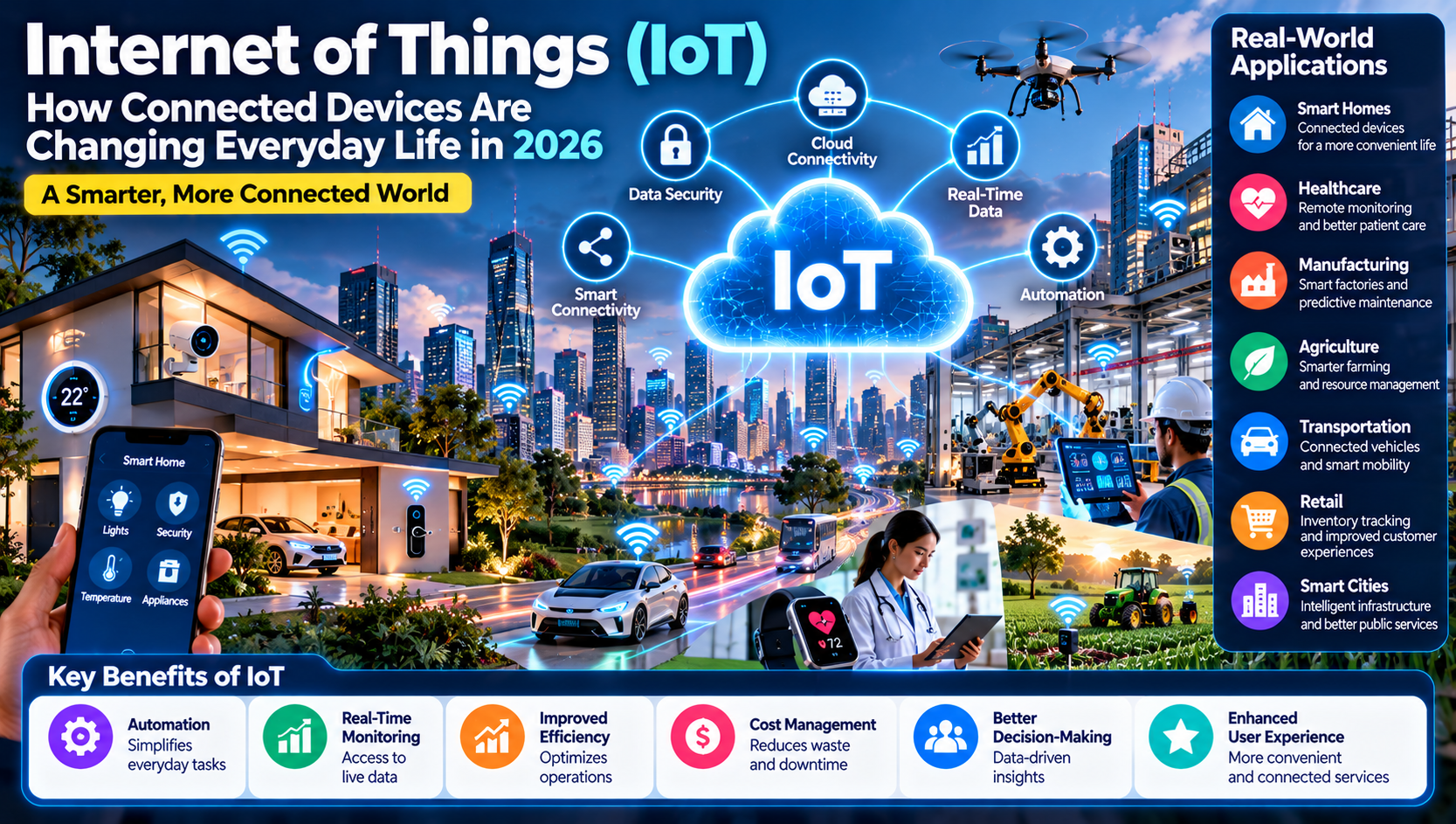
IoT is no longer limited to technology companies. Its applications are expanding across industries and everyday environments.
1. Smart Homes
<PRIVATE_PERSON> Smart home technology allows people to control household devices through smartphones, voice assistants, and automated systems.
Common applications include:
Smart lighting
Connected thermostats
Smart door locks
Security cameras
Motion sensors
Smart appliances
For example, homeowners can monitor security cameras remotely or automatically adjust lighting based on occupancy.
2. Healthcare and Remote Patient Monitoring
Healthcare organizations increasingly use connected medical devices to collect and transmit health-related information.
Wearable devices can monitor activity, heart rate, and other measurements. Remote monitoring systems can help healthcare professionals review information without requiring every interaction to happen in person.
However, medical IoT devices should be properly validated and used under appropriate healthcare guidance.
3. Manufacturing and Industrial Automation
Factories use IoT sensors to monitor production equipment and operational conditions.
Connected machines can provide information about:
Equipment temperature
Machine vibration
Production performance
Energy consumption
Maintenance requirements
This information can support predictive maintenance, helping businesses identify possible equipment problems before they cause costly downtime.
4. Agriculture and Smart Farming
IoT technology can help farmers make more informed decisions using real-time field information.
Connected sensors can measure soil moisture, temperature, humidity, and environmental conditions.
Applications include automated irrigation, greenhouse monitoring, livestock tracking, and crop condition monitoring.
5. Transportation and Logistics
Connected vehicles and tracking devices help transportation companies monitor vehicle locations, delivery progress, and equipment conditions.
Businesses can use IoT to:
Track shipments
Monitor vehicle performance
Optimize delivery routes
Manage fleet operations
Monitor temperature-sensitive cargo
For example, refrigerated delivery vehicles can use temperature sensors to monitor storage conditions during transportation.
6. Retail and E-Commerce
Retail businesses use IoT to improve inventory management and store operations.
Connected systems can monitor product availability, track equipment, and support automated stock management.
Smart shelves and connected sensors can help retailers identify when products need restocking.
7. Energy and Utilities
Energy companies use connected meters and monitoring systems to measure electricity, water, and gas consumption.
Smart meters can provide more frequent usage information, while connected grid equipment can help utility operators monitor infrastructure.
These technologies can support better resource management and operational efficiency.
8. Education
Educational institutions can use IoT systems to improve campus management and classroom environments.
Examples include smart attendance systems, connected classroom equipment, environmental sensors, and smart access control.
These applications can help institutions manage facilities and improve the learning environment.
Benefits of the Internet of Things
IoT offers several advantages for individuals, businesses, and organizations.
1. Automation and Convenience
Connected devices can perform repetitive tasks automatically.
Smart home systems, for example, can adjust lighting, temperature, and security settings without requiring constant manual control.
2. Real-Time Monitoring
IoT systems provide access to information from connected devices.
Businesses can monitor machinery, vehicles, inventory, and environmental conditions through centralized dashboards.
3. Improved Efficiency
By collecting operational data, organizations can identify inefficiencies and improve processes.
Manufacturers can monitor equipment performance, while retailers can manage inventory more effectively.
4. Predictive Maintenance
IoT sensors can help identify unusual equipment behavior.
Instead of relying only on fixed maintenance schedules, organizations can use sensor data to identify potential problems earlier.
5. Better Decision-Making
Connected devices generate information that can help organizations understand operations and make more informed decisions.
When combined with analytics and artificial intelligence, IoT data can provide additional insights.
6. Cost Management
IoT can help businesses identify unnecessary energy consumption, reduce equipment downtime, and improve resource utilization.
Actual savings depend on implementation costs, system reliability, and the quality of the collected data.
7. Improved Customer Experiences
Businesses can use connected technology to provide more responsive services.
For example, connected retail systems can improve product availability, while smart home devices can offer greater convenience.
Challenges and Risks of IoT
Despite its advantages, IoT introduces technical, financial, and security challenges.
1. Cybersecurity Threats
Every internet-connected device can potentially become an entry point for cyberattacks.
Weak passwords, outdated firmware, insecure communication, and poorly configured networks can expose connected devices to unauthorized access.
Businesses should use strong authentication, regular security updates, network segmentation, and secure device configurations.
2. Data Privacy Concerns
IoT devices can collect sensitive information, including location details, usage patterns, and personal activity data.
Organizations must establish clear data collection policies and protect information throughout its lifecycle.
Users should understand what information their devices collect and how it is shared.
3. Device Compatibility
Different manufacturers may use different communication standards and platforms.
This can create compatibility problems when organizations try to connect devices from multiple suppliers.
Choosing systems that support recognized standards and integration requirements can reduce these difficulties.
4. High Initial Investment
Deploying an IoT system may require investment in sensors, gateways, software, network infrastructure, and maintenance.
Businesses should evaluate the expected return on investment before large-scale deployment.
5. Network Dependence
Many IoT applications depend on reliable connectivity.
Poor network coverage, interruptions, or high latency can affect device performance.
Some systems address this issue by processing information locally through edge computing.
6. Data Management Complexity
Large IoT deployments can generate significant amounts of information.
Organizations need appropriate storage, processing, analytics, and data governance systems to manage it effectively.
IoT vs. Traditional Devices
Traditional devices generally operate independently, while IoT devices can connect to networks and exchange information.
Feature | Traditional Devices | IoT Devices |
|---|---|---|
Connectivity | Usually limited | Internet or network connected |
Data Collection | Often manual | Often sensor-based |
Remote Control | Limited | Commonly supported |
Automation | Usually basic | Can support advanced automation |
Monitoring | Local or manual | Remote and real-time |
Data Sharing | Limited | Connected systems |
Examples | Traditional thermostat | Smart thermostat |
The main difference is the ability of IoT devices to collect, communicate, and act on information through connected systems.
IoT and Artificial Intelligence: How They Work Together
Artificial intelligence and IoT are increasingly used together to create more intelligent connected systems.
IoT devices collect information, while AI systems can analyze that information to identify patterns, make predictions, and support automated decisions.
This combination is sometimes called Artificial Intelligence of Things (AIoT).
Examples include:
Smart security cameras that identify unusual activity
Industrial systems that predict equipment maintenance needs
Smart energy systems that analyze consumption patterns
Agricultural systems that help detect crop conditions
Connected vehicles that analyze driving and sensor information
AI can make IoT systems more useful, but the quality of results depends on reliable data, appropriate models, and effective security controls.
Popular IoT Platforms and Technologies
Businesses and developers use different platforms to build, manage, and monitor IoT solutions.
Platform or Technology | Main Purpose |
|---|---|
AWS IoT | Connect and manage IoT devices using Amazon cloud services |
Microsoft Azure IoT | Build and manage connected device solutions |
Google Cloud | Cloud infrastructure and data analytics for connected systems |
Arduino | Electronics prototyping and connected device development |
Raspberry Pi | Building IoT prototypes and edge computing projects |
MQTT | Lightweight messaging protocol for connected devices |
Zigbee | Low-power wireless communication |
LoRaWAN | Long-range, low-power device connectivity |
The right platform depends on the project's scale, budget, security requirements, connectivity needs, and integration capabilities.
How Businesses Can Implement IoT
Organizations interested in IoT should begin with a clear business objective rather than purchasing connected devices without a defined purpose.
A practical implementation process includes the following steps.
Step 1: Identify the Business Problem
Determine what the organization wants to improve.
Possible objectives include reducing equipment downtime, monitoring inventory, improving energy efficiency, or tracking deliveries.
Step 2: Select Suitable Devices and Sensors
Choose sensors and connected devices that collect the information required to achieve the objective.
Consider accuracy, durability, power consumption, compatibility, and operating conditions.
Step 3: Choose a Connectivity Solution
Select a suitable communication technology.
Wi-Fi may work well for connected office devices, while LoRaWAN or cellular connectivity may be more suitable for remote monitoring applications.
Step 4: Select an IoT Platform
Choose a platform that can manage devices, process information, provide analytics, and integrate with existing business systems.
Step 5: Establish Security Controls
Security should be included from the beginning.
Use device authentication, encryption, secure updates, access controls, and network monitoring.
Step 6: Run a Pilot Project
Test the system on a limited scale before expanding it across the organization.
Measure performance, reliability, costs, and business outcomes.
Step 7: Monitor and Improve
Review device performance and collected data regularly.
Update software, replace faulty sensors, and improve system configurations as business requirements change.
What Is the Future of the Internet of Things?
The future of IoT will be shaped by developments in connectivity, artificial intelligence, cloud computing, edge computing, and cybersecurity.
Several trends are particularly important in 2026.
1. AI-Powered Connected Devices
AI integration is helping connected devices analyze information and support more advanced automation.
2. 5G and Advanced Connectivity
Faster and more responsive network technologies can support applications that require reliable communication between connected devices.
3. Edge Computing
Edge computing allows information to be processed closer to where it is generated.
This can reduce delays and limit the need to transfer every piece of data to a distant cloud server.
4. Smart Cities
Connected traffic systems, environmental sensors, smart lighting, and intelligent utilities may help cities manage infrastructure more effectively.
5. Industrial IoT Growth
Manufacturers are using connected sensors and monitoring systems to improve equipment visibility, maintenance planning, and production management.
6. Stronger IoT Security
As connected devices become more common, manufacturers and organizations will need stronger security practices, longer software support, and better device lifecycle management.
7. Connected Healthcare
Wearable technology and remote monitoring systems may continue to expand the ways healthcare professionals collect and review patient information.
The future of IoT will depend not only on connecting more devices but also on making connected systems secure, reliable, and useful.
Frequently Asked Questions About IoT
1. What does IoT stand for?
IoT stands for the Internet of Things. It describes physical objects connected to networks that collect and exchange data using sensors, software, and communication technologies.
2. What are some examples of IoT devices?
Common examples include smartwatches, smart thermostats, connected security cameras, smart refrigerators, industrial sensors, vehicle tracking devices, and remote health monitoring equipment.
3. How does IoT work?
IoT devices collect information through sensors, transmit it using network connections, and process it through software or cloud platforms. The information can then be displayed to users or used to trigger automated actions.
4. What are the four main types of IoT?
Common categories include consumer IoT, industrial IoT, commercial IoT, and infrastructure or public-sector IoT. Other classifications include healthcare IoT and agricultural IoT.
5. What is Industrial IoT?
Industrial IoT connects machinery, sensors, and industrial systems to collect operational data. It helps organizations monitor equipment, improve production processes, and support predictive maintenance.
6. Is IoT safe to use?
IoT can be safe when devices are properly designed, configured, updated, and protected. Users should choose trusted manufacturers, change default passwords, enable security features, and install updates.
7. What is the difference between IoT and AI?
IoT connects physical devices and collects information. Artificial intelligence analyzes information and can support predictions, recommendations, or automated decisions. Both technologies can work together.
8. How does IoT help businesses?
IoT helps businesses monitor equipment, manage inventory, track assets, improve efficiency, analyze operations, and automate selected processes.
9. Does IoT require the internet?
Not every IoT system requires a direct internet connection. Some connected devices communicate through local networks or gateways and can perform certain functions without continuous internet access.
10. What is the future of IoT in 2026 and beyond?
IoT is expected to develop through greater AI integration, improved connectivity, edge computing, industrial automation, smart infrastructure, and stronger device security.
Conclusion
The Internet of Things is transforming the way people interact with technology and how organizations manage their operations. By connecting physical devices to digital networks, IoT makes it possible to collect information, monitor conditions, automate tasks, and improve decision-making.
From smart homes and healthcare to manufacturing, transportation, agriculture, and smart cities, its applications continue to expand.
However, successful IoT adoption requires more than connecting devices. Businesses must also consider cybersecurity, data privacy, compatibility, connectivity, and long-term maintenance.
As AI, cloud computing, and advanced networks continue to develop, IoT will remain an important part of the connected digital world.
Understanding this technology today can help individuals and businesses prepare for a more connected future.