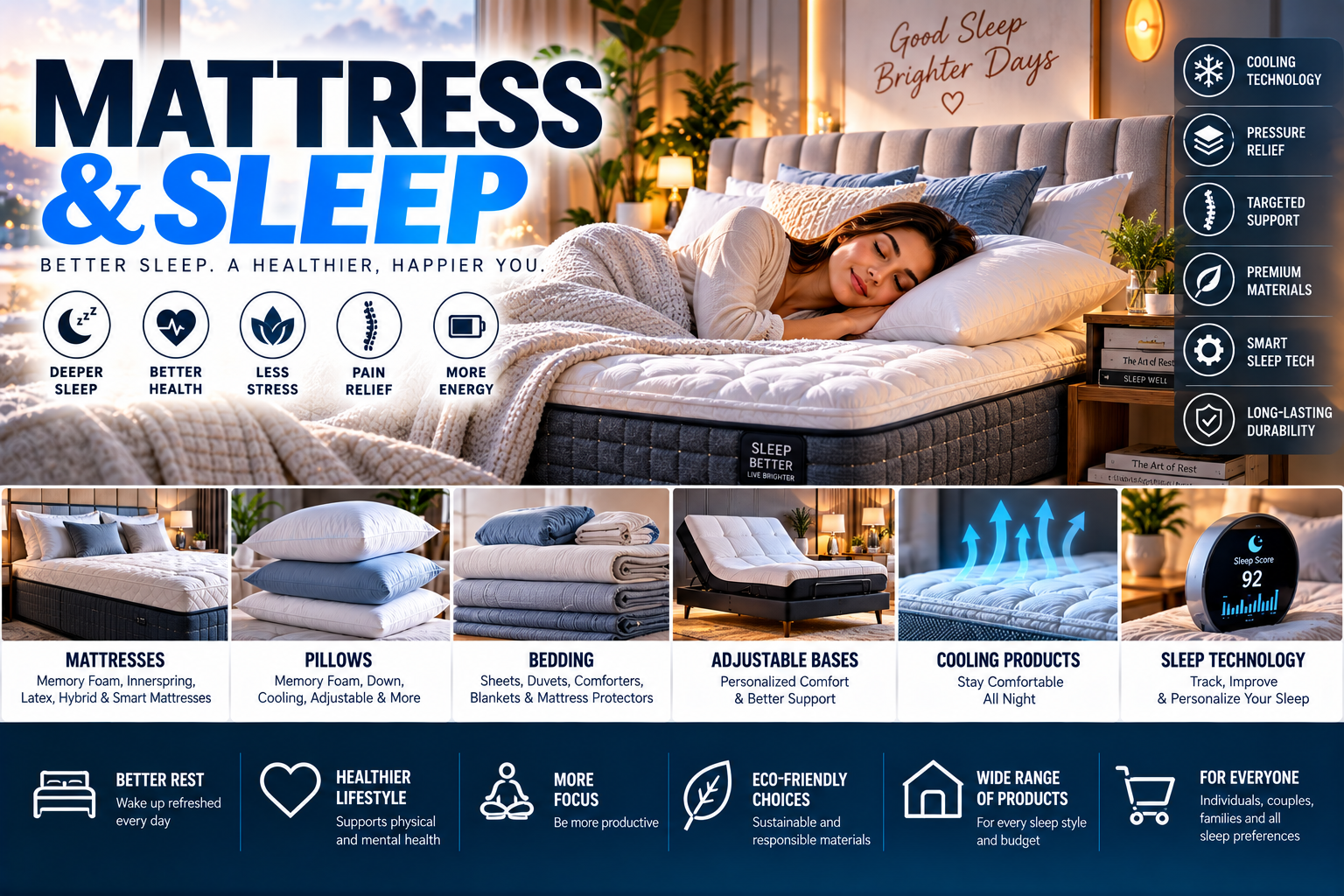
Sleep has become an increasingly important part of the broader wellness and consumer-products economy. What was once a relatively simple mattress-and-bedding category has developed into a diverse industry spanning mattresses, pillows, sheets, adjustable bases, smart beds, sleep trackers, cooling products, bedroom furniture, and other sleep-focused technologies.
The mattress industry, however, is navigating a challenging period in 2026. U.S. mattress demand remained under pressure during 2025, with total mattress market value declining 6.5% and unit shipments falling 13.2%, according to the International Sleep Products Association's 2026 industry report. At the same time, consumers who did purchase mattresses tended to spend more, with the average selling price of U.S.-produced mattresses increasing nearly 5%.
This combination of lower volume and stronger premium demand is influencing how mattress manufacturers and retailers approach product design, pricing, technology, marketing, and distribution.
What Is the Mattress & Sleep Industry?
The mattress and sleep industry includes products and services designed to support sleep, comfort, bedroom environments, and nighttime routines.
Major categories include:
Mattresses
Pillows
Bed sheets
Mattress toppers
Duvets and comforters
Blankets
Adjustable bases
Smart beds
Bed frames
Sleep trackers
Cooling products
Weighted blankets
Sleep accessories
Bedroom furniture
Mattress protectors
The industry also includes digital products and technologies designed to monitor or improve aspects of the sleep experience.
The Evolution of Mattresses
Mattresses have changed significantly over the last century.
Traditional mattresses were largely based on basic spring systems and natural or synthetic padding. Modern products can combine multiple layers and technologies to address different comfort preferences.
Today's mattresses may use:
Pocketed coils
Memory foam
Latex
Polyfoam
Hybrid construction
Gel-infused foam
Zoned support systems
Cooling fabrics
Adjustable components
The result is a much wider range of products designed for different sleeping positions, body types, temperature preferences, and comfort requirements.
Major Types of Mattresses
Innerspring Mattresses
Innerspring mattresses use metal coils as the primary support system.
They remain a familiar category and can provide:
Bounce
Support
Airflow
Durability
Modern versions often combine coils with foam or other comfort layers.
Memory Foam Mattresses
Memory foam is known for its ability to conform to the body.
Common characteristics include:
Pressure distribution
Motion isolation
Contouring
Reduced partner disturbance
Some consumers, however, prefer other constructions because traditional memory foam can retain heat.
Latex Mattresses
Latex mattresses use natural or synthetic latex.
They are often associated with:
Resilience
Durability
Responsiveness
Breathability
Natural latex products can also appeal to consumers interested in certain material and sustainability attributes.
Hybrid Mattresses
Hybrid mattresses combine two or more construction technologies, often pairing coils with foam or latex.
They attempt to combine characteristics such as:
Support + Pressure Relief + Airflow + Responsiveness
Hybrid designs have become an important part of the premium mattress market.
Adjustable Mattresses and Bases
Adjustable sleep systems allow users to change the position of the sleep surface.
Some systems can raise the head or feet, while more advanced products may incorporate additional smart features.
Adjustable bases have been relatively resilient compared with traditional foundations. ISPA data showed motion-foundation unit shipments increasing year over year in 2025 even as broader mattress demand weakened.
The Rise of Smart Beds
Smart beds represent one of the most technology-focused segments of the sleep industry.
Modern smart sleep systems can include features such as:
Automatic temperature adjustment
Adjustable firmness
Sleep tracking
Position adjustment
Snore-response features
Smartphone controls
Sleep data
Personalized settings
Sleep Foundation's 2026 smart-mattress coverage reflects growing consumer interest in technology-integrated sleep products.
The development of smart beds illustrates the industry's movement from passive furniture toward connected wellness technology.
Sleep Tracking Technology
Wearable devices and smart products have made sleep measurement increasingly accessible.
Sleep-related technology can track information such as:
Sleep duration
Heart rate
Movement
Sleep timing
Breathing-related measurements
Nighttime disturbances
Smartwatches, fitness trackers, rings, and dedicated sleep devices can provide users with information about their nighttime behavior.
However, consumer sleep trackers should not automatically be treated as medical diagnostic devices. Their measurements and interpretations can vary by technology and individual.
Pillows and Sleep Accessories
Mattresses are only one part of the sleep environment.
Pillows play an important role in supporting the head and neck while sleeping.
Modern pillow categories include:
Memory foam pillows
Latex pillows
Down pillows
Down-alternative pillows
Adjustable-fill pillows
Cooling pillows
Contoured pillows
Body pillows
Consumers can also purchase mattress toppers, protectors, weighted blankets, cooling sheets, and other accessories.
Sleep Foundation's 2026 product coverage spans mattresses, pillows, bedding, weighted blankets, and other sleep products, demonstrating the increasingly broad definition of the modern sleep-product market.
Mattress Firmness
Firmness is one of the most important factors consumers consider when selecting a mattress.
Mattresses are generally described using categories such as:
Soft
Medium-soft
Medium
Medium-firm
Firm
Extra-firm
However, firmness is subjective.
Two mattresses with similar technical firmness ratings can feel different because of differences in:
Foam density
Construction
Materials
Body weight
Sleeping position
Individual preference
This is why many retailers offer sleep trials and return policies.
Sleeping Positions and Mattress Design
Different sleeping positions can create different comfort requirements.
Side Sleepers
Side sleepers often look for pressure relief around the shoulders and hips.
Back Sleepers
Back sleepers may prioritize a balance between cushioning and support.
Stomach Sleepers
Stomach sleepers often prefer a surface that prevents excessive sinking.
Combination Sleepers
People who change positions during the night may prefer a responsive mattress that accommodates multiple positions.
Modern mattress manufacturers increasingly use zoned construction to provide different support characteristics across different parts of the sleep surface.
Cooling Technology
Temperature regulation has become an important selling point in the mattress industry.
Consumers who sleep hot may look for:
Breathable covers
Ventilated foam
Coil systems
Phase-change materials
Cooling fabrics
Gel-infused materials
Temperature-regulating technologies
Cooling technology has become particularly important in premium mattresses and smart sleep systems.
Mattress-in-a-Box
One of the biggest changes in mattress retail has been the rise of online mattress shopping.
Mattress-in-a-box companies compress, roll, package, and ship mattresses directly to consumers.
This model can reduce:
Shipping complexity
Showroom requirements
Physical retail costs
It also gives consumers the ability to shop online rather than visiting a traditional mattress store.
Sleep Foundation's September 2026 review of online mattresses notes that consumers increasingly use online channels to purchase mattresses shipped directly to their homes.
Direct-to-Consumer Mattress Brands
Direct-to-consumer, or DTC, brands have transformed mattress shopping.
Instead of selling primarily through physical retailers, DTC companies can market directly to consumers through:
Websites
Social media
Digital advertising
Online reviews
Influencer marketing
Email marketing
The DTC model can also allow brands to control more of the customer journey.
Furniture Today reported that the DTC channel remained the largest channel in its 2025 Top 25 bedding retailers analysis, with Amazon and online mattress brands contributing significantly to the category.
Traditional Mattress Retail
Physical stores remain important despite the growth of online mattress shopping.
Mattresses are difficult to evaluate digitally because comfort is highly personal.
Physical stores allow customers to:
Lie on mattresses
Compare firmness
Test adjustable bases
Speak with sales representatives
Compare different constructions
This creates a hybrid market in which online and physical shopping channels increasingly coexist.
The Premium Mattress Market
One notable 2026 trend is the resilience of premium sleep products.
While overall U.S. mattress demand weakened in 2025, average selling prices increased and larger mattress sizes gained market share.
Some premium manufacturers have also reported stronger demand at higher price points.
For example, Diamond Mattress reported that sales of mattresses priced at $2,000 and above increased 28% year over year from January through early June 2026, while units priced at $3,000 or more increased 60%. These figures are company-specific rather than representative of the entire industry.
This suggests that consumers who are willing to replace a mattress may increasingly prioritize quality, features, and perceived long-term value.
Larger Mattress Sizes
Consumer preferences are also shifting toward larger mattresses.
ISPA reported that queen and king mattresses gained share in 2025 while twin and full mattresses lost share.
Larger sizes can command higher prices and may benefit from consumer preferences for additional sleeping space.
Sustainability in the Mattress Industry
Sustainability has become an important issue in mattress manufacturing.
Key areas include:
Recycled materials
Natural latex
Organic textiles
Lower-emission foams
Responsible sourcing
Reduced packaging
Mattress recycling
Product durability
Mattress recycling is particularly important because mattresses are large and difficult to dispose of efficiently.
Manufacturers and retailers are therefore exploring ways to reduce waste throughout the product lifecycle.
Circular Economy and Mattress Recycling
The traditional mattress model follows:
Manufacture → Sell → Use → Dispose
A circular approach attempts to create:
Manufacture → Sell → Use → Collect → Recycle → Reuse
Materials such as steel, foam, wood, and textiles can potentially be separated and processed for other uses.
Circularity can reduce landfill waste while creating additional value from used products.
Sleep as a Wellness Category
The sleep industry increasingly overlaps with wellness.
Consumers may view sleep as part of broader goals involving:
Fitness
Recovery
Stress management
Productivity
Mental performance
General well-being
This has encouraged companies to market mattresses and sleep accessories as components of a broader sleep environment rather than standalone furniture.
Sleep Technology and Artificial Intelligence
Artificial intelligence is beginning to influence the sleep industry.
Potential applications include:
Personalized sleep recommendations
Smart temperature control
Automated mattress adjustments
Sleep pattern analysis
Product recommendations
Customer service
Demand forecasting
Inventory management
Smart beds may eventually become increasingly personalized by learning user preferences and adjusting automatically.
The challenge is separating genuinely useful technology from features that add complexity without providing meaningful consumer value.
AI and Mattress Shopping
AI can also change how consumers shop for mattresses.
Instead of browsing hundreds of products manually, a consumer could potentially enter preferences such as:
Sleeping position
Firmness preference
Temperature sensitivity
Mattress size
Budget
Partner preferences
An AI shopping assistant could then narrow the selection.
This could make online mattress shopping more personalized.
The Economics of the Mattress Market
The mattress industry is currently dealing with a difficult combination of lower demand and cautious consumer spending.
ISPA's 2026 industry data showed:
Total mattress market value down 6.5% in 2025
Unit shipments down 13.2%
Mattress sales dollars down 4%
Mattress unit shipments down 6.7%
Average U.S.-produced mattress selling price up nearly 5%
The figures indicate that consumers are purchasing fewer products while the average transaction is becoming more valuable.
Consumer Replacement Cycles
Mattresses are generally purchased less frequently than everyday consumer products.
This creates a unique challenge for manufacturers and retailers.
Consumers can delay a mattress purchase when:
Household budgets are under pressure
Housing activity is weak
Interest rates remain elevated
Consumer confidence declines
Furniture Today reported that housing affordability, borrowing costs, and the constrained housing market were among the factors contributing to delayed big-ticket purchases.
2026 Mattress & Sleep Trends
1. Premium Sleep Products
Consumers who do purchase mattresses are increasingly showing interest in higher-value products.
2. Smart Beds
Connected sleep systems are expanding the definition of what a mattress can do.
3. Adjustable Bases
Adjustable sleep products are showing greater resilience than traditional foundations.
4. Mattress-in-a-Box
Online mattress delivery continues to make home shopping more convenient.
5. Sleep Personalization
Consumers increasingly want products suited to their individual sleep preferences.
6. Cooling Technology
Temperature management remains a major product-development theme.
7. Sustainable Materials
Manufacturers are exploring recycled, renewable, and lower-impact materials.
8. Larger Mattresses
Queen and king sizes gained market share in 2025.
9. Sleep Tracking
Wearables and connected devices are expanding consumer interest in sleep data.
10. Hybrid Retail
Consumers increasingly combine online research with physical product testing.
Challenges Facing the Mattress Industry
The mattress industry faces several structural challenges.
Weak Unit Demand
Lower shipment volumes remain one of the industry's biggest concerns.
Long Replacement Cycles
Consumers do not purchase mattresses frequently, creating uneven demand.
Economic Uncertainty
Large purchases can be delayed when household budgets are under pressure.
Rising Costs
Manufacturers face expenses related to materials, transportation, labor, energy, and retail operations.
Retail Consolidation
Industry executives have highlighted shrinking retail doors and increasing consolidation as important changes in the sleep-products sector.
Competition
Traditional mattress stores compete with:
Online mattress brands
Furniture retailers
Department stores
Big-box retailers
Amazon
Direct-to-consumer companies
The Future of Sleep Products
The sleep industry is moving toward a combination of:
Comfort + Technology + Personalization + Wellness + Sustainability
The mattress of the future may not simply be a passive surface for sleeping.
It could become part of a connected bedroom ecosystem that incorporates:
Adjustable positioning
Temperature control
Sleep tracking
Smart-home integration
Personalized settings
Automated recommendations
At the same time, traditional fundamentals such as comfort, durability, support, price, and product quality will continue to influence purchasing decisions.
Frequently Asked Questions
What are the main types of mattresses?
The major categories include innerspring, memory foam, latex, hybrid, and adjustable sleep systems.
What is a hybrid mattress?
A hybrid mattress combines different construction technologies, commonly coils with foam or latex comfort layers.
What is a smart mattress?
A smart mattress or smart-bed system can incorporate technology such as sleep tracking, temperature control, adjustable positioning, and smartphone connectivity.
Are mattress-in-a-box products still popular?
Yes. Online mattress shopping remains an important part of the industry, with consumers increasingly purchasing mattresses that are compressed and shipped directly to their homes.
Are larger mattresses becoming more popular?
ISPA reported that queen and king mattresses gained market share in 2025, while twin and full sizes lost share.
What are the biggest mattress trends in 2026?
Major trends include premium mattresses, adjustable bases, smart beds, cooling technology, online shopping, personalized sleep products, sustainable materials, and sleep-tracking technology.
Is the mattress industry growing in 2026?
The U.S. market is currently facing weaker unit demand. Industry data shows significant shipment declines, although higher average selling prices and premium products have provided some support.
Conclusion
The mattress and sleep industry is undergoing a significant transformation.
Mattresses remain the foundation of the category, but consumers now have access to a much broader ecosystem of sleep products, including pillows, bedding, adjustable bases, smart beds, sleep trackers, cooling technologies, and specialized accessories.
The 2026 market is challenging, with U.S. mattress shipments declining substantially in 2025. However, consumers who continue to purchase are showing greater interest in premium products, larger sizes, and adjustable sleep technologies.
At the same time, online shopping, mattress-in-a-box delivery, artificial intelligence, sustainability, personalization, and sleep technology are reshaping how people discover and purchase sleep products.
The future of the industry will likely depend on how effectively companies combine comfort, quality, innovation, value, technology, and sustainability while responding to increasingly selective consumers.