
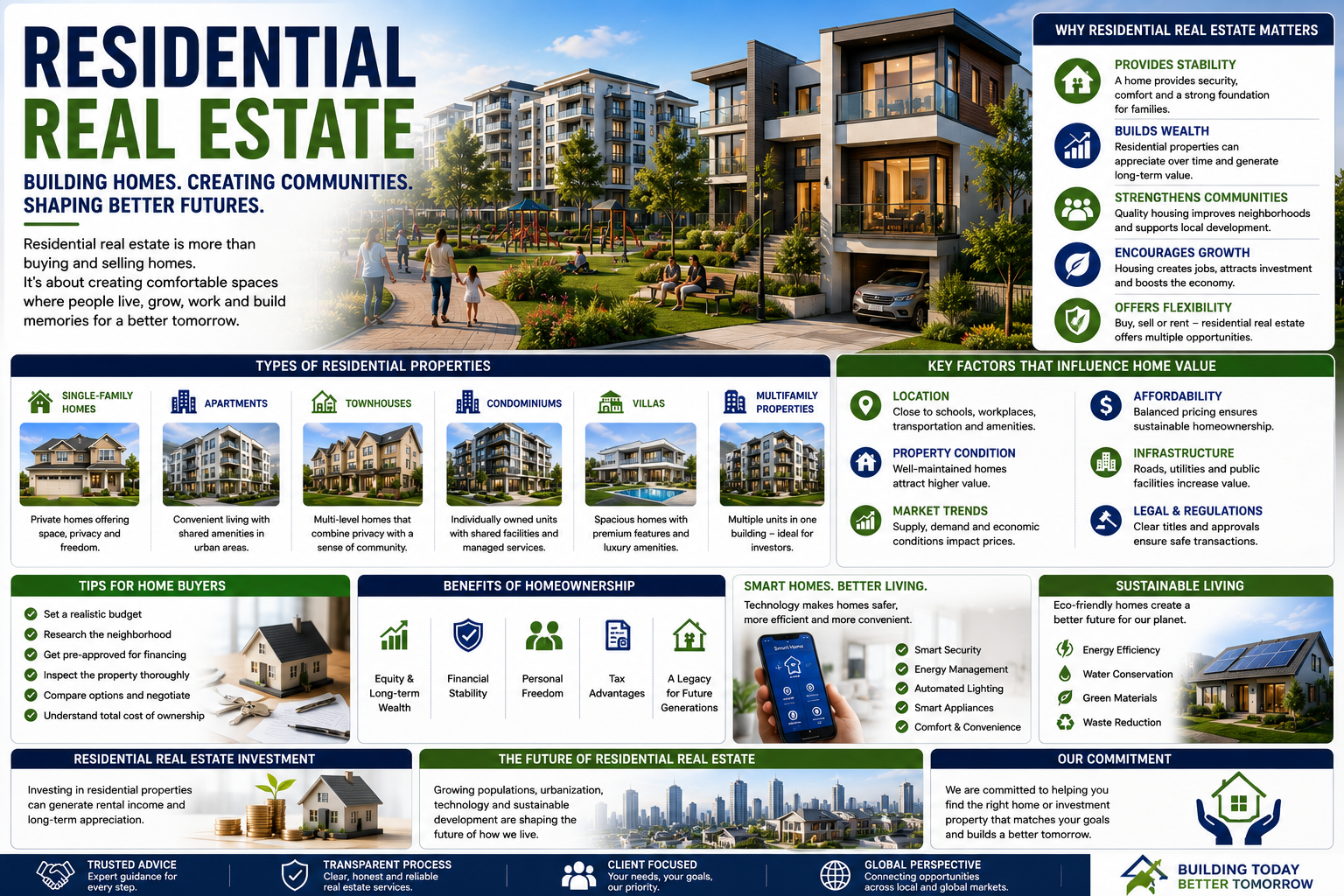
Residential real estate is one of the most important segments of the property industry. It provides homes for individuals and families while also supporting developers, investors, construction companies, property managers, and local communities.
But residential real estate is changing.
The modern housing market is influenced by evolving lifestyles, technology, affordability, sustainability, urban development, changing family structures, and new expectations about how homes should function.
A home is no longer viewed only as a place to sleep and store belongings. For many people, it can also be a workplace, learning environment, entertainment space, investment, and long-term financial asset.
Understanding these changes can help buyers, sellers, homeowners, investors, and developers make more informed decisions.
What Is Residential Real Estate?
Residential real estate includes properties designed primarily for people to live in.
These can include:
Single-family houses
Apartments
Condominiums
Townhouses
Villas
Duplexes
Multifamily buildings
Planned residential communities
Each type of property serves different needs.
Some buyers prioritize privacy and outdoor space, while others prefer convenient apartments close to workplaces, transportation, and entertainment.
There is no single ideal residential property. The right choice depends on lifestyle, budget, location, household size, and future plans.
Housing Is About More Than Property
A residential property is part of a larger environment.
People consider the surrounding neighborhood as much as the building itself.
Factors such as schools, transportation, healthcare, parks, shopping, restaurants, and community services can influence the overall residential experience.
This is why successful residential development requires an understanding of both the home and the community.
Location Remains Essential
Technology may have changed how people search for homes, but location remains one of the strongest considerations in residential real estate.
A good location can provide convenient access to:
Employment
Education
Healthcare
Transportation
Retail
Recreation
Public services
Buyers should consider not only what the neighborhood offers today but also how it may change over time.
Changing Homebuyer Preferences
Today's homebuyers can have different priorities from previous generations.
Depending on individual circumstances, buyers may look for:
Flexible rooms
Home offices
Outdoor areas
Energy efficiency
Modern kitchens
Reliable internet
Security systems
Storage
Community amenities
Developers who understand these preferences can design homes that better match changing lifestyles.
The Rise of Flexible Homes
A flexible home can serve several purposes.
A spare bedroom might become a home office.
A dining area could function as a study space.
An open-plan room may accommodate family activities, entertainment, and work.
Flexible design gives homeowners more options as their needs change.
This can be particularly valuable for households that expect changes in family size or working arrangements.
Remote Work and Residential Property
Remote and hybrid work have influenced how some people evaluate homes.
A property that once needed only comfortable living space may now also need an appropriate work environment.
Buyers may consider:
Dedicated office space
Quiet areas
Natural lighting
High-speed internet
Additional rooms
Comfortable work environments
The importance of these features depends on the household and its working arrangements.
Affordability and Homeownership
Affordability remains an important consideration for residential buyers.
The cost of owning a home involves more than the purchase price.
Potential expenses include:
Mortgage payments
Taxes
Insurance
Utilities
Maintenance
Repairs
Renovations
Community fees
Buyers should evaluate the total cost of ownership before committing to a property.
Renting vs. Buying
Not everyone needs to purchase a home.
Renting can provide flexibility, particularly for people who may move for work, education, or personal reasons.
Buying can provide long-term ownership and may become part of a household's financial strategy.
The better option depends on:
Financial circumstances
Lifestyle
Location
Career plans
Time horizon
Housing costs
There is no universal answer.
Understanding Home Value
Residential property values can be influenced by many factors.
These include:
Location
Property size
Condition
Design
Amenities
Infrastructure
Neighborhood demand
Local supply
Economic conditions
A home's value is not determined only by its construction cost.
Market demand and the characteristics of comparable properties also play important roles.
The Importance of Property Condition
A well-maintained home can provide a better living experience and may be more attractive to future buyers.
Homeowners should pay attention to:
Roofing
Plumbing
Electrical systems
Heating and cooling
Windows
Foundation
Drainage
Appliances
Regular maintenance can help prevent small problems from becoming major expenses.
Smart Home Technology
Technology is becoming an increasingly visible part of residential property.
Smart-home features can include:
Automated lighting
Smart thermostats
Security cameras
Digital locks
Connected appliances
Energy monitoring
These systems can improve convenience and potentially help homeowners manage energy and security.
However, technology should add practical value rather than simply increase the cost of a property.
Energy-Efficient Housing
Energy efficiency is becoming an important consideration for homeowners and developers.
Efficient homes may use:
Improved insulation
Energy-saving windows
Efficient appliances
Modern heating and cooling
Solar technology
Water-saving systems
Energy-efficient design can potentially reduce household operating costs while supporting more sustainable living.
Sustainable Residential Development
Sustainable development focuses on creating homes and communities that use resources responsibly.
Developers may consider:
Green spaces
Water conservation
Renewable energy
Sustainable materials
Waste management
Efficient buildings
Walkable neighborhoods
Sustainability can influence both construction and long-term property management.
The Role of Community Amenities
Residential developments increasingly include amenities designed to improve everyday life.
These may include:
Parks
Walking paths
Fitness facilities
Playgrounds
Community centers
Swimming pools
Shared outdoor areas
Amenities can improve the residential experience, although buyers should consider whether the associated costs fit their budget.
Urban Residential Development
Cities continue to attract residents because they provide access to employment, education, entertainment, healthcare, and services.
Urban residential development can include high-rise apartments, condominiums, townhouses, and mixed-use communities.
High-density housing can make efficient use of land, but successful urban development also requires transportation, infrastructure, public spaces, and community facilities.
Suburban Growth
Suburban communities can appeal to people seeking larger homes, quieter environments, or additional outdoor space.
However, suburban living can involve greater dependence on private transportation.
Buyers should consider commuting times, road access, schools, healthcare, and nearby services before choosing a location.
New Residential Communities
New developments can offer modern designs and infrastructure.
Potential advantages can include:
New construction
Modern layouts
Energy-efficient systems
Planned amenities
New roads
Community facilities
However, buyers should also investigate the developer, construction quality, infrastructure, ownership documentation, and surrounding development.
Real Estate Technology
Digital platforms have transformed residential property searches.
Potential buyers can now research homes, compare prices, view photographs, explore neighborhoods, and communicate with property professionals online.
Virtual tours can also allow buyers to explore properties remotely.
Technology makes research easier, but physical inspections and professional advice remain important.
Artificial Intelligence and Housing
Artificial intelligence is increasingly being used in the real estate industry.
AI can support:
Property recommendations
Market research
Data analysis
Customer communication
Listing creation
Administrative tasks
These tools can improve efficiency, but buyers and sellers should still verify important information independently.
Residential Real Estate Investment
Residential property can also serve as an investment.
Investors may purchase properties for:
Rental income
Long-term appreciation
Portfolio diversification
Future resale
Investment analysis should consider rental demand, operating costs, taxes, maintenance, financing, vacancy, and local market conditions.
A property that looks attractive at first may produce weaker results after all expenses are included.
Rental Housing Demand
Rental demand can vary considerably between locations.
Factors that may influence demand include:
Employment
Universities
Transportation
Population
Household formation
Local services
Housing affordability
Investors should research the local rental market instead of relying solely on broad national trends.
Selling a Residential Property
Selling a home requires realistic preparation.
Property owners can research comparable homes to understand the local market.
They should also evaluate:
Property condition
Presentation
Repairs
Pricing
Marketing
Timing
A property doesn't necessarily need an expensive renovation before being sold.
Often, cleaning, repairs, organization, and improved presentation can make a meaningful difference.
Preparing a Home for Buyers
First impressions matter.
Simple improvements can include:
Decluttering
Cleaning
Improving lighting
Maintaining outdoor areas
Repairing visible damage
Organizing rooms
The objective is to help potential buyers understand the property's strengths.
Understanding Neighborhood Development
A neighborhood can change significantly over time.
New roads, schools, shopping areas, offices, transportation systems, and community facilities can influence residential demand.
At the same time, construction can temporarily create noise, traffic, and disruption.
Buyers should therefore consider both current conditions and planned development.
Demographics and Housing
Residential markets are influenced by population patterns.
Changes in household size, age, migration, income, and employment can affect housing requirements.
Developers and investors can use demographic information to understand what types of homes may be needed.
For example, different communities may have different levels of demand for apartments, family homes, accessible housing, or larger properties.
Financing a Home
Home financing is an important part of the buying process.
Potential buyers should understand:
Interest rates
Loan duration
Down payment
Monthly payments
Fees
Total repayment
Financing conditions
A financially responsible purchase should leave enough room in the household budget for other expenses and unexpected costs.
The Importance of Due Diligence
Before purchasing residential property, buyers should carefully review the available information.
Due diligence may include:
Ownership records
Property documents
Taxes
Building approvals
Zoning
Utility connections
Physical condition
Community regulations
The exact requirements vary by location.
Qualified legal, financial, and property professionals can provide valuable assistance during major transactions.
Common Homebuying Mistakes
Ignoring Total Costs
The purchase price is only part of the financial commitment.
Choosing Based Only on Appearance
A beautiful property may still have hidden problems.
Ignoring the Neighborhood
The surrounding environment can affect long-term satisfaction.
Skipping Inspection
Hidden maintenance problems can become expensive.
Overlooking Future Needs
A home should ideally remain suitable as circumstances change.
Rushing the Decision
Pressure can lead to poor financial choices.
A Practical Residential Property Framework
A simple process can help buyers evaluate homes:
Define → Budget → Research → Compare → Inspect → Verify → Decide
Define your lifestyle and housing requirements.
Budget for the full cost of ownership.
Research neighborhoods and local property conditions.
Compare several suitable properties.
Inspect the physical condition.
Verify legal and financial documentation.
Decide based on evidence and long-term suitability.
The Future of Residential Real Estate
Residential real estate will continue to evolve as technology, demographics, work patterns, and lifestyles change.
Smart-home technology will become more integrated.
Energy-efficient design will become increasingly important.
Flexible spaces will support changing household needs.
Digital tools will simplify property searches and management.
New communities will continue to develop around transportation, employment, and infrastructure.
But the fundamental purpose of residential real estate will remain unchanged.
People need homes that provide comfort, safety, accessibility, affordability, and a sense of community.
Final Thoughts
Residential real estate is about more than buying and selling houses.
It is about creating places where people can live, work, raise families, build communities, and plan for the future.
For buyers, successful decisions require careful consideration of location, affordability, property condition, financing, and long-term needs.
For sellers, realistic pricing, preparation, and presentation can help create stronger opportunities.
For investors, rental demand, expenses, financing, maintenance, and market conditions should all be evaluated carefully.
For developers, changing lifestyles, sustainability, infrastructure, and community needs should remain central to residential planning.
Technology will continue to transform the industry, but strong residential real estate will always depend on understanding people.
The best home isn't simply a property with attractive features. It is a place that fits the way people live today while remaining adaptable enough for tomorrow.