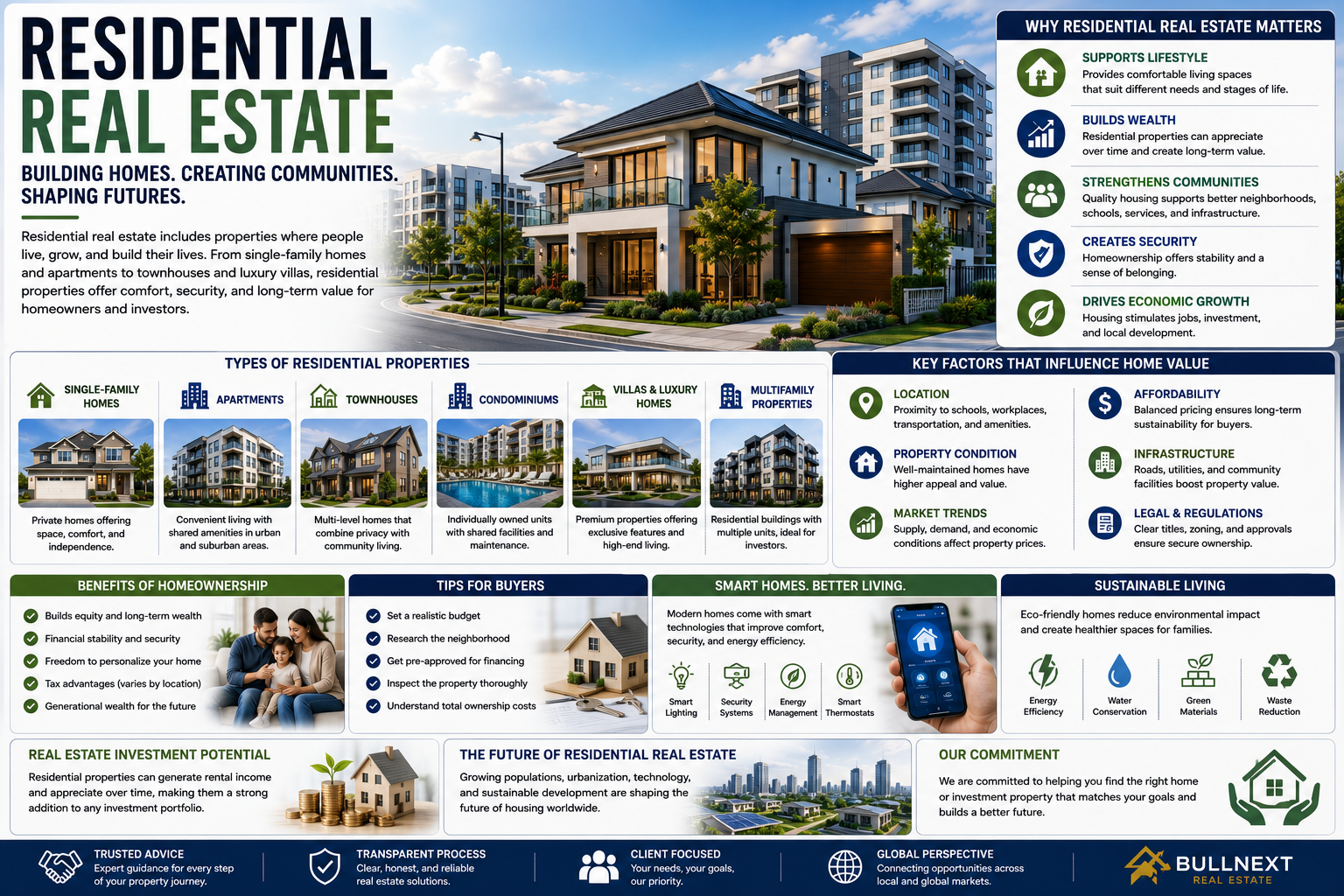
Residential real estate is one of the most important parts of the property industry. It provides homes for individuals and families while also creating opportunities for developers, landlords, investors, agents, and other professionals.
A residential property can represent much more than a financial asset. For homeowners, it can provide stability and a place to build a life. For investors, it can become a source of rental income or part of a long-term portfolio. For communities, residential development can influence infrastructure, services, employment, and quality of life.
As lifestyles change, the residential real estate market continues to evolve. Technology, sustainability, flexible living spaces, changing household structures, and urban development are all influencing how people choose where and how they live.
Understanding these trends can help buyers, sellers, homeowners, and investors make more informed property decisions.
What Is Residential Real Estate?
Residential real estate refers to properties primarily designed for people to live in.
Common examples include:
Single-family homes
Apartments
Condominiums
Townhouses
Villas
Duplexes
Multifamily buildings
Residential developments
Each property type offers different advantages.
A single-family home may provide privacy and outdoor space, while an apartment may offer convenient access to services and shared amenities.
The right choice depends on lifestyle, finances, location, household needs, and long-term plans.
Why Residential Property Matters
Housing is a fundamental need.
The availability, affordability, and quality of residential property can influence how communities develop.
Strong residential neighborhoods can support:
Local businesses
Schools
Healthcare
Transportation
Recreation
Community services
Residential development therefore affects more than individual homeowners.
It can shape entire communities.
Location Is a Key Factor
Location remains one of the most important considerations when choosing a home.
People may evaluate proximity to:
Schools
Workplaces
Hospitals
Shopping
Public transportation
Parks
Restaurants
Entertainment
Major roads
A property's location can influence convenience, demand, and long-term appeal.
The ideal location depends on the needs of the household.
Understanding Different Housing Types
Residential properties come in many forms.
Single-Family Homes
These properties are generally designed for one household and may offer private outdoor areas and greater control over the living environment.
Apartments
Apartments can provide convenient urban living and may include shared facilities and maintenance services.
Condominiums
Condominiums typically provide individual ownership of a residential unit within a larger development that may have shared amenities.
Townhouses
Townhouses can combine features of apartments and detached homes, often providing multiple levels and some private outdoor space.
Multifamily Properties
Multifamily buildings contain multiple residential units and can be particularly relevant to rental-property investors.
Buying a Home
Buying a home is a major financial and personal decision.
Before purchasing, buyers should consider:
What can I comfortably afford?
Is the location suitable?
Does the property meet current needs?
Will it work for future needs?
What additional costs will I have?
Is the property in good condition?
Answering these questions can help buyers avoid focusing only on appearance.
Creating a Realistic Budget
The purchase price is only one part of homeownership costs.
Other expenses can include:
Financing
Taxes
Insurance
Utilities
Maintenance
Repairs
Renovation
Property management
Community or association fees
A realistic budget should account for both expected and unexpected expenses.
Understanding Home Financing
Many homebuyers use mortgages or other forms of financing.
Before choosing a loan, buyers should understand:
Interest rate
Loan duration
Monthly payments
Fees
Down payment
Total repayment
Conditions of the loan
The lowest monthly payment isn't necessarily the cheapest option over the full term.
Understanding the complete financing cost is important.
Property Inspections
A home can look excellent while having hidden problems.
Potential buyers should pay attention to:
Roof condition
Plumbing
Electrical systems
Heating and cooling
Foundation
Drainage
Windows
Walls
Appliances
A professional property inspection can help identify issues before a purchase is completed.
Home Maintenance
Homeownership comes with ongoing responsibilities.
Regular maintenance can help preserve a property's condition.
Common maintenance tasks include:
Checking plumbing
Maintaining heating and cooling systems
Inspecting roofs
Caring for outdoor areas
Checking electrical systems
Repairing damaged surfaces
Preventive maintenance can help reduce the risk of larger problems later.
Residential Real Estate as an Investment
Residential property can also be used as an investment.
Investors may purchase homes or apartments for:
Rental income
Long-term appreciation
Portfolio diversification
Future resale
However, property investment involves costs and risks.
Investors should evaluate rental demand, operating expenses, financing, vacancy, maintenance, taxes, and local market conditions.
Rental Property
Rental properties can provide recurring income, but rental income isn't the same as profit.
Expenses may include:
Property management
Repairs
Maintenance
Insurance
Taxes
Financing
Utilities
Vacancy periods
Investors should calculate expected income and expenses realistically.
Understanding Tenant Demand
For rental properties, location and tenant demand are particularly important.
Investors can research:
Local rental prices
Vacancy
Nearby employment
Transportation
Schools
Amenities
Competing properties
A property with strong tenant demand may be easier to rent, but market conditions can change.
Selling a Residential Property
Homeowners selling property should understand the local market before setting a price.
Factors that can influence a home's appeal include:
Location
Property condition
Size
Layout
Amenities
Comparable properties
Current buyer demand
A realistic asking price can attract more serious buyers.
Preparing a Home for Sale
Presentation can influence how buyers perceive a property.
Simple improvements may include:
Deep cleaning
Decluttering
Improving lighting
Repairing visible damage
Maintaining landscaping
Improving curb appeal
Not every property requires expensive renovations.
Often, a clean and well-maintained home can create a stronger first impression.
The Role of Technology
Technology has transformed residential real estate.
Buyers can now research properties, compare listings, view photographs, explore maps, and communicate with agents online.
Digital tools can also support:
Virtual tours
Online applications
Digital documentation
Property management
Market research
These tools make property searches more convenient and accessible.
Virtual Property Tours
Virtual tours allow potential buyers and renters to explore homes remotely.
They can be particularly useful for people who live far from the property.
However, virtual tours should complement rather than completely replace physical inspections.
Images and videos cannot always reveal structural, maintenance, or neighborhood issues.
Smart Homes
Smart-home technology is becoming increasingly common.
Features may include:
Smart lighting
Security cameras
Connected appliances
Smart thermostats
Automated locks
Energy monitoring
These technologies can improve convenience, security, and energy management.
However, homeowners should evaluate whether the features provide meaningful value.
Energy-Efficient Homes
Energy efficiency is becoming an important consideration for homeowners.
Efficient properties may use:
Better insulation
Efficient windows
Energy-saving appliances
Modern heating and cooling
Solar systems
Water-saving technologies
Energy efficiency can potentially reduce recurring household costs while supporting environmental goals.
Sustainable Residential Development
Developers are increasingly considering sustainability when designing communities.
Sustainable residential projects may focus on:
Efficient buildings
Green spaces
Water management
Renewable energy
Sustainable materials
Waste reduction
Walkability
The objective is to create homes that are comfortable while using resources more efficiently.
Changing Family Needs
Residential property needs can change throughout life.
A young professional may prefer a smaller apartment near employment and entertainment.
A growing family may require additional bedrooms and outdoor space.
Older residents may prioritize accessibility, healthcare, and convenient services.
Residential development must therefore respond to different stages of life.
Flexible Living Spaces
Modern homes increasingly need to support multiple activities.
A single room may function as:
Home office
Study area
Guest room
Exercise space
Entertainment area
Flexible layouts can make residential properties more adaptable as household needs change.
Remote and Hybrid Work
Changes in working patterns have influenced housing preferences.
Some residents may now place greater importance on:
Dedicated workspaces
High-speed internet
Quiet rooms
Natural light
Flexible layouts
The ideal home can therefore depend partly on how residents work.
Residential Communities
People often evaluate more than the individual house.
The surrounding community can influence quality of life.
Important features can include:
Parks
Schools
Healthcare
Shopping
Transportation
Recreation
Public spaces
A well-connected community can make everyday life more convenient.
Urban Residential Development
Cities continue to evolve as populations and lifestyles change.
Urban residential projects can help accommodate population growth while placing people closer to employment and services.
High-density housing can provide efficient use of land, but successful development also requires adequate infrastructure, transportation, public spaces, and community facilities.
Suburban and Emerging Communities
Residential growth can also occur outside established urban centers.
New communities may offer:
Larger homes
More space
New infrastructure
Modern amenities
Planned development
However, buyers should consider transportation, schools, healthcare, employment access, and future infrastructure before making a decision.
Residential Real Estate and Infrastructure
Infrastructure can influence residential demand.
Roads, public transportation, utilities, schools, hospitals, and commercial facilities can make an area more attractive.
Buyers and investors may therefore benefit from understanding both existing infrastructure and planned development.
Demographics and Housing Demand
Population trends can influence residential markets.
Changes in:
Population growth
Household size
Age
Migration
Employment
Income
can affect the types of homes people need.
Understanding these trends can help developers and investors anticipate changing housing requirements.
The Importance of Due Diligence
Before purchasing a property, buyers should conduct appropriate due diligence.
This may include reviewing:
Ownership documents
Property condition
Taxes
Zoning
Building approvals
Utility arrangements
Community regulations
Existing liabilities
The exact requirements depend on the location and property type.
Professional legal and financial advice can be valuable during major transactions.
Common Residential Real Estate Mistakes
Buying Beyond Your Budget
A home should remain financially manageable after considering all costs.
Focusing Only on the House
The neighborhood and location matter too.
Ignoring Maintenance
Small problems can become expensive if neglected.
Skipping Inspection
Hidden defects may create unexpected costs.
Ignoring Future Needs
A property should ideally fit both current and foreseeable requirements.
Making Emotional Decisions
A home can be emotionally appealing while still being financially unsuitable.
A Smart Home-Buying Framework
A practical process can be:
Define → Budget → Research → Compare → Inspect → Verify → Decide
Define
Identify your housing needs.
Budget
Determine an affordable overall cost.
Research
Study locations and available properties.
Compare
Evaluate multiple homes rather than focusing on one.
Inspect
Assess physical condition.
Verify
Review legal and financial documentation.
Decide
Choose the property that best fits your needs and long-term plans.
The Future of Residential Real Estate
Residential real estate will continue to change alongside society.
Technology will make property searches more digital.
Smart-home systems will become more capable.
Sustainability will influence construction.
Flexible spaces will support changing lifestyles.
Demographic trends will affect housing demand.
Urban development will reshape communities.
Despite these changes, the fundamental purpose of residential property will remain the same.
People need homes that are safe, comfortable, accessible, affordable, and suited to their lives.
Final Thoughts
Residential real estate is about more than buying and selling houses.
It is about creating homes and communities that support people's lives.
For buyers, the right decision requires careful consideration of budget, location, property condition, financing, and future needs.
For investors, rental demand, operating costs, financing, maintenance, and market conditions are essential considerations.
For developers, successful residential projects require an understanding of demographics, infrastructure, sustainability, and community needs.
Technology is changing the way people search for, manage, and experience residential property, but the fundamentals remain important.
The best residential property is not necessarily the biggest or most expensive.
It is the property that provides the right combination of location, comfort, affordability, quality, and long-term suitability.
As communities continue to evolve, residential real estate will remain an essential part of how people live, work, and build their futures.