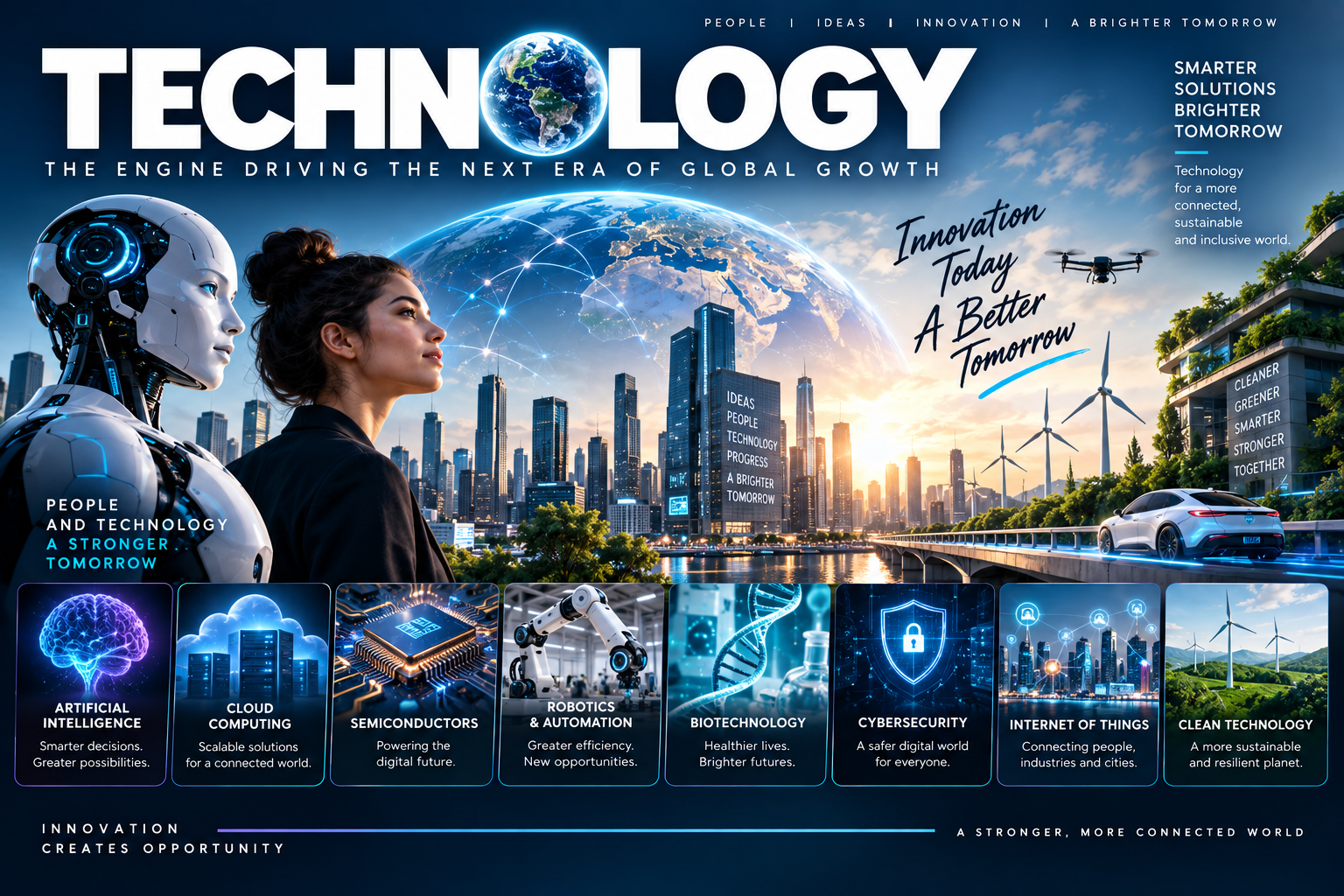
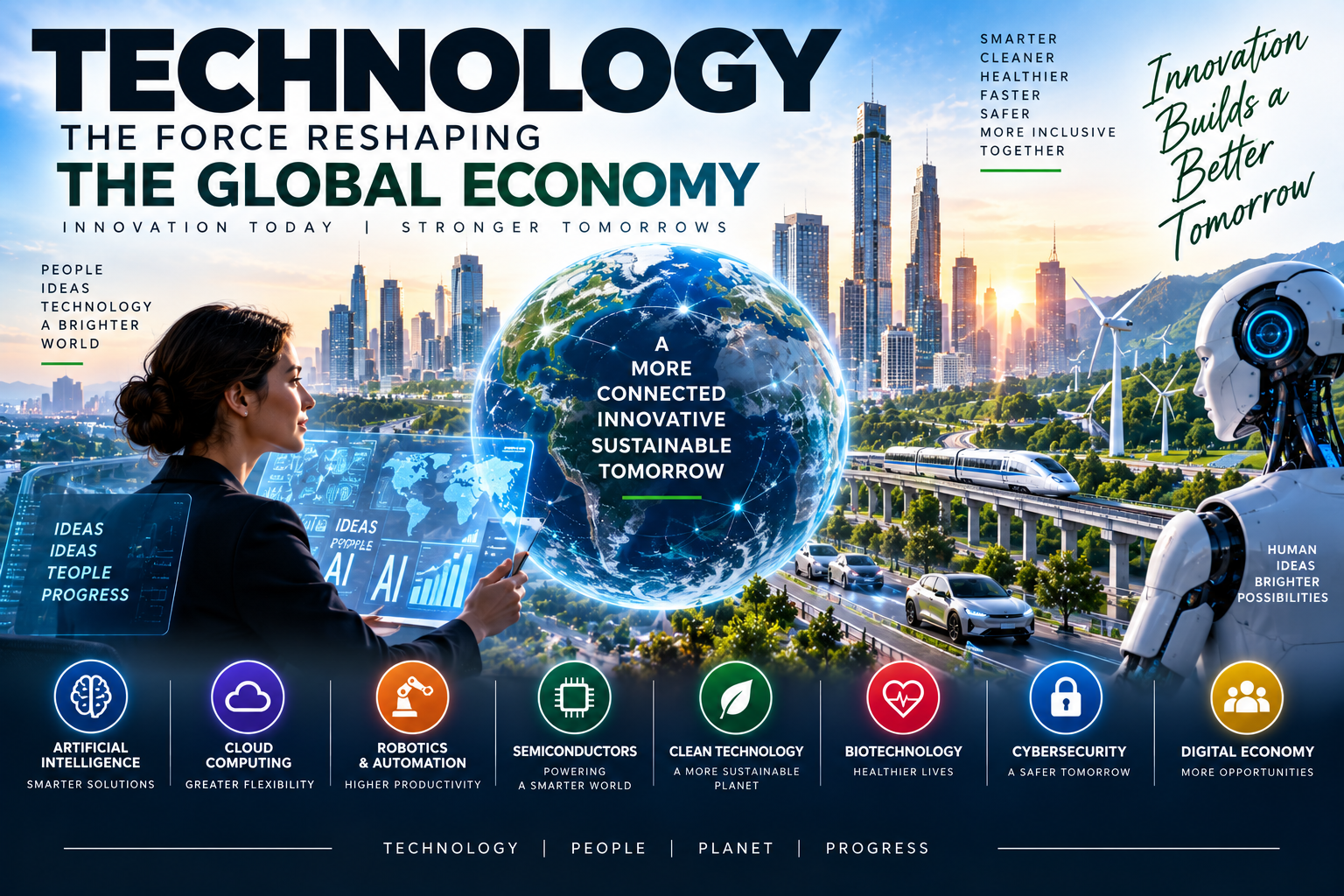
Technology has become one of the most powerful forces shaping the modern world. From smartphones and cloud computing to artificial intelligence, robotics, biotechnology, and advanced energy systems, technological innovation is changing how people live, businesses operate, and economies compete.
The pace of technological change has accelerated dramatically over the past several decades. Digital technologies have moved from specialized tools used by large organizations to essential parts of everyday life. Businesses can now operate across borders, consumers can access services instantly, and individuals can communicate with people around the world in real time.
Technology is also changing the structure of the global economy. New industries are emerging while established businesses are being forced to adapt. Companies that successfully adopt new technologies can improve productivity, reduce costs, develop new products, and reach larger markets. At the same time, technological disruption creates challenges involving employment, privacy, cybersecurity, regulation, and inequality.
The future will depend not only on developing new technologies but also on ensuring that innovation is used responsibly and that its benefits are widely accessible.
The Digital Transformation
Digital transformation refers to the growing use of digital technologies across businesses, governments, and society. It has changed everything from accounting and communication to manufacturing, retail, healthcare, and transportation.
Businesses increasingly rely on software and cloud-based systems to manage operations. Digital payments have transformed commerce, while online platforms allow companies to reach customers without requiring large physical networks.
The transformation is particularly significant for small businesses. A company can use digital tools for marketing, customer management, accounting, inventory, communication, and online sales without building expensive technology infrastructure from scratch.
As digital systems become more integrated, technology is increasingly viewed as a core component of business strategy rather than simply an IT function.
Artificial Intelligence
Artificial intelligence has emerged as one of the most important technological developments of the current era. AI systems can analyze large amounts of information, recognize patterns, generate content, automate tasks, and assist with decision-making.
Businesses are using AI for customer service, marketing, software development, fraud detection, forecasting, logistics, and data analysis. In creative industries, AI tools can assist with writing, image generation, video production, and design.
Healthcare organizations are exploring AI for medical research, diagnostics, drug discovery, and administrative processes. Manufacturers can use intelligent systems to identify equipment problems and improve production efficiency.
However, AI also raises difficult questions. Concerns about misinformation, bias, privacy, intellectual property, cybersecurity, and job displacement are becoming increasingly important.
The long-term impact of AI will depend partly on how governments, companies, and society establish appropriate standards for its development and use.
Cloud Computing
Cloud computing has fundamentally changed how organizations access technology. Instead of maintaining all computing infrastructure on their own premises, companies can use remote data centers to store information, run applications, and access computing resources.
This model provides businesses with flexibility. Companies can increase or decrease computing capacity according to demand rather than investing in large amounts of hardware upfront.
Cloud services have also helped smaller businesses access sophisticated technology that was previously available primarily to large corporations.
As organizations move more operations into digital environments, cloud security and data management have become increasingly important. Businesses must protect sensitive information while ensuring systems remain available and reliable.
The Importance of Cybersecurity
As technology becomes more deeply integrated into everyday life, cybersecurity has become a critical economic and national-security issue.
Businesses, governments, hospitals, financial institutions, and individuals all face risks from cyberattacks. Criminals may attempt to steal information, disrupt operations, demand ransom, or gain unauthorized access to systems.
The growth of artificial intelligence is creating both new defensive capabilities and new risks. Security teams can use AI to identify unusual activity and respond to threats, while attackers may use automated tools to create more sophisticated attacks.
Strong cybersecurity therefore requires multiple layers of protection, including secure software, employee training, access controls, encryption, monitoring, and effective response plans.
Technology and Business Productivity
One of technology's greatest economic benefits is its ability to improve productivity. Automation can reduce repetitive work, while software can help employees complete complex tasks more quickly.
Manufacturing companies use robotics and automated production systems to improve consistency and efficiency. Retailers use data analytics to forecast demand and manage inventories. Logistics companies use route optimization to reduce delivery times and transportation costs.
Productivity improvements can increase competitiveness and allow businesses to produce more value with fewer resources.
However, productivity gains do not automatically benefit everyone equally. Companies and governments must consider how workers can be retrained and supported as technology changes the nature of employment.
Robotics and Automation
Robotics is transforming industries that require physical labor, precision, or repetitive processes. Modern robots are increasingly capable of performing tasks in factories, warehouses, laboratories, hospitals, and other environments.
In manufacturing, robots can assemble products, move materials, inspect components, and perform dangerous operations. In warehouses, automated systems can sort and transport packages.
Robotics may also become increasingly important in areas such as agriculture, construction, healthcare, and transportation.
Automation can improve safety and efficiency, but it can also change employment patterns. Jobs involving repetitive tasks may decline, while demand increases for workers who can design, operate, maintain, and manage automated systems.
Education and workforce training will therefore play a major role in ensuring that workers can participate in an increasingly automated economy.
Biotechnology and Technology in Healthcare
Technology is also transforming healthcare. Advances in biotechnology, computing, medical imaging, wearable devices, and data analysis are creating new opportunities for prevention, diagnosis, and treatment.
Wearable devices can track measurements such as physical activity, heart rate, and sleep patterns. Medical imaging technologies allow doctors to examine the human body in increasingly detailed ways.
Artificial intelligence can assist researchers in analyzing biological data and identifying potential drug candidates. Biotechnology companies are also developing new approaches to treating diseases and producing medicines.
These technologies could improve healthcare outcomes, but they also raise questions about data privacy, affordability, regulation, and access.
Technology and Education
Education has been transformed by digital platforms and online resources. Students can access lectures, tutorials, research materials, language-learning tools, and interactive educational content from almost anywhere.
Online education can expand access to learning for people who cannot attend traditional institutions. Digital tools can also allow students to learn at their own pace.
Artificial intelligence may further personalize education by helping students practice skills, receive explanations, and identify areas where they need additional support.
Technology should not completely replace teachers, however. Human guidance, critical thinking, collaboration, and social interaction remain important parts of education.
The most effective approach is likely to combine technology with skilled educators rather than treating digital tools as a substitute for human expertise.
The Internet of Things
The Internet of Things, commonly known as IoT, refers to connected devices that can collect and exchange information.
Smart homes may use connected thermostats, security systems, lighting, and appliances. Businesses can use sensors to monitor equipment, buildings, vehicles, and production processes.
In agriculture, connected sensors can help monitor soil conditions, temperature, and water usage. Cities can use connected systems to manage traffic, lighting, energy, and public infrastructure.
The expansion of connected devices creates significant opportunities for efficiency but also increases the number of systems that need to be secured.
Technology and Transportation
Transportation is undergoing a major technological transformation. Electric vehicles, advanced navigation systems, automated driving technologies, smart traffic management, and digital logistics are changing how people and goods move.
Electric vehicles are becoming increasingly important as countries and manufacturers seek to reduce dependence on conventional fuels.
Autonomous-driving technology could eventually reshape transportation, although widespread adoption will depend on safety, regulation, infrastructure, and public acceptance.
In logistics, artificial intelligence and real-time data can help companies optimize routes, predict demand, monitor shipments, and reduce delivery costs.
The integration of digital technology with transportation infrastructure could create more connected and efficient mobility systems.
Technology and Sustainable Development
Technology is playing an important role in addressing environmental challenges. Renewable energy systems, batteries, smart grids, electric transportation, energy-efficient buildings, and advanced recycling technologies can support the transition toward more sustainable economies.
Artificial intelligence and data analytics can help organizations identify opportunities to reduce energy consumption and waste.
Satellite technology can monitor forests, agricultural land, oceans, and environmental changes. Sensors can provide information about air quality, water use, and industrial emissions.
Technology is not a complete solution to climate and environmental challenges, but it can provide tools that make sustainable practices more practical and scalable.
The Semiconductor Industry
Semiconductors are among the most important components of the modern technological economy. They power smartphones, computers, vehicles, industrial equipment, communication systems, and artificial intelligence infrastructure.
Because advanced chips are essential to so many industries, semiconductor manufacturing has become a major strategic priority for governments and companies.
Supply-chain disruptions have demonstrated the importance of reliable access to chips. Countries are investing in domestic manufacturing capacity, research, and semiconductor infrastructure to strengthen technological resilience.
The semiconductor industry is likely to remain central to competition in advanced technology.
The Future of Work
Technology is changing not only the tools people use but also the nature of employment.
Remote and hybrid work have become more practical because of high-speed internet, cloud platforms, video conferencing, and collaboration software. Employees can work with colleagues across countries without sharing the same physical office.
AI and automation may further change job responsibilities. Some tasks will become automated, while new roles will emerge in areas such as AI development, cybersecurity, data management, robotics, and technology governance.
The ability to continuously learn new skills may become increasingly important. Education will need to focus not only on existing knowledge but also on adaptability, problem-solving, creativity, and digital literacy.
Technology and Privacy
The growing collection of digital data creates significant privacy challenges. Smartphones, websites, applications, connected devices, and online services can generate large amounts of information about users and their behavior.
Data can improve services and personalization, but it can also create risks if information is collected excessively, used without adequate transparency, or exposed through security breaches.
Companies therefore face growing pressure to protect customer information and explain how data is collected and used.
Users can also take steps to improve privacy by using strong passwords, enabling multi-factor authentication, reviewing permissions, and limiting unnecessary data sharing.
Regulation and Responsible Innovation
The rapid pace of technological development can make regulation difficult. Policymakers need to encourage innovation while protecting consumers, workers, businesses, and society.
AI provides a clear example. Governments around the world are considering rules covering transparency, safety, privacy, accountability, and the use of automated systems.
Effective regulation needs to evolve alongside technology. Excessive restrictions can discourage innovation, while insufficient oversight can allow harmful practices to spread.
The challenge is finding a balance that supports technological progress while maintaining public trust.
The Global Technology Race
Technology has become an important element of international economic competition. Countries are investing heavily in artificial intelligence, semiconductors, quantum computing, biotechnology, telecommunications, cybersecurity, and clean technologies.
Technological leadership can create economic advantages by supporting high-value industries, skilled employment, exports, and innovation.
At the same time, technological development is increasingly interconnected. Companies depend on international supply chains, global research communities, and markets around the world.
The future of technology will therefore be shaped by both competition and cooperation.
Challenges and Opportunities
Technology creates enormous opportunities, but progress is not guaranteed to benefit everyone equally. Differences in internet access, digital skills, education, infrastructure, and financial resources can create a digital divide.
Businesses must also manage the cost and complexity of adopting new technologies. Implementing AI, cloud systems, cybersecurity measures, or automated equipment requires investment and expertise.
Yet these challenges exist alongside major opportunities. Technology can improve productivity, expand access to information, create new industries, and solve problems that were previously difficult or impossible to address.
The organizations and societies that adapt effectively will be better positioned to benefit from technological change.
Conclusion
Technology is no longer simply a supporting element of the global economy. It has become one of its central engines.
Artificial intelligence, cloud computing, robotics, biotechnology, semiconductors, connected devices, and digital platforms are transforming businesses and creating new possibilities across virtually every sector.
The next phase of technological development will bring both opportunity and uncertainty. Companies will need to innovate while managing cybersecurity and privacy risks. Workers will need opportunities to develop new skills. Governments will need policies that encourage innovation while protecting society.
Ultimately, the impact of technology will depend on how it is designed, governed, and used. Innovation can create enormous economic and social value when combined with responsible decision-making.
The future belongs not simply to those who develop the most advanced technologies, but to those who can use innovation to create greater productivity, stronger economies, better services, and broader opportunities for society.