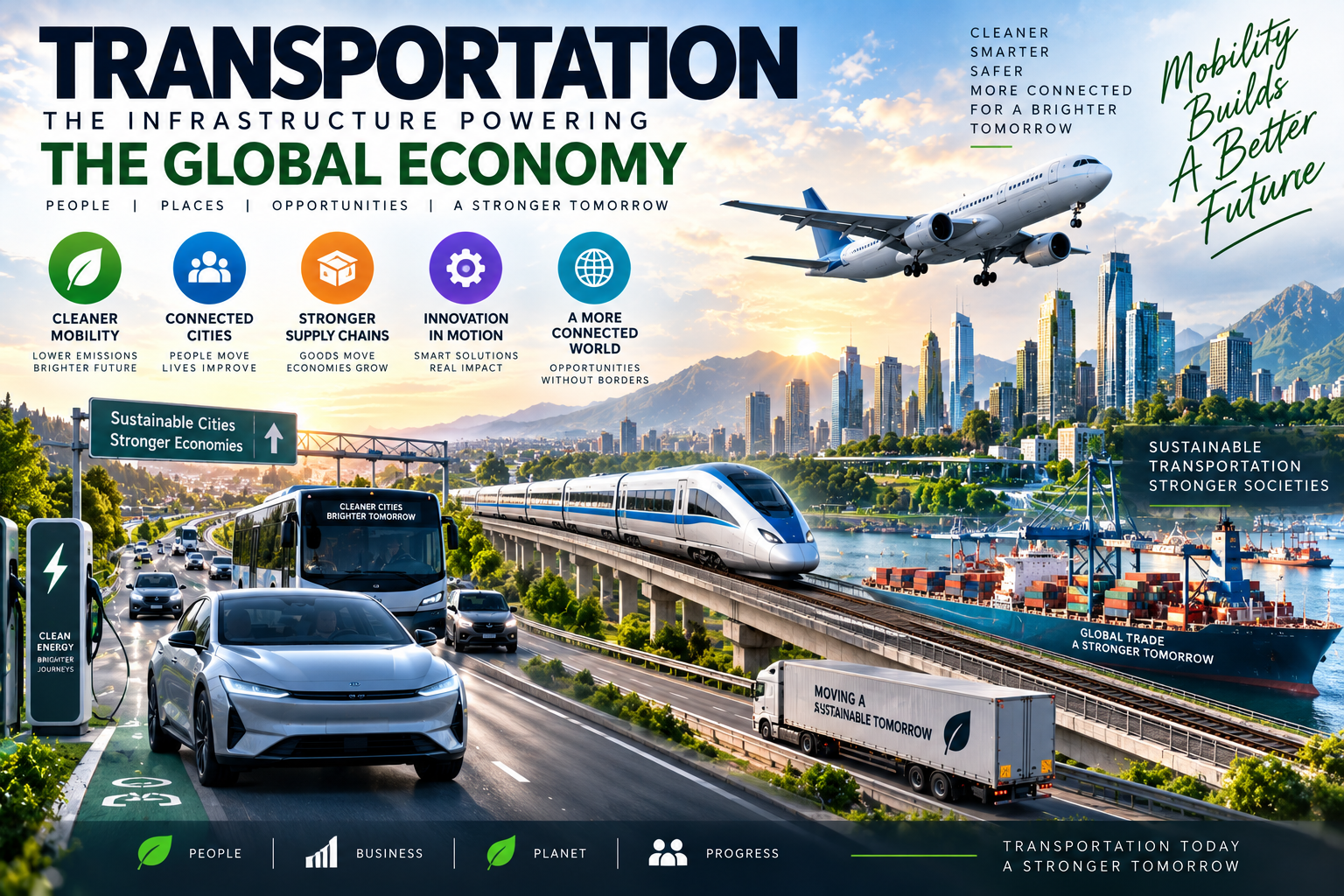
Transportation is one of the foundations of modern civilization. Every day, millions of people travel to work, students move between homes and schools, businesses transport products to customers, and international supply chains move goods across oceans and continents. From roads and railways to airports, ports, ships, and emerging electric mobility systems, transportation connects economies and plays a critical role in global development.
The transportation industry is undergoing a major transformation. Technological innovation, urbanization, climate concerns, changing consumer expectations, and investment in infrastructure are reshaping how people and goods move. Electric vehicles are becoming increasingly important, public transportation systems are being modernized, and digital technologies are making logistics more efficient.
At the same time, transportation faces major challenges. Congestion, aging infrastructure, pollution, rising costs, supply-chain disruptions, and unequal access to mobility continue to affect communities and businesses. The future of transportation will depend on how effectively governments, companies, and cities respond to these challenges while taking advantage of new technologies.
The Importance of Transportation
Transportation is much more than a means of moving from one place to another. It is an essential part of economic activity.
Businesses depend on transportation to obtain raw materials, move products between factories, deliver goods to retailers, and serve customers. Farmers need roads and logistics networks to bring agricultural products to markets. Manufacturers depend on ports, railways, highways, and airports to connect production facilities with suppliers and consumers.
For individuals, reliable transportation provides access to employment, education, healthcare, shopping, and social opportunities. Where transportation systems are efficient and affordable, people generally have greater freedom to participate in economic and social life.
A country's transportation infrastructure can therefore influence its competitiveness, productivity, and quality of life.
Roads and Highways
Road transportation remains one of the most widely used forms of mobility. Cars, buses, trucks, motorcycles, and delivery vehicles rely on road networks to connect cities, towns, industrial areas, and rural communities.
Roads offer flexibility because vehicles can travel directly between locations without requiring passengers or goods to transfer between different modes. This makes road transportation particularly valuable for short- and medium-distance journeys.
However, rapid growth in vehicle ownership can create congestion. Traffic jams increase travel times, fuel consumption, and business costs while contributing to air pollution.
Investment in road infrastructure is therefore not simply about building more lanes. Governments increasingly need to consider intelligent traffic management, public transportation, pedestrian safety, cycling infrastructure, and better urban planning.
Rail Transportation
Railways provide an important alternative to road transportation, particularly for large numbers of passengers and heavy freight.
High-speed rail systems have transformed travel in several countries by allowing passengers to move between major cities quickly and efficiently. Conventional rail remains important for commuter transportation, while freight rail can move large quantities of raw materials and manufactured goods over long distances.
Rail transportation can also reduce pressure on highways. Moving freight by rail instead of relying exclusively on trucks can improve logistics efficiency and reduce road congestion.
Modern railway systems are increasingly incorporating digital signaling, automated systems, improved passenger information, and more efficient trains. Continued investment in rail infrastructure could make rail an increasingly important part of future transportation networks.
Aviation and Global Connectivity
Air transportation has made international travel and global commerce possible on an enormous scale. Airports connect cities across continents, allowing people to travel thousands of kilometers within hours.
Businesses rely on aviation for international meetings, tourism, high-value cargo, urgent deliveries, and global operations. The aviation industry also supports millions of jobs directly and indirectly.
However, aviation faces a significant environmental challenge because conventional aircraft depend heavily on fossil fuels. Developing more sustainable aviation technologies is therefore an important area of research.
Potential solutions include sustainable aviation fuels, more efficient aircraft designs, improved air-traffic management, and eventually new propulsion technologies. Because long-distance aviation is technically difficult to electrify using conventional batteries, innovation in alternative fuels and aircraft technology will remain important.
Maritime Transportation
Ships carry a substantial share of international trade. Major ports connect manufacturers, exporters, importers, and consumers across global supply chains.
Containerization revolutionized maritime transportation by allowing goods to be loaded into standardized containers that can be transferred between ships, trains, and trucks. This intermodal system has dramatically improved the efficiency of international commerce.
Yet maritime transportation is vulnerable to disruptions. Weather events, geopolitical tensions, port congestion, labor disputes, and infrastructure failures can affect shipping routes and delivery times.
The industry is also exploring cleaner fuels and more efficient vessels as it works to reduce emissions. Digital tracking and improved route optimization are helping shipping companies manage operations more efficiently.
Public Transportation and Cities
As urban populations grow, public transportation becomes increasingly important. Buses, metro systems, commuter railways, trams, and other shared transportation services can move large numbers of people while using less road space than private vehicles.
Well-designed public transportation can reduce congestion and provide affordable mobility for people who do not own cars.
Cities are also experimenting with integrated transportation systems in which buses, trains, cycling, walking, ride-sharing, and other services work together. Digital ticketing and real-time travel information can make these systems easier to use.
The challenge is ensuring that public transportation is reliable, safe, accessible, and financially sustainable. Investment must keep pace with population growth and changing patterns of urban development.
The Rise of Electric Vehicles
Electric vehicles have become one of the most visible changes in modern transportation. Advances in battery technology, charging infrastructure, and vehicle design have made electric cars increasingly practical for many consumers.
Electric vehicles can reduce direct emissions from road transportation and may lower operating costs compared with conventional vehicles. Their environmental benefits, however, depend partly on how electricity is generated and how batteries and materials are produced and eventually recycled.
The transition to electric mobility extends beyond passenger cars. Electric buses, delivery vans, trucks, motorcycles, and other vehicles are also being developed.
Charging infrastructure will be crucial to this transition. Drivers need convenient access to reliable charging at homes, workplaces, public facilities, and along major highways.
Autonomous Transportation
Autonomous driving technology could eventually change the way people and goods move. Advanced driver-assistance systems are already available in many vehicles, while companies and researchers continue to develop increasingly sophisticated automated-driving technologies.
Autonomous transportation could potentially improve road safety, increase mobility for some people, and make logistics more efficient. Self-driving vehicles may also change how cities use parking spaces and roads.
However, widespread autonomous transportation presents complex challenges. Safety, regulation, cybersecurity, liability, infrastructure, and public acceptance all need to be addressed.
The transition is therefore likely to be gradual. Human drivers and automated systems may coexist for many years before fully autonomous transportation becomes common.
Digitalization and Smart Transportation
Technology is transforming transportation management. Sensors, GPS, artificial intelligence, cloud computing, and connected devices allow governments and companies to collect and analyze enormous amounts of data.
Smart traffic systems can monitor congestion and adjust signals. Logistics companies can optimize delivery routes based on traffic and weather conditions. Fleet operators can track vehicles in real time and identify maintenance problems before they cause major failures.
Digital platforms have also changed how consumers access transportation. Ride-hailing applications, digital ticketing, navigation systems, and delivery platforms have made mobility more convenient.
The next stage may involve increasingly connected transportation networks in which vehicles, roads, railways, ports, and logistics systems exchange information in real time.
Sustainable Transportation
Environmental concerns are influencing transportation policy around the world. Transportation is a major source of energy consumption and greenhouse gas emissions, making it an important part of climate strategies.
Sustainable transportation does not depend on a single technology. Electric vehicles, public transportation, railways, walking, cycling, cleaner fuels, efficient logistics, and better urban planning can all contribute.
Cities can reduce transportation-related environmental impacts by designing neighborhoods where essential services are located closer to residential areas. This can reduce the need for long car journeys.
Businesses can also improve sustainability by optimizing delivery routes, consolidating shipments, using efficient vehicles, and reducing unnecessary transportation.
The Future of Logistics
The growth of e-commerce has increased demand for fast and flexible delivery systems. Consumers increasingly expect products to arrive quickly, while businesses need logistics networks capable of handling large numbers of individual orders.
Warehouses are becoming more automated, using robotics and software to sort and prepare products. Artificial intelligence can help predict demand and optimize inventory.
Last-mile delivery remains one of the most difficult challenges. Moving products from distribution centers to individual homes can be expensive and inefficient, particularly in crowded cities.
Companies are exploring electric delivery vehicles, cargo bikes, automated lockers, route optimization, and other solutions to improve the final stage of delivery.
Infrastructure Investment
Transportation systems require continuous investment. Roads deteriorate, bridges need maintenance, railways require upgrades, airports must expand, and ports need modernization.
Infrastructure investment can generate significant economic benefits by improving productivity and creating employment. However, major projects can also be expensive and take years to complete.
Governments must therefore prioritize projects based on long-term economic value, safety, environmental impact, and community needs.
Modern infrastructure planning increasingly involves resilience as well. Transportation networks must be designed to withstand floods, storms, extreme heat, earthquakes, and other disruptions.
Transportation and Economic Development
Reliable transportation can be especially important for developing economies. Better roads and public transportation can connect rural communities with markets and services, while modern ports and logistics systems can help countries participate more effectively in international trade.
Improved mobility can also create opportunities for workers. When people can travel more easily to employment centers, businesses gain access to larger labor markets.
Transportation investment can therefore have effects that extend far beyond the transport sector itself. It can support tourism, manufacturing, agriculture, trade, construction, technology, and services.
Challenges Ahead
Despite technological progress, transportation faces significant challenges. Infrastructure costs are rising, cities are becoming more congested, and transportation systems must adapt to environmental pressures.
There are also concerns about affordability. New electric vehicles and advanced transportation technologies can initially be expensive, potentially creating unequal access.
Workforce changes are another consideration. Automation and digitalization may change the skills required in trucking, logistics, manufacturing, aviation, and other transportation industries.
Governments and businesses will need to invest in education and training so workers can adapt to changing technologies.
The Transportation System of Tomorrow
The transportation system of the future is likely to be more connected, electric, automated, and data-driven.
Instead of thinking about cars, trains, buses, ships, and airplanes as completely separate systems, future transportation planning may increasingly focus on how these modes work together.
A passenger could use a digital platform to plan an entire journey involving a bus, train, bicycle, and walking. A shipment could automatically move from a factory to a port by truck, travel by ship, and then continue by rail or electric vehicle based on real-time conditions.
This integration could make transportation faster, cleaner, and more efficient.
Conclusion
Transportation is the infrastructure that connects people, businesses, cities, and economies. Its importance becomes especially clear when systems fail: supply chains slow down, businesses lose productivity, and people struggle to reach essential services.
The transportation industry is now entering a period of major transformation. Electric vehicles, intelligent infrastructure, automation, digital logistics, sustainable fuels, and modern public transportation are creating new possibilities.
Yet technology alone will not determine the future. Successful transportation systems will require long-term investment, effective planning, responsible regulation, skilled workers, and cooperation between governments and private companies.
The goal is not simply to move more people and goods faster. It is to create transportation networks that are safe, accessible, efficient, resilient, and sustainable.
As economies continue to grow and cities expand, transportation will remain one of the most important investments a society can make. The decisions made today will determine how effectively the world moves tomorrow.