Businesses have more information than ever before. Emails, reports, presentations, customer conversations, product documents, research files, internal policies, meeting notes, and databases are constantly generating new knowledge. Yet having more information does not necessarily mean employees can find or use it effectively.
In many organizations, valuable knowledge remains scattered across different platforms. Employees may spend significant time searching through documents, asking colleagues for information, or repeating research that someone else has already completed.
Artificial intelligence is changing this situation.
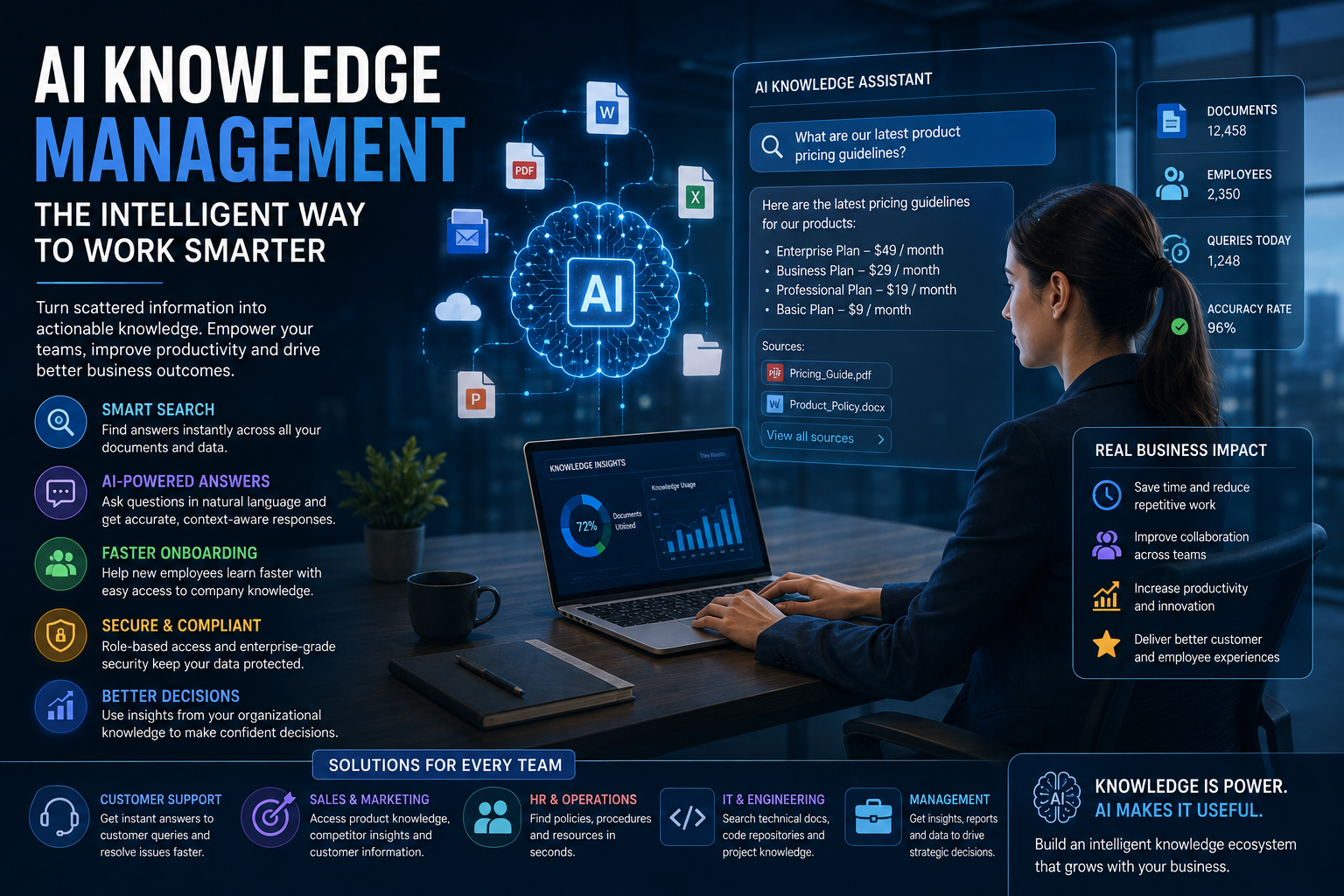
AI-powered knowledge management systems are helping businesses organize information, understand unstructured content, and make internal knowledge easier to access. Instead of treating company information as static documents, organizations can build intelligent knowledge environments where employees can search, summarize, analyze, and interact with business information more naturally.
In 2026, this capability is becoming an increasingly important part of digital business strategy.
The Problem With Traditional Business Knowledge
Traditional knowledge management systems often depend on folders, file names, databases, and manually maintained internal portals.
These systems can work well when information is limited and carefully organized. However, modern organizations generate enormous volumes of data every day.
An employee looking for a specific answer may need to search multiple applications before finding the correct document. Even after locating it, the information may be outdated, incomplete, or difficult to understand.
This creates hidden productivity costs.
Employees may spend minutes or hours searching for information that already exists inside the organization. New employees face an even greater challenge because they need time to learn where information is stored and how different processes work.
AI can provide a different approach by allowing employees to interact with organizational knowledge using natural language.
AI Turns Information Into an Interactive Resource
One of the biggest advantages of AI-powered knowledge management is the ability to interact with information conversationally.
Instead of searching for a document using exact keywords, an employee could ask a question in ordinary language.
For example, a sales employee might ask, “What are the latest pricing rules for enterprise customers?” An AI knowledge system could search approved internal documents and provide a concise answer while identifying the relevant sources.
A new employee could ask about a company's onboarding procedures. A customer support representative could search product documentation without manually opening dozens of files.
This changes knowledge management from document retrieval into intelligent information assistance.
Breaking Down Information Silos
Information silos are a common problem in modern organizations.
Marketing may have one set of customer insights. Sales may maintain another database. Product teams may store research in separate platforms, while customer support maintains its own records.
When these systems are disconnected, employees may lack a complete understanding of important business information.
AI can help connect knowledge across multiple sources when organizations establish appropriate integrations and permissions.
This does not mean every employee should automatically have access to everything. Security and access controls remain essential.
Instead, AI can provide a more unified way of discovering information that an employee is already authorized to access.
Faster Employee Onboarding
Employee onboarding is another area where AI knowledge management can create significant value.
New employees often need to learn company policies, products, processes, tools, organizational structures, and customer requirements.
Traditionally, this information may be distributed across training sessions, documents, videos, presentations, and conversations with colleagues.
An AI-powered knowledge assistant can provide employees with an interactive learning resource.
New team members can ask questions as they encounter unfamiliar processes rather than waiting for another employee to explain them.
This can reduce repetitive questions and help employees become productive more quickly.
However, AI should complement formal training rather than replace it. Employees still need structured instruction, practical experience, and guidance from managers and experienced colleagues.
Improving Customer Support
AI knowledge management can also improve external customer experiences.
Customer service teams often need quick access to product documentation, troubleshooting instructions, policies, pricing information, and previous customer interactions.
An AI system can help representatives find relevant information while handling customer requests.
This can reduce the time employees spend searching for answers and potentially improve response consistency.
AI can also summarize lengthy customer histories, helping representatives understand the context of an issue before responding.
The result can be a more efficient support operation without removing human interaction from situations that require empathy or judgment.
Protecting Institutional Knowledge
Employee turnover can create another major challenge: knowledge loss.
Experienced employees often possess valuable knowledge that is not fully documented. They may understand customer preferences, operational processes, technical workarounds, and historical decisions that are difficult to replace.
When these employees leave, organizations can lose part of their institutional knowledge.
AI-powered knowledge systems can help capture and organize information from approved documents, meeting records, project materials, and other business resources.
This can make organizational knowledge less dependent on individual employees.
The objective is not to record everything indiscriminately. Companies need appropriate policies around privacy, consent, security, and information retention.
AI Can Make Internal Research Faster
Research is a major part of many professional roles.
Employees may need to compare documents, investigate markets, review customer feedback, analyze internal reports, or understand previous business decisions.
AI can accelerate these processes by summarizing large amounts of information and identifying relevant themes.
For example, a product team could analyze customer feedback from multiple sources and identify frequently reported problems.
A management team could ask an internal AI system to summarize previous project reports and highlight lessons learned.
This can reduce repetitive information processing and allow employees to spend more time interpreting results and making decisions.
Data Quality Remains a Major Challenge
AI knowledge management is not a magic solution for poorly organized information.
If an organization has outdated documents, contradictory policies, duplicate files, or inaccurate databases, an AI system may struggle to provide reliable answers.
This makes information governance extremely important.
Businesses need to identify authoritative sources, remove outdated material, establish ownership for important documents, and create processes for updating information.
AI systems should ideally distinguish between approved information and less reliable sources.
The quality of the knowledge environment directly affects the quality of the answers employees receive.
Security and Access Controls Are Essential
Business knowledge can contain highly sensitive information.
Financial records, customer data, intellectual property, employee information, contracts, strategic plans, and confidential communications should not be accessible to everyone.
AI knowledge systems therefore need strong permission structures.
Employees should receive information based on their existing authorization. Organizations should also monitor access, protect sensitive data, and establish clear policies for how AI systems can use internal information.
Security cannot be treated as an afterthought.
As companies connect more business information to AI systems, protecting that information becomes an essential part of responsible AI adoption.
Human Judgment Still Matters
AI can find and summarize information, but it does not automatically understand every business context.
An AI-generated answer may be incomplete or based on outdated information. Employees therefore need to verify important information before using it for high-impact decisions.
Human expertise remains particularly important in areas involving legal, financial, regulatory, medical, or strategic decisions.
The strongest approach is a partnership between AI and employees.
AI can handle information retrieval and synthesis, while people provide context, judgment, creativity, and accountability.
Building an AI Knowledge Strategy
Businesses considering AI knowledge management should start with a specific problem.
Instead of attempting to connect every system immediately, companies can begin with a department that has a clear information challenge.
Customer support, sales, human resources, product development, and internal operations can all provide potential starting points.
Organizations should identify authoritative information sources, define access permissions, establish governance policies, and measure results.
Useful performance indicators may include reduced search time, faster employee onboarding, improved customer response times, fewer repeated questions, and increased employee productivity.
Successful projects can then expand gradually.
The Future of Business Knowledge
AI-powered knowledge management is likely to become an important layer of modern business infrastructure.
As organizations generate more information, simply storing documents will no longer be enough. Companies will need systems that help employees understand and use their knowledge efficiently.
Future AI knowledge environments may become increasingly proactive, identifying relevant information before employees even request it, connecting related projects, highlighting changes in important policies, and helping teams learn from previous work.
The competitive advantage will not come simply from possessing large amounts of data. It will come from the ability to turn information into accessible, trusted, and actionable knowledge.
For modern businesses, AI knowledge management represents a shift from storing information to making organizational intelligence usable. Companies that build strong data foundations, maintain responsible governance, and combine AI capabilities with human expertise can create faster, more informed, and more resilient workplaces in the years ahead.