
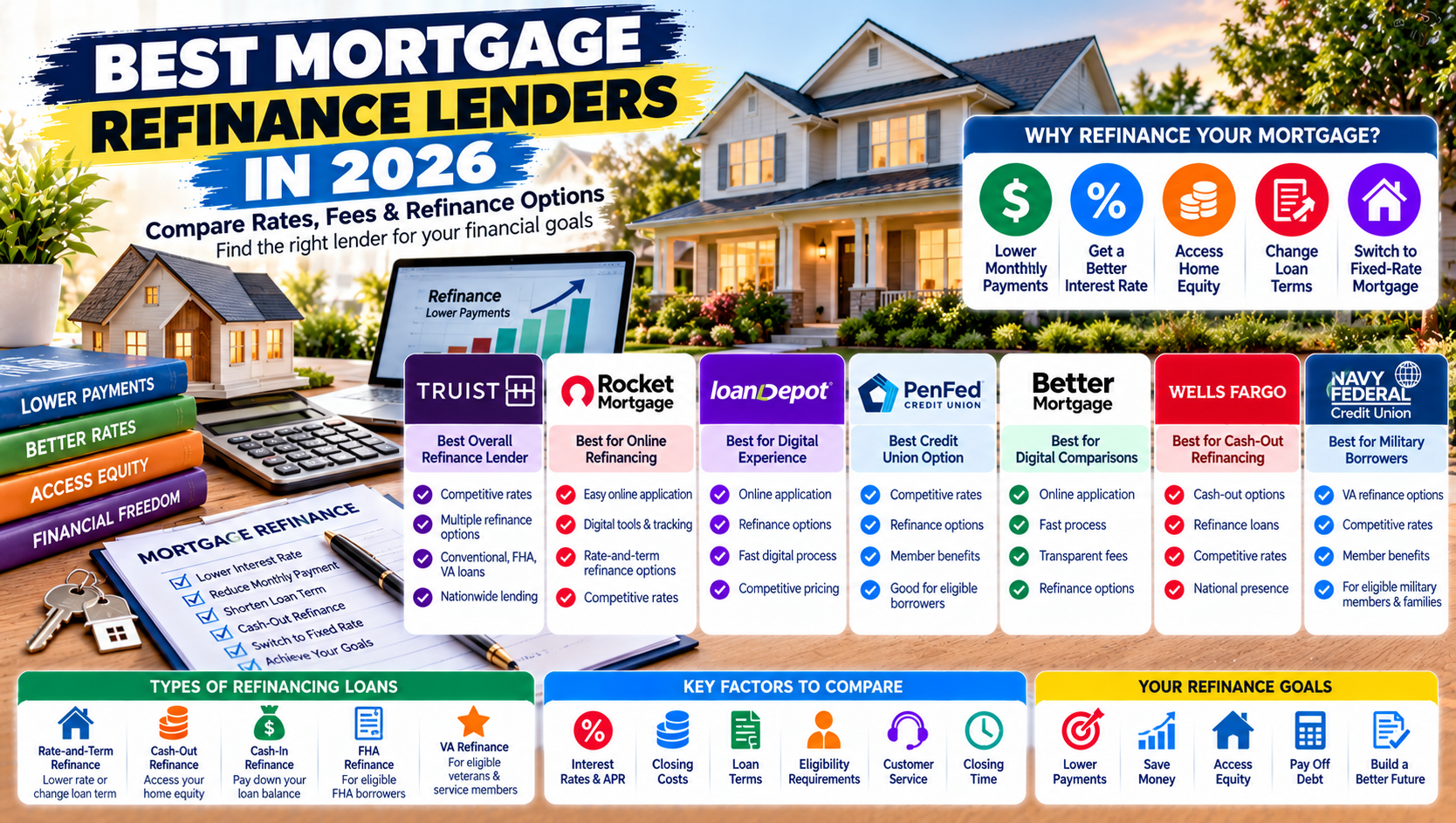
Refinancing a mortgage can help homeowners change their loan terms, reduce monthly payments, access home equity, or switch to a more suitable mortgage. However, the right refinancing option depends on your current interest rate, credit score, remaining loan balance, financial goals, and the costs associated with replacing your existing mortgage.
With many mortgage refinance lenders available in the United States, comparing offers is an important step before making a decision. Some lenders focus on online applications and convenient closings, while others provide government-backed refinancing programs, cash-out options, or competitive pricing for eligible borrowers.
In this guide, we compare some of the best mortgage refinance lenders in 2026, explain the different types of refinancing, and outline the costs and requirements homeowners should understand before applying.
Best Mortgage Refinance Lenders in 2026
The best mortgage refinance company is not necessarily the one advertising the lowest interest rate. Homeowners should also consider annual percentage rate (APR), lender fees, closing times, loan options, customer support, and eligibility requirements.
The following lenders are worth comparing for different refinancing needs. These are category-based recommendations, not a guarantee that every lender will offer the lowest rate to every borrower.
Mortgage Refinance Lender | Best For | Key Consideration |
|---|---|---|
Truist | Overall refinancing | Multiple refinance options and competitive pricing |
Rocket Mortgage | Online mortgage refinancing | Digital application and loan management |
LoanDepot | Online refinance process | Digital tools and refinance options |
PenFed Credit Union | Credit union refinancing | Membership eligibility may apply |
Better Mortgage | Comparing digital mortgage offers | Review available products and fees |
Wells Fargo | Cash-out refinancing | Compare current pricing and eligibility |
Navy Federal Credit Union | Eligible military members and families | Membership requirements apply |
Lender availability, rates, loan products, and underwriting standards can change. Review current offers directly before applying.
1. Truist — Best Overall Mortgage Refinance Option
Truist is worth considering for homeowners who want to compare different refinance products through a large financial institution. NerdWallet named Truist its best mortgage refinance lender in its 2026 awards, citing its pricing, fees, and selection of refinancing options.
Why Consider Truist?
Multiple refinance loan options.
Conventional and eligible government-backed refinancing products.
Options for homeowners with different refinancing objectives.
A nationwide lending presence, although mortgage availability is not identical in every state.
Potential Drawbacks
Borrowers may need to contact the lender to obtain a personalized rate quote. Eligibility requirements and available products depend on the property, loan type, and financial profile.
Best for: Homeowners seeking a lender with a broad range of refinancing options.
Official website: https://www.truist.com/
2. Rocket Mortgage — Best for Online Refinancing
Rocket Mortgage is a well-known mortgage lender with an online application process and digital tools for managing home loans. It may appeal to homeowners who prefer to complete much of the refinancing process online.
Key Benefits
Digital mortgage application.
Online document submission and loan tracking.
Access to personalized loan estimates.
Support for eligible refinancing options.
What to Consider
An online application does not guarantee approval or a lower rate. Compare Rocket Mortgage's APR, origination charges, discount points, and other closing costs against offers from competing lenders.
Best for: Borrowers who value digital convenience and online mortgage management.
Official website: https://www.rocketmortgage.com/
3. LoanDepot — Best for a Digital Refinance Experience
LoanDepot offers mortgage lending services, including refinancing for eligible homeowners. Its online tools can help borrowers begin the application process and explore available loan options.
Potential Advantages
Online application tools.
Refinance options for eligible borrowers.
Digital access to parts of the loan process.
An alternative to compare with banks and credit unions.
Potential Drawbacks
The final cost of refinancing depends on the borrower's credit profile, loan-to-value ratio, property, and selected loan terms. Always request a written Loan Estimate and check whether the quoted rate includes discount points.
Best for: Homeowners who want to explore a digital mortgage refinancing process.
Official website: https://www.loandepot.com/
4. PenFed Credit Union — Best Credit Union Option
PenFed Credit Union is another option for homeowners comparing refinance loans outside traditional banks. Credit unions may offer competitive pricing to eligible members, but their products and underwriting requirements differ.
Reasons to Compare PenFed
An alternative to conventional bank lenders.
Mortgage products for qualifying borrowers.
An opportunity to compare rates, APR, and fees.
Online resources for exploring mortgage financing.
What to Check
Confirm membership requirements, property eligibility, current refinance offerings, and closing costs. Do not assume that credit union membership automatically means a lower mortgage rate.
Best for: Homeowners who want to compare a credit union with banks and online lenders.
Official website: https://www.penfed.org/
5. Better Mortgage — Best for Digital Mortgage Comparisons
Better Mortgage is a digital mortgage company that allows borrowers to explore mortgage financing through an online process. It may be useful for homeowners who want to compare refinancing costs without starting with a traditional bank branch.
Potential Benefits
Online mortgage application tools.
Digital access to loan information.
An additional quote to compare with competing lenders.
A convenient option for borrowers who prefer online services.
Important Considerations
Available refinance products, rates, fees, and eligibility can change. Confirm that the specific refinance product you need is available for your property and location.
Best for: Homeowners who prefer a digital-first mortgage experience.
Official website: https://better.com/
6. Wells Fargo — Best to Compare for Cash-Out Refinancing
Cash-out refinancing allows qualifying homeowners to replace an existing mortgage with a larger loan and receive part of the difference in cash, after accounting for applicable costs and existing obligations.
Wells Fargo is one lender to consider when comparing cash-out refinance offers. NerdWallet selected Wells Fargo for its 2026 cash-out refinancing category in its mortgage lender awards.
Potential Benefits
A major financial institution with mortgage services.
An option to investigate when comparing cash-out refinance offers.
Potential access to funds for eligible homeowners with sufficient equity.
What to Consider
Cash-out refinancing increases the amount borrowed against your home. Your new interest rate, loan balance, repayment term, and closing costs may differ significantly from your existing mortgage.
If your primary goal is to access equity rather than replace your mortgage, compare a home equity loan and a home equity line of credit (HELOC) as well.
Best for: Homeowners who want to compare cash-out refinancing with other equity-access options.
Official website: https://www.wellsfargo.com/
7. Navy Federal Credit Union — Best for Eligible Military Borrowers
Navy Federal Credit Union offers mortgage products for eligible members, including certain military-related refinancing options. It may be particularly relevant to service members, veterans, and qualifying family members.
Potential Benefits
Mortgage options for eligible members.
Products that may serve borrowers with VA loan eligibility.
An alternative for comparing refinance pricing and loan terms.
Eligibility Requirements
Membership eligibility applies. Available refinance products and requirements depend on the borrower's circumstances and the type of loan requested.
Best for: Eligible military members, veterans, and qualifying family members comparing refinance options.
Official website: https://www.navyfederal.org/
What Is Mortgage Refinancing?
Mortgage refinancing means replacing your current home loan with a new mortgage. The new loan pays off the old mortgage, and you begin making payments under the new agreement.
Homeowners typically refinance to pursue one or more financial goals:
Reduce their interest rate or monthly payment.
Change the repayment term.
Move from an adjustable-rate mortgage to a fixed-rate mortgage.
Access home equity through cash-out refinancing.
Remove mortgage insurance when eligible.
Change the borrower structure when permitted by the lender.
Refinancing involves costs, and approval is not guaranteed. Whether it makes financial sense depends on the terms of the new loan and how long you expect to keep it.
Types of Mortgage Refinancing
1. Rate-and-Term Refinance
A rate-and-term refinance changes the interest rate, repayment term, or both, without taking substantial additional cash out of the property.
For example, a homeowner might refinance a 30-year mortgage into a 15-year loan. The monthly payment may rise, but the borrower could pay less interest over the life of the loan if the terms and repayment schedule support that outcome.
2. Cash-Out Refinance
A cash-out refinance replaces an existing mortgage with a larger loan, allowing the homeowner to receive some of the available equity as cash.
Common uses may include home improvements, debt consolidation, or other major expenses. However, this approach converts home equity into additional mortgage debt and may increase long-term borrowing costs.
Compare it carefully with alternatives, particularly if you are using home equity to pay off unsecured debts.
3. Cash-In Refinance
With a cash-in refinance, the homeowner contributes money at closing to reduce the new mortgage balance. Depending on the lender's terms, this may help the borrower qualify for a lower loan-to-value ratio or different pricing.
It is important to consider whether using savings for this purpose leaves enough money for emergencies and other financial needs.
4. FHA Streamline Refinance
Eligible homeowners with existing FHA-insured mortgages may be able to use an FHA Streamline Refinance. This program can simplify certain parts of the refinancing process, subject to FHA and lender requirements.
Eligibility conditions apply, and the new loan must meet the program's applicable rules. Not every homeowner qualifies.
5. VA Interest Rate Reduction Refinance Loan
Eligible borrowers with existing VA-backed mortgages may qualify for a VA Interest Rate Reduction Refinance Loan (IRRRL), sometimes called a VA streamline refinance.
The program is designed to refinance an existing eligible VA loan under specified conditions. Borrowers should compare fees, interest rates, and the financial benefits of the new loan before proceeding.
6. Adjustable-Rate to Fixed-Rate Refinance
Some homeowners refinance an adjustable-rate mortgage into a fixed-rate mortgage to obtain more predictable principal-and-interest payments.
A fixed rate can provide payment stability, but the new loan may have a different interest rate, repayment term, and total cost.
How to Choose the Best Mortgage Refinance Lender
Choosing a refinance lender requires more than checking an advertised interest rate. Use these factors to evaluate your options.
Compare Interest Rates and APR
The interest rate determines the interest charged on the mortgage balance. APR incorporates the interest rate and certain loan costs into a broader annualized measure.
APR can help when comparing similar loans, but its calculation and usefulness depend on the loan structure and how long you keep the mortgage. Review both the interest rate and the itemized fees.
Review Closing Costs
Mortgage refinancing can involve appraisal charges, lender fees, title services, recording fees, prepaid expenses, and other costs.
As a general planning estimate, refinancing costs may amount to around 2%–6% of the new loan amount, although actual expenses vary considerably by lender, location, and loan type.
Ask each lender for a Loan Estimate and compare the same loan amount, term, and points wherever possible.
Check Credit Score Requirements
Your credit history can affect approval, interest rates, and available loan terms. Some government-backed programs have different requirements from conventional mortgages, and lenders may apply their own underwriting standards.
Before applying, review your credit reports and correct any errors you find.
Evaluate Loan Terms
A longer repayment term can reduce the monthly payment but may increase the total interest paid. A shorter term may increase monthly payments while reducing the time spent paying interest.
Compare the total projected cost rather than focusing only on the monthly payment.
Consider Customer Service and Closing Time
Refinancing involves paperwork, underwriting, property valuation, and coordination among several parties. Check whether the lender provides clear communication, convenient document submission, and reliable support throughout the process.
Mortgage Refinance Costs: An Example
Suppose you refinance a mortgage with a new loan amount of $300,000 and closing costs equal to 3% of the loan amount.
Item | Illustrative Amount |
|---|---|
New mortgage amount | $300,000 |
Assumed closing-cost percentage | 3% |
Estimated closing costs | $9,000 |
This is an example, not a quote or a typical cost guarantee. Your actual expenses may be lower or higher.
Before refinancing, estimate how long it will take for monthly savings to recover the upfront costs.
How to Calculate Your Break-Even Point
The break-even point estimates how many months of savings are needed to recover refinancing costs.
Formula:
Break-even period = Total refinancing costs ÷ Monthly savings
For example, if refinancing costs $6,000 and your monthly payment decreases by $200, your estimated break-even period is 30 months.
This calculation is a starting point. It does not account for every change in loan balance, taxes, insurance, interest paid over the full term, or other financial factors. Also compare the total cost of the new loan.
When Does Mortgage Refinancing Make Sense?
Refinancing may be worth exploring when:
Your new loan offers meaningful savings after fees.
You want to change your repayment term.
You need a more predictable fixed interest rate.
You qualify for a suitable government-backed refinance program.
You have a clear reason to access home equity and understand the added risk.
Refinancing may be less attractive if you expect to move soon, the closing costs are high, or the new loan extends your repayment period substantially. A lower monthly payment alone does not prove that refinancing will save money overall.
Documents Needed to Refinance a Mortgage
Most lenders require documentation to verify your finances, property, and existing mortgage. Requirements vary, but you may need:
Government-issued identification.
Recent pay stubs or other proof of income.
W-2 forms or tax returns, where applicable.
Bank and asset statements.
Current mortgage statement.
Homeowners insurance information.
Property tax details.
Information about other debts.
Additional documentation requested by the lender.
Self-employed borrowers may need additional income and business records. Ask the lender for a complete checklist before submitting an application.
Common Mortgage Refinancing Mistakes to Avoid
Focusing Only on the Monthly Payment
A smaller payment can result from extending the loan term rather than reducing borrowing costs. Compare the remaining balance, repayment period, and total interest.
Ignoring Closing Costs
A lower interest rate may not justify expensive fees if you plan to sell or refinance again soon. Calculate the break-even period before making a decision.
Accepting the First Offer
Obtain written quotes from multiple lenders. Compare APR, interest rate, points, lender fees, and estimated cash needed at closing.
Using Home Equity Without a Plan
Cash-out refinancing can increase debt secured by your home. If you cannot make the new payments, you risk foreclosure. Consider the purpose of the funds and whether another financing option is more appropriate.
Assuming You Will Automatically Qualify
Lenders review credit, income, assets, property value, outstanding debts, and other underwriting factors. Get a personalized assessment rather than relying on advertised minimum requirements.
Frequently Asked Questions
Who is the best mortgage refinance lender in 2026?
Truist was named NerdWallet's best mortgage refinance lender in its 2026 awards. However, the best lender for an individual homeowner depends on the available rate, closing costs, eligibility, loan type, and personal financial goals.
What credit score do I need to refinance a mortgage?
There is no single credit score requirement for every refinance. Requirements vary by lender and loan program, and a higher score may help borrowers qualify for more favorable terms. Check the criteria for the specific mortgage product you want.
How much does it cost to refinance a mortgage?
Refinancing costs vary based on the loan, lender, property, and location. A preliminary planning range is approximately 2%–6% of the new loan amount, but obtain written estimates for an accurate figure.
Can I refinance with the same lender?
Yes. You can ask your current lender about refinancing, but you are not required to use it. Compare the offer with quotes from other lenders to determine which option best meets your needs.
Is cash-out refinancing a good idea?
It may be useful when a homeowner has sufficient equity and a clear financial objective. However, it increases or restructures mortgage debt and places the home at risk if payments cannot be made. Compare the total cost with alternatives such as a home equity loan or HELOC.
Does refinancing lower monthly mortgage payments?
It can, depending on the new interest rate, loan term, amount borrowed, and other costs. Extending the repayment term may lower monthly payments while increasing total interest over time.
How long does mortgage refinancing take?
The timeline varies by lender, loan type, property appraisal, documentation, and underwriting. Ask prospective lenders for their current estimated closing times and the conditions that could delay approval.
Can I refinance an FHA or VA mortgage?
Eligible borrowers may have access to specialized programs such as the FHA Streamline Refinance or VA IRRRL. Each program has specific eligibility and loan requirements, so confirm your options with an approved lender.
Final Thoughts
The best mortgage refinance lenders in 2026 offer different combinations of pricing, loan programs, digital services, and borrower support. Truist, Rocket Mortgage, LoanDepot, PenFed Credit Union, Better Mortgage, Wells Fargo, and Navy Federal Credit Union are options to investigate based on your refinancing goals and eligibility.
Before choosing a lender, compare written loan estimates, APR, closing costs, repayment terms, and total projected interest. Calculate your break-even point and consider how long you expect to keep the mortgage.
The goal is not simply to obtain a lower monthly payment. It is to find a refinance that fits your financial circumstances and makes sense over the time you expect to own the home.