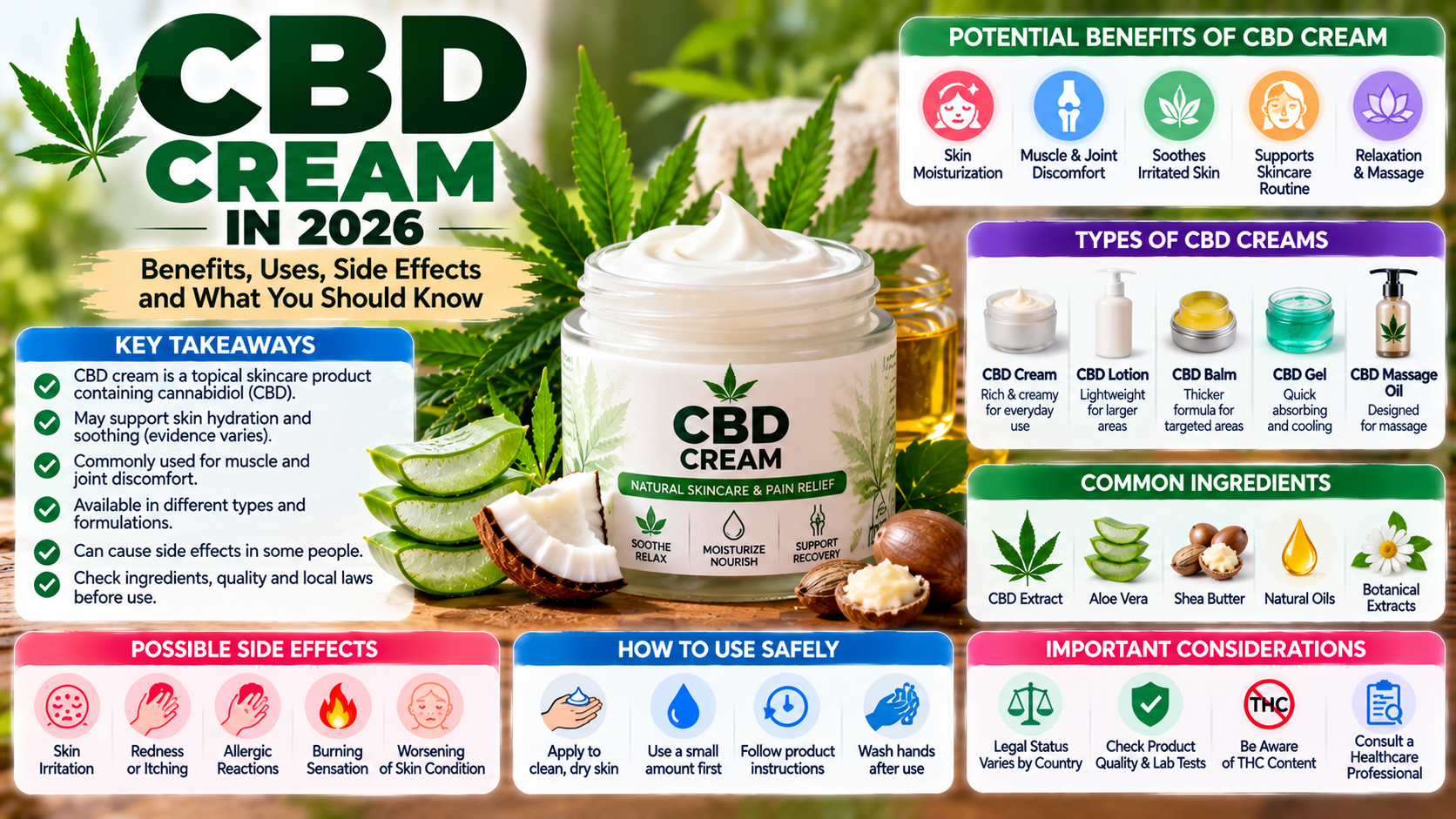
CBD creams have gained attention in the skincare and wellness market as more people explore topical products containing cannabidiol (CBD). These creams are commonly marketed for dry skin, muscle discomfort, joint stiffness, and everyday skincare routines.
But what exactly is CBD cream, how does it work, and what does scientific research say about its potential benefits? Understanding the ingredients, available evidence, and possible risks can help consumers make informed decisions.
In this guide, we explain CBD creams in simple terms, compare different product types, discuss potential uses, and share important safety tips for 2026.
What Are CBD Creams?
CBD creams are topical skincare products that contain cannabidiol, a compound found in the cannabis plant. Manufacturers combine CBD with a cream, lotion, balm, or other base containing ingredients designed for application to the skin.
Depending on the formula, a CBD cream may also contain moisturizing ingredients such as shea butter, aloe vera, glycerin, or plant oils. Some products include fragrance, menthol, essential oils, or other ingredients intended to provide a cooling or warming sensation.
CBD is different from tetrahydrocannabinol (THC), the compound primarily responsible for the intoxicating effects associated with cannabis. Pure CBD is not considered intoxicating in the same way as THC, although some products may contain THC or other cannabinoids.
Important: CBD creams are not all the same. Their cannabinoid concentrations, additional ingredients, quality, and intended uses can vary substantially between brands.
How Do CBD Creams Work?
CBD creams are applied directly to the skin rather than swallowed. The skin acts as a protective barrier, and the way an ingredient interacts with the skin depends on its formulation, concentration, and ability to penetrate the skin barrier.
Researchers are investigating how CBD interacts with biological pathways associated with inflammation, discomfort, and skin function. However, evidence from laboratory studies does not necessarily demonstrate that a commercial cream produces meaningful benefits in humans.
It is also important to distinguish ordinary topical products from transdermal formulations. A typical cream is primarily designed for application to the skin's surface, while a transdermal product is specifically formulated to deliver ingredients across the skin into the bloodstream.
Do not assume that every CBD cream penetrates deeply, reaches joints or muscles, or delivers a predictable amount of CBD into the body.
Potential Benefits of CBD Creams
CBD creams are marketed for several skincare and wellness purposes. However, scientific evidence supporting many of these uses remains limited, and CBD creams should not be considered proven treatments for skin diseases or chronic pain.
1. Skin Moisturization
Some CBD creams contain moisturizing ingredients that can help soften dry skin and support the skin barrier. Ingredients such as glycerin, ceramides, and shea butter may contribute to these effects.
Any moisturizing benefit depends heavily on the complete formula, not just the presence of CBD. A well-formulated moisturizer without CBD may also help relieve dryness.
2. Muscle and Joint Discomfort
CBD creams are often promoted for temporary relief from muscle soreness, joint discomfort, and stiffness.
Research into topical CBD is still developing, and there is not enough high-quality evidence to conclude that ordinary CBD creams reliably relieve these conditions. Some products also contain menthol, camphor, or other ingredients that can create sensations of cooling or warmth, which should not be mistaken for proof that CBD itself is effective.
People with persistent joint pain, swelling, or unexplained muscle symptoms should seek medical assessment rather than relying on a topical product alone.
3. Skincare and Antioxidant Research
CBD has been studied in laboratory settings for its interactions with biological processes related to inflammation and oxidative stress. These findings have generated interest in possible skincare applications.
However, laboratory results do not establish that CBD creams prevent skin aging, remove wrinkles, repair skin damage, or protect against environmental damage in everyday use.
For established skincare benefits, products containing proven moisturizing ingredients and daily broad-spectrum sunscreen remain important options.
4. Sensitive or Irritated Skin
Some CBD skincare products are marketed for redness, itching, and irritated skin. Yet evidence is insufficient to establish that CBD creams consistently improve these symptoms.
People with sensitive skin should pay attention to the entire ingredient list. Fragrances, essential oils, preservatives, and other additives can cause irritation or allergic reactions, regardless of whether the product contains CBD.
If you have eczema, psoriasis, dermatitis, or another diagnosed skin condition, consult a qualified healthcare professional before replacing your usual treatment with a CBD product.
5. Relaxation and Massage
CBD creams and balms are sometimes used during massage routines. The massage itself, together with the cream's texture and other ingredients, may contribute to a relaxing experience.
However, this does not establish that CBD provides additional relaxation or pain-relieving effects. Evidence for these specific benefits remains limited.
Types of CBD Creams
CBD topical products are available in several forms, each designed for a different application experience.
Product type | Main characteristics | What to consider |
|---|---|---|
CBD cream | Creamy texture, often designed for everyday application | Check moisturizing ingredients and CBD concentration |
CBD lotion | Usually lighter and easier to spread over larger areas | May be suitable for routine body moisturization |
CBD balm | Thicker, often oil- or wax-based formulation | Can feel heavier or greasier on the skin |
CBD gel | Often lightweight and quick to spread | Check for alcohol, fragrance, or other potential irritants |
CBD massage oil | Oil-based product designed for massage | Check ingredients and intended use |
CBD transdermal product | Specifically formulated for delivery through the skin | Do not confuse it with an ordinary topical cream |
The best format depends on personal preferences, skin type, and the product's ingredients. No format is automatically more effective simply because it contains a higher amount of CBD.
Full-Spectrum, Broad-Spectrum, and CBD Isolate Creams
CBD creams may also be categorized by the types of cannabis compounds they contain.
Type | Description | Key consideration |
|---|---|---|
Full-spectrum | Contains CBD and other plant compounds and may contain THC | Review THC content and local laws |
Broad-spectrum | Intended to contain CBD and other plant compounds with THC removed | Independent testing is important |
CBD isolate | Uses isolated CBD as the principal cannabinoid | Check purity and the complete ingredient list |
These labels do not guarantee product quality or exact composition. A certificate of analysis from an independent laboratory can help verify the cannabinoid profile and identify certain contaminants.
CBD Creams for Different Skin Types
Choosing a topical product involves more than selecting a CBD concentration. The cream's base and other ingredients may be especially important for different skin types.
For Dry Skin
Look for fragrance-free formulas containing established moisturizing ingredients such as glycerin, ceramides, or shea butter. A CBD label does not guarantee that a product provides better hydration than a conventional moisturizer.
For Oily or Acne-Prone Skin
Consider lightweight, non-comedogenic products and avoid formulas that feel excessively greasy. The term non-comedogenic suggests that a product is formulated to reduce the likelihood of clogged pores, although it is not an absolute guarantee.
There is insufficient evidence to recommend CBD cream as an established acne treatment.
For Sensitive Skin
Choose products with short, clearly disclosed ingredient lists and avoid unnecessary fragrances or irritating additives. Introduce new products cautiously, especially if your skin reacts easily to cosmetics.
For Mature Skin
Moisturizing ingredients can temporarily improve the appearance of dry lines by making the skin look smoother. However, CBD creams have not been established as a replacement for sunscreen, retinoids, or other evidence-based skincare options when appropriate.
How to Use CBD Cream Safely
If CBD products are legal where you live and you decide to try a topical product, follow these precautions.
Read the label: Check the CBD amount, directions, ingredients, and warnings.
Start with a small area: Apply a small amount to intact skin first to check for irritation.
Follow the manufacturer's instructions: Do not apply more frequently or in larger amounts than directed.
Avoid sensitive areas: Keep the cream away from the eyes, mouth, mucous membranes, and broken or damaged skin unless the product is specifically designed for that use.
Wash your hands: Wash after application unless the product is intended for the hands.
Stop if irritation occurs: Discontinue use if you develop burning, a rash, swelling, or worsening symptoms.
Do not combine products carelessly: Avoid applying a product over the same area as heating pads, tight bandages, or other topical medicines unless the instructions or a healthcare professional indicate it is safe.
A patch test can help identify some reactions, but it cannot guarantee that a product will never cause irritation or an allergy.
Possible Side Effects of CBD Creams
CBD creams may cause unwanted effects, particularly when they contain additional active ingredients or irritating additives.
Possible problems include:
Skin redness, itching, or irritation.
Allergic contact dermatitis caused by CBD or another ingredient.
Burning or stinging sensations.
Worsening of an existing skin condition.
Unintended exposure to THC or other substances in poorly labeled products.
The amount of CBD absorbed through the skin varies by formulation and application conditions. Products designed for transdermal delivery may behave differently from ordinary creams.
Systemic effects and medication interactions may be less likely with some topical products than with oral CBD, but they cannot be ruled out for every formulation. Ask a healthcare professional or pharmacist for advice if you use prescription medicines, have a medical condition, or plan to apply a CBD product frequently over large areas.
Seek urgent medical help if you experience signs of a serious allergic reaction, such as difficulty breathing or swelling of the face or throat.
Who Should Be Careful With CBD Creams?
Certain people should seek professional advice before using CBD topical products.
Pregnant or Breastfeeding People
Safety information for CBD use during pregnancy and breastfeeding is inadequate. It is best to avoid CBD products during these periods unless a qualified healthcare professional gives specific advice.
People Taking Prescription Medicines
Although topical exposure may differ from oral CBD use, the extent of absorption depends on the product. Discuss regular use with a doctor or pharmacist if you take medicines or use other topical treatments.
People With Skin Conditions
Those with eczema, psoriasis, severe acne, open wounds, or unexplained rashes should not use CBD cream as a substitute for diagnosis or established treatment.
People Subject to Drug Testing
Some CBD products contain THC, including products marketed as full-spectrum. Depending on exposure and testing circumstances, THC-containing products may create a risk of a positive drug test. Labels such as “THC-free” should be supported by reliable testing, but testing cannot eliminate every risk.
How to Choose a Quality CBD Cream
The quality of a CBD cream depends on its formulation, ingredient transparency, manufacturing practices, and testing.
1. Check the CBD Concentration
Look for the total CBD amount in the container and, where provided, the amount per gram or serving. Compare products using consistent units rather than relying on phrases such as “extra strength.”
A higher concentration does not automatically mean a better or safer product.
2. Look for Independent Laboratory Testing
A reliable certificate of analysis (COA) should correspond to the exact product and batch. It may report cannabinoid concentrations and testing for contaminants such as heavy metals, pesticides, residual solvents, or microbial contamination.
Testing coverage varies, so read the report rather than assuming every possible contaminant has been checked.
3. Review the Complete Ingredient List
Check for fragrances, essential oils, menthol, preservatives, and other ingredients that may affect suitability for your skin. If you have known allergies, confirm that the product does not contain ingredients that trigger them.
4. Avoid Unsupported Medical Claims
Be cautious of products claiming to cure arthritis, eliminate eczema, reverse aging, or treat serious diseases. Such claims are not proof of effectiveness and may be misleading.
5. Choose Transparent Manufacturers
Look for clear manufacturer details, batch numbers, accessible testing reports, and straightforward labeling. Avoid products that conceal their ingredients or make unrealistic promises.
CBD Creams vs. CBD Oil
CBD creams and CBD oils are used differently and should not be treated as interchangeable.
Feature | CBD cream | CBD oil |
|---|---|---|
Application | Applied to the skin | Often swallowed or used under the tongue, depending on the product |
Main purpose | Topical skincare or targeted application | Oral or sublingual use, depending on formulation |
Absorption | Depends on the topical formula and skin barrier | Depends on the route and product formulation |
Common concerns | Skin irritation, allergies, ingredient quality | Drug interactions, digestive effects, liver-related risks |
Evidence | Limited for many advertised topical benefits | Limited for many advertised wellness benefits |
Use instructions | Follow topical product directions | Follow the product's route-specific directions and professional guidance |
A cream intended for external use should not be swallowed. Likewise, an oral CBD oil should not be applied to the skin unless the manufacturer specifically indicates that it is suitable for topical use.
Is CBD Cream Legal in 2026?
The legal status of CBD products varies by country and may depend on the source of the CBD, THC content, product classification, and intended use.
Before purchasing, importing, or using a CBD cream, check the current requirements in your jurisdiction. Do not assume that a product available through an international online store can legally be imported or sold locally.
In Pakistan and other countries with specific controls on cannabis-related products, verify the applicable rules with relevant official authorities before purchasing or using CBD products. Regulations can change, and the legal status of one formulation may differ from another.
Common Myths About CBD Creams
Myth | Fact |
|---|---|
Every CBD cream relieves pain | Evidence for many topical pain claims remains limited |
CBD cream cures skin conditions | It has not been established as a cure for eczema, acne, or psoriasis |
Natural ingredients cannot cause allergies | Plant-derived ingredients can still cause irritation or allergic reactions |
A higher CBD concentration is always better | Concentration alone does not establish effectiveness or safety |
Topical CBD never enters the bloodstream | Absorption varies, particularly with different formulations |
All CBD creams are THC-free | Some products may contain THC or other cannabinoids |
CBD cream is always legal | Laws vary by country and product composition |
Frequently Asked Questions About CBD Creams
What is CBD cream used for?
CBD cream is marketed for skincare, moisturizing, massage, and temporary relief of muscle or joint discomfort. Evidence supporting many CBD-specific benefits remains limited, so it should not replace established treatment.
Does CBD cream make you feel high?
Ordinary topical CBD creams are not generally expected to produce the intoxicating effects associated with THC. However, product composition varies, and THC-containing products may carry additional risks. Avoid assuming that every product is THC-free.
Can CBD cream help with arthritis?
Some products are marketed for arthritis-related discomfort, but there is not enough high-quality evidence to conclude that ordinary CBD creams reliably treat arthritis. Consult a healthcare professional about persistent joint pain or swelling.
Is CBD cream good for acne?
CBD is being studied for possible effects on skin-related biological processes, but CBD creams have not been established as an effective acne treatment. Choose skincare products appropriate for acne-prone skin and seek medical advice for persistent acne.
Can CBD cream cause side effects?
Yes. Possible effects include redness, itching, irritation, and allergic reactions. Some products may also contain THC or other ingredients that create additional concerns.
Can CBD cream be used every day?
Whether frequent use is appropriate depends on the formulation, ingredients, skin condition, and product directions. Check the label and consult a healthcare professional if you plan to use it regularly or over large areas.
Is CBD cream the same as hemp seed cream?
No. Hemp seed ingredients are derived from hemp seeds and are commonly used as moisturizing ingredients. CBD is cannabidiol, a distinct compound extracted from cannabis plant material. A product containing hemp seed oil does not necessarily contain CBD.
Does CBD cream have anti-aging benefits?
There is not enough clinical evidence to establish that CBD creams prevent wrinkles or reverse skin aging. Moisturizing ingredients can improve the temporary appearance of dry skin, while sunscreen and other evidence-based skincare products remain important for skin protection.
Final Thoughts
CBD creams are becoming more visible in the skincare and wellness market, but their benefits should be evaluated carefully. Some products may provide useful moisturization because of their overall formulation, while CBD-specific effects on pain, inflammation, and skin conditions remain insufficiently established for many advertised uses.
Before choosing a CBD cream, review the ingredients, check independent laboratory testing, consider your skin type, and understand the relevant local laws. People with persistent symptoms, existing skin conditions, or medication concerns should consult a qualified healthcare professional.
Disclaimer: This article is for educational purposes only and does not constitute medical or legal advice. CBD creams are not proven treatments for every condition discussed. Consult a qualified healthcare professional before using a CBD product to manage a health problem.