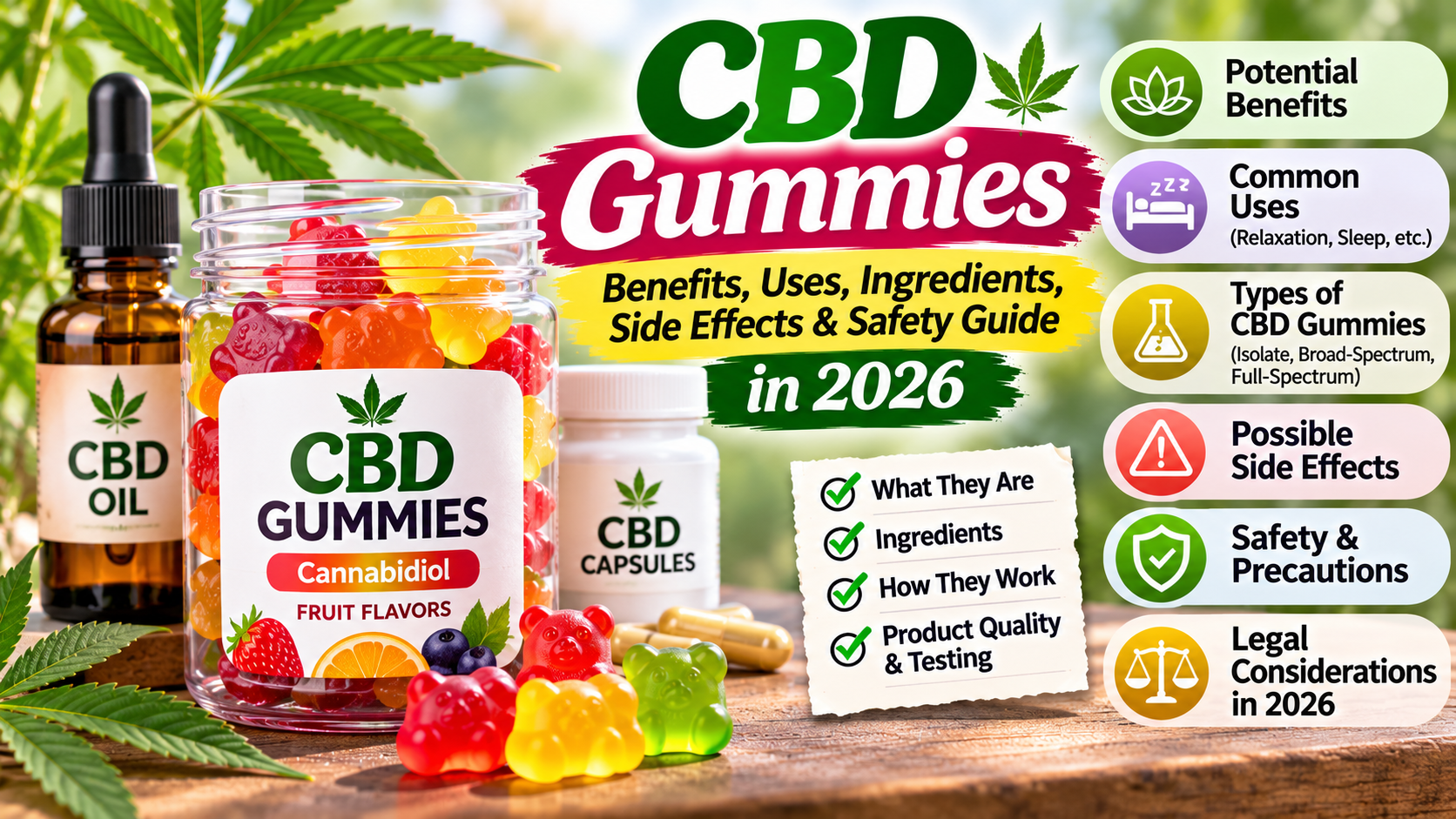
CBD gummies have become a recognizable product in the cannabidiol wellness market. These chewable products combine cannabidiol (CBD), a compound derived from the cannabis plant, with ingredients used to create flavored gummy candies. They are often marketed to adults interested in relaxation, sleep support, and general wellness.
Their popularity comes from their convenient format, familiar appearance, and premeasured product labeling. Unlike CBD oils, which are usually supplied in dropper bottles, gummies are designed to be chewed and swallowed. They are available in different flavors, shapes, formulations, and advertised CBD concentrations.
However, an attractive product and a popular wellness trend do not automatically mean that a product is safe or medically effective. CBD can cause side effects, interact with prescription medicines, and raise concerns about liver health. The quality and actual CBD content of commercial gummies can also vary.
In 2026, scientific and regulatory organizations continue to examine the safety of CBD in food products. Consumers should understand the differences between CBD and THC, review product testing information, and consider the legal requirements in their country before purchasing cannabidiol gummies.
This guide explains what CBD gummies are, how they are made, their potential effects, common ingredients, possible risks, and important considerations for choosing and evaluating these products.
What Are CBD Gummies?
CBD gummies are chewable edible products containing cannabidiol. CBD is one of several naturally occurring cannabinoids found in the Cannabis sativa plant.
Manufacturers generally combine CBD extract with ingredients such as sweeteners, flavorings, gelling agents, and coloring substances to create a gummy formulation.
CBD is different from THC, the cannabinoid primarily responsible for the intoxicating effects associated with marijuana. CBD does not typically produce a traditional cannabis high. Nevertheless, some CBD products may contain THC or other cannabinoids, so consumers should not assume that every gummy is THC-free.
CBD gummies are marketed in different formulations, including:
CBD isolate gummies.
Broad-spectrum CBD gummies.
Full-spectrum CBD gummies.
Fruit-flavored CBD gummies.
Sugar-free CBD gummies.
Vegan CBD gummies.
The amount of cannabidiol advertised in each gummy can vary substantially between products. Some labels state the amount per individual gummy, while others emphasize the total CBD content in the entire container.
Understanding this distinction is important when reviewing product information.
How Do CBD Gummies Work?
CBD gummies are swallowed and processed through the digestive system. After consumption, their ingredients pass through the gastrointestinal tract, where CBD is absorbed and processed by the body.
CBD interacts with several biological pathways, including systems involved in mood, pain signaling, sleep, and other physiological processes.
One system researchers investigate is the endocannabinoid system.
Understanding the Endocannabinoid System
The endocannabinoid system is a network of receptors, naturally produced compounds, and enzymes that helps regulate different functions in the body.
It includes:
CB1 receptors: These are found mainly in the central nervous system and participate in processes involving memory, mood, and coordination.
CB2 receptors: These are found largely in immune cells and various peripheral tissues.
Endocannabinoids: These are compounds naturally produced by the body that interact with cannabinoid receptors.
Enzymes: These help produce and break down endocannabinoids.
THC interacts with cannabinoid receptors in ways that contribute to its intoxicating effects. CBD has a more complex pharmacological profile and does not act in the same way.
Researchers are still investigating the precise mechanisms through which CBD affects the body. It should not be assumed that taking a CBD gummy will produce a predictable medical or wellness effect.
How Are CBD Gummies Absorbed?
Because CBD gummies are swallowed, their contents must pass through the digestive system before CBD enters the bloodstream.
Several factors can influence absorption:
The formulation of the gummy.
The amount of CBD present.
Individual differences in metabolism.
Whether the gummy is consumed with food.
The product's manufacturing process.
Other substances consumed at the same time.
Oral CBD absorption can be variable. A gummy may not produce the same effects in every person, even when the advertised CBD content is identical.
Consumers should avoid taking additional gummies simply because they do not notice an immediate effect.
Potential Benefits of CBD Gummies
CBD gummies are marketed for several wellness purposes. However, it is important to distinguish between advertised benefits, early scientific findings, and medically established uses.
Research into CBD is ongoing, and evidence supporting many commercial claims remains limited.
1. Relaxation and Stress-Related Research
Some CBD products are promoted as relaxation aids.
Scientists are investigating whether cannabidiol influences biological pathways associated with stress responses and mood. Early studies have produced interesting findings, but the available evidence does not establish commercial CBD gummies as a reliable treatment for stress or anxiety disorders.
People experiencing persistent anxiety should consider speaking with a qualified healthcare or mental health professional.
2. Sleep-Related Research
Sleep support is another common marketing theme in the CBD gummy industry.
Some products are advertised for people who experience difficulty sleeping or want to improve their nighttime routine.
However, research has not established that CBD gummies consistently treat insomnia. Sleep difficulties can be associated with medical conditions, medication effects, stress, irregular schedules, and other factors.
A healthcare professional can help identify the underlying cause of persistent sleep problems.
3. Pain-Related Research
CBD is also studied for possible interactions with biological pathways involved in pain perception.
Some companies promote CBD gummies for general discomfort, muscle soreness, and joint-related concerns. However, evidence that CBD alone effectively treats common pain conditions remains limited.
Research involving cannabis-based medicines that contain both CBD and THC should not be treated as proof that CBD-only gummies provide the same effects.
People experiencing ongoing or severe pain should seek medical assessment rather than relying on commercial wellness products.
4. Interest in Inflammation Research
Inflammation is a natural biological response involved in the body's reaction to injury and infection.
CBD has shown effects on certain inflammatory pathways in laboratory and preclinical studies. Researchers are examining whether these findings may have useful medical applications.
However, laboratory results do not establish that CBD gummies can treat inflammatory diseases in humans.
5. Neurological Research
One of the better-established medical applications of purified CBD involves certain seizure disorders.
A prescription cannabidiol medication has been approved in the United States for specific conditions, including Lennox-Gastaut syndrome, Dravet syndrome, and seizures associated with tuberous sclerosis complex.
This approval applies to a specific prescription medicine and its approved medical use. It does not mean that ordinary CBD gummies are approved treatments for epilepsy.
Patients with seizure disorders should follow their prescribed treatment plan and consult their neurologist before considering any CBD product.
Types of CBD Gummies
CBD gummies are available in several formulations. The differences generally relate to the types of cannabinoids and other cannabis-derived compounds included in the extract.
1. CBD Isolate Gummies
CBD isolate gummies contain cannabidiol in a purified form.
CBD isolate is processed to remove most other cannabis plant compounds. Products made with isolate are generally marketed as containing CBD without the broader cannabinoid profile found in full-spectrum extracts.
Consumers should still check independent laboratory testing to confirm the actual composition and THC content.
2. Broad-Spectrum CBD Gummies
Broad-spectrum CBD gummies are made using extracts that contain CBD alongside selected additional cannabis-derived compounds.
Manufacturers generally process these extracts to remove or substantially reduce THC.
However, the actual composition depends on the manufacturing process. A broad-spectrum label alone does not guarantee that a product contains absolutely no THC.
3. Full-Spectrum CBD Gummies
Full-spectrum CBD gummies contain CBD alongside other naturally occurring cannabis plant compounds.
Depending on the source material and production process, these extracts may contain small amounts of THC.
Consumers should understand that full-spectrum products may have different legal and safety considerations from products made using purified CBD.
4. Sugar-Free CBD Gummies
Sugar-free CBD gummies are formulated without conventional added sugar or with alternative sweeteners.
They may appeal to consumers who prefer to limit added sugar.
However, sugar-free does not mean calorie-free or medically safer. Some products contain sugar alcohols or alternative sweeteners that can cause digestive discomfort in certain people.
5. Vegan CBD Gummies
Traditional gummies may use gelatin, which is derived from animal sources.
Vegan CBD gummies generally use plant-based gelling ingredients, such as pectin, to create their texture.
Consumers following specific dietary requirements should review the full ingredient list because other ingredients may also be relevant.
6. Fruit-Flavored CBD Gummies
Fruit-flavored CBD gummies are designed to make cannabidiol products more palatable.
Common advertised flavors include:
Strawberry.
Orange.
Lemon.
Blueberry.
Watermelon.
Mixed berries.
Flavor does not indicate CBD strength, purity, or quality.
CBD Gummies vs. CBD Oil
CBD gummies and CBD oils are two commonly marketed cannabidiol formats. Both may contain CBD, but their delivery methods and product characteristics differ.
Feature | CBD Gummies | CBD Oil |
|---|---|---|
Form | Chewable edible | Liquid extract |
Consumption | Swallowed | Usually swallowed or used as directed on label |
CBD measurement | Often stated per gummy | Often stated per milliliter or serving |
Taste | Usually flavored | May have an earthy or botanical taste |
Ingredients | Often include sweeteners and gelling agents | Usually includes CBD extract and carrier oil |
Absorption | Through digestive system | Depends on how the oil is used |
Portion format | Individual gummies | Dropper or measured liquid |
Neither format is automatically more effective or safer. The appropriate product, if medically suitable, depends on its ingredients, quality, formulation, and individual circumstances.
Common Ingredients in CBD Gummies
CBD gummies contain more than cannabidiol. Their other ingredients influence taste, texture, appearance, and shelf life.
Common ingredients may include:
CBD Extract
This is the cannabidiol-containing ingredient. Its source, purity, and cannabinoid composition should be explained by the manufacturer.
Sweeteners
Some gummies contain sugar, glucose syrup, or other sweeteners to create their taste and texture.
Sugar-free formulations may use alternative sweeteners.
Pectin or Gelatin
These ingredients help create the gummy texture.
Pectin is plant-based, while gelatin is typically animal-derived.
Natural and Artificial Flavors
Flavorings are used to create fruit or other tastes. Their source and composition can vary.
Food Coloring
Coloring ingredients may be included to give gummies their appearance.
Carrier Ingredients
Some formulations contain oils or other ingredients that help incorporate CBD into the gummy mixture.
Consumers should review the complete ingredient list, particularly if they have allergies, dietary restrictions, or food sensitivities.
Possible Side Effects of CBD Gummies
CBD is not risk-free. Although some products are marketed as natural wellness items, cannabidiol can affect the body and cause unwanted reactions.
Possible side effects include:
Drowsiness.
Diarrhea.
Changes in appetite.
Fatigue.
Nausea.
Digestive discomfort.
Changes in mood.
Potential liver-related effects.
The likelihood and severity of side effects may depend on the amount consumed, product quality, individual health, and other medicines being used.
1. Drowsiness and Sleepiness
CBD can cause sleepiness in some individuals. This may become more concerning when CBD is combined with alcohol or other substances that slow activity in the central nervous system.
People should avoid driving or operating machinery if they experience drowsiness or impaired alertness.
2. Digestive Problems
Some people may experience diarrhea, nausea, or other gastrointestinal symptoms.
The gummy's additional ingredients, including sweeteners and sugar alcohols, may also contribute to digestive discomfort.
3. Liver-Related Concerns
CBD has been associated with liver enzyme changes and potential liver injury, particularly in studies involving higher-dose prescription treatment.
The European Food Safety Authority's 2026 assessment also highlighted continuing uncertainties involving liver health and other body systems.
People with liver conditions should not use CBD products without appropriate medical advice.
4. Medication Interactions
CBD can affect enzymes involved in processing medicines. As a result, it may change the effects of certain medications or increase the risk of side effects.
Potentially important interactions include some:
Antiseizure medicines.
Blood-thinning medicines.
Sedatives.
Medicines affecting the central nervous system.
Other prescription and over-the-counter treatments.
Anyone taking medication regularly should consult a doctor or pharmacist before considering CBD gummies.
5. Allergic Reactions and Ingredient Sensitivities
Although CBD itself is not the only ingredient to consider, gummies may contain flavorings, colorings, sweeteners, gelatin, or other substances that cause sensitivities in some people.
Read the complete ingredient list before consuming any edible product.
Who Should Avoid CBD Gummies?
CBD gummies are not suitable for everyone.
Certain groups should avoid CBD because safety information is insufficient or potential risks are significant.
Pregnant or Breastfeeding Women
CBD is not recommended during pregnancy or breastfeeding.
The FDA has highlighted concerns about potential exposure of developing babies and infants through breast milk, along with uncertainties about product contamination and reproductive safety.
Children and Teenagers
CBD gummies should not be treated as ordinary sweets or given to children without a specific medical indication and professional supervision.
The colorful appearance and candy-like texture can also create a risk of accidental consumption.
People Taking Prescription Medication
CBD may interact with medicines, potentially changing their effects or increasing side effects.
A healthcare professional should review possible interactions before CBD is considered.
People with Liver Conditions
Because CBD may affect liver function, individuals with existing liver problems should seek medical advice before using cannabidiol products.
People Who Need to Drive or Operate Machinery
CBD may cause drowsiness in some users. Anyone experiencing reduced alertness should avoid driving or operating equipment.
Are CBD Gummies Addictive?
CBD does not typically produce the intoxicating effects associated with THC.
However, consumers should not assume that every product labeled CBD contains only cannabidiol. Some products may contain THC or other cannabinoids.
THC can produce intoxicating effects and carries different risks.
The composition of a product should therefore be verified through reliable testing rather than assumed from the front label.
How to Choose Quality CBD Gummies
The CBD market contains products with different ingredients, concentrations, manufacturing standards, and testing procedures.
A professional-looking package does not guarantee quality.
Consumers should evaluate the following factors before purchasing a CBD gummy product.
1. Check for Independent Laboratory Testing
Look for a certificate of analysis, commonly called a COA, from an independent laboratory.
A batch-specific report may provide information about:
CBD concentration.
THC content.
Other cannabinoids.
Pesticide residues.
Heavy metals.
Microbial contamination.
Residual solvents, where relevant.
The laboratory report should match the product batch being sold.
2. Read the CBD Amount Carefully
Product labels may display the total CBD content in the entire container rather than the amount in each gummy.
For example, a container advertising a total of 500 mg CBD does not mean every gummy contains 500 mg.
Consumers should distinguish between total container content and individual serving information.
3. Review the Complete Ingredient List
Check the sweeteners, flavorings, coloring agents, gelling ingredients, and other components.
This is especially important for people with food allergies, dietary restrictions, or digestive sensitivities.
4. Research the Manufacturer
Look for clear manufacturer information, contact details, product sourcing information, and transparent quality-control procedures.
Be cautious about products with no identifiable manufacturer or unclear testing information.
5. Avoid Unrealistic Health Claims
Be suspicious of companies claiming that CBD gummies can cure cancer, eliminate chronic pain, treat every anxiety disorder, or replace prescription medication.
Commercial products should not be presented as universal medical treatments.
6. Understand the THC Content
CBD products can contain different amounts of THC depending on their formulation.
Full-spectrum products may contain THC, while other formulations are designed to remove it.
Consumers should check laboratory results and applicable local regulations.
CBD Gummies and Product Quality Testing
Independent testing is an important part of evaluating cannabidiol products.
CBD is a plant-derived ingredient, and the quality of an extract can be affected by cultivation, extraction, storage, and manufacturing processes.
A useful certificate of analysis should identify the tested product and batch.
Cannabinoid Profile Testing
This testing helps determine the levels of CBD, THC, and other cannabinoids in a sample.
It can help consumers assess whether the product's actual composition matches its label.
Heavy Metal Testing
Cannabis plants can absorb certain substances from their growing environment.
Testing can help identify potentially harmful levels of metals such as lead, arsenic, cadmium, and mercury.
Pesticide Testing
Agricultural chemicals may remain in plant material if appropriate cultivation and processing controls are not followed.
Independent pesticide testing can help assess product quality.
Microbial Testing
Food products can be affected by bacteria, yeast, and mold.
Appropriate testing and manufacturing controls help reduce contamination risks.
Manufacturing Transparency
Consumers should be able to find basic information about where the product was made, who manufactured it, and how quality is controlled.
CBD Gummies and the Wellness Industry
CBD gummies have become a recognizable category within the wider cannabidiol market.
Their candy-like format has attracted attention from manufacturers, retailers, and wellness businesses. However, commercial growth also creates challenges involving labeling, safety, advertising, and regulation.
Growing Interest in Edible CBD Products
Edible CBD products are available in several formats, including gummies, capsules, chocolates, and beverages.
Their familiar format makes them easy to recognize, but it can also lead consumers to underestimate the fact that they contain a biologically active compound.
Demand for Product Transparency
Consumers increasingly need clear information about ingredients, CBD concentration, THC content, and laboratory testing.
Manufacturers that provide transparent product information make it easier for consumers and regulators to evaluate product quality.
Responsible Marketing
CBD products should not be advertised using unsupported medical claims.
Businesses should distinguish between general product descriptions and claims that a product can diagnose, treat, cure, or prevent a disease.
Regulatory Challenges
CBD products may be classified differently depending on their country, intended use, THC content, and product formulation.
Companies involved in manufacturing, importing, or selling CBD gummies must understand the rules applicable to their markets.
Are CBD Gummies Legal in 2026?
The legal status of CBD gummies varies across countries and jurisdictions.
Some governments distinguish between hemp-derived CBD, cannabis-derived CBD, prescription medicines, and CBD-containing food products.
The rules may depend on:
The source of cannabidiol.
THC concentration.
Product classification.
Manufacturing requirements.
Food and supplement regulations.
Importation and distribution laws.
Advertising and labeling requirements.
United States
The FDA regulates cannabis-derived products under federal food, drug, and cosmetic laws.
The FDA has not approved ordinary commercial CBD gummies as treatments for medical conditions. It has also stated that CBD products are generally excluded from the federal dietary supplement definition under the relevant statutory provisions.
Federal and state rules should be reviewed before manufacturing or selling these products.
United Kingdom
The UK Food Standards Agency treats CBD products intended for consumption as novel foods.
Its 2026 guidance advises healthy adults to limit CBD consumption to a maximum of 10 mg per day and recommends that children, pregnant or breastfeeding people, people trying to conceive, and those taking medication avoid CBD.
This is UK-specific guidance and should not be treated as a universal safe-use recommendation for every country or product.
European Union
The European Food Safety Authority's February 2026 assessment highlighted continuing safety uncertainties involving the liver, reproductive system, neurological development, and medication interactions.
The assessment concluded that the available evidence was not sufficient to establish the safety of CBD as a novel food.
Pakistan and Other Markets
Consumers and businesses in Pakistan should verify current official requirements before purchasing, importing, distributing, or selling CBD gummies.
Cannabis-related products may be subject to controlled-substance, pharmaceutical, food, and importation rules. A product being available on an international website does not establish that it can legally be imported or sold locally.
The same principle applies in other countries: check the relevant government regulator rather than relying on advertising or seller claims.
CBD Gummies vs. THC Gummies
CBD gummies and THC gummies may look similar, but their active compounds and effects are different.
Feature | CBD Gummies | THC Gummies |
|---|---|---|
Main compound | Cannabidiol | Tetrahydrocannabinol |
Traditional intoxicating high | Not typically | Yes |
Main research areas | Certain seizure disorders and other developing research | Several medical and recreational applications |
Product composition | May contain other cannabinoids | Usually formulated around THC |
Potential risks | Drowsiness, medication interactions, liver concerns | Impaired coordination, altered perception, anxiety, and other effects |
Legal status | Varies by country and formulation | Varies by country and formulation |
Some products may contain both CBD and THC. Consumers should never assume that a product is THC-free simply because its packaging emphasizes cannabidiol.
Common Myths About CBD Gummies
Misleading advertising and incomplete information can create confusion about CBD gummies. Understanding the facts helps consumers make more informed decisions.
Myth 1: CBD Gummies Always Make You Relaxed
There is no guarantee that CBD gummies will produce relaxation. Individual responses vary, and research does not establish commercial gummies as reliable treatments for stress or anxiety.
Myth 2: CBD Gummies Cannot Cause Side Effects
CBD can cause side effects, including drowsiness, diarrhea, and potential liver-related problems.
It may also interact with prescription medicines.
Myth 3: All CBD Gummies Are THC-Free
Not necessarily. Some CBD formulations contain THC, including certain full-spectrum products.
Independent laboratory testing is important.
Myth 4: More CBD Always Means Better Results
A higher advertised CBD concentration does not automatically mean a better product or a more effective result.
Higher exposure may increase safety concerns.
Myth 5: Natural Products Are Always Safe
Natural origin does not guarantee safety, purity, or effectiveness.
The product's ingredients, manufacturing standards, cannabinoid content, and potential interactions all matter.
Myth 6: CBD Gummies Are Approved Medicines
Most commercial CBD gummies are not approved medicines for treating medical conditions.
A prescription CBD medicine has been approved for specific seizure disorders in certain jurisdictions, but that approval does not extend to ordinary gummies.
The Future of CBD Gummies in 2026 and Beyond
The future of the CBD gummy market will depend on scientific research, product transparency, regulatory decisions, and consumer education.
Several developments are likely to remain important.
More Research Into Safety
Researchers continue to investigate CBD's long-term effects, including potential liver, reproductive, neurological, and endocrine concerns.
More high-quality human studies are needed to establish safe exposure levels for different populations.
Better Product Testing
Independent laboratory testing can help manufacturers demonstrate that their products meet declared specifications.
Clearer testing information may also help consumers distinguish reliable products from those with uncertain contents.
Improved Labeling
More understandable labels can help consumers identify the CBD amount, THC content, ingredients, and manufacturer information.
Clear serving information is particularly important for edible products.
Stricter Regulatory Oversight
Governments continue to evaluate the classification and regulation of CBD-containing foods, supplements, and medicines.
Manufacturers and retailers will need to follow changing legal requirements.
Greater Consumer Awareness
Consumers are increasingly encouraged to look beyond marketing claims and examine evidence, product quality, and potential risks.
Responsible education will remain essential as CBD products become more visible in the wellness marketplace.
Conclusion
CBD gummies are edible products containing cannabidiol, a naturally occurring compound found in cannabis plants. Their flavored, chewable format has made them a recognizable part of the CBD wellness market.
They are available in isolate, broad-spectrum, and full-spectrum formulations, as well as sugar-free and vegan varieties. However, their popularity should not be confused with established medical effectiveness.
Research supports a specific prescription CBD medicine for certain seizure disorders, but evidence for many other advertised benefits of commercial CBD gummies remains limited. CBD can also cause side effects, interact with medicines, and raise concerns about liver health and long-term safety.
Consumers should examine product labels, verify independent laboratory reports, understand THC content, and check local laws before purchasing or importing CBD gummies. People taking medication or living with health conditions should consult a qualified healthcare professional before considering CBD.
As research and regulation continue to develop in 2026, accurate information and transparent manufacturing will be essential for responsible decisions about CBD gummies.
Frequently Asked Questions (FAQs)
1. What are CBD gummies?
CBD gummies are chewable edible products containing cannabidiol, a compound found in cannabis plants. They are usually made with CBD extract, sweeteners, flavorings, and gelling ingredients.
2. Do CBD gummies make you high?
CBD itself does not typically produce the intoxicating high associated with THC. However, some CBD gummies may contain THC or other cannabinoids, so consumers should check independent laboratory reports.
3. What are CBD gummies used for?
CBD gummies are marketed for relaxation, sleep support, and other wellness purposes. However, scientific evidence supporting many of these advertised uses remains limited.
4. Are CBD gummies safe?
CBD gummies are not risk-free. CBD may cause drowsiness, diarrhea, medication interactions, and liver-related concerns. Product quality and individual health circumstances also matter.
5. What is the difference between CBD isolate and full-spectrum gummies?
CBD isolate gummies use purified cannabidiol, while full-spectrum products contain CBD alongside other cannabis plant compounds and may contain THC.
6. Can CBD gummies interact with medication?
Yes. CBD can affect enzymes involved in processing medicines. Anyone taking prescription or regular medication should consult a doctor or pharmacist before using CBD.
7. Are CBD gummies legal?
Their legal status varies by country, product composition, THC concentration, and regulatory classification. Check local government requirements before buying, importing, or selling them.
8. Can CBD gummies help with sleep?
Some products are marketed for sleep support, but evidence that commercial CBD gummies consistently treat insomnia remains insufficient. Persistent sleep difficulties should be discussed with a healthcare professional.
9. Can CBD gummies help with anxiety?
CBD is being studied for possible effects on anxiety-related pathways. However, current evidence does not establish ordinary CBD gummies as a proven treatment for anxiety disorders.
10. What ingredients are found in CBD gummies?
Common ingredients include CBD extract, sweeteners, pectin or gelatin, flavorings, coloring agents, and other formulation ingredients. The exact composition varies by manufacturer.
11. How can I identify quality CBD gummies?
Look for transparent manufacturer information, a complete ingredient list, clearly stated CBD content, and a batch-specific certificate of analysis from an independent laboratory.
12. Are CBD gummies suitable for pregnant women?
CBD is not recommended during pregnancy or breastfeeding because of unresolved safety concerns. Anyone who is pregnant, breastfeeding, or trying to conceive should avoid CBD unless specifically advised by an appropriate healthcare professional.
13. Can children consume CBD gummies?
Ordinary commercial CBD gummies should not be given to children. A specific prescription CBD medicine may be used for certain childhood seizure disorders under specialist medical supervision.
14. Do CBD gummies contain THC?
Some may. Full-spectrum formulations can contain THC, while isolate and broad-spectrum products are generally designed to contain little or no THC. Independent laboratory testing is needed to verify the actual content.
15. Are CBD gummies the same as cannabis edibles?
Not necessarily. CBD gummies are formulated around cannabidiol, while cannabis edibles may contain THC or combinations of cannabinoids. Their effects and legal status can differ significantly.