
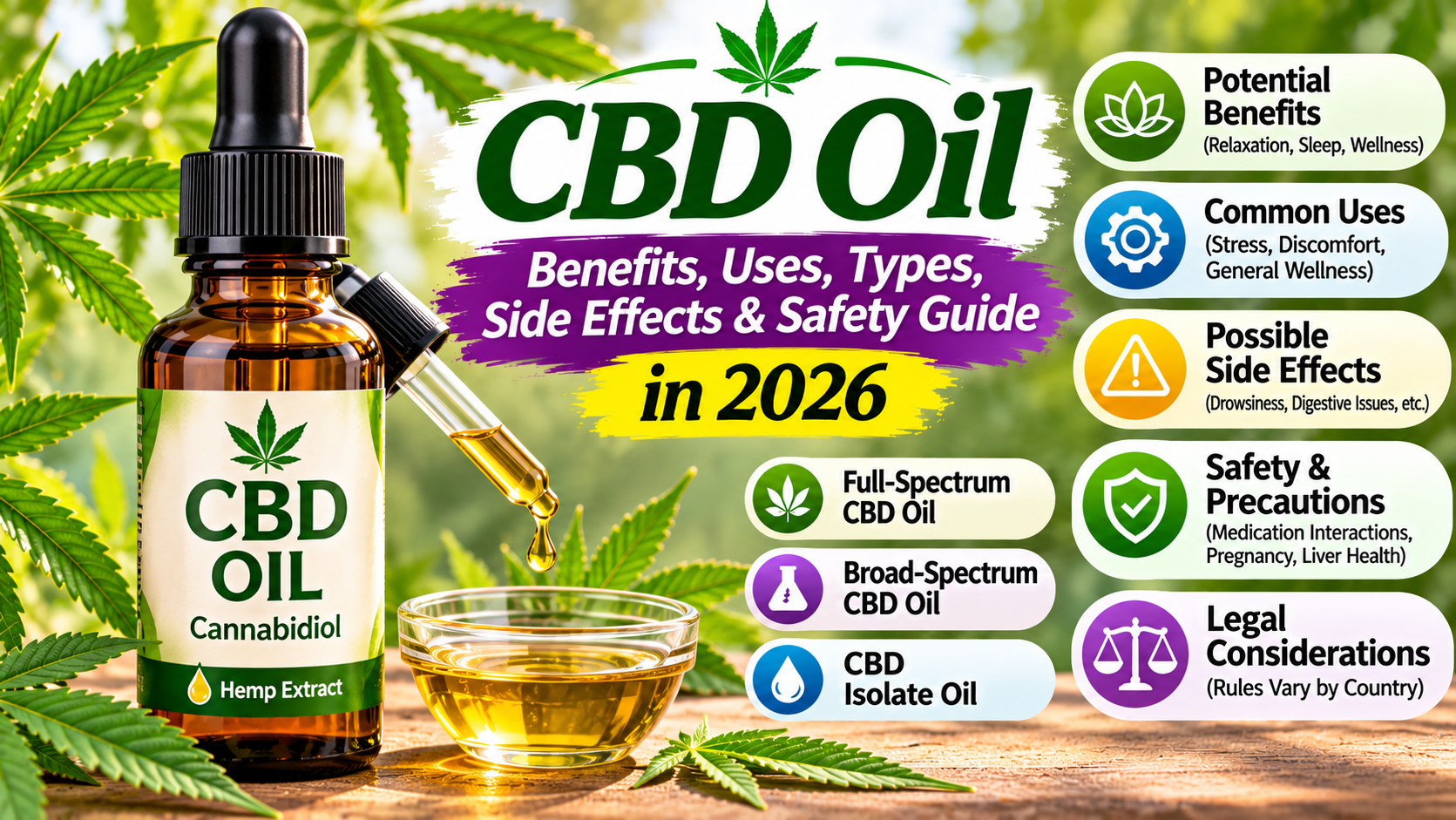
CBD oil has become one of the most recognized products in the growing cannabidiol wellness market. It is available in health and wellness stores, online marketplaces, and specialized product retailers. Consumers encounter CBD oil in different formulations, concentrations, and flavors, often marketed for relaxation, sleep support, pain management, and general wellness.
CBD stands for cannabidiol, a naturally occurring compound found in the Cannabis sativa plant. Unlike THC, the cannabinoid primarily responsible for the intoxicating effects associated with marijuana, CBD does not typically produce a traditional cannabis high. However, it is not completely risk-free. It can cause side effects, interact with prescription medicines, and potentially affect liver health.
Scientific research into cannabidiol is continuing. One prescription CBD medication has been approved in the United States for certain seizure disorders, but many other health claims associated with commercial CBD oils have not been established through sufficient clinical evidence.
Understanding the difference between scientifically supported medical applications and commercial wellness claims is essential before considering any CBD product.
This comprehensive guide explores what CBD oil is, how it works, its potential benefits, different formulations, possible side effects, product quality, and legal considerations in 2026.
What Is CBD Oil?
CBD oil is a product made by extracting cannabidiol from the cannabis plant and combining the extract with a carrier oil or another suitable formulation.
Cannabidiol is one of many naturally occurring cannabinoids found in cannabis. Other plant compounds include THC, CBG, and CBC.
CBD is particularly well known because it is not typically intoxicating. Unlike THC, it does not produce the characteristic high associated with marijuana.
Manufacturers produce CBD oil using different extraction and processing methods. The resulting product may contain purified CBD or a combination of cannabinoids and other cannabis-derived compounds.
Common ingredients in CBD oil products include:
Cannabidiol extract.
Medium-chain triglyceride (MCT) oil.
Hemp seed oil.
Olive oil.
Natural flavorings.
Other botanical ingredients.
The exact formulation depends on the manufacturer.
CBD oil is generally sold in small bottles with dropper caps. Product labels may advertise different CBD concentrations, such as 5%, 10%, or 20%, or provide the total cannabidiol content in milligrams.
Consumers should distinguish between the total CBD amount in a bottle and the amount in an individual serving.
How Does CBD Oil Work?
CBD interacts with several biological pathways in the human body. Researchers are studying these interactions to understand how cannabidiol may influence processes involving mood, pain perception, sleep, inflammation, and neurological activity.
One important area of research is the endocannabinoid system.
Understanding the Endocannabinoid System
The endocannabinoid system (ECS) is a biological network involved in regulating several physiological processes.
It consists of three main components:
1. Cannabinoid receptors
CB1 and CB2 are two major cannabinoid receptor types. CB1 receptors are found mainly in the central nervous system, while CB2 receptors are associated largely with immune cells and peripheral tissues.
2. Endocannabinoids
These are compounds naturally produced by the human body that interact with cannabinoid receptors.
3. Enzymes
Enzymes help produce and break down endocannabinoids, regulating their activity.
The endocannabinoid system participates in processes related to mood, appetite, memory, sleep, and pain signaling.
THC activates cannabinoid receptors in ways that contribute to its intoxicating effects. CBD has a more complex pharmacological profile and does not interact with these receptors in the same way.
Scientists are still investigating the precise mechanisms behind CBD's effects. Its activity may involve several receptor systems and biological pathways beyond the endocannabinoid system.
How Is CBD Oil Absorbed?
CBD oil can be formulated for different methods of use. Some products are intended to be swallowed, while others are marketed for placement under the tongue.
Absorption depends on the formulation and method of administration.
When swallowed, CBD passes through the digestive system and is processed by the liver. This can influence how much CBD reaches the bloodstream.
Food intake, particularly meals containing fat, may also affect CBD absorption.
Sublingual products are designed to be held under the tongue before swallowing, although the extent of absorption through oral tissues can vary.
Consumers should follow the product's approved labeling and avoid assuming that all CBD oils work in the same way.
Potential Benefits of CBD Oil
CBD oil is marketed for several health and wellness purposes. However, the evidence supporting these uses varies considerably.
Some applications have undergone clinical investigation, while others are supported mainly by early research or commercial claims.
1. CBD Oil and Certain Seizure Disorders
One of the strongest areas of medical evidence for cannabidiol involves certain forms of epilepsy.
A purified prescription CBD medication called Epidiolex has been approved by the United States Food and Drug Administration for specific seizure disorders, including:
Lennox-Gastaut syndrome.
Dravet syndrome.
Seizures associated with tuberous sclerosis complex.
Clinical studies have evaluated this prescription medication under controlled conditions.
It is important to understand that this approval applies to a specific purified prescription product and its approved medical uses. It does not mean that ordinary CBD oils sold online or in wellness stores are equivalent treatments.
People with epilepsy should never replace prescribed treatment with commercial CBD products without specialist medical supervision.
2. CBD Oil and Anxiety Research
Anxiety is one of the most frequently discussed reasons consumers become interested in CBD oil.
Researchers are studying whether cannabidiol affects biological pathways associated with stress responses, mood, and emotional regulation.
Some early studies have produced potentially interesting results. However, the available evidence is not sufficient to establish ordinary commercial CBD oil as a reliable treatment for anxiety disorders.
The effects of CBD may differ depending on the individual, product formulation, and other health factors.
People experiencing persistent anxiety should seek guidance from a qualified healthcare or mental health professional.
3. CBD Oil and Pain Research
CBD oil is often marketed for muscle discomfort, joint problems, and general pain management.
Researchers are investigating how cannabidiol interacts with biological pathways involved in pain signaling and inflammation.
However, evidence supporting CBD alone as a treatment for common pain conditions remains limited.
Some studies examine cannabis-based medicines containing both CBD and THC. Their findings cannot automatically be applied to CBD-only products.
People experiencing ongoing or severe pain should seek medical assessment to identify the underlying cause.
4. CBD Oil and Sleep
Sleep support is another common marketing category for CBD oil.
Some companies advertise cannabidiol products to people experiencing difficulty sleeping or irregular sleep patterns.
However, research has not established that CBD oil consistently treats insomnia.
Sleep difficulties may be associated with several factors, including:
Stress and anxiety.
Irregular sleep schedules.
Medical conditions.
Medication side effects.
Caffeine consumption.
Lifestyle habits.
People experiencing persistent sleep problems should discuss possible causes and treatment options with a healthcare professional.
5. CBD Oil and Inflammation Research
Inflammation is a natural biological response that helps the body respond to injury and infection.
Laboratory and preclinical studies have examined the effects of CBD on certain inflammatory pathways.
These findings have encouraged further investigation into possible medical applications.
However, laboratory results do not prove that commercial CBD oils treat inflammatory diseases in humans.
More high-quality clinical research is required.
6. CBD Oil and Neurological Research
Researchers are investigating CBD in relation to different neurological conditions.
Research areas include:
Certain forms of epilepsy.
Neurological signaling.
Neuroinflammatory processes.
Movement-related conditions.
Potential effects on brain function.
These are developing research areas, not established reasons for consumers to self-medicate with commercial CBD oil.
7. CBD Oil and Skincare
CBD has also attracted attention from the skincare and cosmetics industries.
Some manufacturers include cannabidiol in creams, lotions, serums, and other topical formulations.
These products may contain additional ingredients such as botanical extracts, moisturizers, and skin-conditioning agents.
However, evidence that CBD itself treats acne, eczema, psoriasis, or other skin diseases remains insufficient.
Consumers should review the full ingredient list and distinguish cosmetic claims from medical treatment claims.
Different Types of CBD Oil
CBD oil products are available in several formulations. Understanding these differences can help consumers evaluate product labels and cannabinoid content.
1. Full-Spectrum CBD Oil
Full-spectrum CBD oil contains cannabidiol alongside other naturally occurring compounds found in the cannabis plant.
Depending on the source material and manufacturing process, these compounds may include:
THC.
CBG.
CBC.
Terpenes.
Other plant-derived compounds.
Full-spectrum products may contain THC, even when the amount is relatively small.
Consumers should check independent laboratory results to understand the actual composition.
2. Broad-Spectrum CBD Oil
Broad-spectrum CBD oil generally contains CBD and selected additional cannabis-derived compounds.
Manufacturers typically process these products to remove or substantially reduce THC.
However, the exact composition can vary between products. A broad-spectrum label does not guarantee that a product contains absolutely no THC.
3. CBD Isolate Oil
CBD isolate is a highly purified form of cannabidiol.
Manufacturers process the extract to remove most other cannabis plant compounds.
Products made with CBD isolate are generally marketed as containing cannabidiol without the broader cannabinoid profile found in full-spectrum extracts.
Independent testing is still necessary to confirm purity and cannabinoid content.
4. Hemp-Derived CBD Oil
Hemp-derived CBD oil is produced from hemp varieties of Cannabis sativa.
In some jurisdictions, hemp is legally defined according to a specific THC threshold. For example, United States federal law uses a threshold of no more than 0.3% delta-9 THC on a dry-weight basis for hemp.
This definition does not automatically establish that every hemp-derived CBD product is legal in every country.
5. Flavored CBD Oil
Flavored CBD oils include ingredients intended to improve taste.
Common options include:
Mint.
Citrus.
Berry.
Vanilla.
Natural botanical flavors.
Flavor does not indicate product strength, purity, or medical effectiveness.
CBD Oil vs. CBD Gummies vs. CBD Capsules
CBD is available in several consumer product formats. Each has different characteristics and formulation requirements.
Feature | CBD Oil | CBD Gummies | CBD Capsules |
|---|---|---|---|
Form | Liquid | Chewable edible | Capsule |
Consumption | According to product instructions | Swallowed | Swallowed |
CBD measurement | Often per milliliter or serving | Often per gummy | Often per capsule |
Additional ingredients | Usually carrier oil | Sweeteners and gelling agents | Capsule materials and fillers |
Absorption | Depends on formulation | Through digestive system | Through digestive system |
Taste | May have an earthy flavor | Usually flavored | Often minimal taste |
No single format is automatically the most effective or safest.
Product quality, cannabinoid concentration, ingredients, and individual health circumstances are more important than the format alone.
Common Ingredients in CBD Oil
CBD oil is not necessarily made from cannabidiol alone. Manufacturers commonly use carrier oils and other ingredients to produce a stable formulation.
Cannabidiol Extract
This is the main cannabinoid-containing ingredient.
Its source, purity, and cannabinoid profile should be explained by the manufacturer.
MCT Oil
Medium-chain triglyceride oil is commonly used as a carrier ingredient.
It is often derived from coconut or palm sources.
Hemp Seed Oil
Hemp seed oil is produced from hemp seeds. It contains fatty acids but is not the same thing as CBD extract.
Some products combine hemp seed oil with cannabidiol.
Olive Oil
Olive oil may be used as a carrier oil in certain CBD formulations.
Natural Flavorings
Some products include mint, citrus, or other flavoring ingredients.
Additional Botanical Ingredients
Manufacturers may include other plant-derived ingredients. Consumers should check these carefully, particularly if they have allergies or take medication.
Possible Side Effects of CBD Oil
Although CBD is frequently marketed as a natural wellness ingredient, it is not risk-free.
Research and regulatory organizations have identified several possible adverse effects.
Commonly reported concerns include:
Drowsiness.
Diarrhea.
Changes in appetite.
Fatigue.
Nausea.
Digestive discomfort.
Changes in mood.
Potential liver-related effects.
The likelihood of these effects can depend on CBD exposure, product quality, individual health, and other medicines being used.
1. Drowsiness and Fatigue
CBD may cause sleepiness or reduced alertness in some people.
The risk may increase when CBD is combined with alcohol or other substances that slow activity in the central nervous system.
People who feel drowsy should avoid driving or operating machinery.
2. Digestive Problems
Some consumers may experience diarrhea, nausea, or other gastrointestinal symptoms.
The formulation and carrier ingredients may also contribute to digestive discomfort.
3. Liver-Related Concerns
CBD has been associated with liver enzyme changes and potential liver injury, particularly in studies involving higher-dose prescription treatment.
The European Food Safety Authority has highlighted continuing uncertainties about possible liver effects in its 2026 safety assessments.
People with liver conditions should seek medical advice before considering CBD.
4. Medication Interactions
CBD can influence enzymes involved in processing medicines.
This means it may change how certain medications work or increase the risk of unwanted effects.
Potentially important interactions include some:
Antiseizure medicines.
Blood-thinning medicines.
Sedatives.
Medicines affecting the central nervous system.
Other prescription and over-the-counter treatments.
Anyone taking regular medication should consult a doctor or pharmacist before considering CBD oil.
5. Reproductive and Pregnancy-Related Concerns
CBD is not recommended during pregnancy or breastfeeding.
Safety information is insufficient, and regulatory authorities have highlighted concerns about potential effects on reproduction and development.
People who are pregnant, breastfeeding, or trying to conceive should avoid CBD unless specifically advised by an appropriate healthcare professional.
Is CBD Oil Addictive?
CBD does not produce the same intoxicating effects associated with THC and is not generally associated with the same dependence profile.
However, consumers should not assume that every product labeled CBD contains only cannabidiol.
Some commercial products may contain THC or other cannabinoids.
THC has different effects and risks, so consumers should review independent testing information rather than relying solely on product descriptions.
How to Choose Quality CBD Oil
The CBD market includes products with different manufacturing methods, ingredients, and quality standards.
A professional-looking label does not guarantee purity or accurate CBD content.
Consumers should consider several factors before purchasing a CBD oil product.
1. Look for Independent Laboratory Testing
A reputable manufacturer should provide a certificate of analysis, commonly known as a COA.
The report should come from an independent laboratory and correspond to the specific product batch.
A useful COA may include:
CBD concentration.
THC content.
Other cannabinoid levels.
Pesticide residues.
Heavy metal testing.
Microbial contamination.
Residual solvent testing, where relevant.
2. Check CBD Concentration
CBD oil labels may state the total amount of cannabidiol in the bottle or the concentration per serving.
For example, a bottle containing 1,000 mg of CBD does not mean that every drop contains 1,000 mg.
Consumers should read the label carefully and understand how the manufacturer expresses the CBD content.
3. Review the Full Ingredient List
Check the carrier oil, flavorings, preservatives, and other ingredients.
This is especially important for people with allergies or sensitivities.
4. Research the Manufacturer
Look for transparent information about:
Manufacturer identity.
Business contact details.
Product origin.
Extraction methods.
Quality-control procedures.
Laboratory testing.
Avoid products with unclear sourcing or no verifiable manufacturer information.
5. Avoid Unrealistic Medical Claims
Be cautious when companies claim that CBD oil can cure cancer, eliminate chronic pain, treat every anxiety disorder, or replace prescription medicines.
No commercial CBD oil should be considered a universal medical treatment.
6. Understand THC Content
Some CBD oils contain THC, particularly full-spectrum formulations.
Consumers who need to avoid THC should not rely on terms such as natural, hemp-derived, or premium.
Independent laboratory results are more useful for assessing the actual cannabinoid content.
Understanding CBD Oil Concentration
CBD products are sold in different concentrations and bottle sizes.
A percentage label usually describes the proportion of CBD in the formulation, while a milligram label describes the total amount of CBD.
For example, a manufacturer may advertise a product as containing 500 mg or 1,000 mg of CBD.
These numbers alone do not explain how much CBD is present in an individual serving.
Consumers should check:
Total bottle volume.
Total CBD content.
CBD content per milliliter.
Serving information.
Other cannabinoid content.
It is important not to assume that a higher concentration is better. Greater exposure may increase the possibility of adverse effects.
There is no universal CBD oil dose that is appropriate for everyone. A healthcare professional should assess suitability, especially when medication or an existing medical condition is involved.
CBD Oil and Drug Testing
CBD itself is not usually the main target of standard workplace drug tests. Many tests focus on THC or its metabolites.
However, some CBD products contain THC, and inaccurate labeling may create additional uncertainty.
People who undergo workplace, sporting, or legal drug testing should understand that using a CBD product may carry a risk of THC exposure.
A product advertised as THC-free is not necessarily guaranteed to contain absolutely no THC.
Independent laboratory testing can help, but it cannot eliminate every possible risk.
CBD Oil and the Wellness Industry
CBD oil has become an important category in the broader wellness and consumer products market.
Its popularity has attracted attention from manufacturers, retailers, researchers, and investors.
Growing Interest in Hemp-Derived Products
Hemp-derived products are marketed in different formats, including oils, capsules, gummies, topical creams, and cosmetics.
CBD oil remains one of the most recognizable formulations because of its concentrated liquid format.
Demand for Transparent Product Labels
Consumers increasingly need clear information about CBD concentration, THC content, product ingredients, and manufacturing quality.
Independent testing can help distinguish transparent products from those with unclear composition.
Development of CBD Skincare Products
Some cosmetic manufacturers use CBD in topical formulations.
These products may combine cannabidiol with moisturizers, botanical extracts, and other skin-conditioning ingredients.
However, cosmetic use should not be confused with proven treatment of skin diseases.
Responsible Advertising
Businesses must avoid unsupported medical claims.
Marketing statements should distinguish between general product information and claims that a product can diagnose, treat, cure, or prevent a disease.
Is CBD Oil Legal in 2026?
The legal status of CBD oil varies across countries and jurisdictions.
Some governments distinguish between hemp-derived CBD, cannabis-derived CBD, prescription medicines, and CBD-containing consumer products.
Legal requirements may depend on:
The source of cannabidiol.
THC concentration.
Product classification.
Intended use.
Manufacturing requirements.
Importation and distribution rules.
Advertising and labeling standards.
United States
The FDA regulates cannabis-derived products under federal food, drug, and cosmetic laws.
The FDA has approved a prescription CBD medicine for certain seizure disorders. This does not mean that all CBD oils are approved medicines.
The agency has also stated that CBD products face specific restrictions under federal food and dietary supplement laws.
United Kingdom
The UK Food Standards Agency treats CBD products intended for consumption as novel foods.
Its consumer guidance recommends that healthy adults limit CBD consumption from food products to a maximum of 10 mg per day. It advises children, pregnant or breastfeeding people, people trying to conceive, and people taking medication to avoid CBD.
This is UK-specific precautionary guidance, not a universal safe-use recommendation for all countries or medical products.
The FSA also recommends checking its public list of CBD novel food applications before purchasing CBD food products.
European Union
In February 2026, the European Food Safety Authority established a provisional safe intake level of approximately 2 mg per day for a 70 kg adult, but only for specific highly purified CBD food supplement formulations meeting defined conditions.
EFSA emphasized that important safety uncertainties remain. Its assessment did not establish a universal safe intake for every CBD oil or commercial formulation.
Pakistan and Other Markets
Consumers and businesses in Pakistan should check current official rules before purchasing, importing, distributing, or selling CBD oil.
Cannabis-related products may be subject to controlled-substance, pharmaceutical, food, and importation requirements.
A product being available through an international online retailer does not establish that it can legally be imported or sold in Pakistan.
The same principle applies elsewhere: verify the relevant national and local regulations before buying or distributing CBD products.
Common Myths About CBD Oil
There is considerable confusion surrounding CBD oil. Understanding the difference between established facts and commercial claims can help consumers make informed decisions.
Myth 1: CBD Oil and Marijuana Are the Same
CBD is a specific chemical compound found in cannabis plants. Marijuana refers to cannabis material containing various cannabinoids and other plant compounds.
The terms should not be used interchangeably.
Myth 2: CBD Oil Always Produces a High
CBD itself does not typically produce the intoxicating effects associated with THC.
However, some CBD products contain THC or other cannabinoids that may have different effects.
Myth 3: CBD Oil Has No Side Effects
CBD can cause drowsiness, digestive problems, and other unwanted effects. It may also interact with prescription medicines and affect liver health.
Myth 4: More CBD Means Better Results
A higher concentration does not automatically make a product more effective or safer.
Greater exposure may increase potential risks.
Myth 5: Every CBD Oil Is Medically Approved
Most commercial CBD oils are not approved medicines for treating medical conditions.
A specific prescription CBD product has been approved for certain seizure disorders, but this approval does not extend to ordinary wellness products.
Myth 6: Natural CBD Products Are Always Safe
Natural origin does not guarantee safety, purity, or effectiveness.
Consumers should consider the complete formulation, laboratory testing, legal status, and potential medication interactions.
The Future of CBD Oil in 2026 and Beyond
The future of CBD oil will depend on scientific research, product quality, regulatory decisions, and consumer education.
Several developments are likely to remain important.
More Clinical Research
Researchers need larger and better-designed human studies to determine which medical applications of CBD are effective and which claims lack sufficient evidence.
Improved Product Testing
Independent laboratory testing can help manufacturers verify CBD concentrations, THC content, and contamination levels.
Better testing standards may improve consumer confidence.
Stronger Product Transparency
Clear labeling, accurate cannabinoid information, and traceable manufacturing processes can help consumers understand what they are buying.
Evolving Regulations
Governments continue to review CBD's classification as a food ingredient, supplement, cosmetic, or medicine.
Businesses will need to monitor regulatory changes in the countries where they operate.
Greater Focus on Long-Term Safety
Research into liver health, reproductive effects, neurological development, and medication interactions will remain important.
More evidence is needed before broad claims about the long-term safety of commercial CBD oil can be supported.
Conclusion
CBD oil is a cannabidiol-containing product derived from the Cannabis sativa plant. It is available in several formulations, including full-spectrum, broad-spectrum, and CBD isolate products.
Its popularity has increased because it is marketed for relaxation, sleep support, pain-related concerns, and general wellness. However, scientific evidence supporting many of these advertised benefits remains limited.
A specific prescription CBD medicine has been approved for certain seizure disorders, but ordinary commercial CBD oils should not be considered equivalent medical treatments.
CBD can cause side effects, interact with prescription medicines, and raise concerns about liver health and long-term safety. Consumers should examine product labels, verify independent laboratory testing, understand THC content, and check local regulations.
Anyone taking medication, living with a medical condition, or considering CBD for a health concern should consult a qualified healthcare professional before using it.
As research continues in 2026, responsible marketing, transparent manufacturing, and reliable scientific evidence will be essential to understanding the role of CBD oil in healthcare and the wider wellness industry.
Frequently Asked Questions (FAQs)
1. What is CBD oil?
CBD oil is a product containing cannabidiol, a naturally occurring compound extracted from cannabis plants and usually combined with a carrier oil.
2. Does CBD oil make you high?
CBD does not typically produce the intoxicating high associated with THC. However, some CBD oils may contain THC, so consumers should check independent laboratory results.
3. What is CBD oil used for?
CBD oil is marketed for relaxation, sleep support, and other wellness purposes. However, scientific evidence for many of these uses remains limited. A specific prescription CBD medicine is approved for certain seizure disorders.
4. What are the different types of CBD oil?
The main formulations include full-spectrum CBD oil, broad-spectrum CBD oil, and CBD isolate oil. They differ in their cannabinoid composition and potential THC content.
5. Is CBD oil safe?
CBD oil is not risk-free. Possible concerns include drowsiness, diarrhea, medication interactions, and liver-related effects. Safety depends on the formulation and individual health circumstances.
6. Can CBD oil interact with medication?
Yes. CBD can affect enzymes responsible for processing medicines and may change their effects. Consult a doctor or pharmacist before combining CBD with prescription medication.
7. Is CBD oil legal?
CBD laws vary by country and region. Legal status may depend on the product's source, THC content, intended use, and regulatory classification.
8. Does CBD oil contain THC?
Some CBD oils contain THC, particularly full-spectrum products. Broad-spectrum and isolate products are generally designed to contain little or no THC, but laboratory testing is needed to verify their composition.
9. Can CBD oil help with anxiety?
CBD is being investigated for possible effects on anxiety-related pathways. However, current evidence is not sufficient to establish commercial CBD oil as a reliable treatment for anxiety disorders.
10. Can CBD oil help with sleep?
CBD is marketed for sleep support, but research has not established that commercial CBD oil consistently treats insomnia. Persistent sleep difficulties should be discussed with a healthcare professional.
11. What is the difference between hemp seed oil and CBD oil?
Hemp seed oil is extracted from hemp seeds and contains fatty acids. CBD oil contains cannabidiol extracted from cannabis plant material. They are different products and should not be confused.
12. How can I identify quality CBD oil?
Look for a transparent manufacturer, a complete ingredient list, clearly stated CBD content, and a batch-specific certificate of analysis from an independent laboratory.
13. Is CBD oil suitable during pregnancy?
CBD is not recommended during pregnancy or breastfeeding because of unresolved safety concerns. People who are pregnant, breastfeeding, or trying to conceive should avoid CBD unless specifically advised by an appropriate healthcare professional.
14. Can CBD oil appear on a drug test?
Standard drug tests generally focus on THC or its metabolites rather than CBD. However, CBD products containing THC may create a risk of a positive result.
15. Can CBD oil replace prescription medicine?
No. Commercial CBD oil should not replace prescribed treatment. Anyone considering CBD for a medical condition should first discuss it with a qualified healthcare professional.