The role of the Chief Human Resources Officer has changed significantly. HR leaders were traditionally focused on recruitment, employee relations, compensation, benefits, compliance, and workforce administration. Today, CHROs are increasingly expected to participate directly in enterprise strategy.
Organizations are navigating rapid technological change, shifting workforce expectations, economic uncertainty, and new approaches to how work is designed. In this environment, the CHRO has become an important strategic partner to the CEO and other members of the C-suite.
Current CHRO priorities include AI and workplace digitization, leadership development, organizational culture, workforce planning, and preparing employees for changing roles. The 2026 CHRO Association survey identifies AI and workplace digitization among the dominant priorities for HR leaders, alongside resilience and risk management.
These developments make professional networking increasingly important for HR executives.
What Is a CHRO Network?
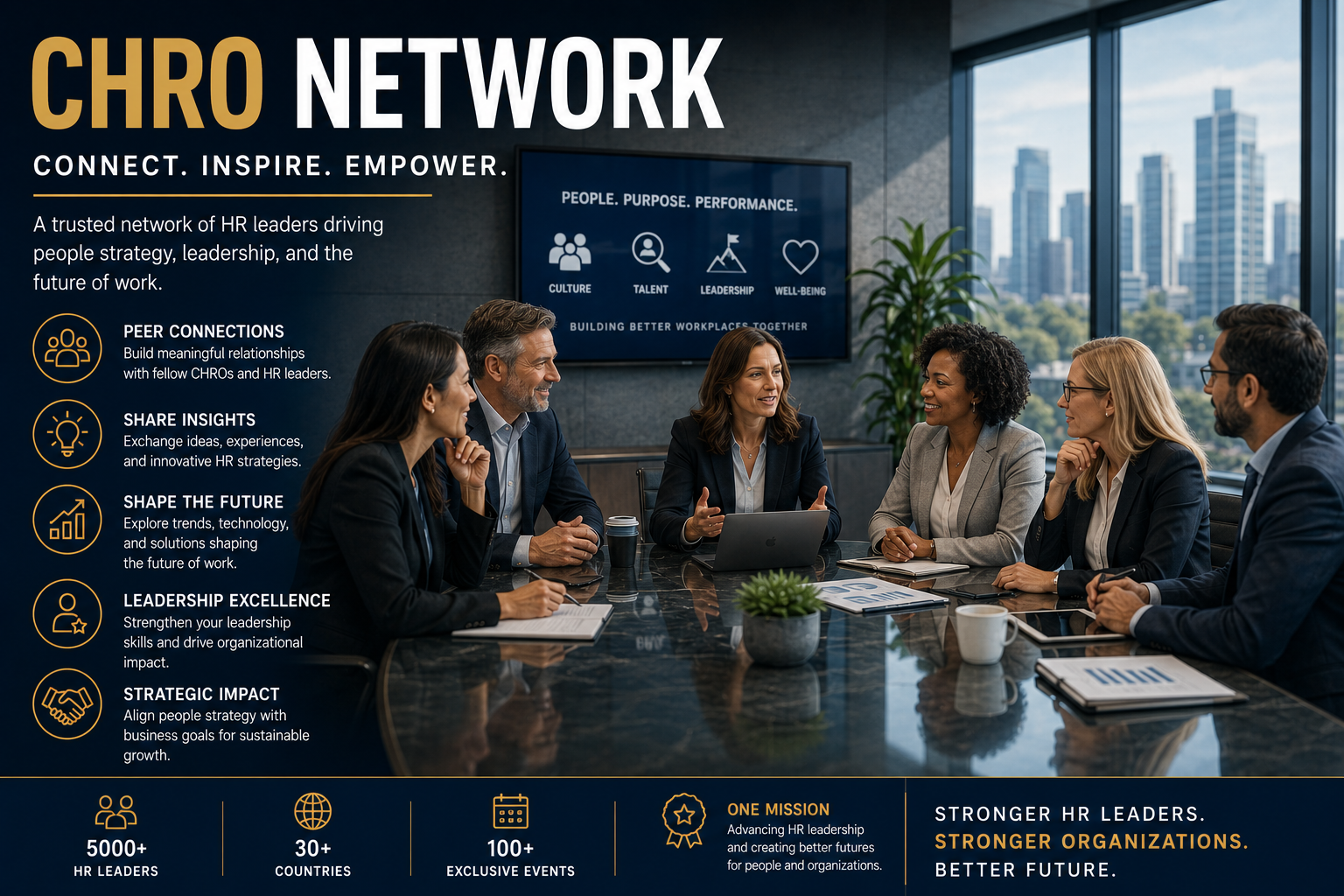
A CHRO Network is a professional community that brings together Chief Human Resources Officers, senior HR executives, people leaders, and other professionals responsible for organizational talent and workforce strategy.
These networks can operate through executive forums, private peer groups, conferences, roundtables, professional associations, and digital communities.
The purpose goes beyond simply creating professional contacts. Effective CHRO networks provide trusted environments where leaders can share experiences, compare approaches, discuss complex workforce issues, and learn from peers.
For example, executive communities may organize confidential discussions around organizational culture, AI adoption, leadership development, talent strategy, employee experience, workforce analytics, and organizational transformation.
The value of these communities comes from the quality of the relationships and knowledge exchanged between members.
Why CHRO Networking Matters
HR leaders frequently face challenges that do not have simple solutions.
A CHRO may need to redesign an organization, respond to changing employee expectations, develop future leadership capabilities, introduce new technology, or manage a major transformation.
Talking with other experienced HR leaders can provide perspectives that may not be available within the organization.
A peer may have already faced a similar challenge and can share what worked, what failed, and what they would do differently.
The objective is not necessarily to copy another organization's strategy. Instead, peer conversations can help CHROs identify important questions, recognize potential risks, and consider alternative approaches.
This makes a CHRO Network a valuable source of practical knowledge.
Learning From Other HR Leaders
One of the biggest advantages of a CHRO Network is peer-to-peer learning.
HR leaders can exchange experiences related to:
Talent acquisition and retention
Leadership development
Organizational culture
Employee engagement
Workforce planning
Artificial intelligence
HR technology
Skills development
Organizational restructuring
Change management
Compensation and benefits
Diversity and inclusion strategies
Workforce analytics
Succession planning
Sharing real experiences can make complex challenges easier to understand.
For example, one CHRO may have developed a successful workforce planning model while another may have experience introducing AI into recruitment or learning programs.
Current CHRO research shows that organizations are already using AI in areas such as talent acquisition, HR service delivery, and learning, although scaling these initiatives remains challenging.
Peer networking allows executives to discuss these developments from a practical business perspective.
CHRO Networks and Artificial Intelligence
Artificial intelligence is changing the responsibilities of HR leaders.
AI can influence recruitment, employee services, learning, workforce analytics, job design, performance management, and talent planning. As these technologies develop, CHROs must consider not only how HR can use AI but also how AI will change the workforce itself.
Gartner identifies AI-driven HR transformation and shaping work in the human-machine era among the major priorities for CHROs in 2026.
This creates an important opportunity for CHRO networking.
HR leaders can discuss questions such as:
Which HR processes should be automated?
How should employees be prepared for AI-enabled work?
What skills will become more important?
How can organizations maintain trust?
How should AI-related workforce decisions be governed?
How can organizations combine human judgment with technology?
These discussions can help CHROs move beyond technology adoption toward broader workforce transformation.
Building Future-Ready Workforces
A future-ready workforce requires more than hiring new employees.
Organizations must understand how jobs are changing, which skills will be needed, and how existing employees can develop those capabilities.
CHROs increasingly have responsibility for connecting workforce planning with business strategy.
This means identifying future talent requirements, developing internal capabilities, creating effective learning programs, and preparing employees for changing roles.
PwC highlights job architecture, skills, career paths, and human-AI collaboration as important areas for CHROs as AI reshapes how work is performed.
A CHRO Network can provide a valuable environment for discussing these workforce challenges and sharing practical approaches.
Strengthening Leadership and Organizational Culture
Technology may transform how organizations work, but leadership and culture remain critical.
CHROs play an important role in helping organizations develop leaders who can manage uncertainty, communicate effectively, and guide employees through continuous change.
A strong organizational culture can support employee trust, collaboration, innovation, and performance.
CHRO networks allow leaders to exchange ideas about leadership development, culture-building, employee communication, and change management.
These conversations can be especially valuable during periods of major organizational transformation, when employees may experience uncertainty about their roles and the future direction of the company.
Building Strategic Relationships
A strong CHRO Network is based on relationships rather than transactions.
Executives can develop professional connections with peers who understand the responsibilities and challenges of senior HR leadership.
Over time, these relationships can develop into mentorship opportunities, strategic partnerships, knowledge-sharing relationships, or trusted professional friendships.
The strongest connections are usually built through consistent engagement and mutual value.
Rather than contacting another executive only when assistance is needed, CHROs can strengthen their networks by sharing resources, making introductions, discussing industry developments, and supporting one another's professional growth.
Confidentiality and Trust
Confidentiality is particularly important for senior HR executives.
CHROs may need to discuss sensitive issues involving employees, organizational restructuring, leadership changes, compensation, workforce strategy, or cultural challenges.
A trusted peer environment can allow executives to discuss these issues more openly.
For this reason, the quality of a CHRO Network often matters more than its size.
A smaller community of experienced leaders who can have honest and confidential conversations may provide greater value than a large network built primarily around superficial connections.
Current executive communities emphasize confidential peer conversations and practical insights as central elements of CHRO networking.
How CHROs Can Build a Stronger Network
Building a valuable CHRO Network requires a deliberate approach.
Prioritize Quality
CHROs should focus on developing meaningful relationships with experienced leaders rather than simply collecting contacts.
Share Knowledge
Networking should be a two-way process. Sharing experiences, research, resources, and useful introductions can strengthen professional relationships.
Connect Across Industries
HR challenges often cross industry boundaries. Connecting with leaders from different sectors can expose CHROs to new ideas and alternative approaches.
Stay Consistent
Strong professional relationships develop over time. Regular conversations, executive events, roundtables, and digital engagement can help maintain valuable connections.
Learn From Different Perspectives
A strong network should include leaders with different experiences, backgrounds, company sizes, and business models. Diverse perspectives can improve strategic thinking.
The Future of CHRO Networks
The future of CHRO networking will be shaped by the changing nature of work.
As AI becomes more integrated into organizations, HR leaders will increasingly need to address workforce redesign, skills development, organizational culture, leadership readiness, and responsible technology adoption.
The CHRO is increasingly becoming an architect of workforce transformation rather than simply an administrator of HR processes. Recent research describes the modern CHRO as a leader responsible for reshaping how employees, technology, skills, and organizational models work together.
This transformation makes executive communities even more valuable.
CHROs will need trusted environments where they can discuss emerging trends before they become mainstream, learn from organizations already experimenting with new approaches, and develop strategies for managing change.
Conclusion
A CHRO Network is more than a professional contact list. It is a community where senior HR leaders can exchange knowledge, challenge assumptions, develop relationships, and prepare for the future of work.
As the CHRO role continues to expand into AI, workforce planning, organizational transformation, leadership, culture, and business strategy, access to trusted peer perspectives can become an important leadership advantage.
The strongest networks are built on trust, confidentiality, meaningful conversations, and mutual value.
For today's CHRO, the right network can provide more than professional connections. It can offer a sounding board for difficult decisions, a source of new ideas, a platform for leadership development, and a community of experienced executives navigating many of the same challenges.
Ultimately, stronger CHRO networks can help create stronger HR functions, more capable leaders, more adaptable workforces, and organizations that are better prepared for the future.