The role of the Chief Marketing Officer has changed dramatically as technology, consumer behavior, and digital channels continue to evolve.
Marketing leaders were traditionally responsible for advertising, branding, public relations, campaigns, and customer communications. While these responsibilities remain important, today's CMOs are increasingly expected to contribute directly to business growth and corporate strategy.
Modern CMOs must understand customer behavior, revenue objectives, technology, data, brand positioning, digital experiences, and organizational priorities.
They are often expected to demonstrate how marketing investments contribute to measurable business outcomes. This requires a combination of creativity, analytical thinking, technological awareness, and strategic leadership.
As these responsibilities grow, CMOs can benefit significantly from connecting with other experienced marketing executives through a strong CMO Network.
What Is a CMO Network?
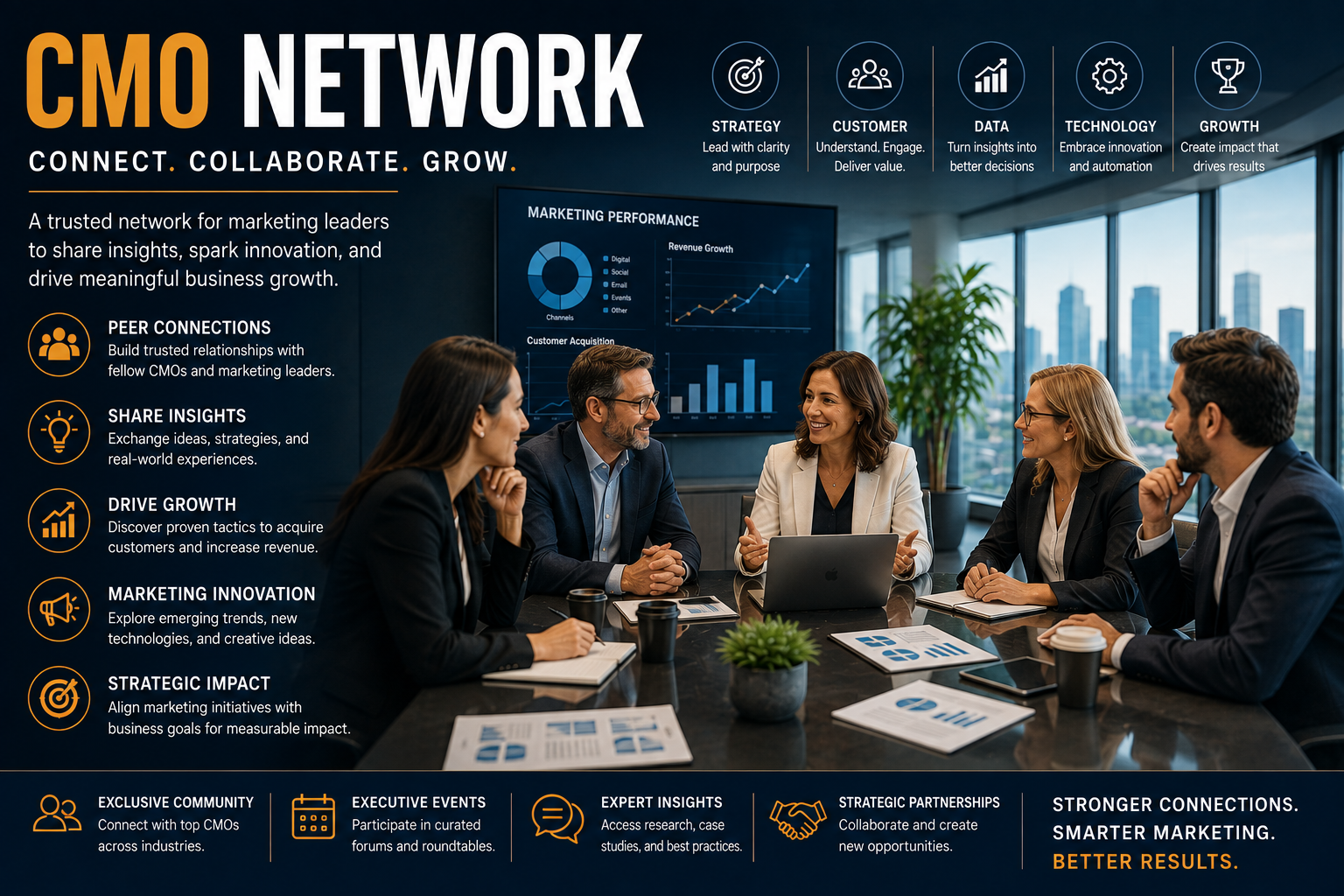
A CMO Network is a professional community that connects Chief Marketing Officers, senior marketing executives, brand leaders, digital marketing professionals, growth executives, and other senior business leaders.
These networks can take the form of executive forums, private peer communities, conferences, marketing roundtables, leadership events, professional associations, and digital platforms.
The purpose is not simply to create a larger contact list.
An effective CMO Network provides an environment where marketing leaders can discuss real challenges, exchange experiences, explore new ideas, and develop trusted professional relationships.
Because marketing is constantly influenced by changing technology and customer expectations, access to diverse perspectives can help CMOs stay informed and adaptable.
Why CMO Networking Matters
Marketing leaders operate in an environment where trends can change quickly.
Consumer expectations, social platforms, search behavior, advertising technologies, artificial intelligence, privacy requirements, and digital experiences are continually evolving.
A strategy that performs well today may require significant changes tomorrow.
Connecting with other CMOs allows executives to learn how peers are responding to similar changes.
A marketing leader may discover a new approach to customer acquisition, learn how another organization measures marketing performance, or gain insight into how a peer is using artificial intelligence to improve productivity.
The value of networking is not necessarily finding a ready-made solution. It is gaining new perspectives that can improve strategic thinking and decision-making.
Learning From Other Marketing Leaders
Peer-to-peer learning is one of the most valuable benefits of a CMO Network.
CMOs can exchange experiences involving:
Brand strategy
Customer acquisition
Digital marketing
Marketing analytics
Artificial intelligence
Content strategy
Social media
Customer experience
Marketing technology
Revenue growth
Personalization
Brand reputation
Market expansion
Marketing team development
Performance measurement
These conversations can provide practical insights that are difficult to gain from theoretical resources alone.
For example, a CMO considering a major marketing technology investment can learn from another executive who has already implemented a similar platform.
A marketing leader entering a new market may also benefit from the experience of a peer who has already managed an international expansion.
CMO Networks and Artificial Intelligence
Artificial intelligence is changing marketing at an extraordinary pace.
AI tools can assist with content creation, customer insights, campaign analysis, personalization, forecasting, research, automation, and many other marketing activities.
However, the increasing availability of AI also creates challenges.
CMOs need to consider brand consistency, accuracy, customer trust, data governance, privacy, intellectual property, employee skills, and the appropriate role of human judgment.
A CMO Network can provide a valuable environment for executives to discuss these issues.
Marketing leaders can share practical experiences about how AI is being used, which applications are producing meaningful results, and where human oversight remains essential.
Peer conversations can help CMOs distinguish between technology that creates genuine value and technology that simply follows a temporary trend.
Building Customer-Centric Strategies
Modern marketing is increasingly focused on understanding the complete customer journey.
Customers may interact with a brand through websites, social media, search engines, mobile applications, email, physical locations, customer service teams, and other channels.
Creating a consistent experience across these touchpoints requires collaboration between marketing, sales, technology, operations, and customer service.
CMOs can use their professional networks to learn how other organizations are improving customer journeys.
Sharing customer research methods, personalization strategies, loyalty programs, and experience-management approaches can help marketing leaders identify new opportunities.
The goal is to move beyond individual campaigns and create lasting customer relationships.
Connecting Marketing With Revenue
The modern CMO is increasingly expected to demonstrate measurable business impact.
Brand awareness and engagement remain important, but organizations also want to understand how marketing contributes to customer acquisition, retention, revenue, and long-term growth.
This requires CMOs to work closely with sales, finance, product, and executive leadership.
A strong CMO Network can help marketing executives exchange ideas about performance measurement and attribution.
Leaders can discuss which metrics are most useful, how marketing budgets are evaluated, and how teams can better connect marketing activities with organizational objectives.
This business-oriented approach can strengthen the strategic position of marketing within the C-suite.
The Importance of Brand Leadership
While data and technology are transforming marketing, brand leadership remains essential.
A strong brand can help organizations differentiate themselves in competitive markets and create stronger relationships with customers.
CMOs are responsible for protecting and developing brand identity while ensuring that marketing communications remain relevant.
Executive networking can expose CMOs to different approaches to brand positioning, storytelling, reputation management, and customer trust.
Learning from leaders in different industries can also help marketing executives identify new ways to communicate value and build emotional connections with audiences.
Driving Marketing Innovation
Innovation is a core part of modern marketing leadership.
New channels, technologies, platforms, and customer behaviors create opportunities for organizations to experiment with new approaches.
However, innovation needs strategic discipline.
CMOs must determine which experiments are worth pursuing, how success should be measured, and when resources should be shifted away from approaches that are not producing results.
A CMO Network can encourage this type of experimentation by allowing leaders to discuss successful and unsuccessful initiatives openly.
Learning about what did not work can be just as valuable as learning about successful campaigns.
Developing Marketing Talent
Marketing transformation depends heavily on people.
Modern marketing teams may require expertise in analytics, content, performance marketing, brand management, technology, customer research, artificial intelligence, creative strategy, and digital platforms.
CMOs therefore need to develop teams that can adapt as the marketing environment changes.
A professional network can help executives exchange ideas about recruitment, employee development, organizational structures, succession planning, and leadership training.
CMOs can also learn how other organizations are combining creative and analytical capabilities to build stronger marketing functions.
Building Strategic Relationships
A strong CMO Network is built on genuine professional relationships.
Networking should not be limited to seeking customers or business opportunities.
CMOs can create stronger connections by sharing useful resources, exchanging experiences, making introductions, and supporting other marketing leaders.
Over time, these relationships may lead to strategic partnerships, mentorship opportunities, collaborations, talent connections, or new business opportunities.
The most valuable relationships often develop gradually through consistent engagement.
Confidentiality and Trust
Marketing executives sometimes deal with sensitive information involving campaigns, product launches, brand strategies, customer data, budgets, competitive positioning, and organizational decisions.
For this reason, trust is essential within executive networks.
A confidential peer environment can allow CMOs to discuss difficult challenges more openly and seek honest feedback.
The quality of a CMO Network is therefore more important than its size.
A smaller group of experienced and trusted marketing executives can provide significant value when members feel comfortable sharing practical experiences and asking difficult questions.
How CMOs Can Build a Stronger Network
Building a valuable CMO Network requires intentional effort.
Focus on Quality
CMOs should prioritize meaningful relationships with experienced executives rather than simply accumulating contacts.
Connect Across Industries
Marketing challenges can often be solved through ideas borrowed from outside a particular industry. Cross-industry connections can introduce new perspectives and creative approaches.
Share Knowledge
Effective networking is a two-way process. CMOs can strengthen relationships by sharing research, insights, resources, and lessons from their own experiences.
Stay Consistent
Professional relationships require ongoing communication. Participating in events, roundtables, online discussions, and one-to-one conversations can keep networks active.
Embrace Diverse Perspectives
A strong network should include leaders with different professional experiences, markets, business models, and areas of expertise.
The Future of CMO Networks
The future of marketing leadership will be shaped by artificial intelligence, changing customer expectations, privacy considerations, data-driven decision-making, emerging digital channels, and increasingly competitive markets.
CMOs will need to combine creativity with technology and analytics while maintaining a strong understanding of people and brand value.
This changing environment makes peer communities increasingly valuable.
The most effective CMO Networks will provide opportunities for leaders to discuss emerging trends, exchange practical knowledge, explore new technologies, and develop relationships with executives who understand the realities of modern marketing.
Digital platforms will make global connections easier, while in-person meetings and private executive discussions will remain important for building trust.
CMO Networks and Sustainable Business Growth
Marketing has a direct connection to how organizations attract, engage, and retain customers.
When CMOs develop stronger strategies, improve customer experiences, build trusted brands, and allocate marketing resources effectively, they can contribute significantly to long-term business performance.
A CMO Network can support this process by providing access to new ideas and experienced perspectives.
A conversation with another marketing executive may lead to a new customer acquisition strategy, a better measurement framework, a technology investment, a partnership, or a different approach to brand development.
These insights can become valuable sources of competitive advantage when adapted thoughtfully to an organization's unique circumstances.
Conclusion
A CMO Network is more than a collection of marketing professionals. It is a community where senior marketing leaders can exchange knowledge, explore innovation, discuss challenges, and develop trusted relationships.
As the CMO role continues to expand into business strategy, artificial intelligence, customer experience, technology, data, and revenue growth, professional connections can provide an important source of perspective and expertise.
The strongest CMO networks are built around trust, meaningful conversations, diverse perspectives, and mutual value.
For today's marketing executive, the right network can provide a sounding board for strategic decisions, a source of innovative ideas, opportunities for collaboration, and a community of leaders facing many of the same challenges.
Ultimately, stronger CMO connections can help create stronger brands, more effective marketing teams, better customer experiences, and sustainable business growth.
In a world where customer expectations and marketing technologies continue to evolve, the ability to learn, adapt, and connect with other leaders can become one of the most valuable advantages a CMO can develop.