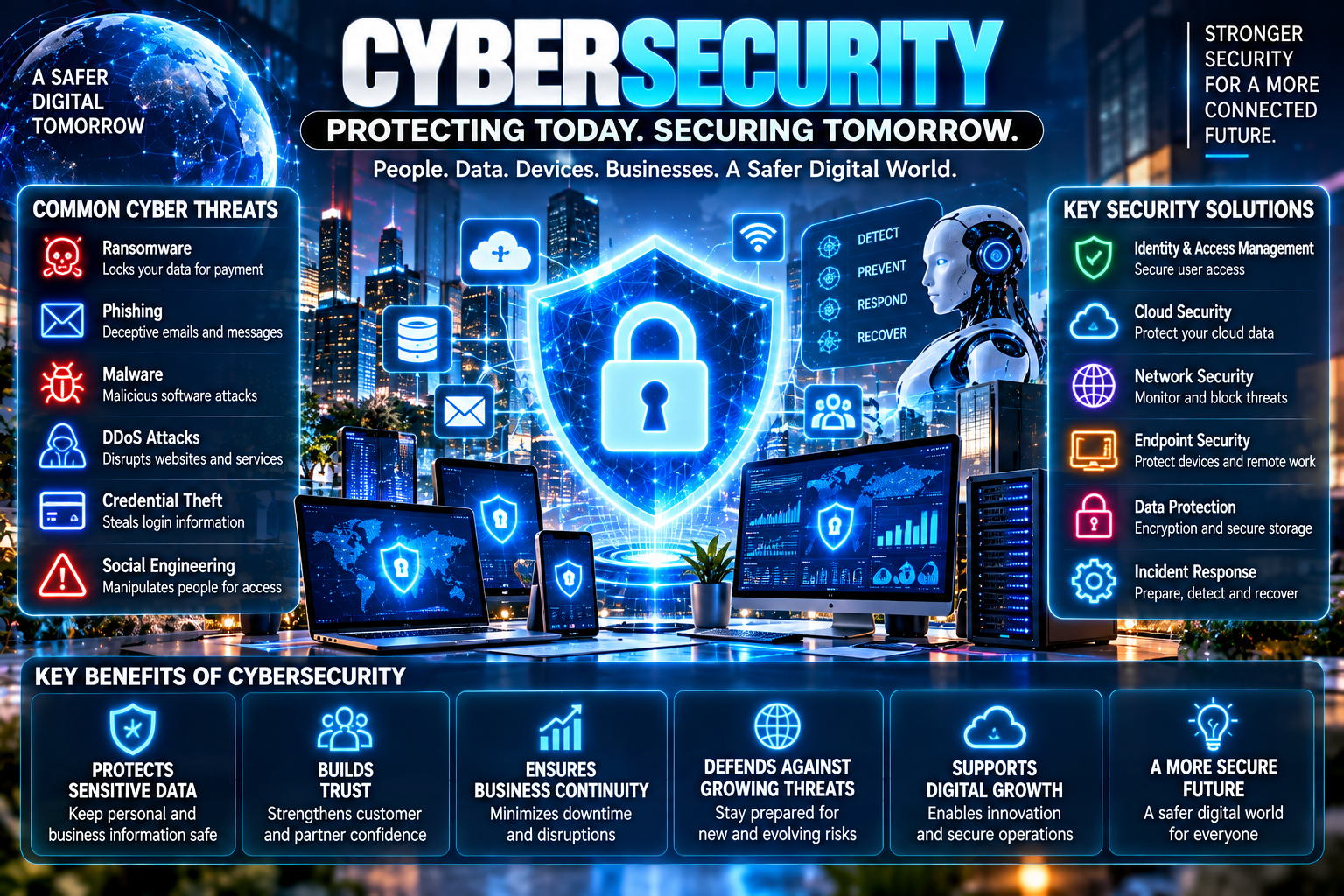
Cybersecurity has become an essential part of modern life. Businesses, governments, financial institutions, healthcare organizations, schools, and individuals increasingly depend on connected systems to store information, communicate, conduct transactions, and operate digital services.
As organizations become more dependent on technology, protecting digital systems becomes increasingly important.
Cybersecurity refers to the technologies, processes, policies, and practices used to protect systems, networks, applications, devices, and information from unauthorized access, disruption, damage, or misuse.
The cybersecurity environment continues to change rapidly. ENISA's 2026 Threat Landscape, published in September 2026, identifies ransomware as the most impactful short-term type of cyber incident and notes continuing activity involving cybercrime, cyberespionage, hacktivism, and emerging AI-supported malicious operations.
For organizations, cybersecurity is no longer simply an IT responsibility. It is increasingly part of enterprise risk management, business continuity, privacy, and operational strategy.
What Is Cybersecurity?
Cybersecurity is the practice of protecting digital environments from threats.
These environments can include:
Computers
Smartphones
Servers
Cloud platforms
Networks
Websites
Applications
Databases
IoT devices
Industrial systems
Artificial intelligence systems
Cybersecurity aims to protect three fundamental objectives commonly known as the CIA triad:
Confidentiality
Confidentiality means ensuring that information is accessible only to authorized people and systems.
Integrity
Integrity means protecting information from unauthorized modification or destruction.
Availability
Availability means ensuring that authorized users can access systems and information when needed.
Together, these principles form an important foundation for cybersecurity planning.
Why Cybersecurity Matters
Modern organizations depend on digital infrastructure for everyday operations.
A cybersecurity incident can potentially affect:
Customer information
Financial systems
Business operations
Intellectual property
Websites
Cloud applications
Supply chains
Employee accounts
Critical infrastructure
The consequences can include financial losses, operational disruption, regulatory problems, reputational damage, and loss of customer trust.
Cybersecurity therefore needs to be treated as an ongoing risk-management activity rather than a one-time technology purchase.
The NIST Cybersecurity Framework
The NIST Cybersecurity Framework 2.0 provides guidance that organizations can use to understand, assess, prioritize, and communicate cybersecurity risks.
The framework is designed to be flexible and can be used by organizations of different sizes and sectors.
CSF 2.0 organizes cybersecurity outcomes around six core functions:
Govern
Identify
Protect
Detect
Respond
Recover
These functions provide a useful structure for building and improving cybersecurity programs.
Common Cybersecurity Threats
Cyber threats take many forms.
Phishing
Phishing involves deceptive messages designed to convince people to reveal information, open malicious files, click dangerous links, or perform unauthorized actions.
Phishing may appear through:
Email
Text messages
Social media
Messaging applications
Fake websites
Phone calls
Employee awareness and technical email-security controls can both help reduce phishing risk.
Ransomware
Ransomware is malicious software that can prevent access to systems or data and may involve demands for payment.
Ransomware remains a major cybersecurity concern. ENISA's 2026 Threat Landscape identifies ransomware as the most impactful short-term cyber incident type in its assessment of the 2025 threat environment.
Organizations can reduce potential impact through measures such as backups, network segmentation, access controls, endpoint security, vulnerability management, and incident-response planning.
Malware
Malware is a broad category of malicious software.
It can include:
Trojans
Spyware
Worms
Ransomware
Botnet software
Information stealers
Malware can be delivered through malicious downloads, compromised websites, phishing messages, vulnerable applications, or infected devices.
Denial-of-Service Attacks
A denial-of-service attack attempts to disrupt the availability of a service.
A distributed denial-of-service attack, or DDoS, uses multiple systems or sources to generate traffic toward a target.
ENISA's 2026 assessment notes that hacktivist-led DDoS campaigns have continued to affect essential entities, particularly public administration in the EU threat landscape.
Credential Theft
Attackers may attempt to steal usernames, passwords, authentication tokens, or other credentials.
Stolen credentials can potentially provide access to email accounts, cloud systems, business applications, and financial services.
Multi-factor authentication can provide an additional layer of protection beyond passwords.
Cloud Cybersecurity
Cloud computing has transformed how organizations store data and run applications.
However, cloud environments introduce their own security considerations.
Organizations need to manage:
Identity and access
Cloud configurations
Encryption
Application security
Logging
Monitoring
Data protection
Backup
Third-party services
Cloud security is based on shared responsibilities between cloud providers and customers, with the exact responsibilities depending on the service model.
Identity and Access Management
Identity is one of the most important parts of cybersecurity.
Organizations should ensure that users receive only the access they need.
This principle is often described as least privilege.
Important identity-security practices include:
Strong authentication
Multi-factor authentication
Role-based access
Privileged-access management
Password management
Access reviews
Account monitoring
NIST's CSF 2.0 emphasizes governance and risk management alongside technical protections, reinforcing the importance of organizational controls and accountability.
Network Security
Network security focuses on protecting communication infrastructure and controlling traffic between systems.
Common technologies include:
Firewalls
Intrusion detection
Intrusion prevention
Network segmentation
Secure gateways
VPNs
Network monitoring
Organizations increasingly combine traditional network controls with identity-based and application-based security approaches.
Endpoint Security
Endpoints include devices such as:
Laptops
Desktops
Smartphones
Tablets
Servers
Specialized devices
Endpoint security can include antivirus and endpoint-detection tools, patch management, application controls, device encryption, and monitoring.
Because employees increasingly work from different locations, securing endpoints outside traditional office networks is particularly important.
Application Security
Applications can contain vulnerabilities that attackers may exploit.
Application security should therefore be considered throughout the software-development lifecycle.
Security practices can include:
Secure coding
Code review
Vulnerability testing
Dependency management
Authentication
Authorization
API security
Security testing
Organizations increasingly use DevSecOps approaches to integrate security into software development and deployment.
Data Security
Data is one of the most valuable assets for many organizations.
Data security involves protecting information throughout its lifecycle.
Important measures include:
Encryption
Access controls
Data classification
Backup
Monitoring
Data-loss prevention
Secure deletion
Sensitive information may require additional controls depending on legal, regulatory, or contractual requirements.
Cybersecurity and Artificial Intelligence
Artificial intelligence is creating both opportunities and challenges in cybersecurity.
Security teams can use AI for:
Threat detection
Anomaly detection
Security analytics
Alert prioritization
Malware analysis
Vulnerability analysis
Security operations
Incident investigation
NIST is also developing guidance for using AI in cybersecurity risk analysis and reporting, including work related to CSF 2.0.
At the same time, AI systems themselves need to be protected.
AI-Powered Cyber Threats
AI can potentially help attackers automate or improve certain activities.
ENISA's 2026 Threat Landscape notes that emerging AI models are expected to increasingly support malicious operations.
Potential concerns include:
More convincing phishing
Automated content generation
Faster reconnaissance
Social engineering
Automated vulnerability discovery
Malicious code assistance
This creates an environment where defenders need to improve both traditional cybersecurity controls and AI-specific security practices.
Cybersecurity for AI Systems
Organizations deploying AI should consider risks involving:
Sensitive training data
Unauthorized access
Model manipulation
Prompt injection
Data leakage
Insecure integrations
Excessive permissions
Third-party AI services
AI systems should therefore be incorporated into broader cybersecurity and governance programs.
Mobile and Smartphone Security
Smartphones contain significant amounts of personal and business information.
Mobile security threats can involve:
Malicious applications
Account compromise
Phishing
SIM-related attacks
Unsecured networks
Device theft
Spyware
Outdated software
Users should keep operating systems and applications updated and use strong authentication.
Internet of Things Security
The Internet of Things connects physical devices to networks.
Examples include:
Smart cameras
Smart appliances
Industrial sensors
Connected vehicles
Wearable devices
Smart-home systems
IoT security can be challenging because devices may have limited computing resources, long lifecycles, or inconsistent update mechanisms.
Organizations should carefully manage device identity, network access, software updates, and monitoring.
Cybersecurity in Healthcare
Healthcare organizations manage sensitive information and increasingly rely on connected digital systems.
Cybersecurity is important for protecting:
Patient information
Medical devices
Electronic health records
Hospital systems
Research data
Communication platforms
Security incidents can potentially affect both information and operational continuity.
Healthcare organizations therefore need strong identity controls, segmentation, monitoring, backup, and incident-response capabilities.
Cybersecurity in Finance
Financial organizations are major targets for cybercrime because they manage valuable financial information and transactions.
Security programs may focus on:
Fraud detection
Account security
Transaction monitoring
Identity verification
Network security
Data protection
Incident response
AI and advanced analytics are increasingly used to analyze large quantities of security and transaction information.
Cybersecurity in Small Businesses
Cybersecurity is not only a concern for large corporations.
Small businesses may have fewer resources and fewer dedicated security professionals, making basic security controls especially important.
Small organizations should prioritize:
Multi-factor authentication
Regular software updates
Secure backups
Strong passwords
Employee awareness
Endpoint protection
Access controls
Incident-response planning
A small business does not need to implement every advanced security technology immediately. A risk-based approach can help prioritize the most important protections.
Cybersecurity and Supply Chains
Modern organizations depend on suppliers, software vendors, cloud providers, contractors, and technology partners.
A security weakness in one organization can sometimes affect others through interconnected systems.
NIST's CSF 2.0 places increased emphasis on cybersecurity supply-chain risk management as part of modern cybersecurity programs.
Organizations should therefore evaluate the security practices of important third parties.
Security Awareness
Technology alone cannot eliminate cybersecurity risk.
Employees and users play an important role in protecting systems.
Security-awareness programs can teach people how to recognize:
Phishing
Suspicious attachments
Fake login pages
Social engineering
Unusual requests
Malicious downloads
Training should be practical and updated as threats evolve.
Incident Response
No organization can assume that a security incident will never occur.
An incident-response plan helps organizations prepare for potential attacks.
A response process can include:
Preparation
Establish teams, procedures, communication channels, and technical capabilities.
Detection
Identify suspicious activity and determine whether an incident has occurred.
Containment
Limit the spread or impact of the incident.
Eradication
Remove malicious components and address the underlying cause.
Recovery
Restore systems and operations safely.
Lessons Learned
Review the incident and improve security controls.
Cybersecurity Monitoring
Continuous monitoring can help organizations detect unusual activity.
Security teams may monitor:
Login activity
Network traffic
Endpoint behavior
Cloud environments
Application logs
User activity
Security alerts
Security information and event management platforms can help organizations collect and analyze security events from multiple sources.
Cybersecurity Risk Management
Cybersecurity should be connected to broader business risk management.
Organizations can identify:
Critical systems
Important data
Potential threats
Vulnerabilities
Business impacts
Existing controls
They can then prioritize investments according to risk.
NIST's 2026 quick-start guidance connects cybersecurity risk management with enterprise risk management and workforce decisions, reflecting the growing importance of cybersecurity at organizational leadership level.
The Importance of Backups
Backups are particularly important when organizations face ransomware or destructive incidents.
A strong backup strategy should consider:
Backup frequency
Multiple copies
Separate storage
Access controls
Encryption
Recovery testing
Organizations should regularly test whether critical systems can actually be restored.
Cybersecurity and Zero Trust
Zero Trust is a security approach based on the principle that users and devices should not automatically receive trust simply because they are inside a network.
Security decisions can consider:
Identity
Device status
Application
Location
Risk
Requested resource
Zero Trust can be particularly useful in environments involving cloud services, remote work, mobile devices, and distributed applications.
Common Cybersecurity Mistakes
Organizations frequently create unnecessary risk through basic weaknesses.
Common mistakes include:
Reusing passwords
Ignoring software updates
Excessive user permissions
Poor backup practices
Unsecured cloud configurations
Lack of employee training
No incident-response plan
Unsupported software
Insufficient monitoring
Addressing fundamental security weaknesses can provide an important foundation before organizations adopt more advanced technologies.
Building a Cybersecurity Strategy
A practical cybersecurity strategy can follow these steps:
1. Identify Critical Assets
Determine which systems and information are most important.
2. Assess Risks
Identify threats, vulnerabilities, and potential consequences.
3. Establish Governance
Define responsibilities, policies, security objectives, and accountability.
4. Implement Controls
Deploy appropriate identity, network, endpoint, application, and data protections.
5. Monitor Continuously
Look for unusual activity and emerging threats.
6. Prepare for Incidents
Develop and test response and recovery procedures.
7. Train Employees
Build cybersecurity awareness across the organization.
8. Review and Improve
Cybersecurity should evolve as technologies, threats, and business requirements change.
The Future of Cybersecurity
The future of cybersecurity will be shaped by several major trends.
Artificial Intelligence
AI will increasingly support security operations while also creating new threats that defenders must address.
Cloud Security
As organizations rely more heavily on cloud platforms, cloud identity, configuration, data, and application security will remain important.
Identity Security
Identity and access management will become increasingly central to distributed digital environments.
Automation
Automated security workflows can help teams respond to large numbers of alerts and repetitive tasks.
Security of AI Systems
As organizations deploy AI agents and AI-powered applications, protecting models, data, permissions, and integrations will become an increasingly important security requirement.
Supply-Chain Security
Organizations will need stronger visibility into the security of software, vendors, cloud services, and connected partners.
Final Thoughts
Cybersecurity is now a fundamental part of the digital economy.
As organizations adopt cloud computing, artificial intelligence, connected devices, remote work, and increasingly complex software systems, the number of dependencies and potential attack paths can also increase.
The current threat environment demonstrates why cybersecurity needs continuous attention. ENISA's 2026 Threat Landscape highlights ransomware, DDoS activity, cybercrime, cyberespionage, and AI-supported malicious operations as important elements of the evolving threat environment.
At the same time, frameworks such as NIST CSF 2.0 provide organizations with structured approaches for governing and managing cybersecurity risk.
The strongest cybersecurity strategy is not based on a single product. It combines people, processes, technology, governance, monitoring, preparation, and continuous improvement.
As digital systems become more connected and intelligent, cybersecurity will remain essential for protecting information, maintaining business operations, and building trust in technology.
FAQs About Cybersecurity
What is cybersecurity?
Cybersecurity is the practice of protecting digital systems, networks, applications, devices, and information against unauthorized access, disruption, damage, and misuse.
What are the main goals of cybersecurity?
The core goals are confidentiality, integrity, and availability of information and systems.
What are the biggest cybersecurity threats?
Major threats include ransomware, phishing, malware, credential theft, DDoS attacks, exploitation of vulnerabilities, and social engineering. ENISA's 2026 Threat Landscape provides current analysis of the evolving threat environment.
What is the NIST Cybersecurity Framework?
NIST CSF 2.0 is a framework that helps organizations understand, assess, prioritize, and communicate cybersecurity risks.
How does AI affect cybersecurity?
AI can assist defenders with threat detection, analytics, automation, and investigation. At the same time, emerging AI capabilities can support malicious operations, creating additional security challenges.
How can small businesses improve cybersecurity?
Small businesses can begin with multi-factor authentication, secure backups, software updates, employee awareness, strong access controls, endpoint protection, and an incident-response plan.
Is cybersecurity only an IT responsibility?
No. Cybersecurity affects business operations, leadership, employees, suppliers, customers, and enterprise risk. Modern frameworks increasingly connect cybersecurity with broader organizational risk management.
What is the future of cybersecurity?
Cybersecurity is likely to become increasingly focused on AI security, cloud security, identity protection, automation, supply-chain security, continuous monitoring, and resilience.