
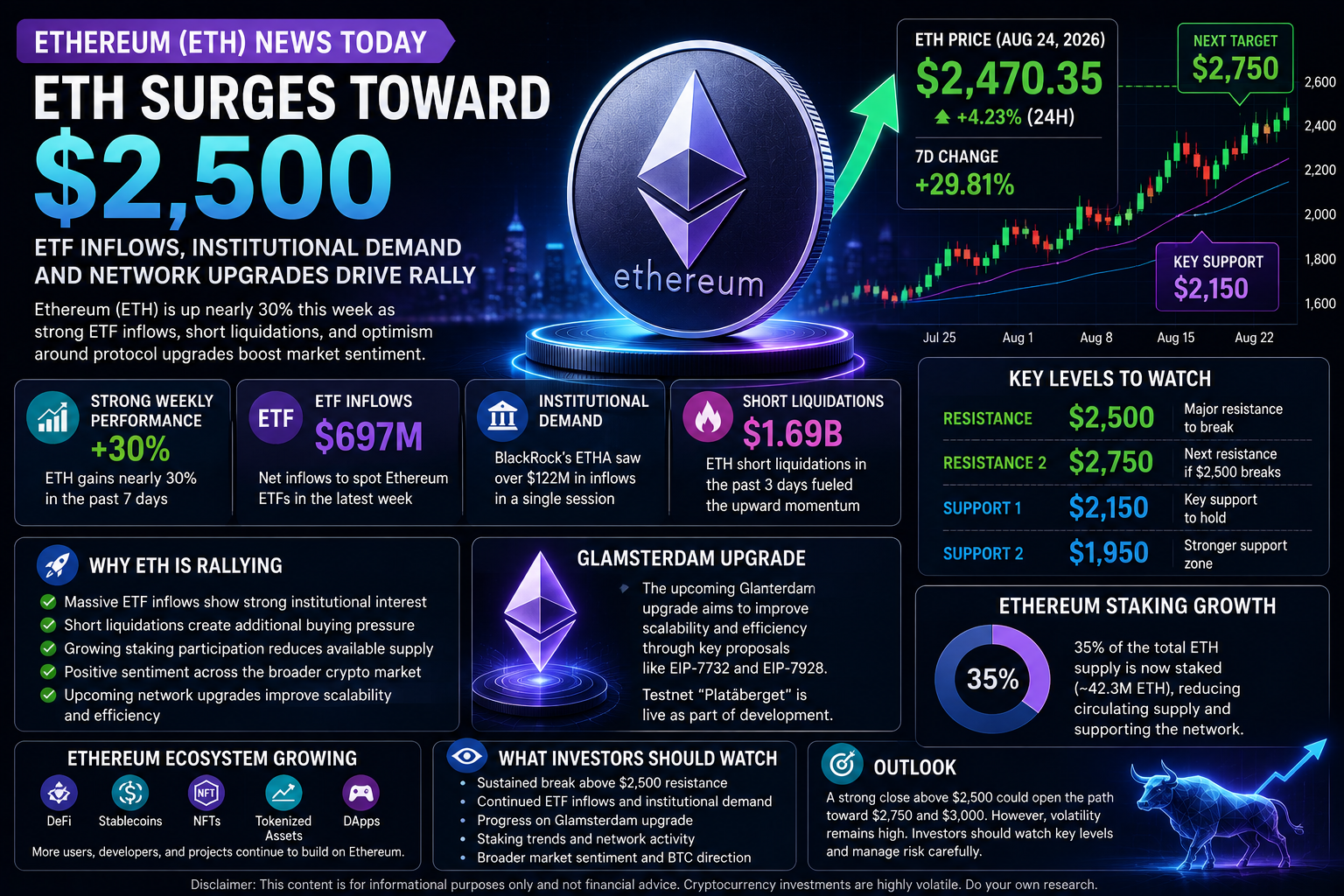
Ethereum (ETH) has become one of the biggest stories in the cryptocurrency market in August 2026. After a strong recovery from its recent lows, ETH has climbed roughly 30% over the past week, with the cryptocurrency trading around the $2,400–$2,500 range on August 24. The rally has been supported by strong institutional demand, rising spot Ethereum ETF inflows, short liquidations, and improving sentiment across the broader crypto market.
The latest move has brought Ethereum back above important technical levels and renewed speculation about whether ETH could eventually challenge $3,000. However, cryptocurrency markets remain highly volatile, and the recent rally does not guarantee that prices will continue moving higher.
Ethereum Price Rallies Sharply
Ethereum's latest recovery has been particularly impressive because ETH spent much of the recent period below the $2,000 level.
On August 24, ETH was trading around $2,470–$2,520, depending on the market and time of measurement. The cryptocurrency has gained approximately 28–30% over the previous seven days.
The move above $2,000 represented an important psychological milestone for Ethereum. ETH subsequently pushed toward $2,500, with some market reports identifying $2,500 as a major resistance area.
If Ethereum can hold above this level, traders may begin watching the $2,750 and $3,000 areas. These are market-analysis levels rather than guaranteed future prices.
Ethereum ETF Inflows Become a Major Catalyst
One of the strongest factors behind Ethereum's recent rally is institutional demand through U.S. spot Ethereum exchange-traded funds.
Recent data shows that spot Ethereum ETFs attracted nearly $700 million in net inflows during the latest week, making it one of the strongest weekly periods for ETH ETF demand in months.
Another report put August's cumulative Ethereum ETF inflows at approximately $940 million, highlighting how quickly institutional interest has improved.
ETF inflows matter because they allow traditional investors to gain exposure to Ethereum through conventional investment accounts rather than directly managing cryptocurrency wallets.
Continued inflows could therefore provide an additional source of demand for ETH. However, investors should watch the trend over several weeks because ETF flows can reverse quickly.
BlackRock and Institutional Demand
Large asset managers are playing an increasingly important role in the Ethereum market.
BlackRock's iShares Ethereum Trust, known by its ticker ETHA, is one of the largest spot Ethereum investment products. Current ETF-tracking data shows ETHA with billions of dollars in assets, highlighting the scale of institutional access to Ethereum.
Recent Ethereum market reports have also highlighted strong inflows into ETHA during the latest rally. On August 19, BlackRock's fund reportedly attracted more than $122 million in a single session.
Institutional demand is important because it potentially creates a more diversified investor base for Ethereum.
Instead of relying only on individual crypto traders, ETH is increasingly accessible to asset managers, financial institutions, and traditional-market investors.
Short Liquidations Add Fuel to ETH's Rally
Ethereum's rapid rise has also been amplified by short-position liquidations.
When traders bet that ETH will decline, they can open leveraged short positions. If Ethereum rises instead, some of these positions may be forcibly closed, requiring traders to buy ETH.
This can create a short squeeze, adding further upward pressure to an already rising market.
Recent market data indicates that Ethereum-related short liquidations reached approximately $1.69 billion over a three-day period during the latest rally.
Short squeezes can produce very rapid price increases, but they are not necessarily evidence of sustainable long-term demand. For Ethereum's rally to continue, spot buying and institutional demand will likely remain important.
Ethereum Staking Continues to Grow
Staking is another major part of Ethereum's investment story.
Ethereum operates using a proof-of-stake consensus mechanism. Validators stake ETH to help secure the network and can receive rewards for participating.
Recent market reports indicate that approximately 35% of Ethereum's supply was staked, representing around 42.3 million ETH.
A higher staking ratio can reduce the amount of ETH that is immediately available for trading. Some analysts therefore view increasing staking participation as a potentially supportive factor for Ethereum's supply dynamics.
However, staking also has risks and technical considerations, and rewards are not guaranteed investment returns.
Ethereum's Glamsterdam Upgrade
Ethereum's technology roadmap remains another major factor for long-term investors.
Developers are working toward the Glamsterdam upgrade, which is designed to improve Ethereum's scalability, efficiency, and network performance.
A testnet known as Platåberget has launched as part of the development process for Glamsterdam. The upgrade includes technical proposals aimed at improving how Ethereum handles transactions and block construction.
One important proposal is EIP-7732, which focuses on improving proposer-builder separation. Another, EIP-7928, introduces block-level access lists.
The objective is to improve Ethereum's ability to handle growing demand while maintaining the network's security and decentralization.
Why Ethereum's Network Matters
Ethereum is different from Bitcoin because its primary role extends beyond being a digital asset.
Ethereum provides infrastructure for:
Smart contracts
Decentralized finance
Stablecoins
Tokenized assets
Decentralized applications
NFT marketplaces
Blockchain-based financial products
ETH is the native asset of this ecosystem and is used to pay transaction fees and interact with applications built on the network.
This gives Ethereum multiple potential sources of demand beyond simply holding ETH as an investment.
Ethereum and Tokenized Assets
Tokenization is becoming another important area for Ethereum.
Financial institutions are increasingly exploring the possibility of representing stocks, bonds, funds, and other assets on blockchain networks.
Ethereum remains one of the most established platforms for this activity.
If tokenized financial markets continue expanding, Ethereum could potentially benefit from greater network usage and demand for its infrastructure.
However, competition from other blockchains remains strong, particularly from networks focused on faster transactions and lower costs.
Ethereum vs. Bitcoin
Bitcoin and Ethereum remain the two most important cryptocurrencies by market value, but their roles are different.
Bitcoin is primarily viewed as a decentralized digital asset and store of value.
Ethereum is a programmable blockchain designed to support smart contracts and decentralized applications.
This difference means ETH can sometimes respond differently to market conditions than BTC.
During the latest rally, Ethereum has actually outperformed Bitcoin on a percentage basis over the seven-day period, according to recent market reporting.
Some analysts have interpreted this as evidence of renewed investor interest in Ethereum specifically.
Could Ethereum Reach $3,000?
The $3,000 level has become an increasingly discussed target as ETH approaches $2,500.
Some market analysts believe a sustained break above approximately $2,750 could open the possibility of a move toward $3,000.
However, price targets should not be treated as guarantees.
For ETH to maintain its current momentum, investors will likely watch:
Continued ETF inflows
Institutional buying
ETH trading volume
Staking participation
Broader crypto-market conditions
Ethereum network activity
Progress on Glamsterdam
U.S. monetary policy
Cryptocurrency regulation
A weakening of these factors could lead to profit-taking or a correction.
Risks Facing Ethereum
Despite the bullish momentum, ETH remains a high-volatility asset.
Market Corrections
A rapid 30% rally can encourage investors to take profits, potentially creating short-term selling pressure.
ETF Outflows
If institutional ETF demand reverses, ETH could lose an important source of buying pressure.
Regulatory Changes
Changes in cryptocurrency regulations could affect investment products, staking, exchanges, and institutional participation.
Competition
Other smart-contract networks continue competing with Ethereum on transaction speed, fees, and scalability.
Network Upgrade Risks
Major upgrades can experience technical challenges, delays, or unexpected issues.
What Ethereum Investors Should Watch
As ETH continues its recovery, investors may want to monitor several key indicators.
ETF flows: Continued inflows could support demand.
$2,500 resistance: Holding above this level could strengthen bullish sentiment.
$2,750: A potential next resistance area identified by some analysts.
$3,000: A major psychological price level.
Ethereum staking: Changes in the amount of ETH being staked could affect available supply.
Glamsterdam: Progress toward the next major network upgrade remains important.
Bitcoin: Ethereum's direction is still heavily influenced by the broader crypto market.
Ethereum Outlook for the Rest of 2026
Ethereum enters the remainder of 2026 with several important catalysts.
Institutional access has expanded through spot ETFs, while staking continues to play a larger role in the Ethereum ecosystem. At the same time, developers are working on upgrades designed to improve network performance and scalability.
The latest rally has also changed market sentiment. After spending much of the recent period below $2,000, ETH is now testing significantly higher levels.
Whether the recovery becomes a sustained bull market will depend on whether demand continues after the initial surge.
If ETF inflows remain strong and Ethereum's network fundamentals continue improving, the cryptocurrency could remain one of the most closely watched digital assets for the rest of the year.
However, investors should remember that Ethereum can experience significant price swings in both directions.
Final Thoughts
Ethereum has staged a powerful recovery in August 2026, gaining roughly 30% in a week and moving toward the $2,500 level. Strong spot ETF inflows, institutional demand, short liquidations, staking growth, and optimism surrounding Ethereum's technology roadmap have all contributed to the latest momentum.
The next major question is whether ETH can establish support above $2,500 and eventually challenge $2,750 and $3,000.
While current conditions are encouraging for Ethereum bulls, cryptocurrency markets remain unpredictable. Investors should monitor ETF flows, network developments, macroeconomic conditions, and broader market sentiment rather than relying on any single price prediction.
Frequently Asked Questions
1. What is the latest Ethereum news?
Ethereum has rallied roughly 30% over the past week and is trading around the $2,400–$2,500 range as institutional demand and ETF inflows strengthen.
2. Why is Ethereum going up?
The latest rally has been supported by strong spot Ethereum ETF inflows, institutional demand, short liquidations, and improving sentiment across the cryptocurrency market.
3. Is Ethereum above $2,500?
ETH has recently traded around and above the $2,500 level, although cryptocurrency prices change continuously.
4. Are Ethereum ETFs attracting investors?
Yes. Spot Ethereum ETFs recorded nearly $700 million in weekly net inflows during the latest period, according to recent market data.
5. Can Ethereum reach $3,000?
Some analysts see $3,000 as a potential target if ETH can break through important resistance levels, but no price target is guaranteed.
6. What is the Glamsterdam upgrade?
Glamsterdam is an upcoming Ethereum upgrade focused on improving scalability, efficiency, and network performance. A related testnet has already launched.
7. Is Ethereum staking increasing?
Recent market data indicates that around 35% of ETH supply is staked, representing approximately 42.3 million ETH.
8. What could cause ETH to fall?
Profit-taking, ETF outflows, weaker institutional demand, regulatory uncertainty, broader crypto-market weakness, or technical issues could put pressure on ETH.
9. Is Ethereum a good investment?
Ethereum is a highly volatile digital asset. Whether it is appropriate depends on an individual's financial circumstances, investment goals, and tolerance for risk.
10. What Ethereum price levels should investors watch?
The $2,500 area is currently important, while $2,750 and $3,000 are being watched as potential upside levels by some market analysts.